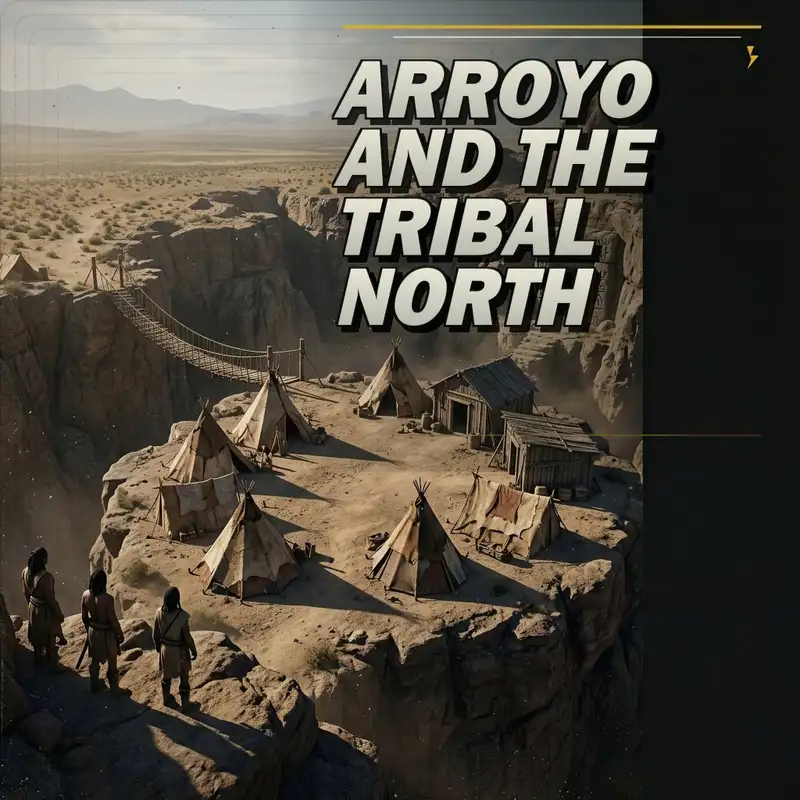
Arroyo and the Tribal North
In the year twenty-two forty-one, Arroyo faced a crisis that no ceremony could wish away. Its crops were failing. Brahmin were dying. The well that sustained the village was weakening. Sickness spread most readily among the very young and the very old, the people least able to endure hunger, contaminated water, or another failed season. Arroyo was not confronting an abstract prophecy. It was confronting the familiar arithmetic of a small agricultural community. Less water meant weaker fields. Weaker fields meant fewer animals, less food, more illness, and less labor available to repair the damage.
The village elder responded as a political leader must respond when a community’s reserves are running out. She consulted the surviving records of Arroyo’s founder, the Vault Dweller. In those records was a promise preserved from the old world, the Garden of Eden Creation Kit, known as the G E C K. To Arroyo, it was not merely a device with a technical designation. It was a possible answer to drought, hunger, and the fear that a village built through generations of labor might fail in a single hard season.
That moment explains much of what Arroyo had become. The people of Arroyo did not live in a sealed Vault. They did not possess the old world’s industrial system, its maintenance crews, its laboratories, or its confidence that every problem could be solved by opening the correct manual. Yet they had not simply abandoned the past. They had carried fragments of it into a new society. The G E C K was remembered as technology, but also as inheritance. The Vault Dweller’s records were an archive, but also a sacred link to the person who had led their ancestors out into the wilderness.
Arroyo’s history begins with another emergency, almost eighty years earlier. In the year twenty-one sixty-two, the Vault Dweller returned to Vault Thirteen after defeating the Master and preventing the Unity from absorbing or destroying human communities across southern California. The return should have been a homecoming. Instead, Overseer Jacoren exiled the person who had saved the Vault.
Jacoren’s decision was not simply personal cruelty, though it was cruel. It was a political act carried out by an institution terrified of change. Vault Thirteen had been built around isolation. Its people had survived by accepting limits, routines, and the authority of an overseer whose central duty was to keep the population inside. The Vault Dweller had done the opposite. They had left, traveled through the wasteland, formed relationships beyond the Vault, fought enemies the Vault could not have understood from behind its door, and returned with proof that the outside world was not empty.
That proof threatened the Vault’s social order. If one resident could leave, survive, and return as a hero, then confinement no longer looked like the only rational path to safety. Others might ask why they remained underground. They might question the overseer’s authority. They might want to see the world that the Vault Dweller had described. Jacoren understood that danger. His solution was to remove the person whose experience had become politically contagious.
The exile transformed the Vault Dweller from a resident obeying a controlled society into a founder outside it. According to the account preserved in the Fallout Two manual, a small group of Vault residents later joined the exile. They traveled north and gradually learned to survive beyond the Vault’s protected systems. This was not an organized colonization program. No stable government dispatched engineers with surveyed land, replacement parts, agricultural stock, and a long-term supply plan. It was a small and uncertain migration undertaken by people who had lost confidence in the institution that had once defined their lives.
The group carried knowledge from Vault Thirteen, but knowledge is not the same thing as capacity. A Vault’s life-support systems depended on machinery, controlled water, technical training, stored supplies, and an enclosed social order. A few former residents in a remote wilderness could not reproduce that system merely by remembering it. They needed food that could be grown or hunted, water that could be reached and protected, shelter that could survive weather, defenses against local threats, and rules that made collective labor possible.
The founder’s greatest contribution was not the recreation of Vault Thirteen. It was the experience gained after leaving it. The Vault Dweller had learned that survival outside depended on reading terrain, dealing with strangers, judging danger, finding water, acquiring food, repairing what could be repaired, and accepting that old-world systems were often broken beyond immediate recovery. Those lessons could be taught, adapted, and passed down. A sealed Vault’s machinery could not.
Over time, the former residents became something more than a group of refugees. The manual describes the change plainly. The original collection of people became a tribe. That word should not be mistaken for a diagnosis of decline. Arroyo did not become tribal because its people became less intelligent, less human, or incapable of understanding the old world. It became tribal because kinship, oral memory, ritual, local authority, and shared labor were practical institutions for a small, isolated population living beyond the reach of large government and industrial support.
In Arroyo, survival depended on hunters, farmers, healers, defenders, and people capable of maintaining the ordinary work of village life. Crops had to be planted and guarded. Brahmin had to be tended. Water had to be drawn and protected. Children had to be raised. Illness had to be treated with the resources available. The community needed people who knew plants, seasons, trails, tools, and the habits of the surrounding land. These were not lesser forms of knowledge than the old world’s technical manuals. They were the knowledge required to remain alive when there was no factory, hospital, or supply convoy over the horizon.
Arroyo retained fragments of technical inheritance. It remembered the Vault Dweller. It preserved artifacts associated with the founder. It kept records whose meanings outlasted many of the systems that had produced them. But retaining an artifact is not the same as retaining a supply chain. Remembering a machine is not the same as manufacturing one. A village could preserve a jumpsuit, a book, or a story for generations. It could not easily preserve the industrial base that made a Vault possible.
This is why Arroyo’s culture changed. The community did not reject all knowledge that came from before the war. It transformed that knowledge into forms that could survive local conditions. A memoir became ancestral history. A Vault suit became an object of memory and legitimacy. A technical promise became a story of future restoration. The past was not discarded. It was translated.
That translation gave Arroyo a political center. The Vault Dweller became more than a historical traveler who had once left Vault Thirteen. The founder became an ancestor whose actions explained why Arroyo existed at all. The village’s identity rested partly on separation from the old Vault and partly on continuity with the person who had escaped it. This was a useful balance. Arroyo could claim descent from the old world without pretending that the old world’s institutions still governed its daily life.
The preserved memory of the G E C K shows how this worked. In its original context, the Garden of Eden Creation Kit was an old-world technological project, associated with plans for rebuilding after catastrophe. In Arroyo, it became a hope inherited through incomplete records. The village understood enough to believe it might restore land and improve survival. It did not possess every technical detail necessary to judge the device’s limits, requirements, or risks. That uncertainty did not make the belief foolish. It reflected the conditions of archival scarcity.
A small society cannot preserve every part of a lost civilization’s knowledge. It must decide what to remember, what to teach, and what to treat as important enough to protect. Sacred memory can serve that purpose. It marks certain objects and stories as too valuable to neglect. It gives younger generations a reason to carry knowledge whose practical application may not yet be clear. In Arroyo’s case, reverence for the founder’s legacy helped preserve a possible tool of recovery through decades when no one could use it.
The elder’s authority rested within that inheritance. She was not simply a custodian of old stories, nor merely a ceremonial figure who sent others to confront danger. She held responsibility for Arroyo’s continuity. In the drought of twenty-two forty-one, the pressure on her office was immediate. A leader in such a village did not have the luxury of separating spiritual legitimacy from material survival. If the fields failed, if water ran low, if people became sick, the crisis reached every part of community life.
Her authority also had a family dimension. As the daughter of the Vault Dweller, she carried the founder’s legacy into a new generation. But ancestry alone would not have sustained a village through repeated hardship. Leadership required communal trust, knowledge of the village’s past, and the ability to make difficult decisions when resources were scarce. The decision to send the Chosen One beyond Arroyo was one of those decisions. It placed hope in a single mission because the village did not have many alternatives.
Hakunin occupied another essential place in Arroyo’s social order. He was its shaman and healer, but those roles should not be separated too neatly. In a vulnerable agrarian community, a healer must understand plants, sickness, food, water, and the human consequences of fear. A spiritual interpreter may also be a keeper of practical ecological knowledge. Hakunin’s work connected the condition of the land to the condition of the people living on it.
The distinction between elder and shaman mattered. The elder represented political continuity and collective decision-making. Hakunin represented healing, spiritual interpretation, and another form of custodianship over the community’s knowledge. Neither office was enough by itself. A leader could authorize a mission, but could not heal every illness or make rain fall. A healer could tend the sick and interpret danger, but could not alone organize the village’s response to famine. Arroyo’s resilience depended on the overlap of their authority without requiring them to be the same thing.
Around them were other forms of labor. Warriors guarded the community and represented its capacity for local defense. Hunters extended the food supply beyond cultivated fields. Farmers worked against drought and poor soil. Other villagers maintained homes, raised families, carried oral traditions, and performed tasks the game does not catalogue in detail because no small settlement survives on heroic figures alone. Arroyo had a social division of labor, even if it did not have a formal bureaucracy or a modern state administration.
Its political order was therefore practical as well as inherited. Authority rested on lineage, but also on competence. It rested on ritual, but also on the fact that people needed reliable decisions in hard circumstances. It rested on communal memory, but also on the daily proof that hunting, farming, healing, and defense had to be coordinated. In that sense, Arroyo was not a remnant of the past frozen in time. It was a functioning society that had developed its own answer to the problem of survival.
The Temple of Trials expressed that answer at a critical moment. For a player, the Temple serves as the beginning of Fallout Two. For Arroyo, it is a rite of passage and an authorization mechanism. The community does not send the Chosen One into the wider world merely because a young descendant of the founder is available. It subjects that person to a socially recognized test before placing the village’s hopes upon them.
The Temple should not be treated as a military academy. It does not prove that Arroyo maintained a professional officer corps, a standardized training system, or a large organized force. Its function is more intimate and more political. It tests readiness, discipline, and the ability to act under pressure within communal expectations. A person who passes is not simply demonstrating physical capability. They are being recognized as someone able to bear responsibility beyond the village.
The Chosen One remains deliberately undefined in many important ways. The game allows different skills, companions, loyalties, decisions, and routes through the northern frontier. No single playthrough establishes a universal personality or political program for Arroyo’s champion. The fixed point is narrower and more important. The Chosen One leaves Arroyo in search of the G E C K because the community’s agricultural crisis has reached the point where internal adaptation is no longer enough.
That mission was an act of faith, but not blind faith. Arroyo had evidence that the old world had produced tools beyond its present means. It had records suggesting that the G E C K might help restore the land. The elder and Hakunin understood that remaining still was also a choice, and likely a fatal one. Sending the Chosen One outward meant accepting risk, uncertainty, and the possibility that the village’s future depended on places and people beyond its control.
That necessity exposed the central contradiction of Arroyo’s isolation. The village had been founded in a secluded location beyond a major canyon or cliff, though the released material does not provide a precise survey map that would allow a more exact claim. The terrain offered protection. It made casual intrusion more difficult. It gave Arroyo a measure of control over who entered its immediate world. For a small community descended from exiles, that separation was not accidental. It was part of its security.
But terrain that protects can also confine. A remote settlement has fewer trade links, fewer outside sources of medicine or technical assistance, and less warning when distant powers begin to move. It may be difficult for raiders or hostile travelers to reach. It may also be difficult for allies, relief, or evacuation to reach when disaster arrives. Arroyo’s isolation preserved identity. It also narrowed the village’s strategic horizon.
The founding generation had not entirely turned away from the old Vault. The manual indicates that scouts were once sent toward Vault Thirteen. Over time, those efforts gradually ceased. That development is understandable. Long-distance reconnaissance requires people, supplies, knowledge of routes, and a reason to keep investing in a connection that may yield nothing. Yet the end of those efforts also meant that the separation between Arroyo and Vault Thirteen became more than geographic. It became an institutional division between two different ways of surviving.
The northern frontier surrounding Arroyo was not one unified tribal world. It contained many communities, each shaped by its own resources, dangers, and political arrangements. Klamath represented one form of local survival, built around a rough settlement economy and the pressures of labor, hunting, and nearby threats. Modoc showed another, with its own farms, families, and dependence on local order. These communities had problems that overlapped with Arroyo’s, but they were not simply extensions of Arroyo’s culture.
The Den presented a harsher model of frontier commerce. It was a place where trade, migration, and opportunity existed alongside exploitation, criminal power, and weak protection for the vulnerable. It demonstrated that contact with wider markets could bring goods and information without guaranteeing justice or stability. A settlement could be connected and still leave its civilians exposed to coercion.
Vault City offered a different inheritance from the pre-War world. It possessed advanced technology, controlled access, and a strong belief in the superiority of its own institutions. Yet its order depended on exclusion. Its relationship with Gecko showed how technical capacity could produce dependency, hierarchy, and political conflict rather than simple prosperity. The old world’s systems had survived there more visibly than in Arroyo, but survival of technology did not automatically mean moral or political wisdom.
Redding illustrated the pressures of resource extraction. Valuable deposits attracted labor, commerce, outside interest, and the possibility of incorporation into larger political systems. The New California Republic, expanding northward and eastward, represented another model entirely. It was a republic with laws, elected institutions, soldiers, merchants, and ambitions beyond any one village. But expansion brought its own burdens. A government could claim order while struggling to govern distant places, protect routes, manage private interests, and extend authority beyond its strongest core.
New Reno demonstrated yet another form of power, one built around vice, wealth, criminal organizations, and the ability of local elites to profit from disorder. None of these settlements formed a single northern civilization. They were competing experiments in survival. Some relied on local kinship. Some on commerce. Some on technical control. Some on organized crime. Some on expanding state power. Arroyo belonged within that frontier, but it was not representative of all of it.
Compared with these neighboring models, Arroyo’s distinction was its protected separation. It did not seek to become a commercial crossroads like the Den. It did not maintain Vault City’s exclusionary technological order. It did not possess the New California Republic’s state machinery, however imperfect that machinery could be. Arroyo’s strength was that it had built cohesion without depending on distant institutions. Its weakness was that cohesion did not create the resources of a larger network.
The drought made that weakness visible. A community can be well organized, culturally legitimate, and skilled in local survival, yet still face an environmental shock that exceeds its reserves. Arroyo had crops, brahmin, hunting grounds, a well, and accumulated knowledge. It did not have limitless water. It did not have a major irrigation system documented in the record. It did not have industrial agriculture, deep external markets, or a standing relief apparatus. When drought intensified, the village had little margin for error.
This is why the search for the G E C K should not be understood as a rejection of Arroyo’s way of life. The elder was not sending the Chosen One away because tribal institutions had failed in every respect. Those institutions had preserved the community for generations. The mission was an attempt to preserve that community when its local systems could no longer absorb the damage. Technology was being sought in service of continuity, not as a substitute for belonging.
The Garden of Eden Creation Kit carried enormous expectations because Arroyo did not fully understand its capabilities. The village knew it as a means of renewal and had inherited a promise of land made fertile and settlements made viable. But old-world technology always carries an institutional problem. Its value depends on people who understand it, resources that sustain it, maintenance that keeps it working, and political authority that determines how it will be used. A powerful device without that supporting knowledge can become another form of dependency.
Arroyo’s leaders could not answer every one of those questions in advance. They possessed fragments of the original record, not a complete technical establishment. Still, their judgment was rational. The drought was immediate. The possibility of recovery through the G E C K was worth pursuing because the alternative was to watch the village decline while preserving its traditions perfectly in the middle of a famine. Communities do not survive by refusing every uncertain opportunity. They survive by choosing risks they can justify.
While the Chosen One searched outward, another power identified Arroyo as something other than a village in distress. The Enclave saw human populations through the logic of biological control. Its broader project treated contamination, mutation, and human survival as problems to be managed through coercion and extermination. In that framework, Arroyo was valuable because its people were considered genetically useful to the Enclave’s program.
The Enclave’s assault in the year twenty-two forty-two was not an ordinary raid. Raiders take what they can carry, intimidate local populations, and often operate for immediate gain. The Enclave conducted an extraction operation. Its purpose was to seize people. Arroyo’s residents were taken into captivity, while Vault Thirteen’s inhabitants were also captured for the Enclave’s experiments and control groups. The victims were not treated as citizens, enemies with rights, or even as people with their own communities. They were treated as biological material.
Arroyo’s terrain and local defenders could not prevent this outcome. The village had warriors and a defensible setting, but nothing in the record supports describing it as a force capable of resisting a technologically superior expedition organized by a distant military-scientific regime. The failure was not a failure of courage. It was a problem of scale. Local defense can deter ordinary threats. It cannot necessarily stop an enemy that has better equipment, broader intelligence, transport capacity, and a mission designed around surprise and capture.
The operational consequences were devastating. Arroyo was effectively destroyed as a functioning community because its population was removed. A village is not merely its buildings, fields, and ceremonial spaces. It is the people who maintain them. When those people are abducted, the well, crops, homes, and defenses lose the labor and social relationships that made them meaningful. The drought had already threatened Arroyo’s food system. The Enclave turned that environmental emergency into mass displacement and captivity.
Hakunin remained behind as a principal witness to what had happened. His survival did not mean Arroyo had survived intact. It emphasized the opposite. One healer, one keeper of memory, could not replace an entire abducted population. The attack created family separation, fear, and the reduction of a living community into prisoners of a regime that viewed human difference as a laboratory problem.
Arroyo had little capacity to anticipate the Enclave’s approach. Its isolation limited intelligence as much as it limited contact. It had no large diplomatic network, no established system of strategic warning, and no evidence of the kind of external alliance that might have deterred or complicated the operation. This was not because its people were incapable of understanding danger. It was because no small remote settlement can maintain awareness of every hidden power moving across a continent.
The destruction of Arroyo reveals an uncomfortable truth about post-War resilience. A community can be socially durable without being strategically secure. It can possess legitimate leaders, skilled workers, effective local customs, and strong mutual obligation. It can endure hardship for decades. Yet it may still be vulnerable to forces operating at a scale it cannot see, cannot deter, and cannot defeat alone.
Arroyo’s recovery came only after events beyond the village’s independent control. The Chosen One eventually reached Vault Thirteen, acquired the G E C K, and became central to the struggle against the Enclave. The destruction of the Oil Rig ended the immediate threat posed by that regime’s program. But the relevant Arroyo outcome is not simply that a villainous institution was defeated. It is that the people of Arroyo and the surviving residents of Vault Thirteen were able to form a new community together.
That reunion mattered because it brought two separated survival systems back into contact. Vault Thirteen had preserved technical knowledge, institutional memory, and a population shaped by life within controlled infrastructure. Arroyo had preserved fieldcraft, agriculture, social adaptation, and the hard-earned ability to live outside the machine. Neither side represented a complete answer by itself. The Vault had endured, but it had remained sealed away from the world that had changed around it. Arroyo had adapted, but its remoteness had left it exposed to crises that required wider capacity.
The G E C K did not erase that history. It provided a means of rebuilding, but the ending’s deeper significance lies in complementarity. Technology became useful because people with local knowledge, labor, and social cohesion could apply it. Tribal survival skills became more powerful when joined to preserved technical expertise. The new community was not a return to Vault Thirteen, and it was not simply the restoration of old Arroyo. It was a reconstruction shaped by both inheritances.
The Chosen One becomes elder in the Arroyo ending. That transition preserves the village’s tradition of leadership while acknowledging the changed circumstances of its survival. The title of elder remains meaningful because legitimacy still matters. A community rebuilt after captivity and displacement needs more than equipment. It needs a recognized authority, shared purpose, and institutions capable of turning recovery into a durable way of life.
This does not mean that every problem in the northern frontier was solved. Fallout Two allows many outcomes for other settlements, and those outcomes should not be merged into one tidy regional history. Arroyo’s reconstruction did not automatically unite Klamath, Modoc, Vault City, Gecko, Redding, the Den, New Reno, and the New California Republic into a single political order. A successful settlement is not the same thing as a settled region.
What Arroyo proved was that cultural adaptation could preserve a people across generations. The descendants of former Vault residents did not need to recreate every habit of Vault Thirteen in order to remain connected to their past. They created a society capable of farming, defending itself, healing its sick, remembering its founder, and organizing collective action under pressure. The tribal form was not a failure to understand civilization. It was Arroyo’s version of civilization.
What Arroyo could not solve alone was the problem of strategic exposure. Defensible ground could discourage local threats, but it could not guarantee protection from an organized extraction force. Hunters, farmers, healers, and warriors could maintain village resilience, but they could not create a continental intelligence network, a reserve of industrial capacity, or an evacuation system simply through courage and ritual. Isolation had made Arroyo safer from some dangers. It had also made the community easier for a distant predator to isolate and seize.
The civilian cost remained severe. Drought was felt first through empty fields, weak animals, sick children, exhausted elders, and families wondering whether the next season would come in time. Enclave captivity was not simply a strategic setback. It was the destruction of homes, the separation of relatives, and the conversion of villagers into subjects of forced experimentation. The history of Arroyo is not only about founders, artifacts, and legendary missions. It is also about ordinary people whose security depended on water, food, labor, and the decisions of powers far beyond their village.
By the year twenty-two eighty-one, a brief reference from Emily Ortal confirms that Arroyo still endured as a place of family connection. That later mention does not establish its exact political status, population, location, or relationship with the New California Republic. It does establish something quieter and more important. Arroyo remained a remembered community long after its first village had been destroyed and rebuilt.
Arroyo survived because it transformed a founder’s fragmented Vault inheritance into a culture capable of living beyond the Vault’s walls. It nearly died because no village, however cohesive or legitimate, can meet drought, isolation, and a technologically superior predator with ritual and courage alone. Its reconstruction with Vault Thirteen suggests that civilization endures not by choosing technology over tradition, but by joining technical knowledge to the hard-earned social skills of people who have learned how to live outside the machine.