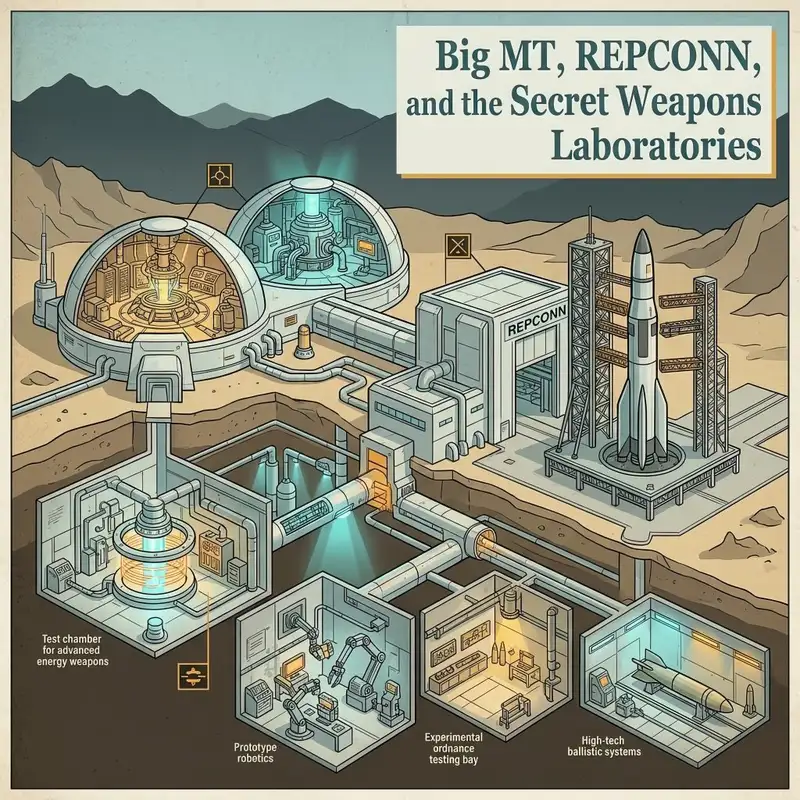
Big MT, REPCONN, and the Secret Weapons Laboratories
In the crater of Big Mountain, the laboratories did not die when the bombs fell. Their lights remained on. Their robots continued their routines. Their weapons programs, medical systems, animal experiments, and buried test chambers remained available to anyone with the access, technical skill, or bad judgment to activate them. At the center of that surviving machine sat the Think Tank, a council of scientists who had preserved their brains in mechanical life-support units and lost much of what made authority responsible. They retained fragments of genius, vanity, appetite, and institutional memory. They had not retained a reliable grasp of consequence.
Doctor Mobius understood that danger well enough to build a prison around them. He used a radar-guided barrier to keep the Think Tank inside Big Mountain, then altered their understanding of maps, time, and the world beyond the crater. His purpose was protective. His methods were coercive. The result was not a restored chain of command or a lawful containment regime. It was one damaged scientist controlling several other damaged scientists through deception, isolation, and machinery. Big Mountain survived as a functioning laboratory, but not as a functioning institution.
REPCONN left a different kind of inheritance in the Mojave. Its headquarters advertised rockets, exploration, and the polished confidence of pre-War aerospace engineering. Its test site near Novac still contained launch infrastructure, hazardous materials, security systems, and rockets that later survivors could attempt to use. Yet REPCONN’s ruins also reveal a company pulled away from its public image and into a more secretive defense-oriented corporate order. One facility became dangerous because research escaped ethical restraint. The other became dangerous because corporate consolidation and classified work narrowed who could question what the company was becoming.
Neither story is simply about science gone wrong. Scientific knowledge can heal injuries, build communications networks, produce clean energy, and preserve communities through catastrophe. The deeper problem was institutional. Big Mountain and REPCONN operated in a pre-War system that rewarded military usefulness, commercial advantage, secrecy, and technical ambition. It offered far weaker incentives for public accountability, informed consent, worker safety, or responsibility toward the civilians living beside the laboratories. The Great War destroyed the governments and corporations that should have answered for these systems. It did not destroy the systems themselves.
During the final years before October twenty-third, twenty seventy-seven, the United States faced a strategic crisis shaped by resource scarcity, foreign war, domestic repression, and a growing dependence on corporate technology. The conflict with China had made military procurement a central engine of research and industrial policy. Energy, automation, aerospace engineering, advanced weapons, biological science, surveillance, and civil defense all carried obvious military value. The line between civilian innovation and strategic preparation became increasingly thin, though companies often found it useful to keep that line visible in advertising.
The government, the Army, and private industry were connected, but they were not identical. The Army sought equipment, intelligence advantages, medical solutions, secure facilities, and weapons that could change the balance of conflict. Companies sought contracts, market position, protected research, and influence over the direction of technological development. Government agencies supplied money, legal authority, secrecy classifications, and sometimes direct coercive power. Corporate laboratories supplied specialized knowledge and the freedom to experiment beyond the reach of ordinary military units. This arrangement could produce formidable capability. It could also diffuse responsibility until no one was accountable for the human cost.
The released television record offers a brief glimpse of that corporate world. Representatives associated with Big Mountain and REPCONN appear in the same broad pre-War business environment as Vault-Tec, RobCo, and West Tek. That meeting does not prove that these firms formed one unified organization, nor does it settle every disputed relationship among their leaders. It does show that the companies moved through the same strategic ecosystem. They were part of a culture in which private corporations were not merely suppliers to the state. They were becoming partners in planning the technological terms on which survival, war, and social control would be organized.
Big Mountain occupied one end of that system. It was a research and development center in the American Southwest, privately operated but deeply connected to military contracts and defense needs. Its facilities were distributed across a crater and surrounding terrain. Different laboratories pursued different projects. Some focused on stealth. Others investigated toxins, cybernetics, energy weapons, robotics, medical systems, biological research, or unusual forms of animal experimentation. Big Mountain was not a conventional arms factory turning out standardized rifles or tanks by the thousand. It was a place designed to create possibilities, including possibilities too unstable, secret, or morally compromising for ordinary deployment.
That distinction mattered. A factory depends on repeatable processes, supply chains, labor discipline, quality control, transport, and a customer who knows what it wants. A research complex can work differently. It can be funded to ask whether something can be done before anyone has decided whether it should be done, how it would be governed, or who would bear the risk. At Big Mountain, the laboratory itself became a strategic asset. The United States did not need every project to become a mass-produced weapon. It needed breakthroughs, prototypes, and methods that might produce advantage in a war already consuming enormous resources.
REPCONN began from a more public-facing position. It was an aerospace company associated with rockets, propulsion, and the language of space exploration. Its corporate tours presented technological progress as a bright, controlled ascent toward the future. Rockets stood for national confidence, industrial sophistication, and the promise that nuclear power could carry humanity beyond the Earth. The presentation was reassuring by design. It encouraged visitors to see propulsion research as an inspiring technical achievement rather than as a field built around dangerous fuels, radiation risks, complex guidance systems, and infrastructure that could easily serve military purposes.
Aerospace technology has always carried strategic value even when its public purpose is peaceful. The same industrial capabilities needed to build advanced rockets can matter for propulsion, materials research, guidance, communications, nuclear engineering, high-altitude operations, and weapons delivery. That does not mean every REPCONN project was a missile program, or that every rocket launch was a military operation. It means that a company working at the edge of propulsion and nuclear technology was valuable to a state preparing for war and to corporations seeking a stronger position in the defense economy.
The contrast between Big Mountain and REPCONN is therefore not one between a sinister laboratory and an innocent company. Both belonged to the same late pre-War environment. The difference lay in the route they took. Big Mountain concentrated high-risk experimentation under scientists who enjoyed unusual autonomy inside a secured research complex. REPCONN developed industrial aerospace expertise in public view, then became more deeply entangled with classified work and defense-oriented corporate ownership. One institution shows what happens when experimental authority expands beyond ethical restraint. The other shows how acquisition and secrecy can redirect an existing company without requiring its public image to change immediately.
Big Mountain’s strategic portfolio was broad because its research was broad. Stealth technology could alter reconnaissance, infiltration, sabotage, and the ability of small forces to move unseen. Cybernetics offered the prospect of repairing, modifying, or controlling bodies for military and medical purposes. Robotics and automated defenses promised security without the political and logistical burden of deploying large numbers of human guards. Toxins and biological research could provide weapons, deterrents, or tools of covert action. Sonic and energy weapons explored means of force that did not fit comfortably into conventional categories. Each field had potential military value. None of them came with an automatic doctrine for responsible use.
The facility’s experiments with cybernetic animals make that problem particularly clear. An animal modified for surveillance, security, or combat might appear useful to a military planner. It could move through terrain where a human scout could not. It could carry sensors, weapons, or supplies. It could perform dangerous tasks without risking a soldier. Yet a laboratory success is not the same as an operational capability. A fielded system requires trained handlers, reliable maintenance, replacement components, transport, doctrine, command responsibility, and some understanding of how it will affect civilians. Big Mountain often appears to have treated those questions as someone else’s problem.
The same caution applies to the strange weapons and devices found across the crater. Their existence proves that Big Mountain could develop remarkable prototypes. It does not prove that the United States Army issued them widely, understood their limitations, or possessed the industrial capacity to support them across a continent at war. A prototype may be powerful precisely because it has not yet encountered the ordinary burdens of procurement. It has not been manufactured at scale. It has not been repaired by tired personnel in the field. It has not been carried through bad weather, used by imperfect operators, or judged against the cost of more practical alternatives.
Big Mountain’s real military significance was its capacity to generate options. That kind of capability can be more dangerous than a single weapon. A laboratory able to combine automated systems, human subjects, advanced materials, biological research, and military funding can create threats faster than any outside authority can understand them. Secrecy makes the problem worse. Compartmentalization protects sensitive research from espionage, but it also prevents workers, regulators, neighboring communities, and even other scientists from seeing the full pattern of risk. Each project may appear defensible within its own secure room. The institution becomes indefensible when the rooms are considered together.
The people subjected to that system were not an unfortunate side effect of research. In some cases, they were treated as part of the research material. Little Yangtze, located within the Big Mountain complex, held Chinese-American prisoners suspected of espionage. Its existence connects wartime fear, state power, military contracting, and corporate science with unusual clarity. These were not enemy soldiers captured on a distant battlefield. They were people held within the United States under the logic of suspicion and security. The detention site demonstrates how easily a government at war can transform citizenship, ethnicity, and fear into administrative categories for confinement.
The surviving evidence does not establish every procedure performed at Little Yangtze, every individual held there, or every decision that sent a prisoner into Big Mountain’s orbit. It establishes enough. Detention and experimentation existed within the same institutional landscape. The facility’s advanced technology was supported not only by intellectual ambition and government contracts, but by coercive access to vulnerable people. That is a central fact about the laboratory’s political character. Big Mountain did not merely study biology in the abstract. It operated in a system prepared to treat human beings as security risks, test subjects, or expendable inputs.
There is a persistent temptation to separate technical achievement from moral responsibility. A scientist may claim to have produced data. A contractor may claim to have fulfilled a contract. A military office may claim to have authorized only a narrow program. Each statement can be partly true while concealing the larger system of responsibility. A laboratory can generate useful findings and still commit abuses. A state can gain information and still weaken the legitimacy it claims to defend. The tactical utility of coercive research, where it exists, does not remove the political cost. It normalizes the idea that some people can be denied consent because an institution has classified their suffering as necessary.
Big Mountain’s most revealing human experiment eventually reached its own senior staff. The Think Tank developed procedures to remove and preserve human brains within robotic containers. The achievement was extraordinary by any technical measure. It allowed consciousness, memory, and specialized knowledge to survive the physical destruction of the body. It also demonstrated a profound inability to understand the relationship between intelligence and personhood. The scientists preserved thought, but damaged the conditions under which thought becomes judgment. Memory deteriorated. Identity fragmented. Emotional regulation faltered. Curiosity remained, but the ordinary human limits that might have moderated it became unstable or disappeared.
By the year twenty-two eighty-one, Doctor Klein, Doctor Dala, Doctor Borous, Doctor Eight, and Doctor O are not a coherent command staff in any conventional sense. They have titles, authority over laboratories, access to machines, and remnants of old professional rivalries. They do not possess the shared understanding, reliable information, or institutional discipline required to govern a complex facility responsibly. Their disagreements are not simply the normal friction of talented researchers. They are symptoms of minds altered by their own work and sustained by an environment that rewards obsession over self-correction.
The Think Tank’s condition exposes the weakness of Big Mountain’s pre-War culture. The laboratory pursued technical control over the body and mind without establishing meaningful limits on what its own leaders could do to themselves. It treated the brain as a component to be extracted, preserved, and upgraded. But a brain is not merely a processing unit. It is embedded in memory, sensation, relationships, moral habit, and a living body’s awareness of pain and consequence. The Think Tank’s survival is therefore not a triumph over mortality. It is a warning about mistaking continuity of cognition for continuity of human responsibility.
Doctor Mobius recognized the danger after the war. He feared that the Think Tank, if allowed to escape Big Mountain, would resume large-scale experimentation across the Mojave. His answer was containment. He constructed and maintained a barrier around the crater, manipulated the Think Tank’s perception of the outside world, and encouraged them to direct their fear toward him rather than toward the communities beyond their reach. In narrow security terms, the policy worked. Big Mountain remained isolated. The scientists remained confused, distracted, and unable to project their power easily into the surrounding wasteland.
But Mobius did not solve the underlying problem. He substituted one form of unaccountable authority for another. He made himself jailer, censor, historian, and psychological custodian of his former colleagues. His choices were shaped by a real threat, and the Mojave may have been spared worse because of them. Yet his prison depended on deception rather than consent or law. It preserved a dangerous institution in suspended animation. It bought time. It did not create a legitimate way to decide what should happen to Big Mountain’s technology, its prisoners, its research records, or the beings trapped inside its machinery.
REPCONN’s history followed a less grotesque but no less significant path. Its public-facing facilities promoted the company as a pioneer of rocketry and spaceflight. Visitors encountered the language of exploration, re-entry technology, and scientific progress. This was corporate propaganda in the literal sense of the word. It was meant to shape public understanding. The tours did not necessarily lie about the company’s technical achievements. They simply arranged the truth into a reassuring story. The public saw rockets as symbols of aspiration. Employees and nearby communities had more immediate reasons to think about radioactive materials, dangerous fuel, restricted areas, and the consequences of industrial accidents.
The company’s nuclear-powered rocket work required far more than a dramatic launch. It depended on advanced engineering, specialized materials, carefully managed propulsion systems, trained personnel, secure testing grounds, and a supply network capable of sustaining delicate equipment. That industrial complexity made REPCONN valuable. It also made the company vulnerable to the same pressures that affected the rest of the pre-War economy. A rocket program cannot be separated cleanly from the institutions that fund it, regulate it, defend it, and decide which risks are acceptable.
REPCONN’s public optimism became increasingly difficult to separate from the realities of militarization after RobCo acquired the company. The exact date remains unclear. Surviving accounts place the acquisition during the final two years before the Great War, but they do not agree on whether it occurred in twenty seventy-five or later in twenty seventy-six. The dispute is minor in one sense. The larger point is clear. The purchase came during the closing phase of the pre-War crisis, when aerospace technology, automation, defense contracts, and corporate consolidation were all becoming more closely connected.
Employees recognized that the acquisition represented more than a change on a letterhead. Internal concern focused on the possibility that REPCONN’s older identity would be absorbed into the orbit of companies more directly associated with military and defense work. RobCo had major interests in automation, robotics, and strategic technology. Its ownership gave it access not only to REPCONN’s facilities, but to specialized engineering knowledge, research personnel, launch infrastructure, and an established aerospace brand. A company that had marketed the future to the public could now contribute to a much more restricted corporate and military agenda.
Security tightened after the acquisition. Badge controls, facial-recognition systems, hardened access points, locks, and armed robots turned workplaces into more visibly controlled spaces. Such measures can be justified in a facility dealing with expensive research, hazardous materials, and classified information. They also change the political structure of an institution. More people are excluded from knowledge. Fewer employees can challenge decisions because they do not know enough to understand the whole program. Access becomes a privilege granted by managers and security systems rather than a normal condition of professional work.
That is the operational meaning of secrecy. It is not merely that information is hidden from foreign spies. Secrecy redistributes authority inside an organization. It determines who can enter a laboratory, who can inspect a process, who can raise a safety concern, who can know whether a project has shifted toward military use, and who can tell a community what danger exists nearby. When classification expands, an employee may see only the machinery in front of them. The company’s leadership can see the wider picture. The public sees a museum display, a logo, and a promise that the experts are in control.
The exact boundary between REPCONN’s original aerospace work, RobCo’s broader research interests, Poseidon Energy’s role in the surrounding industrial world, and government military contracts is not fully documented. It would be careless to merge these institutions into one giant conspiracy. They had different ownership structures, different technical specialties, and different formal responsibilities. Yet their interests converged. The state needed advanced technology. Corporations needed contracts and protected markets. Security systems needed reasons to expand. The result was a landscape in which a company could be publicly celebrated as an aerospace pioneer while becoming increasingly difficult for ordinary people to understand or supervise.
The REPCONN Test Site shows why a rocket is not simply a symbol of technological progress. A launch vehicle requires fuel, guidance, maintenance, technical knowledge, secure infrastructure, and people capable of coordinating the whole process. The facility near Novac preserved enough of that system to remain important long after the company itself vanished. It held machinery, hazardous materials, surviving rockets, and information that different post-War groups could value for entirely different reasons. To one group, it might be refuge. To another, salvage. To another, a source of weapons-related technology. To nearby residents, it could be a dangerous industrial ruin attracting armed outsiders.
The military-linked remnants associated with the area reinforce that point. Old technology can preserve information, perform limited tasks, or become useful to a skilled individual. It does not automatically restore the organization that once designed, supplied, and commanded it. A machine may survive longer than the doctrine that gave it purpose. A robot may continue to follow programming after the country that wrote the program no longer exists. A vehicle, weapon, or automated system can become strategically important because it is rare, not because it is reproducible. In the Mojave, rarity often creates conflict faster than it creates stability.
By twenty-two eighty-one, the REPCONN Test Site has become a refuge for the Bright Brotherhood, a community of non-feral ghouls led by Jason Bright. Their presence changes the meaning of the facility. What was once a corporate test site becomes a religious destination, a sanctuary, a launch point, and a source of anxiety for the people of Novac. The Bright Brotherhood sees the rockets through its own spiritual and communal needs. The facility is not merely a ruin to be looted. It offers the possibility of departure, transformation, and collective purpose.
At the same time, the site is contested by Nightkin connected to Jacobstown, who are searching for Stealth Boys they believe should be found there. Their presence demonstrates another kind of post-War demand. To the Nightkin, the test site matters because it may contain technology with immediate tactical and personal significance. To the Bright Brotherhood, the site is a path toward a promised future. To Novac, it is a nearby danger whose occupants, hazards, and armed intruders can threaten local security. One abandoned installation serves several incompatible purposes at once.
The Courier’s arrival at the site is fixed. The resolution of its crisis is not. Different choices can alter the immediate fate of the Bright Brotherhood, the Nightkin, and the rockets. What remains constant is the political problem created by the facility itself. REPCONN’s abandoned infrastructure has outlived the corporation, but it has not become neutral. It shapes the choices available to communities that never consented to inherit it. The test site offers opportunity, but opportunity mixed with contamination, scarcity, conflict, and the need for technical knowledge that few people possess.
The Bright Brotherhood’s attempted launch is a striking act of repurposing. It demonstrates that survivors can recover fragments of pre-War capability and assign them new meaning. It does not demonstrate that REPCONN’s space program has been restored. A single launch, however remarkable, is not a functioning aerospace sector. It does not prove access to reliable production, skilled replacement crews, secure fuel supplies, quality-controlled components, or the wider economic system required to sustain regular operations. The difference matters because the Mojave is full of impressive remnants that can perform one extraordinary task without becoming the foundation of durable regional power.
Big Mountain presents a sharper version of the same problem. Its laboratories retain extraordinary capabilities. They have robots, defenses, research data, experimental weapons, medical devices, biological knowledge, and technical infrastructure that most Mojave factions could not reproduce. That gives the facility real tactical potential. A force with access to Big Mountain’s systems might gain unusual tools for sabotage, reconnaissance, terror, or defense. But tactical potential is not the same as operational power, and operational power is not the same as the capacity to govern.
To govern the Mojave, an institution would need more than laboratories and automated defenses. It would need food, water, transport, repair systems, personnel, intelligence about communities beyond its walls, and an ability to communicate with people who did not choose to live under its authority. It would need some basis for legitimacy, whether through law, consent, negotiated protection, or sheer coercive capacity sustained over time. The Think Tank has almost none of these things. It is isolated. Its members are cognitively damaged. Its understanding of the outside world is distorted. Its machinery is formidable, but machinery cannot replace political judgment.
The Think Tank’s plans to reach beyond Big Mountain must therefore be understood as a danger, not as a realistic blueprint for state-building. The scientists could cause enormous harm. They could release experiments, exploit vulnerable people, and create localized crises that other Mojave powers would struggle to contain. Yet they are poorly positioned to administer territory, build trust, maintain trade routes, or organize ordinary civil life. Their ambition is expansive because their imagination is not constrained by responsibility. Their actual capacity is narrower because responsibility is precisely what they have lost.
The Courier’s arrival at Big Mountain creates a moment when that balance can change, but the final disposition of the Think Tank and Mobius depends on player choice. The fixed historical fact is the encounter itself: an outsider reaches the crater, confronts the surviving research regime, and reveals that Big Mountain’s isolation is no longer absolute. The variable outcomes matter because they prevent any single neat conclusion. The Think Tank may be restrained, destroyed, or left with room to continue its work. Mobius may remain a containment figure or lose his control over the system he built. The facility’s future is conditional.
That uncertainty is appropriate to the site. Big Mountain was never merely a storehouse of weapons waiting for a new owner. It was an institutional failure embedded in machinery. Destroying one laboratory or defeating one scientist would not decide who should control the research, which experiments could be preserved, what was owed to people harmed by the programs, or whether useful knowledge could be separated from the culture that produced the abuse. Any outside faction trying to absorb the complex would also face the risk of reproducing the same secrecy and coercion that made it dangerous.
Mobius’s containment policy illustrates the limits of a purely defensive answer. He kept a threat from spreading, which was no small achievement. But containment does not create accountability. It does not provide justice to the prisoners and subjects whose lives were shaped by Big Mountain. It does not establish civilian oversight. It does not transform a laboratory into a public institution capable of using knowledge responsibly. It merely prevents the most immediate disaster while leaving the machinery, records, and moral debts in place for someone else to confront.
The comparison with REPCONN now becomes clear. Big Mountain turned scientific autonomy into an enclosed culture of experimentation so extreme that its leaders eventually made themselves part of the experiment. REPCONN turned public aerospace ambition into a more secretive and militarized corporate asset as ownership, security, and classified work tightened around it. Big Mountain’s failure was internal. It lost the human judgment required to control its own inventions. REPCONN’s failure was structural. It showed how a company could preserve the appearance of public progress while the real centers of decision-making moved behind locked doors and security clearances.
Both laboratories reveal that technological capability is not evidence of wisdom. A rocket can carry people toward a new horizon, transport a weapon, or become a dangerous relic in an abandoned test site. A robotic brain jar can preserve knowledge while destroying the judgment needed to use that knowledge well. Automated defenses can protect a facility, imprison its inhabitants, or make a ruin inaccessible to the people who need to understand its dangers. The machine itself does not settle the political question. The institution controlling it does.
The Mojave inherited these facilities after the people who built them had vanished. Its settlers, ghouls, scavengers, soldiers, scientists, and travelers inherited the risks without receiving the contracts, records, safety systems, courts, or public institutions that might have restrained them. That is the lasting burden of Big Mountain and REPCONN. They left behind more than weapons laboratories and rockets. They left unresolved obligations imposed by a pre-War order that treated secrecy as a substitute for accountability, and technical power as though it had already earned the right to decide the future.