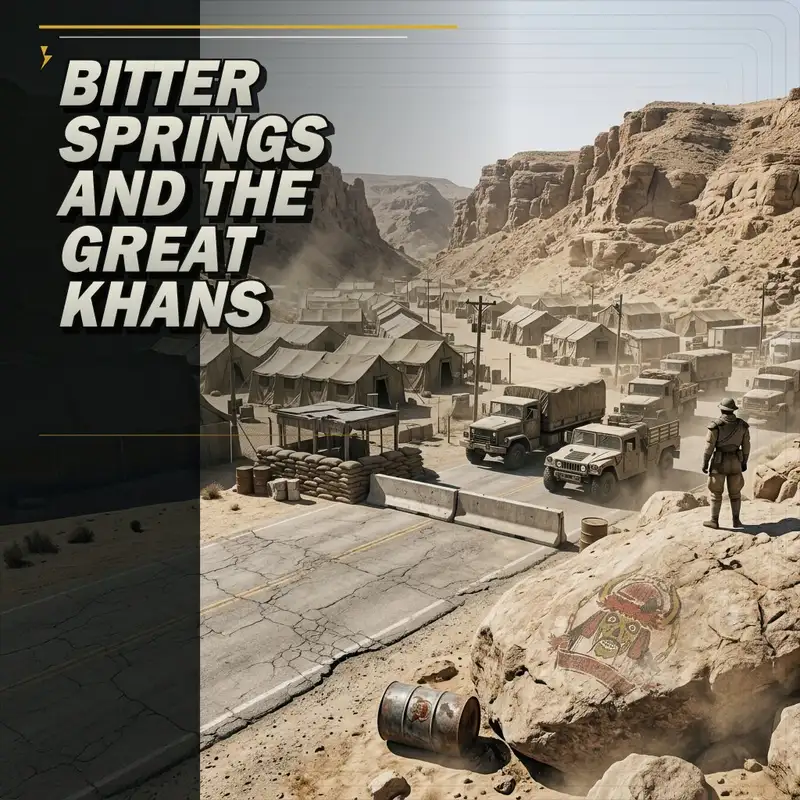
Bitter Springs and the Great Khans
At Canyon Thirty-Seven, also called the Red Pass, the NCR had created a textbook blocking position. The main assault would strike Bitter Springs from the front. The troops in the pass would prevent the Great Khans from escaping through the narrow route behind their settlement. Against an armed raider force, the logic was clear enough. Contain the enemy. Deny dispersal. Prevent survivors from regrouping somewhere beyond the reach of the operation. Then the people emerging into the pass were not only armed fighters. They were women, children, elderly people, and wounded survivors, fleeing the attack on their homes. First Recon personnel radioed for clarification. The standing order remained to shoot on sight. The firing continued until ammunition ran out. That is the central fact of Bitter Springs. Not that the Great Khans had been peaceful. They had not been. The question is what an army owes civilians after the assumptions behind its operation have already collapsed.
Three years later, in the year twenty-two eighty-one, Bitter Springs remains more than a place on the Mojave map. It is a scar across the political life of the Great Khans, across the reputation of the New California Republic, and across the choices facing both groups as the Second Battle of Hoover Dam approaches. NCR officers often describe the event with restrained language. An incident. A tragedy. A mistake. Khan survivors use a harsher and more accurate word. Massacre. Those descriptions are not merely competing emotions. They reveal competing institutions trying to explain what happened, and trying to decide what obligations still remain.
The evidence does not support a simple claim that NCR high command issued a documented policy ordering the extermination of Khan civilians. It does support something more recognizable, and in some ways more troubling. The operation was launched on bad intelligence. A populated tribal settlement was treated as a hostile gang hideout. The plan put a lethal blocking force across the route used by people escaping the attack. Once troops reported that civilians were coming through that route, command did not adapt quickly enough to stop the killing. The disaster was not made harmless by its apparent origins in error. Military responsibility does not vanish because a commander began with the wrong map, the wrong estimate, or the wrong assumption about who lived behind the target line.
The Great Khans who lived at Bitter Springs were not simply the same political body as every earlier group that used the Khan name. Khan communities had appeared in the post-War West before, often as raider societies shaped by mobility, violence, and conflict with larger settlements. The Mojave Great Khans inherited parts of that identity, including its pride, its reputation, and its habits of raiding. But they were also a later community with its own leaders, losses, internal arguments, and strategic problems. Treating them as one unbroken criminal organization across centuries makes their history sound cleaner than it was. It also makes it easier to conclude that whatever happened to them was inevitable.
Around fourteen years before the events of New Vegas, the Great Khans moved east from territory dominated by the New California Republic. By their own account, they arrived in the Mojave and briefly became a major power in its unsettled spaces. That success did not last. When the Three Families consolidated control of New Vegas with the support of Mister House, they drove the Khans away from the city. House provided weapons, technology, and money to his new clients. The Khans were defeated by a coalition that understood the value of organization, outside support, and control of strategic ground.
That earlier defeat mattered. The Khans did not arrive at Bitter Springs as a settled agricultural community suddenly victimized by outside conquest. They arrived as a displaced armed people whose economy had long included intimidation, theft, and raiding. Their leadership had lost status and territory. Their fighters had lost a place in the regional order. Their families were trying to survive in a harsher position than the one they had expected to hold. Displacement did not excuse later violence. But it shaped the choices available to them, and it shaped the importance they placed on autonomy, reputation, and revenge.
Bitter Springs gave the Khans a place to regroup, but it did not remove the pressures that had brought them there. In the Mojave, power depended on routes, water, trade, and the ability to make others account for your presence. The Khans had few secure means of doing that. They were not a state with a reliable tax base, a broad agricultural hinterland, factories, or formal alliances strong enough to protect them. Raiding could provide goods, weapons, captives, and status. It could also demonstrate that the Khans had not been reduced to refugees waiting for stronger neighbors to decide their fate.
Then the New California Republic expanded into the Mojave. By the year twenty-two seventy-four, NCR soldiers, administrators, settlers, merchants, and contractors were moving into the region in larger numbers. The Republic had strategic reasons for doing so. It needed safer routes. It wanted to protect settlements and caravans. It sought influence over the territory around Hoover Dam and New Vegas. It also had a frontier problem familiar to every expanding government. Once it claimed responsibility for a road, a camp, or a town, it had to show that those claims meant something. Merchants and settlers do not trust a flag that cannot protect a caravan beyond the next ridge.
The Great Khans saw the same NCR presence and drew a different conclusion. Papa Khan later admitted that the tribe regarded the Republic as weak when it first arrived. Its soldiers and camps looked like opportunities for plunder. Khan raiders struck NCR caravans, towns, military interests, and other targets across the Mojave. Those attacks were not invented afterward to justify the campaign at Bitter Springs. They were part of the conflict that led to it. Khan violence imposed real costs on NCR civilians and soldiers. It made route security harder. It made the Mojave more dangerous. It gave NCR commanders a legitimate reason to pursue armed raiders.
But a government’s right to pursue raiders is not a license to stop distinguishing fighters from families. That distinction is especially important in frontier warfare, where armed groups often live among relatives, dependents, wounded people, and civilians whose lives are inseparable from the military organization around them. A camp can be both a base for raiding and a home. A tribe can commit violence and still contain people who neither planned nor carried out that violence. An army that refuses to recognize those facts may achieve a short-term security objective, but it will do so by converting an opponent’s civilian population into part of the battlefield.
The immediate event said to have triggered the NCR assault involved four Republic soldiers who were abducted and killed. The detail appears in the official game guide and fits the broader pattern of escalating conflict. Yet even this part of the record requires caution. The guide misidentifies the location of the attacked settlement as Red Rock Canyon, while the game’s own evidence places the assault and massacre at Bitter Springs. That does not mean the entire account of the four soldiers must be discarded. It does mean the record is not a polished operational history written by people with perfect knowledge.
That discrepancy is worth taking seriously because Bitter Springs survives through fragments. There are survivors whose memories are shaped by grief. There are NCR officers who carry guilt, defensiveness, or institutional loyalty. There are later accounts written to explain how a campaign went wrong. There are people who know only what their community taught them. Papa Khan remembers the dead, but tends to compress the Khan raids and killings that preceded the operation. NCR personnel acknowledge a terrible mistake, but often frame it as if relief supplies and resettlement settled the matter. Neither side possesses a complete, neutral archive. History in the Mojave rarely arrives that neatly.
Still, the broad sequence is clear. NCR forces prepared to strike Bitter Springs in the year twenty-two seventy-eight. The main force approached the settlement directly. First Recon was positioned at Canyon Thirty-Seven, the Red Pass, to seal the route behind it. First Recon was an elite NCR formation, known for skilled marksmanship and mobile reconnaissance. It should not be imagined as a fully documented modern sniper battalion with a precise table of organization. The available evidence does not establish its exact strength, its complete command structure, or the number of troops involved in the operation. What matters is its assigned function. It was the force meant to stop Khan escape.
From a narrow tactical perspective, the plan made sense. Raider groups survive by dispersing. If fighters can slip through a pass, scatter into terrain they know, and reconnect later with caches, relatives, or other bands, the attacking force may win a firefight and still fail the operation. A blocking position turns geography into control. The attacking force drives the target toward a predictable exit. The force in the pass closes that exit. The enemy is caught between pressure from the front and fire from the rear. It is a basic method of encirclement, and one that can be devastating even when the attackers lack heavy equipment or overwhelming numbers.
The problem was not that the NCR used terrain. The problem was that its intelligence had confused the nature of the target. NCR troops expected a gang hideout full of hostile raiders. Bitter Springs was an inhabited community. It included people who fought, people who supported fighters, people who were dependent on them, people who were wounded, and people who were simply trying to survive where their group had settled. The operational design had no reliable way to separate those categories once the assault began. Its central assumption was not merely incomplete. It was lethal.
The same route that a raider force might use to escape was also the route that civilians would use to flee an attack. Once the main assault began, the people of Bitter Springs moved toward the pass. Craig Boone, who served with First Recon, later described what his unit saw. They had been sent to intercept Khan raiders. They had been told to shoot on sight. Then women, children, elderly people, and wounded survivors began emerging from the settlement. The troops radioed for clarification. They did not simply mistake a distant shape in poor visibility. They recognized that the people in the pass were not the enemy they had been sent to stop.
The response from command is the point at which a disastrous plan became a massacre. Boone’s account is not a full operational record. It is the testimony of one participant, given years later and shaped by his own trauma. But it is direct testimony from a man who was present at the blocking position. According to Boone, the orders to fire continued. First Recon kept shooting until its ammunition was exhausted. The force designed to prevent armed raiders from slipping away became a killing position for civilians trapped by their own geography.
Captain Dhatri offers another perspective. At the time, he was a junior officer in the operation. He describes the intelligence as bad and says the senior officer present froze when the scale of the civilian disaster became clear. Dhatri then assumed practical control, halted the violence, and organized medical aid for survivors. He was later promoted, but he regarded that advancement with bitterness rather than pride. A promotion earned through crisis management is not much comfort when the crisis was the deaths of people your own force was supposed to distinguish from combatants.
Dhatri’s testimony does not reveal every order given, every radio exchange, or every decision made above his level. It does reveal an institutional failure that was larger than one frightened officer. The radios worked. Information reached people with authority. The problem was judgment, responsiveness, and command control. The operation lacked an effective mechanism for changing its behavior after its original intelligence proved false. There was no functioning pause. No rapid reassessment. No clear instruction to shift from killing to screening, evacuation, or aid. The force continued to execute a plan built for a different target.
On the battlefield, the failure was straightforward. At the institutional level, it was the absence, or breakdown, of safeguards strong enough to stop troops from following standing orders after the human reality on the ground had become visible. And at the moral level, it was the continued firing on people known to include noncombatants.
None of that requires inventing a secret extermination order. There is no established evidence that NCR high command planned Bitter Springs as a deliberate policy of civilian annihilation. The record supports something different: a counter-raider operation that became catastrophically indiscriminate when its assumptions failed. That is not a lesser issue of terminology. An army can commit grave wrong through a plan designed for the wrong target, through orders that are not revised, and through commanders who cannot or will not respond when soldiers report that civilians are in the line of fire.
The number of dead remains uncertain. No reliable casualty total survives. Some accounts suggest several dozen people, but that should be treated as an indication of scale, not a final ledger. What is established is that many Khan noncombatants died. Families were shattered. Survivors were wounded, displaced, and left with a memory of NCR soldiers firing into their escape route. In a society where communities are already small, where every adult can be a worker, defender, parent, teacher, or keeper of scarce skills, such losses carry consequences far beyond a battlefield count.
Calling Bitter Springs a tragic mistake captures only part of the truth. It recognizes that the operation was not necessarily conceived as a campaign of extermination. It does not explain why the killing continued after civilians were identified. An error in intelligence can begin a disaster. It cannot excuse every decision that follows. A force that sees women, children, wounded people, and elderly survivors coming through a pass has a duty to reassess its fire. If it keeps firing because the original order has not been changed, then the original order has become part of the harm.
The Great Khans’ raids still matter. Their fighters had attacked people. They had helped create the conditions in which the NCR saw Bitter Springs as a military problem. That fact must remain in the history. But it does not turn children, wounded people, or fleeing families into legitimate targets. The responsibility for starting a conflict is not the same as responsibility for every act committed during that conflict. That distinction is one of the first disciplines a military organization must preserve if it intends to claim that it provides security rather than simply applying violence more efficiently than its enemies.
After the shooting stopped, NCR forces provided medical aid to survivors. The Republic also permitted the remaining Great Khans to relocate to Red Rock Canyon. Those actions mattered. Medical care saved lives. Resettlement gave the survivors a place to go. Dhatri’s efforts to stop the operation and organize aid should not be dismissed. They show that some NCR personnel understood, at least in the aftermath, that the people at Bitter Springs had been grievously wronged.
But aid is not the same as reconciliation. A government can distribute medicine without explaining who failed. It can permit resettlement without offering a secure political future. It can call a massacre an accident without making the victims part of the process of accountability. The NCR response addressed the immediate humanitarian emergency. It did not create a mutually accepted record of what happened. It did not offer the Khans durable compensation, meaningful inclusion, or a relationship based on trust. It did not solve the basic question of whether the Republic saw surviving Khans as neighbors, defeated enemies, wards, or a problem temporarily moved farther down the road.
By the year twenty-two eighty-one, Bitter Springs had become an NCR refugee camp. Captain Gilles, responsible for the camp, represents the complicated limits of the Republic’s later policy. She acknowledges that noncombatants were killed. She describes the operation as a mistake and points to the assistance the NCR gave afterward. Her work at the camp is not meaningless. Refugee administration, food distribution, medical care, and local security are real forms of public service in the Mojave. But they cannot, by themselves, repair the legitimacy destroyed when the same state that claims to provide protection killed the relatives of people it now seeks to administer.
The continuing violence around the camp makes that clear. Oscar Velasco, a Khan survivor, comes to Bitter Springs seeking revenge. His actions are not a mass movement or a full insurgency. They are the act of an individual shaped by loss, anger, and the belief that the NCR has never paid for what it did. Yet his presence demonstrates a wider strategic reality. A massacre can outlast the battle that caused it. The attacking force may withdraw. The survivors may be resettled. The paperwork may describe the incident as closed. But the political memory remains active wherever people believe the dead were never recognized and the responsible institution never changed.
For the surviving Khans, Red Rock Canyon was shelter, but it was not prosperity. Diane, who manages much of the tribe’s trade, describes a community with too little food, barely enough water, and too few people to meet its needs. Bitter Springs had reduced Khan manpower and disrupted their old ways of sustaining themselves. A community already displaced from New Vegas now had to survive after losing more of its families, fighters, workers, and elders. The canyon offered defensible ground and a degree of separation from NCR authority. It did not offer an easy economic base.
This is where the Khan drug trade must be understood as more than a colorful criminal enterprise. The Followers of the Apocalypse had previously provided the Khans with education, medicine, and scientific knowledge. That assistance gave individuals such as Jack the ability to produce chems. Diane organized distribution and trade. In a different political environment, those skills might have supported clinics, workshops, agriculture, or a more stable regional economy. At Red Rock Canyon, under conditions of scarcity and reduced manpower, they became part of a survival strategy built around narcotics.
The trade brought resources into the canyon. It also imposed serious costs. Khan chems flowed into the wider Mojave, feeding addiction and supplying violent consumers, including the Fiends. The Khans gained an income stream, but not a durable social contract with their neighbors. The Followers saw their educational work turned toward destructive ends. The NCR saw further evidence that the Khans remained a source of instability. The tribe’s survival economy deepened its isolation. It kept people alive, but it did not resolve hunger, water insecurity, political weakness, or the loss of a future beyond trafficking.
It would be easy to call this decline the natural result of Khan choices and stop there. The Khans did make choices. Their raiding had consequences. Their drug trade had consequences. Their leaders could not blame every hardship on the NCR. But political communities do not choose from an infinite menu. Bitter Springs narrowed the Khan range of action. Demographic loss reduced their labor and defense capacity. Displacement limited their access to land and water. The reputation created by raids and drug trafficking made outside trust harder to obtain. The surviving Khans were not helpless, but they were operating from a position of profound weakness.
That weakness did not create a single Khan response. Papa Khan saw Bitter Springs as proof that the NCR intended to destroy his people. From his perspective, compromise looked less like prudence than surrender. He had watched the Khans lose New Vegas. He had watched NCR forces kill people at Bitter Springs. He saw a Republic expanding through the Mojave, planting camps, claiming roads, and treating Khan survival as a problem to be managed. His anger was grounded in real events. Yet grief can become a poor strategic adviser when it treats every rival as permanently identical and every offer of revenge as a path to restoration.
Regis, Papa Khan’s son and a leading figure within the tribe, represents a different assessment. He does not deny Bitter Springs. He does not pretend that the NCR is innocent. But he understands that vengeance can prevent adaptation. The Khans cannot rebuild merely by preserving the emotional intensity of their worst defeat. They need food, water, allies, security, and a future for people who are tired of living as targets or tools. Regis sees that his father’s fixation on the past makes the tribe vulnerable to anyone willing to flatter its pride and direct its anger toward a convenient enemy.
Bitter-Root offers another view, one that should not be treated as the final judgment on all Khan society. He is a survivor of Bitter Springs, but he rejects the Khans and condemns his parents and their treatment of him. His testimony is valuable because it prevents the tribe from becoming a romanticized community of uncomplicated victims. Khan life could include abuse, coercion, violence, and neglect. Bitter-Root’s alienation is evidence of fractures within the group. It is not proof that every Khan parent, fighter, or survivor was the same, any more than one NCR officer’s remorse proves the Republic as a whole had solved its own failures.
Oscar Velasco turns memory into retaliation. Papa Khan turns it into collective grievance. Regis tries to turn it into a warning about the future. These are different political uses of the same trauma. Collective suffering can create cohesion. It can help a scattered people preserve a name, a story, and a reason to endure. But it can also narrow political judgment. Leaders who promise revenge gain authority. Moderates can be accused of betrayal. Every compromise can look like another march into the pass at Bitter Springs. A community may become bound together by its dead while losing the ability to imagine what the living need.
Caesar’s Legion understands how to exploit that condition. Karl, a Legion frumentarius operating among the Great Khans, does not approach them merely with military plans. He offers recognition. He praises Khan martial identity. He presents Caesar’s alliance as an opportunity for the tribe to regain status, seize purpose, and strike back at the New California Republic. For a people who have been defeated, displaced, impoverished, and humiliated, that appeal has force. It promises that their losses will be transformed into power.
The Legion’s offer is persuasive precisely because it does not begin by asking the Khans to forgive. It asks them to remember. It turns Bitter Springs into recruitment capital. It suggests that the NCR’s violence proves the Khans have only one honorable path left: to fight alongside Caesar. In that story, the Legion becomes not an outside power using Khan pain, but the first major state to recognize what the Khans have suffered. Karl’s work is an intelligence operation in the broad political sense. He identifies a grievance, validates it selectively, and directs it toward a strategic objective that serves his own government.
Yet the promise of alliance deserves scrutiny. Caesar’s Legion values military utility, obedience, conquest, and ideological incorporation. Its treatment of conquered communities gives little reason to believe that enduring Khan autonomy would be respected once the tribe had served its purpose. The Khans might gain weapons, prestige, and a chance to fight the NCR. They might even gain a temporary place in the Legion’s order. But the Legion does not build partnerships easily. It absorbs, subordinates, and transforms. A people joining it for revenge could discover that they had exchanged one form of vulnerability for another.
This is the cruel strategic consequence of Bitter Springs. The NCR had sought to weaken a raider threat and secure its frontier. In the immediate military sense, it succeeded. Khan capacity was badly damaged. The tribe was displaced. The Republic no longer faced the same strong raider presence at Bitter Springs. But the political result was worse than the tactical map suggested. The surviving Khans carried a grievance that the NCR never adequately addressed. Their poverty and isolation made them easier for the Legion to recruit. A campaign meant to increase security helped create an opening for the Republic’s most dangerous enemy.
The Khans’ future during the struggle for Hoover Dam is not fixed history. In one possible path, the Khans can be persuaded toward accommodation with the NCR, accepting that survival may require a political settlement rather than another doomed war. It represents an attempt to keep the tribe alive by recognizing that the old cycle of raids, reprisals, and revenge has become strategically unsustainable.
In another path, the Khans join the Legion in a destructive attack against the NCR, pursuing vengeance even at immense cost to themselves. That possibility captures the emotional power of Bitter Springs, but also the danger of allowing trauma to define all strategy. A people can gain a moment of satisfaction in battle and still lose the capacity to shape its own future. There are also paths in which the Great Khans are exterminated, demonstrating the most brutal consequence of treating a damaged community as a problem to be removed. And there is a path in which they leave the Mojave, heading toward Wyoming in search of a new beginning away from the ground that has repeatedly consumed them.
Those outcomes are mutually exclusive possibilities, not parts of one settled timeline. Later stories set in the shared Fallout world have not established a definitive Great Khan outcome that overrides those branches. That uncertainty is appropriate to the subject. Bitter Springs did not predetermine every choice the Khans could make. It did, however, shape the political terrain on which those choices were made. It made trust harder. It made revenge easier to sell. It made departure look, to some, like the only way to break free of a history in which every attempt to hold ground had ended in defeat or death.
Bitter Springs was neither a simple tale of innocent victims nor a defensible raid against an empty bandit camp. The Great Khans helped create the conflict through raids, killings, and a predatory survival strategy. The NCR had real obligations to protect its people and secure the Mojave’s roads. But the massacre occurred because NCR intelligence, command judgment, and operational control failed when the force encountered an inhabited community rather than the enemy it expected. The Republic won the ground and broke Khan strength. It did not create reconciliation, legitimacy, or durable security. Instead, it left behind a wounded political community whose grief, poverty, and desire for dignity could be turned into a weapon by Caesar’s Legion.