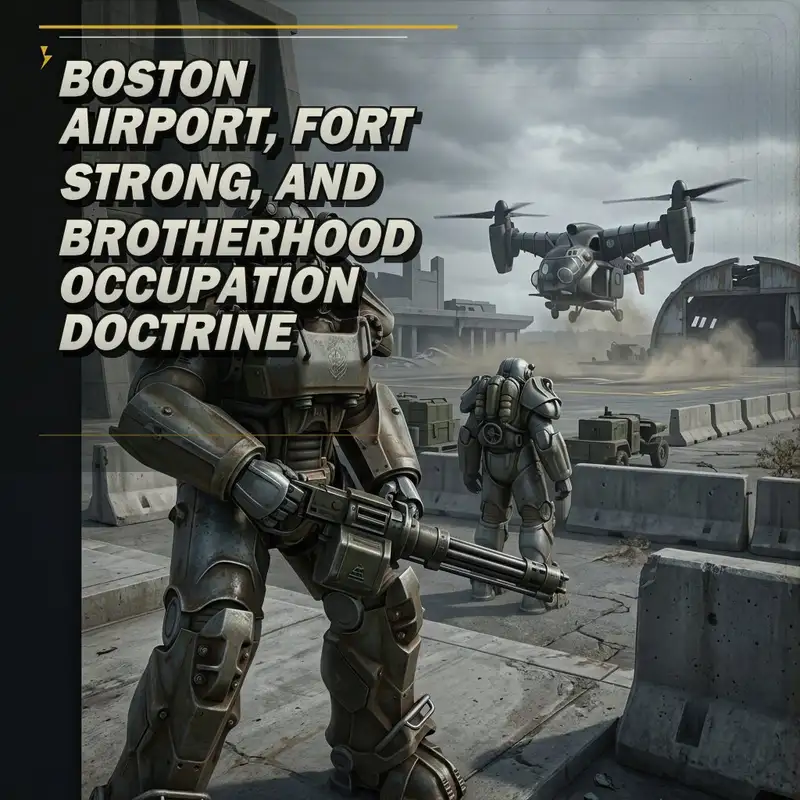
Boston Airport, Fort Strong, and Brotherhood Occupation Doctrine
Below the Prydwen’s armored hull, Boston Airport has stopped being an airport. Its runways no longer promise civilian travel. Its open ground, battered terminals, and surviving service spaces now support an army that arrived from the sky. Brotherhood personnel move between depots, workshops, guard posts, and landing areas. Above them, the airship serves as command post, barracks, symbol, and heavy transport. Beyond the perimeter lies the Commonwealth, a region the Brotherhood has not come to administer through elections, courts, or public consent. It has come to investigate, secure, confiscate, and, where necessary, destroy.
That contrast explains the importance of Boston Airport and Fort Strong. The airport was not simply a convenient place to park the Prydwen. It was the ground anchor for an expeditionary military system. Fort Strong was not merely another ruined installation occupied by super mutants. It was a nearby threat, a pre-War arsenal, and an opportunity to extend Brotherhood power beyond the runway. Together, the two sites reveal an occupation doctrine in practice, though not one the Brotherhood formally names. Secure infrastructure. Restrict access. Concentrate supplies and dangerous technology. Project force outward. Treat uncertain populations as security concerns until they prove useful, obedient, or harmless.
The Brotherhood’s main force did not enter the Commonwealth blind. Before the Prydwen appeared over Boston, Paladin Danse and his reconnaissance team were already operating from Cambridge Police Station. Their mission was part investigation, part recovery effort, and part advance screening for a larger intervention. Danse’s unit searched for technology, assessed threats, and encountered the kind of hostile environment that would shape the expedition’s later posture. The Commonwealth contained super mutants, feral ghouls, raiders, armed settlements, old military facilities, and persistent rumors of the Institute.
A reconnaissance team cannot govern a region, but it can establish a picture of risk. Danse’s patrol gave the Brotherhood an initial foothold and a local source of intelligence. The patrol was looking for recoverable technology and dangerous actors. An advance party sent to make alliances behaves differently from one sent to identify threats, locate military assets, and prepare the ground for a larger force.
After the events at Fort Hagen bring the Brotherhood’s wider campaign into view, the Prydwen arrives in the Commonwealth and moves toward Boston Airport. Its appearance is dramatic, but its strategic meaning is more important than its spectacle. The Brotherhood has shifted from reconnaissance to expeditionary warfare. Elder Arthur Maxson now has a mobile headquarters, a visible symbol of authority, trained troops, technical staff, air mobility, and a means to place all of them inside a contested region without depending on local permission.
The Prydwen is not just transportation. Lancer-Captain Kells’s authority over shipboard order, personnel, and discipline makes clear that the airship is also an administrative center. It carries command relationships with it. It gives the expedition a protected headquarters above the city, beyond the immediate reach of most Commonwealth groups. That security is useful, but it also creates distance. The Brotherhood can observe the Commonwealth, strike into it, and draw resources from it without having to live under the same conditions as the settlements below.
Boston Airport gave that airborne command structure a place to land politically and materially. The Brotherhood took the airport from its feral-ghoul population and converted it into the ground base for the Prydwen. The broad fact of the occupation is established. The exact battle is not. The surviving record does not provide reliable troop totals, casualty numbers, or a detailed account of how long the fighting lasted. It would be easy to imagine a neat assault plan, a precise perimeter clearance, and a final secured runway. The game does not establish those details, so history should not manufacture them.
What can be said is that the airport suited the Brotherhood’s needs. It offered open terrain, existing hard infrastructure, room for staging and storage, and a perimeter that could be guarded more easily than a dense urban neighborhood. It sat beneath the Prydwen’s operating area and connected the airship to workshops, supply depots, ground crews, and field forces. The airport’s importance came less from what it had been before the Great War than from what it could become after the Brotherhood occupied it.
The Commonwealth map is compressed, so no exact tactical geometry should be inferred from a short walk or a Vertibird flight path. But the operational logic is still clear. A large force arriving by air needs protected ground space. It needs places to unload equipment, move personnel, repair machinery, store rations, manage ammunition, treat injuries, and stage missions. A military expedition cannot operate indefinitely from an airship alone. Even the most impressive flying fortress requires a base beneath it.
Boston Airport therefore became a support complex rather than a civilian center. It was a place designed around the needs of the expedition. The Brotherhood could establish security zones, regulate movement, store equipment, and keep its technical personnel close to the tools they needed. This was force protection in the most basic sense. Before an army can project power outward, it must first protect the systems that keep it supplied, armed, and organized.
The airport also demonstrates that Maxson’s force is more than a collection of armored patrols. The Brotherhood expedition contains a division of labor. Maxson provides overall direction and political purpose. Kells represents the disciplinary and administrative machinery of the Prydwen. Proctor Quinlan handles records, research, and the preservation of technical knowledge. Proctor Ingram leads engineering work. Proctor Teagan manages procurement. Knight-Sergeant Gavil supervises logistical activity on the ground. Paladin Danse, whose team operated in the Commonwealth before the airship’s arrival, represents the connection between reconnaissance and field operations.
Around them are knights, scribes, initiates, pilots, technicians, medical staff, and enlisted personnel. The game does not provide a complete table of organization, and it does not establish the expedition’s exact manpower. Still, the institutional pattern is unmistakable. This is a combined military and technical organization. Its soldiers are supported by administrators. Its patrols are connected to a supply system. Its strategic ambitions are backed by engineers, researchers, and specialists who understand that power armor, energy weapons, aircraft, and recovered machines do not maintain themselves.
That matters because the Brotherhood’s advantage in the Commonwealth is not merely better equipment. Equipment without trained operators, spare parts, records, workshops, and command discipline is salvage. The Brotherhood is dangerous because it can turn salvage into organized capability. It can inspect it, repair it, classify it, move it, and assign it to a larger purpose. A laser rifle in the hands of a scavenger is one weapon. A supply system that can arm, train, and sustain a unit is something closer to military power.
At Boston Airport, logistics is visible in the routines of the base. Rations, weapons, armor, technical components, and other supplies pass through a controlled environment. Gavil’s work reflects inventory discipline rather than casual scavenging. The Brotherhood tracks what it needs because it has learned a basic military truth. An army does not fail only when it loses a battle. It also fails when it cannot account for food, ammunition, medical supplies, replacement equipment, or the people assigned to handle them.
The airport should not be read as an exact warehouse diagram. Game containers, item placement, and workshop mechanics are not reliable measures of real stockpiles or supply tonnage. But the institutional emphasis on storage, accountability, and distribution is meaningful. The Brotherhood has created a place where materiel can be collected and assigned rather than simply found and consumed. That is the difference between a patrol living from encounter to encounter and an expedition trying to remain in the field.
Access control is part of the same system. Boston Airport is not presented as an open civic space where Commonwealth residents can freely participate in decision-making. It is a military installation. Outsiders are screened, watched, and treated according to their usefulness or their threat level. That is not unusual for an army operating in hostile territory. A secure depot cannot invite unrestricted traffic through its ammunition stores and engineering spaces. But it is also a political choice. Security procedures establish who belongs inside the institution and who remains outside its protection.
The Brotherhood’s early presence in the Commonwealth is therefore not the beginning of a civilian capital. It is the creation of a protected enclave. The expedition can communicate with local people, recruit information, acquire supplies, and conduct operations from the airport. Yet it does not initially offer Commonwealth settlements a clear role in the authority being established around them. The Brotherhood has a chain of command. The Commonwealth does not have representation within it.
That separation becomes especially important when the Brotherhood has to feed itself. The Prydwen, the airport garrison, and field units all require food. Power armor may attract attention, but soldiers cannot eat doctrine, and Vertibirds do not fly on institutional confidence. The expedition can bring some supplies with it, but a continuing campaign requires a reliable flow of material. Food must be imported, purchased, requisitioned, or taken. Every army eventually reveals its relationship with civilians through the way it answers that question.
Proctor Teagan’s procurement work provides the clearest evidence. In the operation known as Feeding the Troops, Commonwealth settlements can be approached for agricultural produce. The methods available vary. Payment may be offered. Persuasion may be attempted. Intimidation can be used. Tribute may be demanded. Violence is also possible through player action. The exact resolution depends on choices outside the fixed record, and it would be wrong to claim that every Brotherhood transaction ends in robbery or bloodshed.
But the existence of those options matters. The Brotherhood’s supply system is willing to treat local agricultural communities as a resource base for a foreign military expedition. That is a familiar occupation problem. A force that arrives with superior weapons but limited local production must either maintain long and vulnerable supply lines, pay for goods in a functioning market, negotiate mutual support, or compel communities to provide what it needs. The Brotherhood’s practice leaves room for several methods.
Payment can be a legitimate exchange. Persuasion can become negotiation. Intimidation and tribute are something else. They shift the relationship from commerce toward extraction. A settlement facing armed Brotherhood representatives may technically possess a choice while lacking much practical freedom to refuse. This is especially true in the Commonwealth, where most communities have limited defenses, unstable harvests, and no guarantee that another faction will protect them if a military power decides its needs take priority.
The Brotherhood may understand this procurement as necessary to the campaign against the Institute and other threats. Its soldiers may believe that they are asking civilians to support a mission that will make the Commonwealth safer. Some individual members may deal fairly with settlers. None of that removes the structural imbalance. The Brotherhood arrives armed, organized, and backed by an airship. The settlements are approached as suppliers before they are approached as political partners.
For that reason, food matters as much as technology. A faction that controls weapons but cannot feed its personnel is weak. A faction that can obtain food by pressure may remain strong in the short term, but it may also create resentment, fear, and resistance. Military supply and legitimate government are related, but they are not the same thing. A government must eventually explain why its demands are lawful, how burdens are shared, and what ordinary people receive in return.
Fort Strong brought this occupation model into sharper focus. Soon after establishing the airport base, the Brotherhood identifies the fort as a major objective. In the operation called Show No Mercy, Maxson orders an assault on the old military installation. The fort is occupied by super mutants, including a behemoth that makes the position more dangerous than a simple depot seizure. The Brotherhood’s immediate objective is clear. Remove the hostile force, secure the facility, and gain access to its armory.
Fort Strong mattered for more than one reason. First, it was a security problem. A super-mutant force holding a military installation near the Brotherhood’s new operating area could threaten patrols, interfere with movement, and deny use of valuable infrastructure. The exact relationship between the airport and the fort should not be reduced to a precise radius on a compressed game map. Still, both sites belonged to the same broader Boston operating area. A hostile fort filled with heavy weapons could not be ignored by an expedition attempting to establish a protected base nearby.
Second, Fort Strong was a weapons objective. The installation contains a substantial stockpile of Mark Twenty-Eight mini-nukes. The precise inventory is not established, and the Brotherhood’s full intended doctrine for the weapons is not explained. But their presence changes the strategic value of the fort. These are not ordinary small arms. Mini-nukes are compact nuclear munitions, weapons whose destructive potential makes uncontrolled possession a regional security concern.
Third, Fort Strong offered the Brotherhood a chance to extend its control outward from Boston Airport. The airport secured the expedition’s support system. The fort promised to remove a threat and add a military asset. This is how occupation expands in practice. An army does not need to govern every street before it can shape a region. It can seize nodes. Airfields, depots, bridges, water facilities, radio towers, factories, and arsenals can matter more than open land because they connect force to movement, supply, and coercive reach.
At the tactical level, the operation calls for clearing Fort Strong and defeating its defenders. At the operational level, it seeks to protect the Brotherhood’s emerging base structure and open access to a usable weapons site. At the strategic level, it serves Maxson’s larger campaign to destroy the Institute and place dangerous technology under Brotherhood custody. The three levels reinforce one another. A successful assault removes super mutants. The cleared fort yields weapons. The weapons and the secure operating area strengthen a wider campaign.
The Brotherhood’s use of Vertibirds illustrates how Boston Airport turns into regional reach. The aircraft provide rapid transport, reconnaissance, fire support, and visible presence. They allow the Brotherhood to move personnel over damaged roads and hostile terrain more quickly than a purely ground-bound force. They also make the expedition appear larger and more mobile than a settlement militia or a scattered patrol network. A Vertibird arriving over a contested site is a military event and a political message.
Yet air mobility is not magic. Vertibirds need trained pilots, maintenance crews, replacement parts, secure landing areas, and some form of fuel or power support. They can move troops rapidly, but they do not eliminate the need for ground forces to secure buildings, clear rooms, protect supply routes, and hold a site after the aircraft depart. The Brotherhood’s aviation capability gives it an advantage, not immunity from the ordinary demands of campaigning.
The same is true of power armor and energy weapons. Brotherhood troops carry equipment that many Commonwealth groups cannot match. Power armor protects its users and can increase their ability to fight in dangerous terrain. Energy weapons provide significant firepower. Together, these systems give the Brotherhood a powerful edge in direct combat. But they also impose a maintenance burden. Armor needs repair. Weapons need parts and power cells. Trained personnel must understand how to operate both. The airport’s workshops and technical staff are what make those battlefield advantages sustainable.
The fight at Fort Strong also demonstrates that advanced equipment does not erase risk. The super-mutant behemoth is not simply an obstacle placed in the Brotherhood’s way for dramatic effect. It represents the kind of close-range danger that can complicate even a well-equipped assault. Fortifications, confined spaces, heavy defenders, and hostile terrain can still force an attacking unit into costly and uncertain fighting. Technology can improve the odds. It cannot guarantee that an operation will unfold cleanly.
The decisive issue at Fort Strong was not only the destruction of super mutants. It was control of what their occupation had denied to the Brotherhood. The Mark Twenty-Eight mini-nukes transformed the installation from a security liability into a weapons node. By recovering the arsenal, the Brotherhood could deny those munitions to super mutants, raiders, rival factions, or anyone else capable of reaching the fort. Denial is a central part of weapons control. A dangerous device does not have to be fired to influence a campaign. Its possession alone can alter who feels secure and who must plan around its possible use.
The Brotherhood explains technology recovery through the language of stewardship. Its members have witnessed, inherited, and studied the wreckage of pre-War militarism. They see uncontrolled advanced technology as a recurring danger. In the Commonwealth, that concern is not irrational. The Institute possesses extraordinary scientific capacity. The ruins contain military hardware, automated systems, experimental research, and weapons that could devastate communities in untrained or malicious hands. Fort Strong’s mini-nukes are exactly the kind of arsenal a cautious military organization would want secured.
But stewardship is never only about intent. It is also about authority. The Brotherhood does not propose that the Commonwealth collectively decide how the mini-nukes should be stored, inspected, or destroyed. It does not create a civilian oversight body. It does not ask settlements to appoint representatives to a shared security council. It places the weapons under Brotherhood command. The institution condemns uncontrolled destructive technology while concentrating destructive technology inside its own hierarchy.
That contradiction does not prove that the Brotherhood intends to use the mini-nukes recklessly. Recovery, storage, technical understanding, and operational deployment are different stages. The game establishes the Brotherhood’s interest in securing the arsenal, not a detailed plan for firing every weapon it finds. A military order that defines itself as uniquely qualified to control dangerous technology is also claiming exceptional power over everyone else who might want a say in that technology’s future.
From the Brotherhood’s perspective, this may look like responsibility. From the perspective of an independent Commonwealth settlement, it may look like monopoly backed by force. The difference depends on trust, accountability, and experience. If the Brotherhood protects communities from threats while respecting their autonomy, custody can appear like security. If it extracts food, restricts access, and treats disagreement as a threat to military discipline, custody can appear like another form of domination.
Fort Strong therefore exposes the political limits of the Brotherhood’s military model. It can seize a weapons site. It can clear hostile defenders. It can transport valuable munitions into a controlled system. What it cannot automatically seize is legitimacy. People may accept the removal of super mutants while still questioning why a distant order has the right to monopolize the fort’s arsenal. Tactical success does not settle that question. It creates the conditions under which the question becomes more urgent.
The released record also requires caution about what happened after Fort Strong was cleared. Maxson’s intention is to occupy and fortify the site. That intent is important. It shows that the Brotherhood does not view the assault as a temporary raid alone. It sees Fort Strong as a position to be held and incorporated into the expedition’s security structure. But the final game does not visibly demonstrate a fully staffed, enduring Brotherhood fortress at the fort.
That gap should not be filled with invented garrisons, patrol schedules, or permanent defensive works. It is best understood as narrative intent with incomplete implementation. The Brotherhood plans to turn Fort Strong into an occupied asset. The game does not provide enough evidence to describe the fort as a mature, functioning outpost with a documented long-term garrison. The difference is small in appearance but large in historical analysis. An army’s desire to hold ground is not the same as its demonstrated ability to sustain that hold.
This distinction reaches beyond Fort Strong. Boston Airport, Vertibird movement, and Brotherhood patrols do not prove that Maxson’s expedition governs the entire Commonwealth. They demonstrate uneven control over bases, routes, personnel, and selected objectives. Territorial power after the Great War is rarely a clean line on a map. It is often a patchwork of guarded facilities, dangerous roads, allied communities, hostile pockets, and spaces where no faction has enough presence to enforce its claims consistently.
A military expedition can dominate a battlespace without becoming a state. It can secure nodes while leaving the terrain between them politically uncertain. It can intimidate a settlement without administering it. It can destroy a hostile base without replacing the social and economic structures that allowed insecurity to take root. The Brotherhood’s airport and its intended Fort Strong occupation are powerful examples of this. They show an organization capable of controlling crucial infrastructure, but not yet one that has built a broadly shared Commonwealth order.
Boston Airport’s later role in the Liberty Prime project makes the expedition’s architecture even clearer. The airport evolves from landing and support area into an engineering and assembly site. Under Proctor Ingram’s direction, the Brotherhood works to restore Liberty Prime for an assault on the Institute. This is not a simple act of turning on an old machine. The project requires specialized knowledge, rare components, technical labor, protected workspace, power systems, and a supply network capable of bringing all those elements together.
Liberty Prime is a dramatic symbol, but the airport is the more revealing institution. The giant robot can only become useful because the Brotherhood has created a system around it. The Prydwen provides command and transport. The airport provides space and security. Engineers provide expertise. Logistics staff move components and maintain inventories. Field forces protect the work and pursue the materials needed to continue it. The Brotherhood’s strength lies in this ability to connect exceptional technology to an organization capable of supporting it.
That does not mean the Brotherhood has restored broad industrial civilization. Rebuilding one strategic weapon through salvage, recovery, and specialist labor is not the same as possessing factories able to mass-produce comparable machines. The expedition can integrate recovered technology. It cannot be assumed to manufacture every part it uses, replace every loss, or sustain unlimited operations far from its support base. Liberty Prime proves technical competence and concentration of resources. It does not prove unlimited industrial depth.
Still, the project transforms Boston Airport into more than a depot. The airport links airship command, field patrols, technical research, weapons recovery, engineering work, and a decisive offensive plan. Fort Strong fits within that broader architecture. Its arsenal is one more resource to be secured by the military system gathering beneath the Prydwen.
The Brotherhood’s campaign is therefore built around concentration. It concentrates personnel at a protected base. It concentrates technological expertise inside its ranks. It concentrates weapons under its command. It concentrates intelligence through its reconnaissance and research divisions. It concentrates mobility through Vertibirds and the Prydwen. Concentration creates power. It also creates vulnerability. A system dependent on a few major nodes can be formidable, but the loss of a critical base, workshop, airship, or supply source can have consequences far beyond one battlefield.
The airport’s internal discipline shows another side of that concentration. In the matter investigated through Duty or Dishonor, missing food crates become a serious concern. That is not bureaucratic trivia. Food loss in a military base raises questions about theft, rationing, security, morale, and command reliability. An expedition that depends on controlled supplies cannot tolerate uncertainty about where those supplies go. The Brotherhood’s response reflects a professional concern with accountability, but also a security culture prepared to see unexplained behavior as a possible threat.
The case centers on Initiate Clarke and his efforts to feed feral ghouls in the airport ruins. The final outcome can vary, and Clarke’s fate should not be treated as fixed history. Clarke does not deny that feral ghouls can be dangerous. The Brotherhood’s security concern is not invented. Feral ghouls pose real risks to isolated personnel and vulnerable facilities. But Clarke’s actions reveal discomfort with an institution that tends to classify ghouls primarily through danger, contamination, and exclusion.
This is not evidence that every Brotherhood member thinks alike. It is evidence of moral friction within the ranks. Some members accept the expedition’s security logic more completely than others. Some may see discipline as the highest duty. Others may recognize suffering even where the institution sees only a threat category. The Brotherhood’s chain of command can enforce behavior, but it cannot eliminate the human differences among the people serving inside it.
Clarke’s case also reveals the danger of a security-first worldview. Military organizations need rules. They must protect their personnel, guard supplies, and prepare for hostile action. Yet when every ambiguous person or creature becomes a potential danger to be managed, compassion begins to look like indiscipline. The institution can become unable to distinguish between prudent caution and blanket exclusion. That does not make every security measure unjustified. It means that security, without flexibility or accountability, can harden into dehumanization.
Occupying forces are judged not only by the threats they defeat, but by the categories they impose on those living around them. At Boston Airport, civilians are generally outsiders. Settlements are potential supply sources. Feral ghouls are threats. Advanced technology is property to be secured. Dissent within the ranks becomes a disciplinary problem. Each classification has a military logic. Together, they produce a society organized around command, access, and control rather than shared political membership.
That is the central lesson of Boston Airport and Fort Strong. The Brotherhood expedition under Arthur Maxson is built to dominate a battlespace. It seizes defensible infrastructure, establishes a protected logistics node, regulates access, tracks supplies, deploys advanced equipment, recovers dangerous weapons, and uses mobility to strike beyond its perimeter. Boston Airport gives it a base. Fort Strong, if seized in the operation, gives it a weapons objective and a forward security gain.
At the tactical level, the Brotherhood can secure the airport and defeat the super-mutant defenders of Fort Strong when the relevant operation takes place. At the operational level, it creates a forward base capable of supporting patrols, air assaults, weapons recovery, engineering work, and the wider campaign against the Institute. At the strategic level, it gains leverage by placing more advanced technology under Brotherhood control and by demonstrating that it can intervene across the Commonwealth with unusual speed and force.
Politically, however, the model remains narrow. Commonwealth civilians are not initially brought into a shared system of representation or public authority. They are suppliers, outsiders, sources of intelligence, possible recruits, and possible security risks. The Brotherhood can pay for food, negotiate for it, or compel it. The availability of all three methods reveals that its relationship with the Commonwealth is governed first by military necessity, not civilian consent.
Boston Airport and Fort Strong show how an army can capture the machinery of regional power without yet creating a legitimate regional order. Airfields, arsenals, armored troops, and strategic weapons can secure an expedition’s position. They cannot by themselves build trust, distribute burdens fairly, settle disputes, feed civilians, or persuade independent communities that Brotherhood rule serves more than Brotherhood purposes.