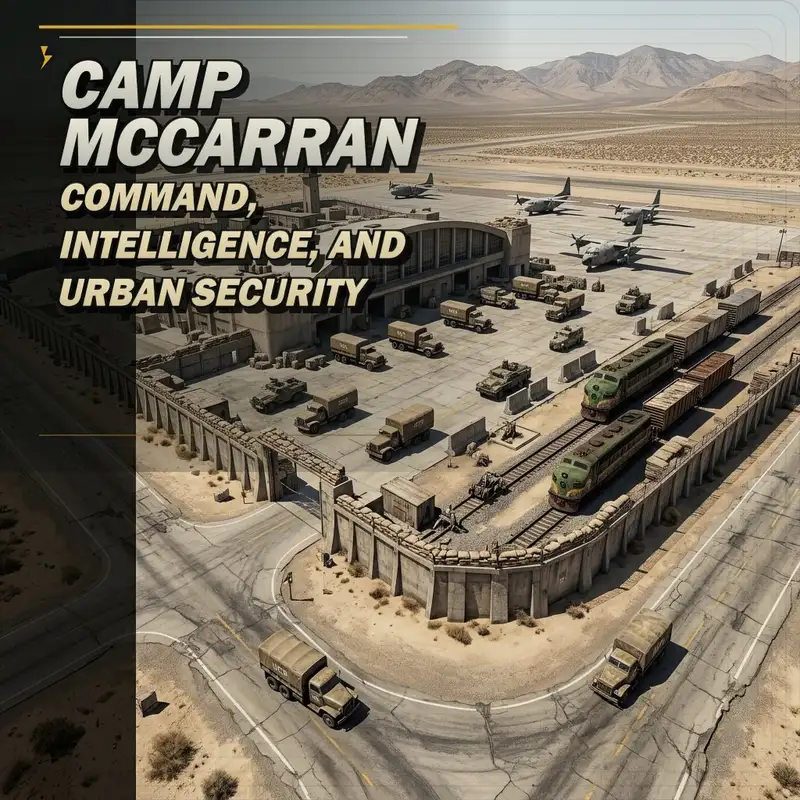
Camp McCarran: Command, Intelligence, and Urban Security
The bomb was meant for a train.
Not the walls of Camp McCarran. Not its command offices, its guarded gates, or the soldiers posted around the old airport grounds. The target was the monorail that ran between the camp and the Strip, a short protected connection whose military value exceeded its modest appearance. In the Mojave of twenty-two eighty-one, movement was security. A reliable route could move officers, supplies, messages, guards, and political authority without forcing each trip through hostile streets and open ground. Destroy that route, and the NCR would still possess an airport. But it would possess an airport less able to influence the city beside it.
The planned attack was part of a Legion infiltration operation, and its outcome depends on player action. The monorail can be saved, or it can be destroyed. What matters historically is the choice of target. Caesar’s Legion did not need to storm McCarran’s perimeter to damage the NCR’s position. It needed to cut a connection that made the camp useful. The airport’s real perimeter was therefore wider than its fences. It included the rails, the Strip, the roads beyond the city, the supply system behind the front, and the trust inside the NCR command structure.
That is the central problem of Camp McCarran. It was one of the New California Republic’s most important positions in the Mojave because it gathered so many functions in one place. It was a headquarters, a transport node, an intelligence center, a detention site, a medical facility, a supply hub, and a base for operations in a difficult urban environment. Yet every one of those functions created another dependency. More personnel meant more access. More supplies meant more paperwork and more opportunities for theft or diversion. More intelligence meant more secrets to protect. More contact with civilians meant more political friction. More infrastructure meant more targets. McCarran was not simply a fort. It was an attempt to make the NCR’s Mojave campaign governable.
Before the Great War, McCarran International Airport served the Las Vegas area. Its surviving structures gave the NCR several advantages that would have been hard to build from nothing in the post-War Mojave. The airport had enclosed grounds, substantial pre-War construction, space for military administration, and a location close to New Vegas. More importantly, the surviving monorail linked it to Las Vegas Boulevard and the Strip. The NCR did not inherit a complete modern air base. It inherited ruins that could be adapted into a military installation. In the wasteland, that distinction matters.
A working or repairable piece of old infrastructure was not valuable merely because it looked impressive. It reduced the cost of creating a new system. Walls saved labor. Terminals and offices gave administrators somewhere to work. Existing utility connections offered possibilities, even if they required constant repair. The monorail gave the NCR a relatively controlled corridor through an unstable urban space. The airport’s importance came from its place within a network, not from the terminal building alone.
The NCR used the site under the political arrangement commonly called the New Vegas Treaty, its agreement with Mr. House. That agreement gave the Republic a basis for maintaining a military presence near the Strip while recognizing that New Vegas was not simply an NCR city. This was not an uncomplicated occupation of an empty ruin. The Strip had its own ruler, its own security apparatus, its own economic role, and its own interests. McCarran was close enough to support NCR influence, but its presence depended on a negotiated political order that the Republic did not fully control.
The exact date when the airport became Camp McCarran is not firmly established by the surviving record. By twenty-two eighty-one, however, its role is clear. It had become the NCR’s principal base in the New Vegas area. It handled logistics, troop allocation, supply distribution, intelligence concerns, prisoners, medical needs, and the everyday administrative work that turns armed men and women into a functioning military force. Hoover Dam was the campaign’s decisive strategic prize. Camp McCarran was part of the machinery required to contest it.
That distinction is important. A dam can be the object of strategy because it offers power, water, and leverage over a region. But an army does not hold a strategic objective by admiring it from a command post. It needs food, ammunition, replacement personnel, intelligence, communications, transport, medical treatment, and some means of moving orders into action. McCarran helped provide those things. It was behind the immediate front line at Hoover Dam, but it was also inside a different kind of front line, one formed by New Vegas, the surrounding ruins, the Fiends, local settlements, and the competing authorities of the Mojave.
The camp’s mission extended into the city around it. It had to maintain a connection to the Strip. It had to protect movement through territory where raiders could attack patrols and travelers. It had to process prisoners and investigate threats. It had to coordinate with a larger military effort while managing problems that did not wait for a decisive battle. A conventional army prefers clear lines, identifiable enemy formations, secure rear areas, and predictable supply routes. The Mojave offered none of these in reliable form.
The Fiends were one of the clearest examples of that problem. They were a local raider organization, heavily associated with drug use, violence, and territory in the southern ruins near New Vegas. They were not established as a conventional army with a documented order of battle and a stable chain of command. But they did not need to be an army to impose military costs. A hostile group operating close to a major base can force regular troops into patrols, escorts, guard duty, raids, searches, and casualty evacuation. It can make every road less reliable and every isolated outpost more expensive to sustain.
For the NCR, the Fiends represented persistent local attrition. Caesar’s Legion threatened the Republic’s wider strategic position through organized military pressure, espionage, and sabotage. The Fiends created a more immediate urban security burden. They could not be dismissed as a nuisance simply because the dam mattered more. A force preparing for a major battle still has to protect its routes, maintain local confidence, and prevent nearby violence from draining its strength a few soldiers at a time.
Major Dhatri’s counter-raider work shows how the NCR tried to address that pressure. He assigns bounties on prominent Fiend leaders after soldiers under his command are killed. The targets include Violet, Cook-Cook, and Driver Nephi. The player may choose whether to pursue those bounties, and the historical record does not establish one universal outcome. But Dhatri’s decision reflects a recognizable security logic. When a dispersed hostile organization cannot be met in a conventional field battle, commanders may seek to disrupt its leadership, reduce its ability to coordinate violence, and create enough pressure that routes become safer.
First Recon was useful in that kind of work. Its personnel were associated with reconnaissance, observation, and precision fire. They were specialized assets, not proof that the NCR possessed a fully documented modern reconnaissance battalion at McCarran. The game does not establish the unit’s full manpower, equipment scale, or exact deployment pattern. Still, its presence tells us something important about the camp. McCarran did not rely only on ordinary guards at gates. It supported soldiers whose value lay in seeing farther, identifying threats, and striking selectively.
A successful operation against raider leadership could produce a tactical effect by removing particular individuals. It could produce an operational effect if safer routes reduced the demand for escorts and patrols. But it would not, by itself, settle the Mojave campaign. This is where military analysis needs restraint. Killing or capturing a local leader can change a security problem. It does not automatically create order, restore civilian trust, or free an army from every obligation in the surrounding city. The NCR was trying to manage a broad environment with limited attention and finite manpower.
Major Dhatri also carried a personal and institutional memory of what happened when intelligence failed. Before his work at McCarran, he had been present at Bitter Springs in the year twenty-two seventy-eight. The operation against the Great Khans became a massacre of civilians after NCR forces acted on faulty assumptions about the people in the area. Dhatri later described the senior officer freezing under the strain of the situation, leaving him to take command. His account does not make him the sole interpreter of Bitter Springs, nor does it erase the wider responsibility of the NCR forces involved. But it establishes that he understood the event as a failure of information, command, and judgment.
That lesson mattered at McCarran. Bad intelligence is not merely a technical inconvenience. It can cause troops to fire on the wrong people, turn a security operation into a civilian disaster, and leave a force carrying political consequences long after the shooting stops. Bitter Springs damaged the NCR’s relationship with the Great Khans and gave its enemies a powerful example of Republican military force used without adequate understanding of the human terrain.
The institutional danger after such an event runs in more than one direction. A command that has been misled or surprised may become more cautious and seek better information. That is the best outcome. But it may also become suspicious of local populations, more willing to use coercion, and more inclined to interpret uncertainty as hostility. In a crowded and fractured region like the Mojave, that response can generate the resentment it claims to suppress. A military force can protect a road while making the people beside that road less willing to cooperate with it.
McCarran’s officers had reason to worry about intelligence. The camp was not dealing only with unreliable reports from outside its walls. It was dealing with the possibility that sensitive information was leaving through its own administrative system. The most serious case involved Captain Ronald Curtis, commander of Bravo Company. Curtis appeared to be an NCR officer with routine command duties and access to the kind of information a headquarters must circulate if it is to function. In reality, he was Picus, a Legion frumentarius operating deep inside the NCR structure.
This was not the dramatic image of espionage favored by old pre-War adventure serials, with a stranger in a false mustache stealing documents from a locked office. The danger was more ordinary, and therefore more serious. Curtis had a legitimate position. He could learn patrol schedules, reinforcement plans, supply arrangements, and internal concerns because his work required him to know them. He was close enough to Colonel James Hsu’s command structure that ordinary professional trust became an intelligence vulnerability.
An army cannot function if every officer treats every other officer as a probable enemy agent. Orders must move. Schedules must be shared. Logistics personnel need to know where supplies are needed. Unit commanders need to know where troops are going. Medical staff need casualty information. Security personnel need access to prisoners and investigations. The very integration that made McCarran valuable also made information difficult to compartmentalize completely.
The Legion understood this. Its military system relied not only on frontal pressure but also on scouts, informants, infiltration, deception, and psychological warfare. A frumentarius inside an enemy headquarters could produce effects out of proportion to one person’s rank. He did not need to command the entire NCR Army. He needed to identify which route mattered, which report would be trusted, which subordinate could be blamed, and which disruption would force the enemy to consume its own attention.
Silus, the captured Legion centurion held at McCarran, provides supporting evidence for this danger. He recognizes Curtis as a former frumentarius and indicates that the Legion had received useful intelligence from within the NCR. Silus is not a neutral archival source. He is an enemy officer and a prisoner, with his own motives, loyalties, and perspective. His testimony should not be stretched into proof that every NCR office was compromised. But in combination with the Curtis operation, it confirms that Legion intelligence work had penetrated beyond the battlefield.
Curtis proves a serious breach, not a total collapse. That distinction matters. It is tempting to look at one infiltrator and declare an entire command corrupt or incompetent. The evidence supports a narrower and more useful conclusion. McCarran’s system contained enough trust, access, and fragmented responsibility for a well-placed enemy operative to exploit it. The problem was not that the NCR had trusted anyone at all. The problem was that trust had not been matched by sufficient verification, counterintelligence discipline, or a structure able to detect compromise before operational damage accumulated.
The monorail plot shows how intelligence becomes sabotage. A bomb on the line would not simply destroy a piece of infrastructure. It would threaten the connection between McCarran and the Strip, forcing the NCR to rely more heavily on ground movement through less secure territory. Personnel and supplies would move more slowly. Escorts might be needed more often. The camp’s political and military access to New Vegas would become less reliable. Even if an alternate route could be improvised, improvisation has a cost. It consumes time, manpower, fuel or power, security planning, and command attention.
The attack also had a psychological dimension. The monorail was visible proof that the NCR could connect a military installation to the Strip through functioning infrastructure. It suggested reach, organization, and permanence. Its destruction would demonstrate the opposite. It would tell soldiers, civilians, and rival powers that the Republic could occupy an airport yet still fail to protect a critical route within its own area of influence.
Curtis’s plan also involved an attempt to frame Private Crenshaw. That detail is as important as the explosive itself. Sabotage works best when the victim misidentifies the cause of failure. If the NCR blamed an ordinary soldier, it could punish an innocent man while leaving the actual operative in place. The result would be more than one damaged train. It would be a security apparatus turned inward, investigating the wrong person, disciplining the wrong subordinate, and perhaps convincing itself that the threat had been resolved.
This is administrative warfare. An enemy infiltrator can make a bureaucracy spend its energy on false leads, internal suspicion, and corrective measures that do not address the real problem. The more complex the institution, the more damaging this can be. McCarran had officers, enlisted personnel, guards, prisoners, scientists, medical staff, supply workers, and civilian administrators moving through the same broad system. Such concentration improved coordination when it worked. It also gave deception many places to hide.
The player can expose Curtis and defuse the bomb. The player can also allow different outcomes. No single resolution should be treated as settled history. But the plot reveals the NCR’s vulnerability whether the line survives or not. The Legion had identified a target that mattered. It had embedded an operative capable of reaching it. And it had built a deception plan around the NCR’s own disciplinary procedures. That is not a failure of wall strength. It is a failure mode of a modernizing military institution operating in a politically unstable theater.
Colonel James Hsu had to manage this environment while General Lee Oliver concentrated on Hoover Dam. Oliver was the senior NCR Army commander in the Mojave, and the dam was the campaign’s principal strategic objective. It was understandable that he would place personal attention there. The dam represented a possible decision point in the conflict with Caesar’s Legion. But command attention is a resource, and concentrating it at the decisive objective created practical burdens elsewhere.
Hsu explains that Oliver normally directed Camp McCarran but had moved to the dam, leaving Hsu to assume many responsibilities at the base. That arrangement should not be mistaken for simple dysfunction. Delegation is necessary in any dispersed campaign. No commander can personally supervise every base, patrol, warehouse, interrogation, medical ward, and intelligence inquiry. The question is whether the delegated system has competent personnel, secure communications, clear authority, reliable reporting, and enough resources to execute its tasks.
At McCarran, formal command and practical responsibility did not always align neatly. Oliver’s focus was on the dam. Hsu had to keep the larger operational network functioning. Other NCR authorities had their own roles, including military officers outside the camp’s immediate command, civilian agencies, local officials, and political leaders far from the Mojave. Colonel Cassandra Moore, for example, should not be folded casually into Hsu’s direct command. The NCR was a republic with institutions, rival priorities, and bureaucratic layers. It was not one person issuing one perfectly unified set of orders.
Hsu’s calm manner can be read as a command style shaped by that complexity. He needed accurate reports, dependable officers, guarded transport, responsive subordinates, and some ability to distinguish a genuine threat from rumor or factional maneuvering. He could not personally inspect every supply crate or interrogate every prisoner. He had to rely on systems. The Curtis affair demonstrates the danger of that reliance. The Fiend threat demonstrates its manpower cost. Civilian disputes over food and water demonstrate that even apparently nonmilitary policies could return to the camp as security problems.
The camp’s overlapping functions made it a kind of administrative machine. Lieutenant Carrie Boyd handled detention and interrogation work. Prisoners such as Silus could provide intelligence, but they also required guards, procedures, and judgment. A prisoner may lie, boast, bargain, or reveal information selectively. The intelligence value of detention depends on the people interpreting what they hear, not simply on holding someone behind a locked door.
Medical services under Doctor Kemp addressed another basic fact of military life. Troops get injured, sick, exhausted, and exposed to the hazards of the Mojave. A medical section does not merely heal individuals. It influences whether a unit can return people to duty, how long casualties remain a burden on transport and supplies, and whether soldiers believe their institution can care for them. The setting does not justify assumptions of unlimited miracle medicine. Stimpaks, doctors, and advanced devices do not remove the need for staff, supplies, sanitation, triage, and evacuation.
Sergeant Daniel Contreras’s supply sphere illustrates the less glamorous side of military power. Armies run on controlled goods. Food, weapons, ammunition, uniforms, medical items, spare parts, and personal necessities must be acquired, moved, stored, accounted for, and guarded. Every warehouse and distribution point is therefore both an asset and a vulnerability. It can support troops. It can also attract theft, black-market dealings, favoritism, and corruption. The more a command relies on scarce goods, the more power accumulates around whoever can move them.
The Office of Science and Industry added another layer. Its presence inside a military installation shows that McCarran was not concerned only with defeating Legion forces or containing raiders. The NCR was trying to apply technical expertise to the broader problem of sustaining a growing republic. Science, in this context, was not an abstract pursuit. It was tied to food, water, agriculture, salvage, health, and the possibility of reducing dependence on fragile supply lines.
This made Camp McCarran a place where the state tried to make the Mojave legible. Prisoners could be classified and questioned. Supplies could be counted and distributed. Medical cases could be treated. Threats could be investigated. Research could be assigned to specialists. Orders could become schedules, schedules could become movement, and movement could become presence. That is what organized government looks like in the wasteland when it is functioning.
But legibility has limits. People do not always fit the categories created for them. A civilian district can be labeled a security concern when it is also a community trying to survive. A missing water allotment can be treated as theft when it is also an act of mutual aid. Hazardous research can be treated as an agricultural resource when it is also a biological danger. A prisoner can be an intelligence source, an enemy soldier, and a political symbol at the same time. Bureaucracy gives a state tools. It can also make officials mistake their paperwork for the full reality.
Doctor Thomas Hildern’s interest in Vault Twenty-Two captures that problem. Hildern worked through the Office of Science and Industry and sought research from the Vault that might help address agricultural pressures. The NCR had reason to care about food. A large military deployment and a growing state both require dependable agriculture. Farms need water, labor, seed, security, transport, and protection from contamination. A republic expanding into harsh territory cannot feed itself on patriotic speeches and scavenged snack food.
Vault Twenty-Two appeared to offer valuable biological research. From the perspective of an official facing agricultural shortages, the attraction was understandable. Pre-War scientific knowledge could seem like a strategic resource waiting to be recovered. But the Vault’s history also demonstrated the hazards of treating every old-world laboratory as a warehouse of useful assets. Knowledge can be valuable without being safe. A biological discovery can require containment, validation, trained personnel, ethical restraint, and long-term oversight before it becomes a public benefit.
Hildern’s approach suggests the pressure of a bureaucracy eager for solutions and willing to send others into danger to retrieve them. The player’s involvement in the Vault Twenty-Two matter can lead to different choices, and the recovered research cannot be assumed to have become a successful NCR agricultural program. What is fixed is the institutional ambition. McCarran was serving as a platform for resource policy as well as military operations. The base was part of an effort to convert old-world science into present-day state capacity.
That ambition was not necessarily foolish. The Mojave’s limits were real. But there is a difference between possessing a research file and possessing the capacity to use it responsibly. A government that can dispatch an expedition may still lack the oversight to manage what comes back. A military base can protect a laboratory office without creating the agricultural system needed to solve hunger. Technology can extend institutional reach, but it cannot substitute for sound judgment, safety standards, or accountability.
The same tension appears in the conflict over water, the NCR sharecropper system, and Westside. Water in the Mojave was never just a utility. It was life, agriculture, public health, trade, and political power. The NCR sought to organize agricultural production through the sharecropper farms, which linked civilian labor to the Republic’s broader needs. From the viewpoint of officials responsible for feeding troops and supporting a regional campaign, allocations and quotas could appear necessary. A military presence cannot be sustained if food production collapses.
But the people living outside the base experienced the system differently. Westside faced its own needs, and water was diverted to help that community survive. Radiation and reduced supply added pressure to an already difficult arrangement. The investigation associated with Corporal White can produce several outcomes depending on player decisions. It should not be used to declare one final resolution for the dispute. Yet the underlying conflict is clear enough. The NCR’s administrative needs and Westside’s survival needs were not naturally aligned.
From McCarran, a missing allocation could look like sabotage, theft, or a threat to military agriculture. From Westside, redirected water could look like an essential response to scarcity and neglect. Both perspectives emerged from material conditions. That does not make every action equally lawful or every official decision equally humane. It means that security policy cannot be evaluated only from inside the command office.
A state gains legitimacy when people believe its rules provide some predictable protection, fair access, and a path for grievances to be heard. It loses legitimacy when its demands appear to extract labor and resources while leaving communities to absorb the risk. The NCR could offer roads, trade, military protection, and a recognizable legal framework. It could also demand taxes, claim water, impose agricultural priorities, and make decisions far from the people most affected by them. Camp McCarran was where many of those demands acquired practical force.
This is why urban security cannot be reduced to patrols and checkpoints. A force may suppress attacks on a road while worsening the conditions that make cooperation difficult. It may protect its own supply chain while convincing nearby residents that they are merely inputs to an external campaign. It may sincerely believe it is bringing order while failing to understand how that order is distributed. The Republic’s challenge was not only to defeat enemies. It was to persuade communities that its presence created a future worth supporting.
McCarran’s strength lay in concentration. Command officers could coordinate from one location. Intelligence could be gathered and assessed nearby. Prisoners could be held. casualties could be treated. Supplies could be moved through an organized system. Scientific personnel could pursue solutions to agricultural and logistical problems. The monorail connected the camp to the Strip. The airport’s physical defenses gave the NCR a protected foothold in a contested city.
Its fragility came from the same concentration. A single transport link could become a strategic target. A trusted officer could become an enemy channel. A shortage of water could become a political crisis. A local raider group could tie down troops needed elsewhere. A scientific office could become a source of reckless expeditions and institutional embarrassment. A detention site could produce intelligence, but only if its staff understood the limits of enemy testimony. The base could not isolate itself from the region because its whole purpose was to act upon the region.
Later events make that fact more haunting. In the Mojave depicted by the second season of the Fallout television series, released long after the events of New Vegas, Camp McCarran appears abandoned and filled with the remains of NCR and Legion personnel. The image confirms that the installation was eventually destroyed, abandoned, or rendered unusable. It does not establish the exact date, the battle that caused it, the weapon involved, the command decision behind it, or the ultimate victor. The ruins are evidence of an outcome, not a complete campaign report.
Still, they sharpen the meaning of McCarran in twenty-two eighty-one. A military installation can survive artillery, raider attacks, and even sabotage if the wider system around it remains functional. It cannot remain powerful merely because its walls stand. It needs trustworthy personnel, protected infrastructure, civilian cooperation, accountable administration, medical and logistical capacity, and a political authority capable of supporting all of them without exhausting the people it claims to protect.
Camp McCarran was the NCR’s effort to turn a ruined airport into an instrument of order. Its failure was not that it tried to build institutions in the wasteland. Its vulnerability was that institutions are harder to defend than buildings, because they depend on the people, routes, information, and obligations that give those buildings a purpose.