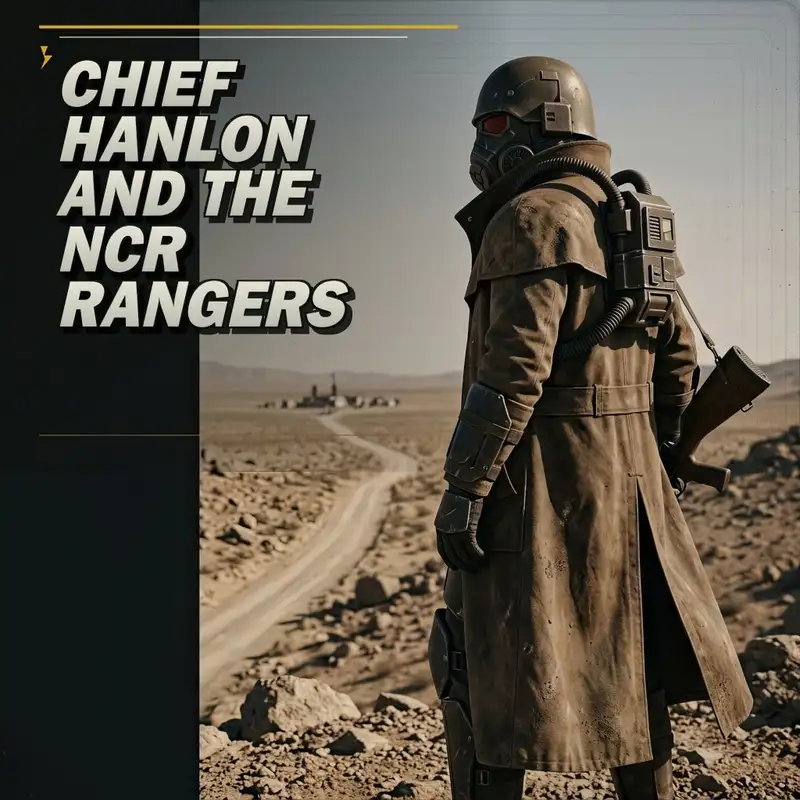
Chief Hanlon and the NCR Rangers
At Camp Golf in the year twenty-two eighty-one, the New California Republic’s war in the Mojave appeared to be coming apart at the edges. Reports moved in from isolated Ranger stations, then onward to the battered troops at Camp Forlorn Hope. One station had supposedly suffered crippling casualties. Another had allegedly encountered Legion forces supported by super mutants. A third warned that the Great Khans had somehow trained Deathclaws for war. Taken together, the messages suggested not a difficult campaign, but a theater slipping beyond control.
Technical Sergeant Reyes found the flaw. The reports arriving at Camp Forlorn Hope did not match the messages sent by the Ranger stations themselves. The Rangers at those stations denied making the most alarming claims. The distortion had not come from a Legion infiltrator, a broken radio relay, or a frightened patrol leader trying to justify a retreat. It had come from inside the Republic’s own reporting system. The altered messages were traced to Camp Golf, and to Chief Hanlon.
That made the affair more than a case of bad intelligence. Hanlon was one of the Rangers’ most respected veterans. He had served for decades. He embodied the image the Republic wanted from its Rangers: disciplined, self-reliant, hard to intimidate, and willing to go where larger forces could not. Yet he had used his authority to make the Mojave war look worse than it was. Not to help Caesar’s Legion win a battle, at least by his own account, but to force the NCR’s leaders to recognize a war he believed they no longer understood.
The question is not whether Hanlon was simply loyal or disloyal. That language is too easy, and it hides the institutional problem. Hanlon had spent his life in an organization built around judgment in the field. By twenty-two eighty-one, he served a republic that needed Rangers for reconnaissance, patrols, intelligence, and difficult missions across a wide frontier. But the same republic had also turned them into instruments of a prolonged campaign for Hoover Dam, New Vegas, and the Colorado River. Hanlon became the Rangers’ greatest representative because he retained their older virtues. He became their crisis because he no longer believed the state they served could hear those virtues without being forced.
Before they became one of the NCR’s most famous military institutions, the Rangers belonged to a more local kind of frontier politics. Their older identity was not built around parade grounds, mass mobilization, or the permanent occupation of distant territory. It was built around movement, observation, endurance, and small groups making decisions far from any secure headquarters. In the fractured western wasteland, that kind of force had a clear purpose. Raiders, slavers, and local strongmen could dominate communities that lacked weapons, water, roads, or outside protection. A patrol that arrived at the right place could matter more than a distant government’s claim on a map.
The old Rangers were not automatically noble, and small volunteer forces are not free from error. Frontier institutions can become insular. Veteran authority can become difficult to challenge. A force that values independence can mistake its own judgment for the public interest. Still, the Ranger ideal carried a real moral and military logic. The Ranger was expected to know the ground, understand local conditions, move with limited support, and avoid wasting lives when a better solution existed. Their authority rested not only on rank, but on demonstrated competence under hard conditions.
Hanlon’s own memories present that world in unusually direct terms. He describes joining the Rangers more than forty years before the Mojave crisis, in an era when the organization was smaller and its missions were more immediate. The Rangers, in his telling, were volunteers who confronted the people making ordinary survival impossible. That distinction matters. A conventional army can seize a road, hold a base, and defend a major installation. A Ranger patrol could identify the specific source of danger to a settlement and act before the threat hardened into a larger war.
The story Hanlon tells about Rattletail in Baja is probably the clearest statement of his professional creed. It is also only his recollection. The game gives no independent military archive confirming every detail, and Hanlon is speaking late in a career shaped by exhaustion and regret. But the story matters because it explains how he understood service, success, and civilian protection.
According to Hanlon, a settlement called Rattletail had been attacked. He took six Rangers south to investigate. The journey lasted about a week. The patrol lost one Ranger to Night Stalkers, and another nearly died from dehydration. That is an important detail, not merely a hard-luck story from an old soldier. Ranger operations depended on physical endurance, water discipline, navigation, and the ability to keep functioning when relief was distant. Even a small mission could become a logistical problem long before anyone fired a shot.
When Hanlon’s party reached the area, they found a small settlement built around a well. More than two dozen civilians lay dead in the dunes around it. Five armed men controlled the water source. The tactical problem was straightforward enough. Hanlon had a patrol, the enemy had a small fixed position, and the well was the decisive terrain. But he did not describe charging in, proving his courage, or turning the encounter into a celebrated fight. He told the men at the well that a large raider force was approaching and that they needed to flee immediately.
The deception worked. The armed men abandoned the well. Hanlon’s Rangers secured the water source and helped escort the surviving settlers back toward NCR territory. In strictly tactical terms, the mission was successful because the Rangers removed the immediate threat without an unnecessary firefight. In civilian terms, it mattered because the well was not just an objective. It was life, movement, agriculture, shelter, and the ability of a small community to remain a community. Whoever controlled the water could decide who stayed alive long enough to leave.
This was Hanlon’s ideal Ranger mission. It was limited in scale, close to the people affected, and shaped by conditions a patrol leader could directly observe. The Rangers were not trying to govern Baja. They were not holding a long defensive line or maintaining a major supply network. They were using field judgment to break a small system of coercion. Hanlon’s deception was still deception, but it was directed outward against armed men controlling civilians through access to water. In the Mojave, he would use the same willingness to manipulate information against his own government.
The change began long before the false reports at Camp Golf. In the year twenty-two seventy-one, the Desert Rangers and the New California Republic entered the Ranger Unification Treaty. The monument at Mojave Outpost records the broad bargain. The Desert Rangers agreed to join the NCR’s security system. In return, the Republic pledged protection for Hoover Dam, New Vegas, and southern Nevada against Caesar’s Legion.
It was a strategic agreement born from a real danger. Caesar’s Legion was not a rumor, and it was not merely a rival flag beyond the Colorado. The Legion had expanded through conquest, absorption, slavery, coercion, and the destruction of communities that stood in its way. Its pressure on the Mojave gave the Desert Rangers strong reasons to seek support from a larger power. A small frontier force could observe the threat and delay it in places. It could not by itself guarantee the security of a major dam, a growing city, and a wide region facing an expansionist military state.
For the NCR, the treaty offered more than additional scouts. It brought experienced personnel, local knowledge, and a powerful symbol. The Rangers had a reputation for competence that a republic expanding into new territory could use. For the Desert Rangers, incorporation meant access to broader resources, a larger military partner, and the political weight of a state that could make promises beyond the reach of a small volunteer organization.
But protection is never free, especially when it is provided by a government with its own ambitions. The treaty did not necessarily erase Ranger autonomy overnight, and the precise command relationship between the Rangers and the NCR Army is not fully documented. What changed was the political setting of Ranger service. Rangers were no longer only defenders of scattered communities and local routes. They were increasingly part of a republic’s strategy for a contested region. Their skill at working independently now served a larger campaign whose objectives were decided far from the patrol routes where Rangers built their reputation.
That distinction became sharper because of Hoover Dam. The dam mattered for its power, water, infrastructure, and symbolic value. It was one of the rare surviving pieces of old-world capacity that could influence the future of an entire region. Control of it offered leverage over settlements, commerce, and political development in southern Nevada. It was not simply a large wall in a dramatic landscape. It was a functioning strategic asset in a continent where functioning strategic assets were scarce.
Yet the value of Hoover Dam also created a trap. Taking responsibility for the dam meant taking responsibility for the routes, bases, supply systems, and political relationships needed to protect it. A government can capture or defend a major installation without acquiring the ability to govern every settlement affected by it. It can hold a dam while struggling to secure the roads leading to it. It can claim a river corridor while lacking the patrol strength, local legitimacy, and transport capacity to make that claim real beyond a few fortified points.
The Mojave was far from the NCR’s core territories. That distance imposed costs which no amount of patriotic language could remove. Troops required food, water, ammunition, medicine, replacement equipment, and a way to return the wounded to care. Radio communications had to work across a scattered theater. Convoys needed protection. Roads and routes had to remain open despite raiders, Legion agents, damaged infrastructure, and the simple attrition of moving people and supplies through dangerous country. The exact scale of those burdens is not established, but their existence is impossible to miss.
This was the larger problem Hanlon saw. He did not argue that the Legion posed no threat. He argued that the NCR’s answer to the threat risked becoming a permanent and costly commitment. Holding Hoover Dam could become a requirement to defend New Vegas. Defending New Vegas could become a requirement to patrol the Colorado. Patrolling the Colorado could require more bases, more soldiers, more supplies, and more political promises. A campaign built to prevent one danger could produce a wider frontier that demanded constant protection.
Rangers were exceptionally useful in that environment. They could scout routes, observe enemy movement, gather intelligence, conduct long-range patrols, work in small teams, and make decisions where centralized command could not see clearly. Their training and culture emphasized skills the NCR Army needed badly in a dispersed theater. The game also indicates that Rangers often drew from the Army, with exceptional troopers nominated for Ranger training. That made them connected to the Army without making them identical to it.
The Army had different responsibilities. It had to hold major positions, defend installations, man camps, move supplies, absorb casualties, and create some measure of persistent territorial control. Camp McCarran, Camp Forlorn Hope, Hoover Dam, and other NCR positions could not be secured by a handful of long-range patrols, however capable those patrols might be. The Army bore much of the routine, exhausting burden of the Mojave campaign. It is easy to celebrate Rangers because their missions are visible and dramatic. It is harder to celebrate the soldiers who spend months guarding a perimeter, escorting supplies, repairing equipment, or waiting in a forward camp for another attack.
That difference created both cooperation and resentment. Elite forces often become symbols. They attract public attention because they appear to represent the best qualities of a military institution. But symbols can distort memory. A Ranger’s contribution to a battle may become the story people remember, while the larger force that sustained the operation becomes background scenery. In a republic already dealing with political pressure, military losses, and a difficult war far from home, that imbalance could become poisonous.
The First Battle of Hoover Dam in twenty-two seventy-seven gave those tensions a powerful historical memory. NCR forces defeated Caesar’s Legion in a major struggle for the dam. General Lee Oliver commanded the broader NCR defense. Rangers and First Recon played an important role in the deception at Boulder City, which helped shape the battle’s outcome. The available record supports a combined victory, not a victory won by one man, one unit, or one branch of service.
That matters because victory itself became contested. The Rangers emerged from the battle with tremendous prestige. They had contributed to a dramatic operation, and dramatic operations are easier to turn into public legend than the long work of holding a defensive line. Hanlon believed the Rangers received too much of the credit while regular Army troops received too little. He also believed General Oliver resented that imbalance and later ignored or discounted Ranger recommendations as a result.
That claim should be handled carefully. It is Hanlon’s account of Oliver’s motives. The record gives much more of Hanlon’s bitterness than it gives Oliver’s private explanation. Oliver is clearly determined to hold Hoover Dam and reject territorial retreat. He represents a command culture centered on visible control, strategic resolve, and the political importance of not yielding ground. But it is not possible to prove every accusation Hanlon makes about why Oliver acted as he did.
Still, the underlying institutional conflict is real. An Army commander responsible for a major campaign cannot simply accept every warning from a reconnaissance organization as a reason to alter strategic policy. Rangers see problems from the frontier outward. A senior commander must weigh those problems against defense of key infrastructure, national commitments, political instructions, and the danger that retreat could invite a stronger enemy advance. At the same time, a commander who dismisses field intelligence because it is inconvenient, embarrassing, or associated with a rival institution creates a system that becomes blind exactly where it needs clear sight.
After the First Battle of Hoover Dam, the NCR had won a major fight. It had not solved the Mojave. The Legion remained across the Colorado and continued to threaten the region. The NCR’s positions had to be supplied and defended. New Vegas remained politically distinct under Mister House’s arrangements with the Republic. The dam’s value continued to pull the NCR deeper into the region. The military problem shifted from stopping a direct Legion assault to maintaining an exposed and costly frontier presence.
By twenty-two eighty-one, the Ranger network showed both the NCR’s strength and its vulnerability. Ranger stations were spread across the Mojave. Camp Golf served as Hanlon’s base and a central point for Ranger activity. Camp Forlorn Hope stood under particular pressure as a forward position near the Colorado. Camp McCarran served as a major NCR base and logistical hub. Hoover Dam remained the strategic center of gravity. These locations did not form a neat, frictionless defensive system. They formed a network dependent on roads, radio traffic, supplies, local knowledge, and the ability of scattered personnel to trust one another’s information.
A remote Ranger station could provide warning, surveillance, and a degree of local security. It could not remain effective through skill alone. It needed working communications. It needed food, water, ammunition, medical support, maintenance, and the possibility of reinforcement or evacuation. It needed commanders at larger bases to take its reports seriously. It needed the people operating there to distinguish actual danger from rumor, exaggeration, and enemy deception. A Ranger station was not merely an outpost with a flag. It was part of an intelligence and logistics system stretched across contested ground.
The Legion understood the value of pressure on that system. Even without accepting every alarming report later attributed to the Rangers, the NCR faced a capable enemy that could use scouts, spies, raids, intimidation, and the threat of concentrated attack. The Legion did not need to occupy every mile of the Mojave to impose costs on the Republic. It needed only to make routes dangerous, isolate outposts, exploit weak points, and keep the NCR uncertain about where the next crisis would emerge.
Hanlon’s critique was not that the NCR had no reason to be in the Mojave. It was that the Republic had failed to match its ambitions with a realistic understanding of what the campaign required. He feared that politicians far from the front had become accustomed to hearing that the dam was valuable, the Rangers were capable, and the Legion could be contained. Those statements could all be true while the broader policy still failed. A state can be militarily competent in individual engagements and strategically careless in the commitments it accumulates.
Hanlon placed particular blame on General Oliver. In his view, Oliver had become fixated on holding ground and proving resolve, especially around Hoover Dam. Hanlon believed Ranger advice was being ignored, and that Rangers were being sent into dangerous situations because their warnings carried political inconvenience. Whether Oliver consciously acted from resentment is uncertain. Whether the Army and Rangers experienced friction is much less doubtful. They had different roles, different institutional cultures, and different stakes in how the campaign was remembered.
Hanlon’s authority in this conflict was unusual. He was a chief, a veteran leader whose influence rested on experience, reputation, and his role in coordinating Ranger activity. Oliver had the authority of the broader campaign command. That created a familiar civil-military problem within the military itself. The officer responsible for the larger force had formal power. The specialist with the best local knowledge had credibility but limited ability to compel action. If their assessments diverged, the institution needed a way to test the disagreement honestly.
The NCR appears to have lacked a healthy process for doing that. The Republic had elected leaders, a Senate, military commands, commercial interests, and citizens whose lives were affected by the war in very different ways. President Aaron Kimball was not the same thing as the Senate. The Senate was not the same thing as Brahmin barons and other economic interests. Army troops at Forlorn Hope were not the same thing as civilians in the NCR heartland. Frontier settlers were not the same thing as officials who could discuss the campaign from a secure office. Yet Hanlon believed too many of the people shaping policy were insulated from the costs imposed on soldiers and communities at the edge of expansion.
That belief may have made him perceptive. It also made him dangerous. Veteran leaders often see consequences before institutions are ready to admit them. They notice the difference between a position that can be held for a week and one that can be sustained for years. They understand that every casualty report represents not only a military loss, but a family, a replacement problem, a medical burden, and a weakening of trust. But experience can also convince a commander that ordinary political processes are too slow, too corrupt, or too ignorant to deserve obedience.
Hanlon crossed that line in the events surrounding Return to Sender. The reports that reached Camp Forlorn Hope contained claims designed to portray the Ranger network as collapsing. Ranger Station Alpha was said to have suffered severe losses. Ranger Station Delta supposedly faced Legionaries supported by super mutants. Ranger Station Foxtrot was associated with the claim that Great Khans were using trained Deathclaws. The details were alarming enough to demand attention, and implausible enough to reveal the method once Reyes compared them with the original station messages.
The station personnel denied filing the altered reports. That is the central fact. Hanlon did not merely interpret ambiguous intelligence pessimistically. He inserted false or exaggerated information into the system. He used the trust placed in a senior Ranger leader to produce a picture of disaster. In intelligence terms, this was not enemy infiltration. It was corruption by a trusted intermediary. The reporting system failed because authentication was weak and because people assumed that the person altering the messages had no reason to deceive them.
Hanlon’s stated objective was political pressure. He wanted the NCR to see the Mojave as a campaign nearing collapse. He hoped that if leaders believed the theater was becoming untenable, they would withdraw rather than commit themselves to what he feared could be another five or ten years of casualties and patrols along hundreds of miles of the Colorado River. The point was not to win a better position in a dispute with Oliver. Hanlon believed the entire strategic project was becoming an open-ended burden the Republic could not afford.
There is hard logic behind that fear. Elite Rangers could identify threats, delay enemies, and improve the quality of a campaign. They could not create the manpower needed to occupy a wide frontier. They could not manufacture replacement troops, repair every road, secure every supply line, or give distant politicians a clearer sense of the human cost of war. A republic that treats specialist units as a substitute for strategic discipline will eventually exhaust both the specialists and the patience of the people asked to support them.
But false reporting was still a profound institutional breach. Rangers depended on trust. A patrol leader had to be believed when reporting an enemy movement, a damaged route, a civilian crisis, or a request for extraction. Army commanders had to know whether a Ranger assessment was a warning, an estimate, or a confirmed fact. Once Hanlon turned intelligence into a private instrument of political coercion, he damaged the credibility of the very organization whose expertise he believed the Republic had ignored.
The irony is sharp. At Rattletail, Hanlon used deception to protect civilians from armed men controlling a well. The deception was immediate, limited, and aimed at avoiding bloodshed. At Camp Golf, he used deception to frighten his own government into changing policy. He may have believed that this too would save lives. But the action operated through a military command system that could not function if its senior officers manufactured evidence. In one case, deception opened a path to protection. In the other, it made warning and manipulation difficult to separate.
That does not reduce Hanlon to a traitor, nor does it absolve him because his strategic concerns were serious. His diagnosis was credible in several respects. The Mojave campaign placed real pressure on the NCR’s logistics. Hoover Dam offered enormous value, but value is not the same thing as sustainable control. The Legion was a real threat, but the presence of a real threat does not prove that every military commitment is wise. The Republic’s political institutions and economic interests could be distant from the hardships imposed on troops, settlers, and frontier communities.
Hanlon also understood something that official maps tend to conceal. A line of control is not simply a line. It is a demand for patrols, supply, repair, communications, and human endurance. A fortified camp is not simply a marker. It is a population that needs food, water, medicine, discipline, and confidence that its sacrifice serves a purpose. A river frontier is not a strategic abstraction. It is territory inhabited by people who will experience the war through raids, checkpoints, disrupted trade, displacement, recruitment, and the fear that every distant decision will arrive at their door with a rifle.
Yet Hanlon’s method reveals the limits of veteran foresight. He had concluded that normal channels could not correct the policy. Perhaps he believed Oliver would ignore an honest warning. Perhaps he believed senators and wealthy interests would not care until the reports became catastrophic. But by deciding that only false evidence could force political attention, he substituted his own judgment for an accountable civil-military process. His experience did not make his concern meaningless. It made the failure of that process more troubling.
The player can produce several different outcomes from this confrontation. Hanlon’s manipulation can be allowed to continue. He can be exposed. He can be killed. Under a conditional path connected to Caesar’s death, he can be persuaded to stop. His suicide is not a fixed historical event, and neither is every possible consequence for the Rangers. Conditional ending material indicates that his loss can weaken the organization for years, a reminder of how dependent the Rangers were on veteran knowledge and institutional memory.
That dependence is itself part of the crisis. The Rangers’ greatest strength was never merely equipment, reputation, or a distinctive uniform. It was accumulated judgment. It was the ability to recognize when a small settlement was being strangled by control of a well, when a patrol had gone too far from support, when a report did not fit conditions on the ground, or when a tactical success was feeding an unsustainable strategy. Those skills take time to develop, and an expanding republic can spend them faster than it can replace them.
Chief Hanlon became the Rangers’ greatest representative because he preserved their original strengths: restraint, local knowledge, civilian protection, and the willingness to see human costs hidden by official maps. He became their institutional crisis because the NCR asked those same Rangers to validate a war whose scale and political purpose exceeded what elite volunteers could responsibly sustain. His falsified reports were not proof that his warnings were empty. They were proof that a republic unable to hear its most experienced scouts had created a system in which warning and sabotage began to look dangerously alike.