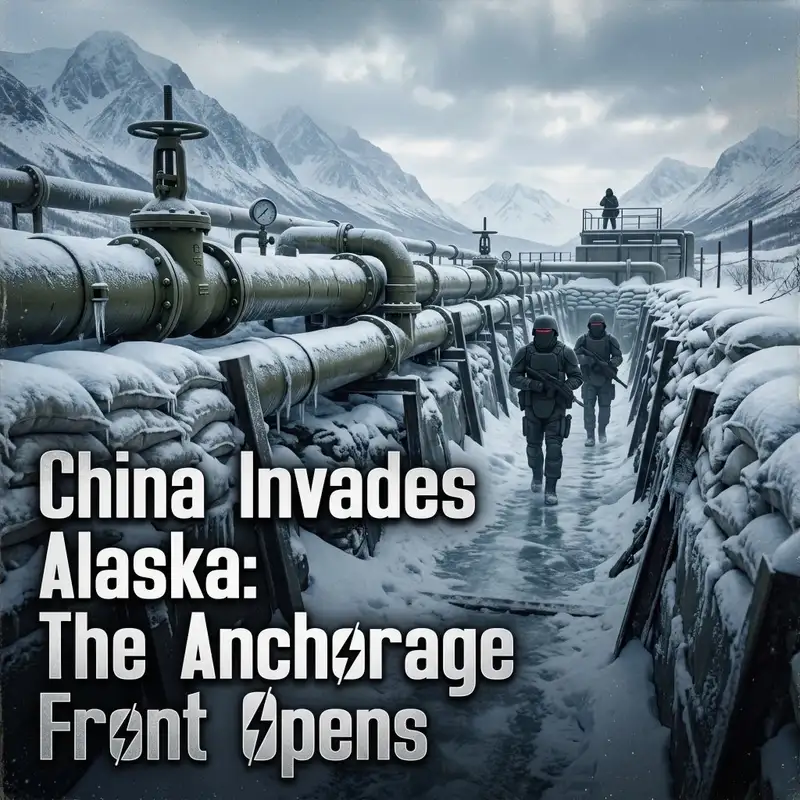
China Invades Alaska: The Anchorage Front Opens
The defenders of Anchorage first had to answer a more immediate question than victory: how long could they keep fighting and stay alive?
In the winter of twenty sixty-six, Chinese naval fire struck the Anchorage area as landing forces came ashore. American troops in prepared mountain defenses received reports that made the local situation plain enough. Enemy forces were advancing on more than one axis. One push threatened Anchorage itself. Another pressed toward an American forward position in the mountains. The defenders had entrenchments, weapons, and a mission. They did not have the luxury of a complete picture.
That mission included civilians. Contractors and technical personnel had to be evacuated while the fighting closed around the position. The people working near Alaska’s strategic infrastructure were not spectators to a distant national crisis. They were part of the military problem. Their knowledge, labor, equipment, and presence on the ground helped make the region valuable. Their evacuation became part of the defense.
The local American accounts describe bombardment, casualties, improvised treatment of the wounded, confusion over the scale of the landing, and a position gradually overwhelmed by pressure it could not absorb forever. The mountain defense was eventually overrun. That much matters because it establishes the character of the war’s opening. This was not a patrol clash at a remote border post. It was a serious attack against infrastructure, population, and national confidence.
The frozen ground around Anchorage was not valuable because anyone wished to own more frozen ground. It mattered because beneath and across that landscape ran one of the old world’s remaining energy arteries. Alaska’s petroleum reserves and pipeline infrastructure had become strategic assets in a world already strained by severe resource scarcity. Whoever controlled that network could hope to influence fuel supplies, industrial capacity, transport, and military endurance.
That does not mean oil was the only cause of the Sino-American War, or that the surviving evidence gives us a complete account of Chinese decision-making. It does not. The wider conflict emerged from an era of global resource pressure, military competition, economic fear, and governments increasingly willing to use force where negotiation had failed or become politically impossible. But Alaska stood out because it connected those abstract pressures to something concrete. Pipelines, wells, storage sites, transport links, maintenance crews, and industrial installations offered a possible answer to a problem neither superpower had solved.
Energy scarcity changes military planning long before a shot is fired. Armies need fuel for ships, aircraft, vehicles, generators, factories, and transport. Civilian economies need it for heating, food distribution, manufacturing, and basic movement. A government can speak in the language of national honor, frontier defense, or historical destiny. Its quartermasters still need to move supplies. Its factories still need power. Its population still notices when rationing becomes normal and confidence begins to thin.
Alaska therefore had value beyond the oil itself. It was a strategic system. To control the system, an occupying power needed access to extraction sites, routes, workers, repair capacity, security forces, communications, and some method of moving the product where it could be used. A pipeline is not a treasure chest. It is a vulnerable industrial organism spread across difficult terrain. It can be captured quickly. It cannot be made useful without sustained control.
For China, an invasion of Alaska offered at least two possible advantages. It could deny resources to the United States while attempting to secure them for Chinese use. It could also force the United States into a northern theater that was expensive to reinforce and politically impossible to ignore. The attack placed pressure on American territory, American infrastructure, and the idea that the continental homeland remained secure behind oceans and military technology.
That was the larger meaning of the Chinese landing. It was an expeditionary operation, not a border incident.
The available accounts support a broad outline. Chinese naval bombardment helped open the attack. Landing forces established themselves on Alaskan soil. One formation moved toward Anchorage. Another struck at an American mountain or forward base. These were coordinated movements directed toward a sustained foothold, not the behavior of a force planning only to raid a depot, destroy a section of pipe, and disappear back across the water.
A raid aims to damage, seize, punish, or signal. An invasion aims to remain. Remaining is much harder.
The Chinese force had to cross sea lanes, land men and equipment in winter conditions, establish communications, secure a perimeter, move inland, hold infrastructure, and prepare for American counterattack. It had to sustain weapons, food, medical care, spare parts, and command arrangements in a region where cold, distance, and damaged transport could turn routine work into a crisis. Its success in getting ashore demonstrated real operational capacity. It did not make the occupation easy.
The same distinction applies to the American defenders. A fortified mountain position could delay an advancing force. It could impose losses, complicate movement, and buy time. But fixed defenses require a functioning rear area. They depend on communications, resupply, relief forces, fire support, casualty evacuation, and an ability to withdraw before encirclement becomes destruction. Once an enemy has landed in strength and begins pressing on multiple directions, a local detachment can find itself defending not a position, but a schedule.
The schedule at Anchorage was evacuation. Hold for another hour. Keep a route open. Move the wounded. Get technical staff away from the advancing enemy. Prevent panic from becoming a second defeat. These are often the real tasks of frontier troops when strategic warning has failed and the main force is still far away.
The defenders knew enough to understand the danger. They knew Chinese forces were landing. They knew bombardment was disrupting their position. They knew the attack was larger than an isolated skirmish. They knew civilians needed to get out. What they did not know, at least from the surviving frontline record, was the complete size of the force facing them, the depth of its reserves, the timetable of its follow-on movements, or the larger intent behind each axis of advance.
That uncertainty is central to understanding the opening battle. Tactical confusion is not simply ignorance. It is a weapon in its own right.
A unit under fire sees fragments. A radio message arrives late, incomplete, or from someone who has already lost contact with the neighboring position. An observer sees ships offshore but cannot know what remains below deck. A commander hears that enemy troops have reached one ridge and must decide whether that means a probe, a breakthrough, or the beginning of encirclement. In winter terrain, visibility, movement, and communications all become less forgiving.
Some American reports from the invasion describe Chinese fire causing casualties among Chinese troops. Such reports are evidence of what frightened defenders believed they were witnessing. They are not enough to establish a general Chinese doctrine of indifference to casualties, much less a complete account of the landing force’s conduct. Troops in a collapsing defensive position do not write neutral history. They describe the enemy as they encounter him, through smoke, fear, anger, and the immediate need to understand what is happening.
This is one reason the opening of the Anchorage Front deserves attention as a military event rather than merely a famous pre-War battle. The invasion was shaped by firepower, but also by incomplete information. The American defenders faced an enemy whose strength and intentions they could not fully see. The Chinese invaders, in turn, were entering a landscape where every captured position created another security requirement, another supply demand, and another piece of infrastructure that had to be guarded against damage.
Anchorage sat within a geographic trap created by its own importance. Alaska’s resources gave the region strategic value. Its climate and distance made those same resources difficult to exploit under wartime conditions.
Cold affects machinery, people, and time. Vehicles need maintenance. Weapons need care. Wounded personnel need rapid evacuation that may not be available. Fuel must reach engines that are already consuming it to survive the environment. Roads and routes become military objectives because there may be few practical alternatives. A damaged bridge, blocked pass, or disrupted coastal route can isolate a force more effectively than an enemy assault.
The terrain also magnified the importance of infrastructure. A pipeline network cannot be defended by placing a flag at one end of it. It passes through wide spaces, difficult approaches, and locations vulnerable to disruption. Wells, pumping stations, storage facilities, power systems, maintenance sites, and transport connections all require people. Those people require food, shelter, security, medicine, communications, and some confidence that their work has a future.
For the Chinese, seizing Alaska meant inheriting responsibility for a hostile and demanding industrial landscape. For the Americans, losing Alaska meant confronting the possibility that a vital resource system could be turned against them, damaged beyond immediate use, or held hostage to the progress of a long campaign. Neither side could treat the theater as a simple contest for map space.
This was especially difficult for the United States because Alaska was American territory, but it was not easy territory to reinforce. The country possessed major military and industrial resources. It also faced the basic problem of getting those resources to the right place, in usable condition, at the right time. Ships, aircraft, roads, depots, engineers, mechanics, medical staff, replacement troops, radio networks, and command staffs all had to be organized around a theater suddenly transformed from frontier infrastructure into a war zone.
That is the contradiction at the heart of the Anchorage Front. Alaska’s oil made it too important to abandon. Alaska’s distance made it expensive to defend. The prize itself ensured that both powers would spend vast effort trying to possess a place that resisted easy possession.
The mountain defenders understood only one part of that wider contradiction. Their immediate world was an entrenchment under bombardment, an advancing enemy, and civilians who needed time. In military terms, their mission changed from denial to delay.
Denial seeks to prevent the enemy from achieving an objective at all. Delay accepts that the enemy may advance, but seeks to make him advance more slowly, at greater cost, and under greater uncertainty. It buys time for forces elsewhere to move, civilians to evacuate, supplies to be removed, defenses to be prepared, and commanders to understand the scale of the emergency.
Delay can look like failure from the position being abandoned. A trench line is lost. A fortification is overrun. Radio contact goes silent. But tactical loss and mission failure are not always identical. If a rearward movement succeeds, if some personnel escape, if equipment is evacuated, or if the enemy’s timetable is disrupted, then a doomed position may still contribute to the larger defense.
The surviving record does not allow us to calculate exactly how much time the mountain position bought, how many contractors escaped, or which individual decisions mattered most. It would be easy to invent a clean story of heroic sacrifice and orderly evacuation. The evidence does not support that kind of certainty. What it does support is a harder and more credible conclusion. The defenders were asked to hold against a larger operation while noncombatants were still exposed. Their entrenchments could not permanently stop the invasion. Their resistance mattered because it imposed friction at the moment China needed momentum.
This is how frontiers often fail. Not because the local troops are indifferent or cowardly, but because local troops are asked to compensate for strategic surprise. A security detachment is not designed to replace a theater army. Yet when a landing begins, it may have to act as one until reinforcement arrives.
China’s initial success gave it control of the ground around key Alaskan infrastructure, including the pipeline and petroleum reserves in the broad historical account. That was a major achievement. It proved that the United States could lose strategically important territory. It forced Washington to recognize that the war had entered a new phase. And it gave Chinese forces a physical foothold from which they could threaten, defend, and perhaps exploit the resources they had come to seize.
But occupying a resource network is not the same as using it.
A pipeline under military occupation remains dependent on workers who understand its systems, engineers who can repair damage, security forces who can protect dispersed sites, and transport arrangements that connect the infrastructure to a wider economy. War puts every part of that system at risk. Pumps require power. Repairs require equipment. Equipment requires supply. Supply routes require protection. Protection requires troops who are then not available for the front.
The more infrastructure an army captures, the more infrastructure it must defend. This is not a glamorous form of warfare. It is a long ledger of guards, mechanics, patrols, checkpoints, repair crews, and replacement parts. It is also a political problem. Workers and residents are not merely labor inputs. They may be evacuees, displaced civilians, reluctant employees, sources of intelligence, people under coercion, or communities trying to survive between two armies. The surviving record does not document every local experience of the occupation. It does establish enough to understand the burden. China had won ground. It now had to govern and sustain what it had taken.
For the United States, that burden offered an opportunity. An occupying force tied to pipelines, depots, and defensive positions can be attacked indirectly. It must guard what it cannot quickly replace. It can be forced to spread out. It can be made to consume resources defending the very prize that justified the invasion.
That did not make American recovery automatic. The United States had its own strategic problem. It could not afford to lose Alaska, and it could not quickly win it back.
The shock of the invasion went beyond petroleum. An enemy army had landed on American soil and taken control of a strategic region. That damaged prestige, but prestige was not merely vanity in a resource war. Governments depend on public confidence, allied confidence, military confidence, and the belief that national institutions can still protect the population. If the United States could not defend Alaska, what did that suggest about the credibility of its military power elsewhere?
Washington therefore had strong reasons to commit to the theater. Alaska mattered as a resource base, a defensive frontier, and a symbol of national endurance. Losing it could encourage further pressure. Retaking it could demonstrate that the United States still possessed the industrial capacity, military organization, and political will to reverse a major defeat.
Yet every commitment carried costs. Reinforcements sent north had to be equipped, transported, fed, housed, and replaced. The campaign demanded industrial output in a world already defined by scarcity. It demanded fuel to fight for fuel. It required a government to commit resources to a distant theater while managing wider conflict, domestic strain, and the mounting consequences of militarization.
The American state had considerable power. It also had the habits of a state under pressure. The wider Sino-American conflict saw expanding military authority, intensified propaganda, and increasingly harsh political measures across North America. Those developments are not necessary to explain every decision at Anchorage, but they form part of the context. A government that believes it is fighting for survival often becomes more willing to centralize power and define dissent as a threat.
Anchorage became a test of whether American mobilization could overcome the basic conditions that had made the invasion possible. Could a resource-stressed power sustain a difficult campaign far from its main centers of population and industry? Could it convert superior technology into operational success? Could it retake a region without exhausting itself further?
The answer, in narrow military terms, was eventually yes. But it took roughly a decade.
From approximately twenty sixty-seven to January of twenty seventy-seven, Alaska remained a major front in the Sino-American War. The available history confirms the broad campaign and the eventual American reclamation of Anchorage. It does not provide a complete operational archive. We do not possess a reliable day-by-day account of every offensive, every defensive line, every Chinese formation, every American unit, or every civilian displacement across those years.
Two names dominate the surviving account. General Constantine Chase is associated with the American campaign that reclaimed Anchorage. General Jingwei is associated with Chinese command in the Anchorage theater. Both became part of the remembered history of the battle. Yet the prominence of their names should not trick us into imagining a war directed entirely through personal duels between two generals.
Campaigns of this scale depend on organizations. They depend on staff officers, engineers, pilots, mechanics, medical personnel, scouts, supply workers, local guides, communications crews, and infantry who may never appear in a commemorative account. They depend on political leaders who decide what can be spared, industrial managers who decide what can be produced, and civilians who absorb the consequences when armies require roads, fuel, labor, or space.
The thinness of the record matters because later American memory of Anchorage became unusually polished. The battle was transformed into a story of recovery, technological adaptation, and national victory. There was truth in that story. American forces did reclaim Anchorage. But a clean victory narrative can hide the years of attrition, failure, maintenance, displacement, and institutional strain required to make that outcome possible.
One important element of the American recovery was the use and development of power armor. Anchorage became closely associated with specialized armored troops, and later accounts connect the campaign to the broader evolution of American power-armor forces. Fallout Four states that T-60 power armor saw extensive use by the United States Army after the Battle of Anchorage. That places the armor within the military system shaped by the war’s final phase, but it does not establish that one model alone won the campaign or that every soldier in Alaska fought inside powered armor.
Power armor matters because it offers a military response to a difficult operational environment. A protected soldier can carry equipment, endure exposure, and operate with a degree of mobility and survivability unavailable to ordinary infantry. In harsh terrain, that potential is significant. It may allow forces to move through dangerous areas, attack fortified positions, or support operations where conventional troops would face greater risk.
Potential is not the same as self-sufficiency.
A power-armor formation needs trained operators. It needs technicians who understand the equipment. It needs spare parts, power sources, ammunition, transport, recovery assets, doctrine, and commanders who know when to use it. A damaged suit in a supply depot is a maintenance burden. A suit deployed without secure support can become an expensive isolated machine. Advanced armor can strengthen an army’s ability to break a position. It cannot repair a broken supply chain, create a road, replace missing personnel, or make an occupied region politically obedient.
The American recovery of operational momentum in Alaska is best understood as organizational adaptation, not technological magic. Power armor was valuable because it functioned within a larger effort to mobilize industry, train forces, sustain logistics, and regain the initiative. The United States needed equipment capable of supporting offensive action. It also needed the institutions to keep that equipment operating.
This distinction is important because Anchorage later became one of the great myths of American military technology. In that myth, armored soldiers march through snow, destroy enemy positions, and prove that the right machine can resolve a national crisis. The actual historical lesson is more demanding. Technology matters when a state can produce, maintain, and employ it coherently. It becomes a liability when treated as a substitute for strategy.
The most famous surviving depiction of Anchorage comes from Operation: Anchorage, the military simulation encountered long after the Great War. The simulation reconstructs the American reclamation of the city as a sequence of missions directed toward Chinese defenses and command. It places General Chase at the center of an American victory story. It presents General Jingwei as the Chinese commander whose defeat marks the conclusion of the operation.
The simulation is useful evidence. It confirms the institutional significance of Anchorage. It supports the broad fact of an American victory. It reflects Chase’s association with the reclamation campaign and Jingwei’s association with Chinese command. It shows that the United States Army considered the battle important enough to turn into a training and memory system.
But it is not a neutral documentary record.
A simulation teaches. It selects. It simplifies. It gives trainees identifiable objectives, clear enemies, useful equipment, and a sequence in which disciplined action produces success. That is not necessarily dishonest. Military training often has to reduce confusion into lessons that can be practiced. The problem begins when the lesson is mistaken for the full history.
Operation: Anchorage presents war in a highly shaped form. It offers dramatic tactical sequences, stylized enemy behavior, and a clear path toward victory. General Chase had a role in its construction and preservation, which means the simulation also reflects the perspective of a commander with an interest in how the campaign would be remembered. It can preserve a real victory while turning a ten-year struggle into a more manageable institutional story.
That story has political value. It depicts American forces as disciplined, innovative, and morally certain. It depicts the enemy in simplified terms, as a force to be defeated rather than an army with its own incomplete records, logistical burdens, and internal debates. It makes technological superiority feel decisive. It turns a hard campaign into a demonstration of national competence.
Yet the opening invasion tells us what the simulation tends to smooth away. The war began with surprise, bombardment, civilian evacuation, fragmented information, and a local defensive position that could not hold. It began not with a clean offensive plan, but with a military system forced to absorb shock.
The simulation should therefore be read as both history and artifact. It tells us that Anchorage mattered. It tells us that the United States reclaimed it. It tells us which names American institutions chose to emphasize. It cannot reliably settle every question about tactics, weapons, force strength, Chinese motives, casualty tolerance, or the precise conduct of the campaign. Its enemy may be based on real adversaries, but it is also an enemy designed for American soldiers to train against.
This is not a reason to dismiss the simulation. It is a reason to use it properly. A victory monument can reveal much about the battle it commemorates, and perhaps even more about the society that needed the commemoration.
By January of twenty seventy-seven, American forces had reclaimed Anchorage. Later records in Appalachia also identify General Chase with that reclamation. The result was a genuine American military success.
Tactically, American troops retook the city and defeated or expelled the Chinese position associated with its defense. Operationally, the Chinese foothold in Alaska was broken. The United States regained control of infrastructure that had been seized at the beginning of the war. Politically, the victory gave Washington a powerful narrative of resilience. The invasion had shown that American territory could be taken. Anchorage showed that it could be recovered.
Industrially, the recovery restored access to strategically important energy infrastructure, though the exact effects on petroleum production and distribution are not fully established. A battlefield victory does not instantly restore a damaged industrial system. Facilities must still be repaired, routes secured, workers protected, and production integrated into a wider economy under wartime strain.
For civilians, the decade-long burden was almost certainly profound, even if the surviving record does not allow a complete accounting. A front of that duration reshapes communities. It interrupts work, displaces families, militarizes infrastructure, and makes ordinary survival dependent on decisions made far away. The historical silence around those experiences is itself revealing. States preserve the names of generals and the images of decisive victories more reliably than the lives of technicians, contractors, evacuees, and local residents caught inside the machinery of war.
Most important, the reclamation did not resolve the strategic crisis between the United States and China. Anchorage was retaken in January. The Great War came in October. Only months separated a celebrated American victory from the nuclear destruction that ended the old world.
That interval is the final judgment on Anchorage.
China’s invasion of Alaska was rational in the grim logic of a resource war. Alaska offered petroleum infrastructure, strategic leverage, and an opportunity to force the United States into a costly northern campaign. The opening assault succeeded because China could combine bombardment, landing forces, and initiative against isolated American defenders struggling to hold long enough for civilians to escape.
But the invasion also exposed the limit of that success. Oil fields could be seized. Pipelines could be occupied. A frontier could be breached. None of those achievements created durable security by themselves. China had to sustain an expeditionary army across difficult routes and defend an industrial network spread through hostile terrain. The United States had to retake a region whose importance made it worth enormous expense. Both powers treated control of energy as the path out of crisis. Both found that territorial conquest turned scarcity into a longer and more dangerous war.
Anchorage became an American victory, but not a cure. It restored territory without restoring restraint. It proved that military institutions could adapt, mobilize, and reclaim ground. It did not repair the political system that had allowed resource panic, militarized competition, and national survival to become reasons for escalation.
The first shells falling on Anchorage in winter twenty sixty-six opened a front over oil, infrastructure, and strategic confidence. Eleven years later, the United States closed that front with a victory it could celebrate. By then, the wider conflict had already consumed the margin in which either side might have learned what the battle had truly demonstrated: possession of resources is not the same thing as security, and a reclaimed battlefield cannot save a world determined to destroy itself.