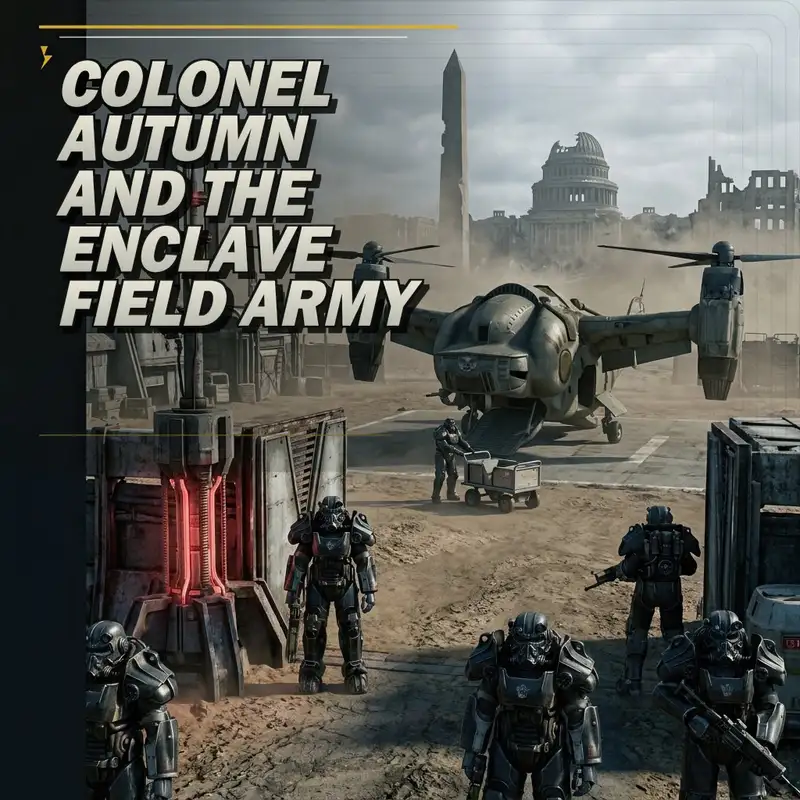
Colonel Autumn and the Enclave Field Army
At the Jefferson Memorial, Colonel Augustus Autumn arrives with more than a patrol and a demand. He arrives with armed soldiers, technical personnel, a claim of federal authority, and a plan for the most important piece of infrastructure in the Capital Wasteland. Project Purity is not simply a machine that makes water clean. In a region shaped by contaminated rivers, unreliable wells, disease, and scavenged supplies, it is a potential source of political power. Whoever controls the purifier can decide who receives water, who waits, who pays, who obeys, and who is left outside the system.
Autumn understands that immediately. His Enclave does not seize the memorial merely to deny its rivals a useful asset. It seeks to make purified water the foundation of a restored American order, one administered by the Enclave and protected by its Army. That is the ambition behind the operation. The contradiction is that capturing the machinery of government is not the same as possessing the institutions that make government real. A force can occupy a water plant. It can even defend one for a time. But it cannot build a country through weapons and access codes alone.
That distinction defines Colonel Autumn’s campaign in the year twenty-two seventy-seven. He commanded a dangerous, disciplined, and unusually capable military force. It had advanced armor, plasma weapons, Vertibirds, robots, fortified installations, researchers, and trained personnel. It could move rapidly, strike hard, and concentrate its best equipment around decisive objectives. Yet the Enclave force in the Capital Wasteland was not necessarily a viable reconstruction army. It was an expeditionary and occupation force attempting to transform technological superiority into political authority.
The phrase Enclave field army is useful here, but it must be used carefully. It is an analytical description, not a confirmed formal title for a neatly documented organization. The surviving record does not provide a reliable troop count, a complete order of battle, or a conventional table of organization. There is no established Enclave division roster, corps structure, or accurate accounting of every human soldier, robot, pilot, engineer, researcher, and support worker in the region. The Capital Wasteland was not watching a transparent modern military headquarters publish its strength returns. It was watching a secretive remnant government emerge from bunkers, radio broadcasts, and armed checkpoints.
What can be established is more important than the missing numbers. Autumn commanded human soldiers and officers under the Enclave Department of the Army. His force employed power-armored troops, specialized field teams, Vertibird crews, automated defenses, robotic units, heavy weapons, and support personnel. It had access to facilities capable of sheltering, repairing, researching, coordinating, and in some cases producing or adapting advanced technology. That gave the Enclave a real operational advantage over most organizations in the Capital Wasteland.
But quality concentrated at decisive points is not the same as regional manpower. A force can dominate a checkpoint, raid a settlement, protect an airfield, seize a laboratory, or overrun a fixed position without having the personnel to patrol every road, secure every water route, govern every town, and replace losses indefinitely. The Enclave’s strength was not that it could appear everywhere. Its strength was that it could appear where it mattered most, with equipment few rivals could match.
That equipment made Autumn’s force look larger than the evidence allows us to prove. Power armor has a political effect as well as a tactical one. It turns a soldier into a visible symbol of technological hierarchy. Plasma weapons communicate that an enemy has access to weapons the average settler cannot repair, manufacture, or easily resist. Vertibirds compress distance, allowing personnel and supplies to move across damaged terrain without depending entirely on roads threatened by raiders, mutants, ambushes, and contaminated ground. Robots reduce the number of human personnel needed for some guard, combat, and labor functions. Fortified bases create protected centers for command, research, maintenance, and storage.
None of this made the Enclave self-sustaining. Vertibirds still required trained crews, maintenance personnel, spare parts, secure landing zones, and a supply system capable of keeping aircraft operational. Power armor required skilled users, repair capacity, replacement components, weapons support, and command discipline. Robots needed power, programming, maintenance, and a chain of control that could tell them what mission they were serving. Plasma weapons and advanced armor did not remove the need for ammunition, energy cells, medical care, communications, food, water, or replacement personnel. Technology amplified the Enclave’s capacity. It did not solve the institutional problem beneath it.
The heart of that problem lay beneath Raven Rock. The mountain complex was more than a headquarters. It was a hardened continuity-of-government facility, a communications center, a research site, a manufacturing and maintenance base, a political theater, and a symbolic capital for an organization that claimed to be the lawful United States government. Raven Rock provided the Enclave with systems no ordinary Capital Wasteland settlement could easily recreate. Its automated defenses, computers, laboratories, workshops, and secure interior spaces helped explain how a relatively constrained force could remain militarily formidable.
Raven Rock also exposed the weakness of Enclave command. President John Henry Eden claimed the title of president and commander in chief. He spoke in the language of constitutional continuity, national destiny, and federal authority. But Eden was an artificial intelligence, dependent on the systems of Raven Rock and on human beings willing to obey his orders. Autumn, meanwhile, controlled the human soldiers who actually carried rifles, flew aircraft, guarded installations, interrogated prisoners, and occupied terrain. Eden himself acknowledges that Autumn controlled the Army. The Enclave therefore had two centers of authority: one with technological command and presidential claims, and another with practical control over the armed personnel required to make policy real.
That is a classic civil-military fracture, although it takes an especially Fallout form. Eden held the machinery, the archives, the broadcasts, and the inherited language of government. Autumn held the people who could fight. Neither authority was complete. Eden could issue orders, but not personally enforce them beyond the systems under his control. Autumn could command soldiers, but could not easily claim the full constitutional legitimacy that Eden’s presidential identity was designed to provide. Their partnership functioned as long as they shared broad goals. It began to break when they disagreed over what kind of population the Enclave intended to rule.
Eden’s plan for Project Purity was not simply a military measure. He intended to use the water supply to distribute a modified form of the Forced Evolutionary Virus, or F E V. The purpose was biological exclusion. Those affected by radiation or mutation would die after exposure to the water. For people living with it, that meant the Enclave would turn the Capital Wasteland’s most valuable humanitarian resource into a weapon against much of the population it claimed to inherit.
Autumn’s position was different, though not humane in any democratic sense. He appears to see the wasteland population as something to be reclaimed, controlled, and incorporated under Enclave authority. His strategy requires people alive enough to need water, labor, protection, administration, and order. A dead population cannot provide recruits, workers, taxpayers, clients, or subjects. Eden’s biological purification plan was therefore not only monstrous. It was strategically incoherent if the Enclave’s actual objective was to restore a functioning state in the Capital Wasteland.
That disagreement should not turn Autumn into a reluctant hero. He did not arrive at Project Purity to negotiate equal access with local settlements. He arrived with soldiers and demands. The Enclave takeover is an act of military coercion. Its personnel seize control of the project, attempt to compel cooperation from those who understand its operation, and treat the purifier as state property because the Enclave says it is state property. Autumn’s version of restoration still rests on monopoly control over essential infrastructure, backed by armed force and an inherited claim to national authority.
The important distinction is not between a good Enclave and an evil Enclave. It is between two authoritarian strategies. Eden’s strategy treats wastelanders as biologically disposable. Autumn’s strategy treats them as a population to be subordinated. One destroys the people needed to build a state. The other attempts to make those people dependent on a military government. Neither demonstrates public consent, representative institutions, or a willingness to share power. But Autumn’s approach at least recognizes that a government requires living people and functioning communities, not merely purified territory.
The surviving evidence does not establish how many Enclave soldiers knew about Eden’s F E V plan, how many supported it, or how many understood the political conflict at Raven Rock. Secretive organizations compartmentalize information for reasons of security and control. A soldier at a checkpoint may know only that the Enclave is securing a federal project. A pilot may know a flight plan and little else. A researcher may understand the biological program without knowing the full military situation. It would be a mistake to treat every uniformed Enclave member as equally informed, equally responsible for every decision, or equally committed to Eden’s most extreme policy.
Still, the dispute mattered because it revealed the weakness in the Enclave’s own definition of America. The organization claimed legal continuity with the United States, but its leadership could not agree on who counted as the American people. Eden’s answer was exclusion through biological death. Autumn’s answer was inclusion through coercive administration. Neither answer began with the consent of the people living in the Capital Wasteland. Both began with the assumption that the Enclave possessed authority because it inherited the symbols, facilities, and surviving systems of the old federal state.
That assumption gave the Enclave confidence at Project Purity. The purifier offered a rare chance to convert military strength into political leverage. Clean water is not just a commodity. It is the basis for health, agriculture, food preparation, sanitation, medicine, and settlement survival. A reliable water supply can stabilize a community. It can attract migrants. It can support markets and reduce disease. In a region where contaminated water is a daily danger, it can become more important than a cache of weapons.
Autumn appears to understand this. If the Enclave controlled Project Purity, it could portray itself as the only organization capable of delivering a life-sustaining public good. That could encourage settlements to cooperate, either from genuine need or from fear of exclusion. It could create a network of guarded distribution points, dependent communities, administrative offices, transport routes, and local intermediaries. In theory, water could become the basis of a new political order.
In practice, that order would have required far more than possession of the Jefferson Memorial. Water must be collected, processed, stored, transported, guarded, distributed, and monitored. Filters and machinery must be repaired. Engineers must remain available. Containers must reach settlements. Caravans, guards, and local authorities must coordinate access. Someone has to establish allocation rules during shortages. Someone has to deal with theft, sabotage, disease outbreaks, rival claims, and the inevitable question of whether an armed government is favoring its supporters over its enemies.
The purifier could have created dependence. Dependence, however, is not consent. A military monopoly over water can make people comply in the short term, but it can also create black markets, smuggling networks, sabotage, resentment, and alliances among communities that fear permanent subordination. The more essential the resource, the more politically explosive its control becomes. Autumn’s plan was plausible as an occupation system. It was much less plausible as a stable social contract.
The Enclave’s conduct made that problem worse. Its presence in the Capital Wasteland was marked by armed patrols, checkpoints, seizures, interrogation, secrecy, and lethal enforcement. Those methods can secure a site, intimidate local opponents, and control movement through a narrow area. They do not create trust. A settlement may accept protection from a superior force when the alternatives are immediate danger and no water. But acceptance under pressure is fragile. It depends on continuous enforcement, continuous supply, and the belief that resistance is impossible.
The Enclave had no demonstrated mass recruitment system among ordinary wastelanders. It had no visible representative institutions capable of incorporating settlements into a shared political order. It had no established public process through which civilians could challenge officials, negotiate distribution, elect leaders, or hold military personnel accountable. Its constitutional language was inherited from a government that had died two centuries earlier. A flag, a presidential broadcast, and a military checkpoint can evoke national authority. They cannot automatically recreate it.
The Brotherhood of Steel, under Elder Owyn Lyons, was not a civilian democracy either. It remained a military order, structured around ranks, technology, discipline, and command. But in the Capital Wasteland, Lyons’s Brotherhood had developed a public role the Enclave lacked. It protected settlements, fought threats visible to local civilians, and associated itself with the defense and eventual distribution of purified water. That did not make the Brotherhood a neutral humanitarian institution. It did make it easier for many wastelanders to see the Brotherhood as a defender rather than an occupying force.
This difference mattered because the contest over Project Purity was never only a battle over equipment. It was a battle over political meaning. The Enclave saw the purifier as an instrument for restoring centralized federal control. The Brotherhood saw it as an asset that had to be kept out of Enclave hands and used to support the region. The Capital Wasteland’s civilians had their own interests, fears, memories, and survival needs. The future of the purifier depended not only on who could seize it, but on who could persuade, compel, or support the people who needed its water.
Autumn’s military force was built to win the first kind of contest. It was far less prepared for the second. The Enclave could mass advanced personnel around a fixed objective. It could defend fortified installations. It could use air mobility to shift forces and reinforce key points. It could deploy robots and armored troops where ordinary militia forces would be at a disadvantage. Its control of Raven Rock and later Adams Air Force Base gave it protected locations from which to coordinate operations.
But the Enclave had difficulty preventing its rival from concentrating on the decisive objective. The Brotherhood’s assault on Project Purity during the final phase of the campaign changed the balance of power. Liberty Prime provided the Brotherhood with overwhelming operational momentum. The machine’s destructive capacity allowed the Brotherhood to break through Enclave defenses that might have held against a less heavily equipped assault. Yet Liberty Prime was not a magical answer to every military problem. It had to be maintained, moved, supported, directed, and used in pursuit of an objective that Brotherhood personnel were prepared to secure.
The Brotherhood brought its own soldiers, staging areas, communications, command structure, and local purpose to the assault. Liberty Prime was the visible spearpoint. The force behind it made that spearpoint useful. The Enclave, by contrast, was defending a facility that had become politically exposed. Its possession of Project Purity had made the memorial an obvious objective for everyone who feared Enclave control of the Capital Wasteland’s water supply. The very infrastructure Autumn intended to use as the center of his political strategy became the center of his military vulnerability.
The fixed strategic result is clear. The Enclave loses control of Project Purity. The precise path through the crisis depends on player action. Raven Rock may be destroyed or left standing. Eden’s modified F E V may be destroyed, retained, or rejected. Colonel Autumn’s personal fate during the original confrontation is not a single fully specified historical record. Those uncertainties matter, and they should not be forced into one invented sequence.
What does not change is the scale of the institutional defeat. In the immediate action, Enclave defenses at the purifier are overcome. At campaign scale, the Enclave loses the facility around which it had hoped to organize regional control. At regional scale, Autumn loses the mechanism that might have transformed military occupation into political dependency. Without Project Purity, the Enclave still has weapons, bases, aircraft, trained personnel, and technical knowledge. What it no longer has is a convincing answer to the question of why the Capital Wasteland should accept Enclave rule.
The defeat at the Jefferson Memorial did not instantly erase Enclave capability. Military organizations can survive the loss of an objective if they retain bases, communications, logistics, and a coherent command structure. The Enclave still possessed another major asset: Adams Air Force Base. In the immediate continuation depicted in Broken Steel, surviving Enclave forces concentrate around Adams and the Mobile Base Crawler. This was not a mere hideout for scattered troops. It was a military-industrial fallback system.
Adams supported air operations, advanced weapons work, robotics, armor development, logistics, communications, and command functions. Its value lay in the ecosystem around the weapons. An advanced suit of power armor matters more when there are technicians capable of servicing it. A Vertibird matters more when there are hangars, mechanics, crews, parts, communications staff, and secure places to land. A robot matters more when there are facilities capable of repairing or directing it. Adams helped preserve the support structure that allowed Enclave technology to remain operational rather than becoming another collection of valuable but decaying relics.
The Mobile Base Crawler symbolized both the Enclave’s remaining strength and its strategic predicament. As a mobile headquarters and weapons platform, it could shift command functions and carry advanced systems under protection. It represented an effort to preserve mobility in a region where fixed installations could become targets. But it was also large, conspicuous, technically demanding, and dependent on the very support network the Enclave was struggling to retain. Mobility is useful only if there are secure destinations, functioning supply lines, reliable intelligence, and a political mission worth moving toward.
Later evidence confirms that Adams had importance beyond the immediate Capital Wasteland campaign. ED-E, the advanced eyebot encountered in the Divide, was created at Adams and dispatched toward other Enclave contacts, including locations associated with Chicago and Navarro. That supports the conclusion that Adams participated in a broader technical and communications network. It suggests an organization attempting to preserve contact across vast distances through machines, archives, and surviving facilities.
It does not prove a unified, continent-wide Enclave command. It does not tell us how many installations remained active, how many personnel survived elsewhere, or whether distant contacts answered to Autumn, Eden, another authority, or no coherent authority at all. The Enclave was not one seamless machine merely because it still possessed old systems capable of sending messages across the continent. Distance, damaged infrastructure, competing commands, secrecy, and the collapse of shared institutions all limited what those connections could accomplish.
At Adams, the Brotherhood confronted the remaining concentration of Enclave military power in the region. The offensive depicted in Broken Steel is the culmination of the campaign. Once again, player action shapes particular details, including the use of the base’s own orbital weapon system against the Mobile Base Crawler. But the broad result is established. Adams is the Enclave’s final major stronghold in the Capital Wasteland, and the Brotherhood’s victory ends the Enclave’s ability to sustain a concentrated regional campaign from that base.
The tactical result is the defeat of defenses and the loss of advanced military assets. The operational result is more serious. The Enclave loses its principal remaining base for coordinating air operations, research, logistics, command, and force concentration. The industrial result is equally important. Specialized facilities are destroyed, captured, or removed from Enclave control. A force that depends on high-end equipment cannot casually replace the workshops, archives, technicians, and protected infrastructure that keep that equipment useful.
The institutional result is the collapse of Autumn’s regional project, whether or not every individual Enclave soldier is accounted for. The fall of Adams does not prove that all East Coast Enclave personnel died. It does not prove that every outpost, research site, or distant contact vanished. It does prove that the Capital Wasteland Enclave lost the capacity to operate as a concentrated military and political challenger from its major surviving base. Isolated survivors, scattered equipment, and distant communications links are not the same thing as a field force capable of contesting a region.
Later Brotherhood history helps show what Adams was worth. By the time of the Commonwealth campaign, Brotherhood officers describe years spent salvaging Adams Air Force Base before assembling the Prydwen there. That fact is revealing. The Brotherhood did not simply capture a ready-made industrial state and immediately convert it into an airship fleet. It spent years recovering materials, systems, technical knowledge, labor, and usable infrastructure. The Prydwen itself became possible through sustained organizational continuity, salvage, engineering, and access to a captured technical base.
That later achievement confirms Adams’s strategic value. It had meaningful depth as a military-industrial site. It contained assets worth recovering over years rather than merely stripping for weapons. But it also reinforces the central lesson of Autumn’s defeat. Advanced technology is not an instant advantage that can be separated from institutions. It depends on people with specialized knowledge, secure facilities, supply systems, time, command discipline, and a broader organization capable of assigning resources to long-term projects.
The Brotherhood’s ability to use Adams does not mean it inherited every Enclave capability intact. It does not mean the Brotherhood became the Enclave under a different flag. The two organizations had different leadership, regional circumstances, political relationships, and institutional cultures. Nor does it prove that the Brotherhood could govern the entire Capital Wasteland simply because it captured an important base. Possessing infrastructure creates possibilities. It does not automatically produce legitimacy, public administration, or a durable civil order.
That was the problem Autumn never solved. He had enough military power to threaten the Capital Wasteland. He had enough advanced technology to seize critical infrastructure. He had enough institutional inheritance to operate from Raven Rock and Adams Air Force Base. He had enough strategic insight to understand that water could become the basis for a restored political system. But he did not demonstrate the tools needed to convert those advantages into a state.
A viable reconstruction army would need more than elite equipment and hardened facilities. It would need a reliable way to recruit and replace personnel. It would need civilian administrators who could govern without treating every town as occupied territory. It would need local alliances, trusted intermediaries, transparent rules, and a credible succession system. It would need secure distribution networks for water, food, medicine, and information. It would need enough manpower to defend its bases while also protecting routes and responding to threats elsewhere. Above all, it would need people to believe that its authority offered a future better than submission under armed supervision.
Autumn’s Enclave had no demonstrated answer to those requirements. It had no public legitimacy beyond its own claim of legal continuity. It had no visible mechanism for accepting criticism, sharing authority, or incorporating the region’s existing communities on anything like equal terms. Its internal command was divided between Eden’s technological presidency and Autumn’s human military authority. Its biological policy was compromised by Eden’s exterminatory vision. Its civilian policy relied on coercion and dependency. Its most important political asset, Project Purity, became a target because the Enclave’s intended monopoly over water frightened the very population it hoped to control.
This does not mean Autumn’s defeat was predetermined in every imaginable circumstance. A different political strategy, a less divided command, stronger local alliances, or a more credible public program might have changed the contest. The available record simply gives no reason to believe that Autumn possessed those tools. His force was designed around inherited power: protected bases, old federal symbols, advanced weapons, and control over strategic technology. It was not designed around the slow work of earning cooperation from a suspicious, wounded, and politically diverse wasteland.
Colonel Autumn therefore commanded a real field force in the meaningful sense. He was not leading a gang of scavengers wearing advanced armor. The Enclave under his practical military command could seize Project Purity, contest the Brotherhood conventionally, operate Vertibirds, defend major bases, and threaten the future of the Capital Wasteland. Its soldiers and systems made it one of the region’s most dangerous organized powers.
But it was not a viable reconstruction army in the deeper sense. It could capture infrastructure faster than it could govern the society around it. It could impose access to water, but not demonstrate that civilians would accept Enclave rule as legitimate. It could preserve weapons, aircraft, robots, and bunkers, but not resolve its own divided command or create a durable relationship with the people it claimed to represent. Autumn tried to restore the United States by reclaiming its facilities, symbols, and strategic resources. The Capital Wasteland showed that rebuilding a government required something harder: institutions capable of serving, restraining, and answering to the people who depended on them.