Elder Maxson and the Reunification of the Brotherhood
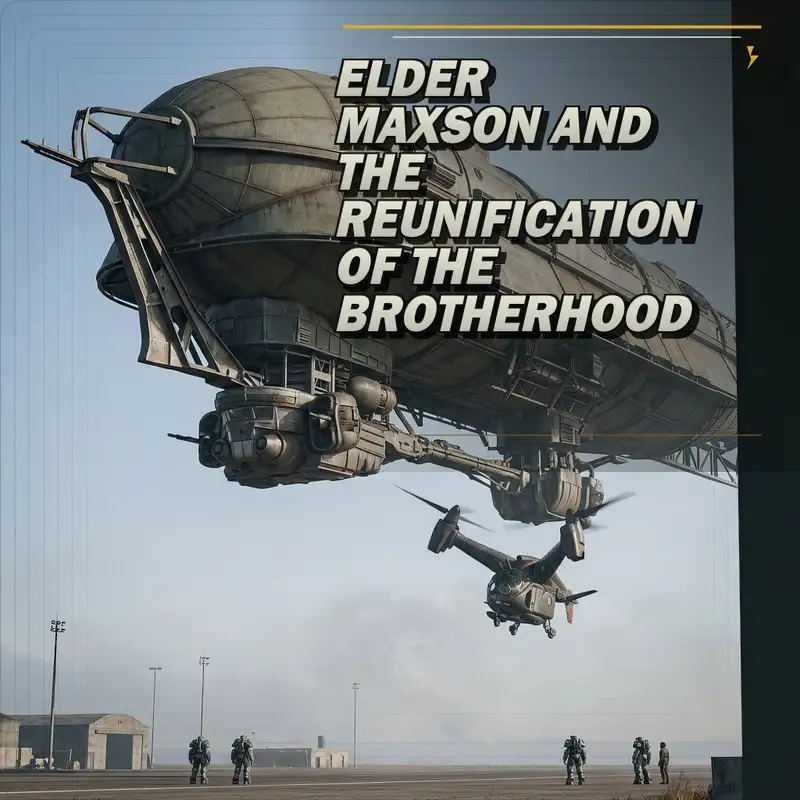
In the autumn of twenty-two eighty-seven, the Brotherhood of Steel arrived over the Commonwealth aboard the Prydwen. From the ground, it looked like an invasion fleet reduced to a single hull. It carried soldiers, scribes, weapons, workshops, command staff, and the confidence of an organization that expected to act far from home. The airship was not just transportation. It was a mobile headquarters, a maintenance base, a political symbol, and a declaration that the Brotherhood based in the Capital Wasteland had become capable of projecting force across a large and dangerous region.
A little more than a decade earlier, that same Brotherhood had been divided against itself. Its principal fortress, the Citadel, was committed to defending local communities and fighting super mutants. A breakaway force calling itself the Brotherhood Outcasts held Fort Independence and accused the Citadel command of abandoning the Brotherhood’s true purpose. Both formations possessed trained personnel, valuable equipment, and a claim to the organization’s legacy. Neither had enough strength to waste in a civil conflict. The Prydwen was the visible result of a settlement that ended that division, but it was not the cause of it.
That settlement is often described as Arthur Maxson reunifying the Brotherhood. The phrase is true, as far as it goes. Maxson did bring the Lyons Brotherhood and the Outcasts back under one Capital Wasteland command. He restored discipline, concentrated resources, and gained recognition from Brotherhood authorities in the West. But he did not reunify every chapter, expedition, bunker, or remnant across North America. He reunited a fractured eastern organization by changing what it existed to do. The result was stronger than either of its predecessors. It was also less committed to the humanitarian mission that had made Elder Owyn Lyons distinctive.
The original East Coast Brotherhood expedition had not been sent east to become a regional relief force. Its mission centered on recovering advanced technology and investigating conditions beyond the Brotherhood’s western base. That assignment reflected the organization’s old habits. The Brotherhood of Steel emerged from the military collapse of the old world with weapons, technical knowledge, and a conviction that dangerous technology should not be left in irresponsible hands. In practice, that conviction could mean preservation, monopoly, confiscation, or selective stewardship, depending on the chapter and the moment.
When Owyn Lyons took command in the Capital Wasteland, he encountered a region where the Brotherhood’s conventional mission could not be neatly separated from the people living around it. The ruins of Washington were not simply a field of recoverable equipment. They were contested by super mutants, raiders, slavers, armed opportunists, and communities struggling to maintain water, trade, and basic security. Lyons committed Brotherhood forces to fighting the super mutant threat and to protecting settlements that could not protect themselves. He did not stop valuing technology. He redefined the relationship between technology and responsibility.
There was a hard strategic logic in that decision. An isolated military order cannot preserve much civilization if the territory around its fortress collapses into permanent predation. A workshop needs labor, food, water, routes, and security. Scribes require records, tools, power, and people able to keep a settlement functioning. Soldiers need recruits, medical care, supply lines, intelligence, and a population that does not view every armored patrol as another band of armed scavengers. Lyons understood that the Brotherhood could not permanently barricade itself behind doctrine while the Capital Wasteland disintegrated outside its walls.
But his policy imposed costs. Brotherhood personnel, armor, ammunition, repair capacity, and attention were committed to threats that did not always yield recoverable technology. Protecting civilians is never merely a moral choice for a military organization. It is also a question of endurance. Every patrol sent to defend a settlement is a patrol not sent to inspect a laboratory, escort a recovery team, or guard a stockpile. Every damaged suit of power armor requires parts and skilled labor. The Brotherhood’s advanced equipment did not exempt it from maintenance, fatigue, casualties, or the simple arithmetic of having too few trained people for too many missions.
Some members of Lyons’ chapter accepted that burden. Others regarded it as a betrayal. Their objection was not merely that Lyons was unpopular, weak, or distracted. It was doctrinal. They believed the Brotherhood had been sent east to recover and secure technology, not to serve as a standing defense force for every endangered community in the Capital Wasteland. In their view, Lyons had allowed compassion and local necessity to displace the Brotherhood’s oath-bound purpose. To them, the chapter was spending irreplaceable resources on an open-ended obligation that could consume it entirely.
That argument produced the Brotherhood Outcasts. Under the leadership of Paladin Henry Casdin, the breakaway faction established itself at Fort Independence. They retained equipment, personnel, and a much stricter interpretation of Brotherhood duty. The Outcasts did not see themselves as deserters from the Brotherhood. They claimed that the Citadel command had departed from the Brotherhood, and that they were preserving its real mission. This distinction mattered. A mutiny is a dispute over obedience. The Outcast break was a dispute over legitimacy, purpose, and the right to define the organization’s future.
Fort Independence gave the Outcasts a defensible base, but it also exposed the limits of their position. A fort can secure a perimeter. It cannot by itself solve the broader problem of recruitment, resupply, intelligence, and regional influence. The Outcasts possessed valuable matériel and trained specialists, but they were isolated. They had to defend their own installation while sustaining a separate arsenal and maintaining a separate command. Their doctrinal clarity came with institutional narrowing. They knew what they opposed. It was less clear how a small, detached garrison would build enough power to achieve its own long-term aims.
The Citadel had the opposite problem. Lyons’ Brotherhood had a larger social presence in the Capital Wasteland. It had relationships with local settlements, a major fortress, and a reputation for confronting threats that endangered civilians. But those commitments stretched it thin. The chapter had to balance super mutant operations, local defense, technical recovery, training, internal discipline, and the political consequences of being visible in a damaged region. It had more roots than the Outcasts, but those roots created obligations. A military force that gains legitimacy by protecting people also risks losing it when it cannot protect everyone.
The split weakened both sides in practical ways. Instead of one organization assigning personnel where they were needed, there were two armed groups defending separate positions and pursuing competing priorities. Instead of a unified technical corps, recovery capacity was divided. Instead of one claim to authority, the Capital Wasteland had rival Brotherhood institutions, each asserting that the other had betrayed the founding mission. This was not simply an argument in a council chamber. It shaped patrol patterns, maintenance work, training, intelligence, and the willingness of outsiders to trust either side.
Neither faction could easily eliminate the other without making the larger situation worse. The Citadel could not afford to treat trained Brotherhood personnel and rare equipment as disposable enemies. The Outcasts could not realistically replace the broader institutional base that Lyons’ chapter retained. A violent settlement might have resolved the question of command, but it would have consumed precisely the people, weapons, and technical knowledge that the Brotherhood existed to preserve. In that sense, the schism endured because both sides were too divided to cooperate fully and too constrained to destroy one another cheaply.
For a time, Owyn Lyons’ personal authority contained the dispute. He had the rank, the experience, and the moral confidence to maintain his own course despite resistance. His daughter, Sarah Lyons, also became an important military figure within the chapter. Yet a faction built around strong personalities always faces a succession problem. Institutions can survive disagreement when command is accepted. They become fragile when the commanding figures disappear and the argument remains. The Capital Wasteland Brotherhood eventually had to confront that problem directly.
Owyn Lyons and Sarah Lyons both died sometime after the events recorded in the year twenty-two seventy-seven. The exact sequence and dates are not cleanly documented. What later Brotherhood records make clear is that their deaths were followed by a period of ineffective or unstable leadership. It is tempting to fill that gap with conspiracies, secret assassinations, or a complete list of failed elders. The surviving evidence does not justify that. The important fact is simpler and more consequential. The chapter lost both its elder and its most obvious military successor while still divided over mission, legitimacy, and relations with the Brotherhood’s western leadership.
This was a succession crisis in the fullest sense. It was not only about selecting a new commander. The Citadel needed someone who could restore discipline without destroying the local foundations Lyons had built. The Outcasts needed a reason to return without admitting that their entire critique had been wrong. The western Elders needed evidence that the eastern chapter had not become permanently detached from Brotherhood principles. Rank alone could not solve these problems. The next leader needed a source of legitimacy strong enough to bridge rival memories of what the Brotherhood had been.
Arthur Maxson possessed one of those sources before he possessed formal authority. In the Capital Wasteland, he had first appeared as a child squire. He was also a descendant of Roger Maxson, the figure associated with the Brotherhood’s founding. In a stable organization, family lineage might be merely ceremonial. In a fractured military order that prizes continuity, lineage can become politically useful. It offers a story of inherited duty. It connects a present crisis to a remembered origin. It gives rival factions a symbol that neither has entirely created for itself.
Brotherhood records later presented Arthur Maxson’s rise in almost heroic terms. They credit him with protecting a patrol from raiders while still young, killing a deathclaw at thirteen, and defeating a super mutant leader known as Shepherd at roughly fifteen. These accounts should not be read as neutral battlefield reports. They come from an institution with every reason to elevate its elder into a model of courage, discipline, and destiny. The details may preserve real events. They may also have been sharpened by retelling, selection, and the Brotherhood’s need for an exemplary commander.
That does not make the stories unimportant. Political myths are not meaningless merely because they serve political purposes. In a military organization, reputation affects obedience, recruitment, morale, and the willingness of officers to accept a difficult settlement. A young leader described as both a Maxson by blood and a proven fighter by deed could represent continuity without looking like a passive heir. The Brotherhood did not need a child mascot. It needed someone who could transform inherited symbolism into command authority.
Maxson’s achievement, therefore, was not that he inherited a unified army waiting for orders. He inherited a divided institution with overlapping grievances. The Outcasts had their equipment, their doctrine, and their suspicion of the Citadel. Lyons’ loyalists had their regional commitments, their memories of service to civilians, and their own suspicion that the Outcasts valued machinery more than people. The Brotherhood’s western tradition offered legitimacy, but also pressure to return to a technology-centered mission. Maxson had to make these elements coexist without allowing any one of them to dictate the whole organization.
Around the year twenty-two eighty-three, he negotiated a settlement with the Outcasts. The broad outcome is established. The Outcasts returned to the Brotherhood, and Arthur Maxson became elder of the reunited Capital Wasteland chapter. What is not established is the detailed machinery of that agreement. There is no reliable account of every meeting, every concession, every internal vote, or every officer who resisted. We should be cautious about imagining a single dramatic conversation that healed years of division. Political reunification is usually less theatrical and more practical than its later legends suggest.
The settlement worked because it did not require either side to surrender its entire self-image. The Outcasts regained a Brotherhood that placed technology recovery, military discipline, and control of dangerous assets near the center of its mission. They could return without accepting that the order had become nothing more than a regional charity in power armor. The Lyons legacy retained something important as well. The reunited Brotherhood did not retreat into total isolation. It continued recruiting from the wasteland, maintained a broader regional presence, and preserved the capacity to work with communities beyond the walls of a single fortress.
This was not a perfect balance between two equal doctrines. The center of gravity shifted. Under Lyons, civilian defense and the struggle against immediate threats to the Capital Wasteland had defined the Brotherhood’s identity. Under Maxson, the Brotherhood became more explicitly focused on the recovery, regulation, and, when necessary, destruction of advanced technology it judged dangerous. Humanitarian action could still occur. Settlements could still receive protection. But those activities were no longer the clearest statement of why the Brotherhood existed. They became subordinate to a larger military and technological program.
The immediate military benefit was concentration of force. Personnel who had been divided between the Citadel and Fort Independence could be assigned within one hierarchy. Equipment could be maintained through a more coherent system. Scribes, knights, scouts, and support staff could contribute to common priorities rather than competing recovery efforts. This did not create unlimited manpower or erase the difficulty of operating in a devastated region. It did reduce the waste created by division. A reunited force could train, repair, plan, and deploy with more purpose than two rival garrisons watching one another across the wasteland.
The political benefit was equally important. Maxson’s Brotherhood could claim to represent both the Capital Wasteland chapter and a restored connection to Brotherhood tradition. It was no longer merely Lyons’ personal project, and it was no longer an isolated Outcast fort claiming purity from behind its walls. A single elder, a clearer chain of command, and an agreed mission gave the organization a more usable public identity. This mattered to its own members, to western authorities, and to outsiders trying to understand whether the Brotherhood was a local militia, a relic army, or a durable regional power.
Recognition from the western Elders strengthened that claim. The restored contact signaled that Maxson’s authority was accepted within a wider Brotherhood tradition. It gave the eastern chapter doctrinal legitimacy and linked it to resources, knowledge, and institutional memory beyond the Capital Wasteland. But recognition should not be confused with direct control. The available record does not show western Elders directing every eastern patrol, every recruitment decision, or every later campaign. Brotherhood chapters have repeatedly adapted to their regions, their leaders, and the material conditions around them.
The word reunification also has limits. Maxson reunited the major factions of the Capital Wasteland Brotherhood. He did not erase regional variation across the continent. Later events, including the Brotherhood’s presence in the year twenty-two ninety-six, show that different chapters and commands still possessed their own identities, rivalries, and claims to authority. A shared name, shared symbols, and shared reverence for technological control do not automatically produce a single national institution. The Brotherhood’s history is full of groups that agree on the importance of the past while disagreeing fiercely about what that past requires them to do.
Still, recognition and command structure were not enough. A reunited Brotherhood needed the material capacity to act on its new ambitions. That capacity was expressed most clearly in the Prydwen. The airship was constructed through an extended effort using salvaged Enclave-related matériel, Brotherhood expertise, and the accumulated labor of personnel who could maintain sophisticated systems. It required more than an inspired elder and an impressive hull. It required workshops, technicians, scribes, trained crew, weapons maintenance, command discipline, replacement parts, secure bases, and enough organizational continuity to keep a complicated machine from becoming an expensive landmark.
The Prydwen’s value was operational. It allowed the Brotherhood to move command personnel, troops, equipment, and technical specialists over long distances without relying entirely on one fixed garrison. It served as a platform from which the organization could coordinate ground operations and sustain an expedition. It also concentrated authority. A commander aboard the Prydwen could bring not only soldiers but the visible apparatus of Brotherhood rule: officers, records, technicians, armories, communications, and a disciplined hierarchy. It was a flying headquarters because the Brotherhood had become an organization capable of supporting one.
An airship is often treated as evidence of technological superiority. It is better understood as a demanding bill for skilled labor. It has to be kept in the air, repaired, defended, supplied, and commanded. Its weapons require maintenance. Its crew requires food, rest, medical care, and training. Its value depends on the bases, routes, personnel, and intelligence networks beneath it. The Prydwen did not free the Brotherhood from logistics. It made the Brotherhood’s logistical system visible. That was precisely why it mattered. Only a more unified and disciplined institution could attempt such a project.
By the time the Brotherhood deployed to the Commonwealth in late twenty-two eighty-seven, Maxson’s settlement had passed its most important test. The organization could conduct a campaign beyond the Capital Wasteland. It had an elder with centralized authority, officers with defined responsibilities, a technology-control mission, a recruitment system, and an expeditionary base. The Brotherhood’s target in the Commonwealth was the Institute, an organization associated with advanced research, synth production, covert operations, and technologies Maxson considered too dangerous to remain beyond Brotherhood control.
The Commonwealth expedition demonstrated operational capacity, not automatic strategic success. The Brotherhood could arrive, establish a presence, gather intelligence, deploy patrols, recover technology, and prepare for major action. None of that by itself guaranteed durable authority over the region. Military forces can seize facilities, destroy enemies, or force decisions without gaining the consent, administrative reach, and economic support required to govern a population. Fallout’s history is full of organizations that confused possession of a powerful installation with possession of a political future.
The later conflict in the Commonwealth also involved choices that could produce different outcomes. It would be a mistake to use the Brotherhood’s campaign there as proof that every one of Maxson’s objectives was achieved in one fixed historical path. What the campaign establishes is narrower and more useful. It proves that the Brotherhood he led had become able to mount a distant, organized intervention against a technologically advanced rival. That capability emerged from reunification, centralized command, accumulated industrial effort, and the recovery of the manpower and matériel once divided by the Outcast split.
Maxson’s recruitment practices show how far his Brotherhood had moved from both Lyons’ and the Outcasts’ earlier positions. The organization did recruit wasteland-born people. It was not sealed off from the population in the way an entirely isolated technical order might have been. But recruitment was controlled through sponsorship, discipline, and hierarchy. Recruits entered a military institution that expected obedience and that defined service in Brotherhood terms. This was not a broadly civic model in which local communities shaped the Brotherhood’s mission. It was a method of drawing capable people into an expanding armed order.
For civilians, the change was mixed. A strong Brotherhood could offer protection against major threats that small settlements could not confront alone. Its patrols, weapons, and technical knowledge could deter some forms of predation. Its presence could create opportunities for trade, employment, and access to expertise. But civilian communities were no longer the central reason for Brotherhood action. They were more likely to encounter the organization as a heavily armed power with strategic priorities of its own. Assistance might be offered, but it was conditional. Cooperation was useful when it aligned with the Brotherhood’s mission.
That distinction affected legitimacy. Lyons’ Brotherhood could claim that it fought because the people of the Capital Wasteland needed protection. Maxson’s Brotherhood could claim that it fought because dangerous technology, powerful enemies, and uncontrolled scientific systems threatened the future. Both arguments could contain truth. Yet they placed civilians differently within the organization’s moral universe. Under Lyons, the protection of ordinary people was close to the center of the mission. Under Maxson, ordinary people were more often people to recruit, defend selectively, negotiate with, or shield from dangers defined by Brotherhood command.
This made the reunited Brotherhood more flexible in some ways. It could concentrate on a major threat without promising to solve every local problem. It could move forces toward a distant objective rather than permanently dispersing them among settlements. It could restore standards of discipline and technical control that the Outcasts believed Lyons had neglected. But flexibility has a cost. A force that is less accountable to local welfare may be easier to deploy, yet harder to trust. It can become stronger militarily while becoming more distant from the societies in whose name it claims to act.
Arthur Maxson’s personal authority held this arrangement together. He represented the Brotherhood’s founding lineage, the military culture valued by the Outcasts, and the broader regional viability that Lyons’ followers could not abandon without undermining their own past. His leadership was not simply a return to tradition. A strict return to the narrowest version of Brotherhood isolation would have left the Capital Wasteland chapter too small, too detached, and too dependent on a bunker mentality. Nor was he simply Lyons’ successor. The humanitarian emphasis that had defined Lyons’ command was no longer the organization’s primary measure of success.
The better description is that Maxson built a political settlement and gave it a military form. He took a doctrinal schism and turned it into a chain of command. He took rival claims to legitimacy and folded them into one institutional story. He took divided equipment and personnel and made them available for common projects. He used recognition from the West to reinforce authority in the East, while using the Capital Wasteland’s local experience to make the Brotherhood more open, recruitable, and expeditionary than a purely isolated order could have been.
That achievement was real. It should not be dismissed as propaganda merely because Brotherhood records praise Maxson extravagantly. The Outcasts did return. The Capital Wasteland chapter did become more coherent. The Prydwen did not build itself, and a major Commonwealth expedition required organizational capacity that the divided Brotherhood of the earlier period did not possess. Maxson solved an immediate institutional crisis that might otherwise have left the Brotherhood fragmented, defensive, and unable to sustain a wider role.
But the achievement was narrower than Brotherhood mythology sometimes suggests. The reunification was regional, conditional, and dependent on a particular balance of interests. It did not settle every question about what the Brotherhood should be. It did not make every chapter across the continent obedient to one elder. It did not eliminate the tension between preserving technology and serving the people living beside it. In fact, it gave that tension a new form. The Brotherhood became better able to act among wasteland societies while becoming less willing to define itself by an obligation to them.
Elder Maxson reunited the Lyons Brotherhood and the Outcasts in the institutional sense that mattered most in the Capital Wasteland. He ended a costly schism by giving each side enough reason to return. The Outcasts regained a disciplined, technology-centered military order. The legacy of Lyons retained recruitment, regional roots, and the ability to operate beyond a fortress wall. The price was a change in purpose. The Brotherhood emerged more mobile, more centralized, and more powerful, but less centered on the civilians whose protection had once made Lyons’ chapter distinctive.