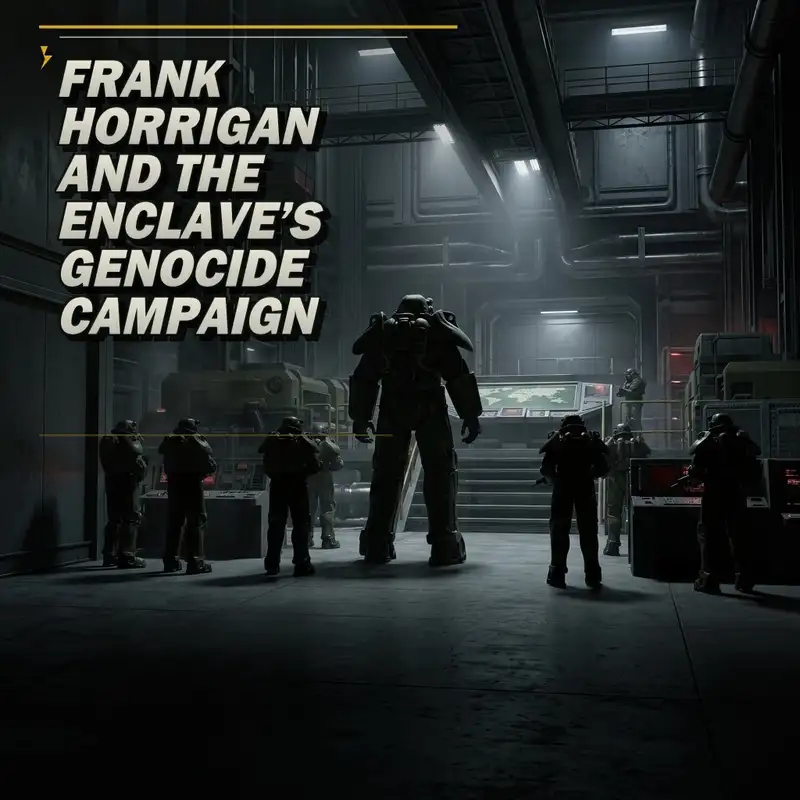
Frank Horrigan and the Enclave’s Genocide Campaign
The oil rig is failing. Prisoners have been released from its holding areas. Its command structure has been exposed, its laboratories compromised, and its plans for the mainland are collapsing with it. Between the Chosen One and the exit stands Frank Horrigan, the Enclave’s final security measure. He is enormous, armored, surgically remade, and still speaking the language of public service. Duty. Honor. Courage. He presents himself as an agent of the United States carrying out his assignment to the end.
That language matters because the installation behind him has not been defending a population under attack. It has been preparing to release a weapon intended to kill nearly every human being outside the Enclave’s protected population. Its scientists have used captives as test subjects. Its field operatives have abducted civilians and murdered families. Its political leadership has defined ordinary people, born and raised in the post-War world, as biological contamination.
Frank Horrigan is not the architect of that policy. He does not appear to be its chief scientist, its political theorist, or its strategic commander. He is something more revealing. He is the point at which an exterminatory ideology becomes physical force. He is the armed hand at the door, the agent sent to make fear immediate, and the last obstacle placed between the victims of the project and the people who built it.
His final stand is often remembered as a confrontation with the Enclave’s largest and most dangerous individual weapon. That is true, but it is incomplete. Horrigan’s importance is not simply that he is hard to stop. His existence exposes the logic of the government he serves. The Enclave claims to preserve pure humanity. Yet its most trusted enforcer is a man altered by Forced Evolutionary Virus, rebuilt with machinery, and used to kill people condemned for being altered, exposed, or merely born outside Enclave control.
To understand Frank Horrigan, then, it is necessary to begin not with the weapon, but with the institution that made him useful.
During the events of Fallout 2, around the years twenty-two forty-one and twenty-two forty-two, the West Coast Enclave presents itself as the surviving authority of the United States. It possesses old national symbols, advanced technology, military discipline, secure facilities, scientific expertise, and a president who speaks as though the American state never truly died. From Control Station Enclave, an offshore oil rig far from the California coast, it claims the inheritance of the pre-War government.
But possession of old institutions is not the same thing as legitimacy. The people living on the mainland have not consented to Enclave rule. They do not appear to have elected its leaders, participated in its laws, or benefited from its protection. The Enclave’s authority is asserted from a distance. It rests on secrecy, technological superiority, and a belief that those inside the rig are the rightful heirs of America, regardless of what has happened to America’s surviving population.
Within that offshore society, responsibilities are divided. President Dick Richardson supplies political authority and ideological justification. Lieutenant Colonel Doctor Charles Curling directs the scientific work associated with the Chemical Corps. Military and security personnel protect the installation, conduct operations on the mainland, and guard prisoners. Technicians keep the machinery functioning. Scientists develop weapons and conduct tests. Captives provide involuntary labor, biological samples, and experimental subjects.
These roles should not be collapsed into one single mind. Not every guard, technician, scientist, or soldier necessarily understands the full plan, much less embraces it with equal conviction. An institution can contain careerists, believers, frightened subordinates, reluctant specialists, and people who understand only their assigned compartment. Yet the institution’s direction is unmistakable. Its leadership does not seek a political settlement with the mainland. It seeks to decide who counts as human before deciding who may live.
That is the Enclave’s central contradiction. It calls itself the last refuge of humanity while treating most surviving humans as a threat to humanity’s future.
Richardson gives that contradiction its clearest political form. He describes the Enclave’s purpose in the language of cleansing, restoration, survival, and democracy. The vocabulary is patriotic, but its function is exclusionary. His government does not use the word mutant only to mean super mutants, ghouls, or visibly transformed creatures. In the Enclave’s political vocabulary, mutant is a much broader category. It can include ordinary human beings who lived outside the Enclave, absorbed radiation, descended from exposed populations, or simply developed beyond the control of the old government.
The distinction is essential. Military conflict normally concerns control. Armies fight over roads, water, territory, governments, resources, or political authority. The Enclave’s project aimed at something more radical. It proposed the destruction of people because of a biologized identity category. A wastelander’s conduct did not matter. Their politics did not matter. Their willingness to obey did not matter. Their place of birth, presumed exposure, and exclusion from the Enclave’s protected population were enough to place them at risk.
Such thinking made extermination appear, to its advocates, not as murder but as sanitation. Once a government defines a population as contamination, ordinary restraints begin to fail. Kidnapping becomes collection. Human experimentation becomes testing. Mass death becomes a clean sweep. The language does not reduce the violence. It makes the violence easier to administer.
The Enclave’s plan did not begin in the laboratory alone. Before it could weaponize Forced Evolutionary Virus, it had to recover the knowledge and material needed to do so. That brought it to the ruins of the Mariposa Military Base.
Before the events of Fallout 2, Enclave personnel located and excavated the old Mariposa facility. The base had been central to earlier research into Forced Evolutionary Virus, the substance most closely associated with the creation of super mutants in the West Coast wasteland. The exact calendar of the Enclave excavation is clearer in supplementary material than in the released game itself, so the safest conclusion is simply that it occurred before the oil rig’s final campaign against the mainland.
What matters is how the Enclave conducted that recovery operation. It used enslaved labor. Human beings were brought into a ruined military research site to dig through contaminated remains, recover equipment, and reach material their captors considered valuable. The workers were not treated as citizens, contractors, or even prisoners protected by law. They were disposable inputs in a salvage operation.
Mariposa was not a safe ruin. Residual F E V contamination remained part of its danger. Some of the enslaved workers were transformed into second-generation super mutants. Their condition was not the result of a carefully supervised medical program. It was a consequence of forcing human labor into a hazardous site associated with one of the old world’s most dangerous biological projects.
The Enclave obtained what it wanted from Mariposa and left the site behind. The transformed workers, like the laborers who had been exposed to danger for the sake of Enclave recovery, were not treated as people whose lives created obligations. They were evidence of risk, inconvenience, and failure. The organization’s concern was the usable material it could extract, not the human cost of extraction.
Mariposa also provided the setting in which Frank Horrigan’s transformation began. He was not simply an outsider brought in to enforce the Enclave’s will. He was one of the Enclave’s own agents, sent into the dangerous world beyond its protected perimeter. The virus that the Enclave would later use to condemn others became part of the process that remade him.
The secure outlines of Horrigan’s early career are limited but significant. He served as a Secret Service agent and had been a presidential bodyguard. At some point, he was assigned to wasteland operations. Accounts outside the released game add more detail about disciplinary trouble and the sequence of his assignments, but those details should be handled cautiously. Fallout 2 itself gives the clearer historical result: an Enclave security operative was exposed to F E V, and the Enclave chose not simply to discard him, but to alter him further.
Doctor Charles Curling refers to modifying F E V in a Secret Service agent with some success. That statement establishes the core fact. Horrigan’s final form was not an accident left untreated in the field. He became the subject of deliberate Enclave experimentation. By the time he appears during the events of Fallout 2, he is a massive mutant human being integrated with extensive cybernetic augmentation and deployed as an elite security asset.
The precise medical sequence remains uncertain. The released game does not provide a complete surgical record, a detailed list of implants, or a reliable account of every procedure that turned Frank Horrigan into what he became. It is unnecessary to invent one. His physical condition makes the larger point without requiring an imaginary operating report. The Enclave took a damaged or transformed agent and remade him into a weapon through biological manipulation and machinery.
In other words, the regime’s categories are not really about biology. They are about power. A person inside the Enclave’s chain of command can be remade into something visibly and radically different from an ordinary human being, then retained as a symbol of state strength. A person outside that chain of command can be marked for death because the Enclave calls them impure.
Horrigan’s transformation also demonstrates the Enclave’s technological arrogance. Its leaders believe that advanced science gives them the right to redefine the limits of humanity. They can manipulate virus strains, rebuild bodies, automate systems, and preserve advanced weapons. From those achievements, they draw a political conclusion that does not follow. They assume that technical power proves moral authority.
But Horrigan is not simply a passive victim of that process. The Enclave exploited him, certainly. It turned an agent into an experiment and an experiment into an instrument of violence. Yet the released story also shows him participating in that violence knowingly. His conditioning, loyalty, and altered body do not erase his responsibility for the coercion and murder he carries out. He is not an innocent trapped inside a machine. He is an Enclave operative who continues to identify himself with the institution’s mission.
On the mainland, Horrigan serves as the kind of asset a secretive and isolated regime finds useful. He is not a governor. He does not build alliances, establish courts, negotiate trade agreements, or organize local administration. He is sent where intimidation is required. His presence communicates that the Enclave has reached beyond the sea and that refusal may carry immediate consequences.
One encounter in the desert makes this clear. It is possible for a traveler to miss it, so it should not be treated as a complete record of every Enclave operation across the West Coast. But its scripted events reveal the methods available to the organization. Horrigan supervises the coercion of a farmer. When the man refuses to cooperate, Horrigan orders the killing of the farmer’s family.
The purpose appears practical in the narrowest sense. Terror can force a person to provide information, surrender resources, reveal contacts, or comply with an order. It can make an example of resistance. In the immediate moment, such violence may appear effective to those wielding it. The victim is powerless. The armed force is overwhelming. There is no courtroom, no appeal, and no expectation that local people will receive protection from the institution imposing the punishment.
But terror is not the same as intelligence, and it is not the same as governance. It may produce obedience in one encounter while destroying the conditions for cooperation everywhere else. A farmer threatened by Enclave agents is not recruited into a political order. Their neighbors are not given a reason to trust Enclave authority. Anyone who survives has reason to warn others, hide information, aid resistance, or treat unfamiliar uniforms as a threat.
Horrigan embodies that blindness. He is formidable as a field enforcer. He can impose fear, secure a prisoner, eliminate resistance, and protect a sensitive site. Yet he cannot solve the political problems created by the policy he enforces. Every act of collective punishment confirms the Enclave’s image as an alien power preying on the mainland. Every witness becomes a potential source of warning. Every abducted civilian has relatives, allies, or a community that may resist.
The Enclave has built a soldier suited to a war against human beings it refuses to recognize as human. It has not built an institution capable of living among them.
The scientific center of the campaign lies with Charles Curling and the modified virus known as F E V Curling-Thirteen. Curling is not merely a laboratory assistant operating without political direction. He is a senior technical figure within the Enclave’s Chemical Corps structure, responsible for converting recovered F E V research into a weapon intended for population destruction.
The stated purpose of Curling-Thirteen is horrifyingly direct. It is designed to attack human beings, including the people the Enclave considers mutated or genetically compromised, while leaving plants and non-human animals unaffected. In theory, this would allow the Enclave to eliminate human populations across large areas without rendering the land itself useless for later occupation. Farms, animals, buildings, machinery, and physical infrastructure might remain. The people who made those systems work would not.
Curling describes the agent as one that would eventually exhaust its available human hosts and disappear. That is his assessment, not independently verified epidemiology. The Enclave’s own research records and scientific claims must be read with caution. They come from an organization deeply invested in proving that its weapon is controllable, effective, and safe for its intended users. A scientist working inside an extermination program may be technically skilled and still underestimate uncertainty, hide risk, or accept assumptions shaped by political pressure.
Even so, the strategic design is clear. The Enclave is not seeking a battlefield advantage over a rival army. It is designing a selective biological weapon for atmospheric release. It intends to use the air itself as a delivery system, allowing prevailing currents to carry the toxin beyond the oil rig and across the mainland. This is a plan for mass death at a scale no conventional raid, campaign, or occupation force could easily achieve.
Such a project requires more than one talented scientist. It depends on the recovery of old research from Mariposa, functioning laboratories, containment systems, technical personnel, electrical power, chemical production, storage, security, and transport. It also requires an isolated facility where the work can proceed beyond the scrutiny of the people it targets. The oil rig provides that combination of industrial capacity and political insulation.
Curling’s role should also be distinguished from Richardson’s. Richardson supplies the political rationale. He speaks in the language of national restoration and cleansing. Curling supplies the technical means. He is responsible for transforming an ideology of exclusion into a working weapon. Yet the evidence suggests that the two men are not identical in temperament or certainty. Under some circumstances, Curling can be pushed to reconsider the project’s assumptions. That does not absolve him. A person willing to manage a genocide program cannot be treated as morally detached from it. But it does show that the Enclave is not a single personality in uniform.
Its strength comes from the coordination of different roles. Its danger comes from the same fact. A president can authorize. A scientist can develop. Guards can contain. soldiers can capture. Technicians can produce. And Frank Horrigan can make sure that anyone trying to interfere is met with overwhelming violence.
The oil rig’s records give the program a name of sorts: the Project. Their language is bureaucratic, technical, and chillingly calm. The objective is described as a clean sweep. Experimental mortality becomes a data point. Atmospheric release becomes a deployment method. Human beings become a category of material to be cleared from the future.
The records include plans for producing two hundred fifty thousand gallons of the weapon within six weeks. They also include a projected extermination rate of ninety-nine point five percent. These numbers should not be treated as confirmed scientific measurements. They are Enclave internal estimates, created by the people trying to persuade themselves and their superiors that the program can work. The game does not provide an independent test of the atmospheric model, production capacity, or predicted human death toll.
But uncertainty about the exact figures does not reduce the intent. A projected death rate of ninety-nine point five percent is not a defensive measure. A production target measured in hundreds of thousands of gallons is not an emergency quarantine. The Project was designed to eliminate almost everyone the Enclave considered outside the boundaries of acceptable humanity.
Bureaucratic language has a particular role in crimes of this scale. It divides responsibility into manageable pieces. One office calculates production. Another conducts tests. Another guards the prisoners. Another manages the facility. Political leaders describe the outcome as restoration. Field operatives suppress resistance. No individual document needs to say, in simple language, that the state intends to murder nearly every person on the mainland. The machinery of policy makes the conclusion visible anyway.
The Enclave’s confidence also contains a strategic failure. It assumes that a technically successful release would produce a politically useful future. But a state is more than the absence of enemies. The Enclave imagines a cleansed continent waiting to be reclaimed. It does not demonstrate how a small offshore population would farm it, repair it, administer it, defend it, transport goods across it, or establish law within it.
Even the weapon’s supposed selectivity reveals the limits of the plan. Preserving plants and animals might leave physical resources intact, but it would not preserve the human networks that make those resources meaningful. Fields do not harvest themselves. Water systems do not repair themselves. Roads do not secure themselves. Factories do not become productive merely because their previous workers are dead. The Enclave sought to inherit the continent’s material remains while destroying the people who understood how to survive within it.
Before it could release the weapon on a larger population, however, the Enclave needed living people to test it upon. That need brought the campaign from abstract projections to its most intimate victims.
Vault Thirteen held special value to the Enclave because its residents were believed to have lived in relative isolation from the irradiated and altered conditions of the surface. In the Enclave’s eyes, they represented a population with lower radiation exposure, useful as a comparison group and as experimental material. The very existence of such a community complicated the Enclave’s rhetoric. Here were people who had survived through discipline, isolation, and continuity with a pre-War shelter system, yet they could still be seized and treated as subjects.
Arroyo’s people were also captured. Their community descended from the Vault Dweller’s legacy, but the Enclave did not approach them as fellow inheritors of a human past. They were prisoners. The people of Arroyo and Vault Thirteen were taken to the oil rig and subjected to the machinery of the Project.
The details of every test are not fully documented, and it would be wrong to invent a standardized procedure or assume that every captive endured the same treatment. What is established is enough. These populations were not incidental hostages held for leverage. They were part of the Enclave’s effort to validate a weapon intended to kill human beings on a massive scale.
For the captives, the distinction between science and security would have meant little. Guards, laboratories, detention rooms, and official classifications all served the same result. Families were separated from their communities. People who had done nothing to threaten the Enclave were taken across the sea and placed under the control of a regime that had already decided their kind did not deserve to survive.
The Chosen One’s intervention matters here not as the achievement of a particular personality or playthrough, but as a fixed reversal of that captivity. The liberation of prisoners denies the Enclave its test population and breaks the illusion that the oil rig is unreachable. The people marked for experimentation do not remain passive entries in a research file. Their survival becomes part of the failure of the Project.
The oil rig could support the Enclave’s plan because it concentrated unusual advantages in one place. Offshore basing gave the organization distance from the mainland. Maritime access allowed it to move selected personnel and material while limiting casual contact with outsiders. Secure communications linked its command systems. Advanced power generation supported laboratories and defensive systems. Technicians maintained equipment. Scientists worked behind layers of security. Guards and soldiers defended the installation. The rig was not just a headquarters. It was the logistical heart of the genocide campaign.
Its isolation was an operational strength. It reduced the risk of public scrutiny and made direct attack difficult. A mainland settlement might be vulnerable to spies, traders, refugees, and local political pressure. The rig could restrict access. It could screen arrivals. It could keep prisoners contained. It could treat the ocean as a defensive barrier.
But isolation was also the Enclave’s strategic weakness. The organization had protected its technical capacity by separating itself from the population it claimed to rule. In doing so, it had lost the information, legitimacy, and relationships that make political power durable. It had no demonstrated base of mainland consent. It did not administer towns, mediate disputes, protect caravan routes, or build reciprocal obligations with civilian communities. Its contact with the outside world was too often conducted through intimidation, abduction, and violence.
A government can survive temporary unpopularity. It can survive local resistance. It can sometimes survive military defeat. What it cannot easily survive is a policy that makes nearly every outsider into a potential enemy and every survivor into evidence of its crimes. The Enclave’s extermination plan removed the need for diplomacy only by imagining that diplomacy would never again be necessary.
That was a fantasy. Even if the Project had succeeded on its own terms, the Enclave would still have faced the immense problem of converting an empty or devastated continent into a functioning country. It would have needed food production, labor, transport, maintenance, local knowledge, medical services, communications, policing, and political institutions. Advanced weapons and laboratories cannot substitute for a population capable of sustaining ordinary life.
The rig’s dependence on specialized systems also created vulnerabilities. Complex facilities need power, maintenance, trained labor, secure access, and reliable internal command. Their defenses can be formidable, but they are not invulnerable to infiltration, sabotage, internal dissent, or the failure of a few critical systems. The Enclave’s leaders mistook controlled access for total security. They assumed that because they could isolate themselves from the mainland, they could remain insulated from its consequences.
They could not. Their kidnappings created enemies. Their cruelty produced resistance. Their secrecy was breached. Their own institutions contained people with different levels of conviction and different willingness to continue the project. The oil rig was built to manufacture death. It was never built to earn the loyalty that might have protected it.
During the final events of Fallout 2, the Chosen One reaches Control Station Enclave. The exact route through the facility, the methods used to enter it, the people who may have offered assistance, and the means of overcoming obstacles are all shaped by player choice. Those details should remain uncertain. The historical result is clearer. Prisoners are freed. Richardson and Curling are confronted. The facility is disabled and destroyed. The Project fails.
That failure has several levels. Tactically, Enclave guards and security systems cannot prevent the penetration of the installation. Frank Horrigan becomes the final armed barrier, delaying the escape and defending the regime to the end. Operationally, the destruction of the rig removes the central site that combined command authority, detention, laboratory work, production capacity, and security. The genocide campaign loses the infrastructure required to continue in its intended form.
Strategically, the Enclave loses more than a base. It loses the illusion that its technology can shield it from politics. Its security apparatus is powerful, but it cannot compensate for the enemies created by the organization’s own conduct. A regime that kidnaps whole communities, treats civilians as experimental material, and plans the extermination of the mainland has made infiltration more likely, not less. It has given people every reason to resist it and no reason to defend it.
Horrigan’s final duty is therefore a grimly appropriate ending. He stands at the exit still committed to the chain of command that transformed him, armed him, and used him. He remains loyal to a state that placed him above ordinary humanity because he was useful, even as it prepared to kill humanity outside its walls. He is the last defender of a project that cannot survive the exposure of its own purpose.
His death does not mean that every problem created by the Enclave disappears with the oil rig. The wider wasteland remains dangerous, divided, and scarred by old institutions. But the immediate extermination project fails because the people it sought to classify, capture, and erase prove capable of resistance.
Frank Horrigan was the Enclave’s ultimate soldier only in a narrow and technical sense. He was its greatest individual instrument of violence, a heavily modified agent built to enforce obedience and defend the regime’s most sensitive assets. But he was never the campaign’s sole author. Richardson supplied its political authorization. Curling supplied its scientific capability. The Enclave’s guards, soldiers, technicians, and administrators supplied the labor needed to operate the machinery of capture, experimentation, and production.
Horrigan supplied the human face of direct terror. He showed what the Project meant when it reached the mainland. Not a chart in a laboratory. Not a production goal in a terminal. A family threatened at gunpoint. A captive dragged from home. An agent who believed that his duty excused murder. He was the point where the Enclave’s bureaucratic abstractions acquired a voice, a weapon, and the ability to kill at close range.
That does not make Horrigan blameless. The Enclave made him into an experiment, but he continued to serve as an executioner. His exploitation explains part of his history. It does not erase the violence he chose to carry out in the name of duty. The moral responsibility for the campaign rests across the institution, from its president to its scientists to its security personnel, but individual participation still matters.
The deeper failure was not that the Enclave lacked weapons, laboratories, or trained operatives. It had all of those. It could recover F E V research, produce a biological agent, maintain an offshore stronghold, and transform a Secret Service agent into a cybernetic enforcer. What it could not do was distinguish security from extermination, scientific capability from political legitimacy, or survival from domination.
The oil rig did not fall because its technology was weak. It fell because a government that defined humanity through exclusion, experimentation, and annihilation could build a weapon of mass death, but could not build a legitimate society worth surviving.