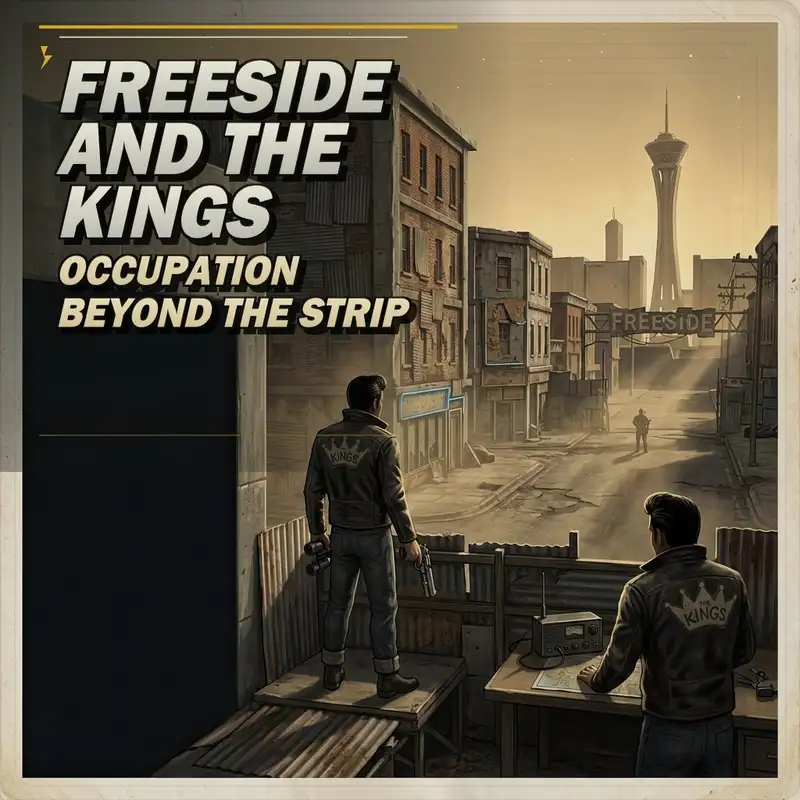
Freeside and the Kings: Occupation Beyond the Strip
At an N C R food-distribution point in Freeside, hunger becomes a border dispute. Armed personnel stand over scarce supplies intended mainly for citizens of the New California Republic. NCR refugees wait for rations in a district that is not formally NCR territory. Nearby, Freeside residents watch outsiders receive food under guard while their own neighborhoods remain poor, insecure, and politically neglected. To Major Elizabeth Kieran and the personnel assigned to her, this is a relief mission and a duty to vulnerable citizens. To many locals, it looks like an armed foreign foothold, supplied from outside and answerable to nobody in Freeside. To the Kings, it threatens their practical authority over the streets. To the Followers of the Apocalypse, it is another example of a preventable emergency becoming political because no one has built a system capable of feeding people fairly. This is why Freeside matters. It is not simply the rough district outside the Strip, nor an ungoverned space waiting for a stronger power to impose order. It is a populated political frontier. Several institutions claim different responsibilities there, and each offers a different answer to the basic question of who belongs. Mr. House claims New Vegas as a strategic and commercial project. The NCR claims obligations toward its citizens and growing influence in the Mojave. The Kings claim the authority that comes from being local, armed, recognizable, and present. The Followers claim no sovereignty at all, but they have earned trust by keeping people alive.
None of those claims entirely cancels the others. The resulting conflict resembles an occupation in one important sense. External power enters a neighborhood with guards, supplies, and political ambitions, but without settled consent from the people who already live there. Yet Freeside is not formally annexed, and the NCR is not conducting a conventional military occupation. The more useful description is external penetration into a district where authority is fragmented. The struggle is not mainly over a flag. It is over food, water, access, protection, and the right to decide who speaks for the streets beyond the Strip’s walls.
That dispute did not emerge because Freeside suddenly became unstable in the year twenty-two eighty-one. It grew out of the way Robert House rebuilt New Vegas. After the Great War, Las Vegas survived in better condition than much of the surrounding region, but survival did not immediately produce a functioning city-state. The ruins still required security, labor, infrastructure, trade, and a political order capable of enforcing decisions. Around the year twenty-two seventy-four, House re-emerged as the central power in the area. Through his Securitrons, his control of pre-War technology, and arrangements with the groups that became the Three Families, he consolidated the Strip. His achievement was real. The Strip became defended, illuminated, commercially active, and internationally important by Mojave standards. It offered gambling, lodging, employment, entertainment, and a controlled gateway into a city that had otherwise been devastated by nuclear war and decades of regional instability. But House’s reconstruction was selective. He restored the parts of New Vegas that could generate revenue, attract travelers, and support his strategic ambitions. He did not build equal civic institutions for everyone living near those walls. The Strip’s fortifications performed two functions at once. They protected an economically valuable center from outside threats, and they separated that center from the poorer district around it. Freeside became an access zone, a commercial margin, and a place where people excluded from the Strip’s wealth gathered. Travelers could arrive there. Workers could live there. Refugees could become stranded there.
Merchants, gangs, relief workers, addicts, prospectors, and people simply trying to survive could all find some place in Freeside, though seldom a secure one. The sources do not establish that House deliberately designed Freeside as a formal buffer district or an occupation zone. His private intentions are not fully documented. But the condition of Freeside was a foreseeable result of selective sovereignty. House controlled the city’s most profitable core while leaving the surrounding population to manage scarcity with weak institutions and uneven protection. His rule was strongest where security and commerce overlapped. It was weaker where governing would have meant public health, food distribution, conflict mediation, and equal protection for people who could not buy their way through the Strip’s gates. Where that gap opened, local institutions emerged.
The Kings were one of those institutions. By the year twenty-two eighty-one, Julie Farkas of the Followers describes them as having dominated Freeside for roughly five years. That places their consolidation sometime in the mid to late twenty-seventies, after House and the Three Families had disrupted older local arrangements. The exact sequence of every displaced tribe and neighborhood group is not fully established, and it need not be. What matters is that the Kings rose in a district where the old order had been broken, while the new order beyond the Strip’s walls remained incomplete. Their headquarters, the old School of Impersonation, gave them more than shelter. It supplied them with a cultural archive. The Kings found fragmentary material about a pre-War performer they understood simply as the King. They did not recover a reliable history of Elvis Presley, nor did they need one. They recovered gestures, clothing, music, and a style of public confidence. From those fragments they built an identity that was recognizable to their neighbors. In a place where most formal institutions had either failed, withdrawn, or arrived from outside, symbolism mattered. A familiar uniform, a shared manner of speech, a public gathering place, and a leader with a memorable title could do practical political work. The Kings’ style gave people a language for belonging. It suggested personal freedom, mutual respect, and a kind of local pride that did not require approval from the Strip or the NCR embassy.
That should not be mistaken for harmless pageantry. Cultural reconstruction became political organization. The King’s title may have begun as imitation, but in Freeside it became a claim to leadership. The gang’s image helped distinguish its members from ordinary street criminals and helped persuade residents that the Kings represented more than themselves. Their legitimacy was not constitutional. It came from familiarity, presence, reputation, and the expectation that they would respond when outsiders or local predators threatened the neighborhood. In that sense, the Kings did what many post-collapse authorities do. They turned a shared story into a practical claim on loyalty. But style alone could not keep order. The Kings mattered because they could make their symbols felt in the streets.
That authority was real, but it had limits. The Kings were not a municipal government with an elected council, a civil service, written law, a tax base, public works department, or reliable succession plan. They did not administer every building in Freeside, and they did not command every resident. The district still contained independent merchants, local businesses, thugs, addicts, families, travelers, and people with no interest in gang politics. Freeside remained dangerous. The Kings’ dominance meant that they were the most visible local force capable of deterring some kinds of violence and influencing who could operate openly in their territory. It did not mean they had created a monopoly on force or a stable civic order. The King ruled through personal authority. He was known, accessible, and treated by many residents as a broker who could settle problems or restrain his followers. That kind of leadership can be effective in a neighborhood where formal institutions are absent. A respected local leader often knows the people, grievances, routes, and threats that an outside government cannot see. He can move quickly because he does not need to navigate a large bureaucracy. He can also offer a sense of dignity to people who have been treated as expendable by richer powers nearby. Yet personal rule contains its own weakness. If authority depends on reputation and personal ties, it can be distorted by lieutenants, rivals, rumors, and fear. There is little institutional distance between a defensive patrol and a punitive gang action.
There is no transparent process to ensure that a lieutenant’s violence represents policy rather than private ambition. Pacer demonstrates that danger. He is not merely an unruly subordinate. He represents the structural problem of a local security organization whose cohesion depends partly on permanent vigilance against outsiders. A man who gains influence by identifying threats has little incentive to reduce fear. The Kings could curb large-scale disorder better than no one at all. They could make certain people think twice before preying on a neighbor. But they could not guarantee food, medical care, sanitation, education, or impartial justice. Their rule provided localized deterrence, not comprehensive government. The very conditions that made residents rely on them also made their authority vulnerable to escalation.
The Followers of the Apocalypse occupied a different position in Freeside. From the Old Mormon Fort, Julie Farkas and her colleagues provided the services that gang authority could not. They offered medical assistance, food, water, education, and community support in a district where all of those things were scarce. Their work was not glamorous, and it was not backed by a standing army. That made the Followers essential, but it also made them constrained. A doctor can treat a wound without controlling the road that brought the wounded person in. In Freeside, the Followers possessed a form of moral legitimacy that the other powers often lacked. Residents knew who treated the sick, who helped the poor, and who did not demand obedience in exchange for every act of assistance. But moral legitimacy is not the same as sovereignty. The Followers could not compel criminals to stand down. They could not regulate migration, guarantee clean water, or settle every dispute between local residents and NCR newcomers. Their position reveals a hard truth about humanitarian work in the wasteland.
Relief is not an alternative to politics. Whoever controls distribution determines whose needs are recognized. Whoever cannot protect a clinic may find that medical neutrality exists only until someone with a gun decides otherwise. Freeside had an informal division of labor. The Followers could address suffering that violence alone could never solve. Their limitations became more important as NCR citizens and refugees entered the neighborhood with needs, expectations, and legal claims of their own.
The New California Republic did not arrive in Freeside as a single actor. Its presence included civilians, refugees, soldiers, diplomats, supply officers, and people whose connection to the republic was simply citizenship. Ambassador Dennis Crocker represented the NCR’s political interests near the Strip. Major Elizabeth Kieran handled a narrower and more immediate responsibility, the distribution of food to NCR citizens in Freeside. NCR soldiers guarded personnel and supplies. Refugees sought safety, work, shelter, and access to the city. Those groups did not necessarily share the same objectives, but together they made the republic increasingly visible in a district whose daily political arrangements had developed without it. The NCR had practical reasons to care. It was fighting for influence in the Mojave and preparing for a larger confrontation over Hoover Dam. It needed to protect its citizens beyond its established lines. It had an interest in preventing violence against NCR civilians near New Vegas. It also had reason to expand its political influence around the Strip, where House remained independent and every local alliance could matter. Freeside was not decisive because it possessed a great factory, a dam, or a strategic arsenal. It mattered because it sat beside the Strip and along the routes through which people, information, commerce, and influence moved. A power unable to understand Freeside could still reach the Strip. But it would do so while remaining blind to the population living just outside its walls. For residents, the arrival of NCR refugees carried a different meaning.
Locals often used the word squatters. That term was not an objective description of every NCR citizen in the district. Many refugees were simply displaced people seeking survival. Still, the word captured a real resentment. New arrivals competed for food, water, shelter, employment, and space. More importantly, they appeared to carry the protection of a distant state. A hungry local resident could look at an NCR aid station and see evidence that citizenship, rather than need, determined who received help. The republic was not conducting a full annexation of Freeside. It had not established ordinary civil administration there, nor had it replaced the Kings with a permanent governing structure. But it was conducting a limited intervention with armed protection, humanitarian supplies, and growing political consequences. That was enough to unsettle an already fragile balance.
Relief became explosive because food and water were never merely humanitarian commodities in Freeside. They were evidence of power. Major Kieran’s distribution effort was constrained by orders, supplies, and the immediate responsibility to protect NCR citizens. The available dialogue suggests that an earlier plan may have been broader. An NCR representative was apparently meant to contact the King and arrange cooperation. After that effort failed, Kieran’s superiors restricted the mission. Her aid became narrower, more guarded, and more visibly tied to NCR citizenship. From an NCR administrative perspective, that decision had a logic. A supply officer cannot distribute stores that have not been allocated. She cannot easily expose personnel to a hostile crowd after an envoy has been beaten. She is accountable to a chain of command that expects her to protect citizens and prevent further losses. But from the street, the distinction between an administrative mandate and political favoritism was hard to see. Hungry people do not experience ration categories as neutral paperwork. They experience them as a judgment about whose hunger counts. The guards around the food point reinforced that message. Security was necessary because the situation was dangerous, yet every rifle also made the aid station look less like shared relief and more like protected foreign property. Water created similar resentments. Freeside’s water pump became a point of friction, particularly where NCR citizens could face higher charges. The available evidence does not justify treating that arrangement as a universal and formally codified Kings policy across every household.
It does show how basic infrastructure could become an instrument of exclusion. A pump is not simply a machine. In a water-scarce district, it is a gatekeeper. Whoever controls access can punish outsiders, reward allies, and demonstrate that formal citizenship does not automatically produce local acceptance. The civilian consequences ran in both directions. NCR refugees could feel threatened, isolated, and targeted because they were visibly associated with an outside power. Local residents could feel abandoned by the Strip, bypassed by NCR relief, and pressured by a population whose needs came with armed protection. Neither group needed to be collectively malicious for the conflict to deepen. Scarcity itself created a politics of comparison. Every ration received by one person became proof, in another person’s eyes, of a wider hierarchy. The crisis might still have been managed through communication. Instead, the channel meant to create that communication failed before it had properly begun.
The breakdown began with an attempted liaison between the NCR and the King. The precise details come through character testimony and quest dialogue rather than a complete neutral archive, so caution is necessary. The broad sequence is clear enough. An NCR envoy was sent into Kings territory to open discussions. That envoy was beaten. Kieran’s operation then became more restricted, and the NCR presence hardened around its own citizens and supplies. The Kings, or at least important members within the gang, interpreted NCR activity as hostile penetration. The republic interpreted violence against its representative and citizens as evidence that the Kings were pursuing a deliberate anti-NCR policy. Both sides responded to what they believed the other had already done. This was an intelligence failure as much as a security failure. There was no trusted liaison channel, no shared command structure, no mutually accepted investigation, and no mechanism for separating a lieutenant’s actions from the King’s intentions. In that environment, rumor became operational intelligence. An attack could be taken as official policy. A guarded ration point could be taken as the beginning of annexation. A defensive patrol could be read as preparation for a crackdown. Pacer benefited from that ambiguity. He presents the envoy as a spy and helps sustain the confrontation. Whether he personally directed every element of the incident is less important than the political role he played. He had reason to ensure that compromise looked like weakness and that the NCR appeared permanently hostile.
Men like Pacer thrive when local authority depends on fear of outsiders. Peace would strengthen the King as a broker and weaken those whose influence rests on militancy. The King, meanwhile, initially lacks full knowledge of the circumstances surrounding the envoy’s beating. That fact is central. It shows that the Kings’ authority, though real, was not fully disciplined. The King could be treated by outsiders as the sovereign voice of Freeside while lacking complete control over his own subordinates. Kieran faced the opposite problem. She belonged to a formal state with a chain of command, but that chain of command did not provide reliable neighborhood knowledge. Her guards could secure a small relief site. They could not tell her which local leader had authorized violence, which residents feared the NCR, or which rumor would trigger the next confrontation. The result was a self-reinforcing cycle. The NCR restricted aid and increased security because it feared attack. Local hostility rose because the restricted aid and armed presence appeared discriminatory and coercive. Each side treated the other’s defensive response as proof of offensive intent. At that point, a dispute over food and water had become an occupation-like political crisis, not because the NCR had formally taken Freeside, but because external force had entered local life without a relationship strong enough to make that force legitimate.
The NCR possessed advantages the Kings could not match. If the republic chose to use force, it could likely disperse or kill many Kings in a direct confrontation. To govern Freeside, the NCR would need more than a successful raid or a guarded ration point. It would need local intelligence, interpreters of neighborhood politics, trusted intermediaries, sustainable supplies, rules accepted by people who were not NCR citizens, and a way to distinguish active threats from ordinary residents trying to survive. The Mojave campaign already placed heavy demands on the republic. Hoover Dam, supply routes, diplomatic pressure, distant command decisions, and the threat of rival powers all competed for resources. It could not immediately replace the informal relationships through which merchants conducted business, residents learned who was dangerous, refugees found shelter, and relief workers reached the sick. A crackdown could remove the Kings’ visible authority while leaving the underlying causes of their authority intact. Hunger, exclusion, resentment, and the Strip’s selective development would still remain. In fact, coercion could deepen them. Residents who had tolerated the Kings as imperfect protectors might begin to see them as defenders against outside domination.
Others might become more vulnerable to ordinary predation after the gang’s deterrent role was shattered. This is the distinction between tactical suppression and political control. Tactical suppression removes or scatters an immediate adversary. Operational control allows movement, supply, and administration over time. Political control depends on some degree of acceptance, compliance, or at least resignation among the population. The NCR could pursue the first with superior arms. The latter two required legitimacy it had not yet earned. Ambassador Crocker’s later involvement suggests that the republic understood this problem, at least in part. Yet even his approach continued to frame Freeside through the state’s security obligations, especially the protection of NCR citizens harmed by local violence.
Crocker’s concern in the events surrounding Kings’ Gambit begins from a legitimate problem. NCR citizens in Freeside have been attacked, and the republic cannot simply ignore violence against people under its protection. He also identifies Pacer as a likely source of escalation. It shows that NCR representatives do not necessarily see the Kings as a single, unified enemy. They can distinguish between the King’s potential willingness to negotiate and Pacer’s interest in provoking a confrontation. But the options available to the NCR remain shaped by the habits of state power. It can seek diplomacy, intensify pressure, or resort to force. Each option carries different consequences, and the game deliberately allows the Courier to influence which path becomes possible. The Courier is not a fixed historical personality in this story. The Courier can uncover information about the failed liaison, reveal that the King did not necessarily authorize the original attack, facilitate negotiations, assist in removing Pacer, or help intensify a violent response. A negotiated solution does not require the NCR to abandon its citizens or the Kings to abandon Freeside. It requires each side to recognize that the other possesses a real claim, though not an unlimited one.
The NCR must accept that relief in Freeside cannot be treated solely as a service for NCR citizens if it is delivered in the middle of a hungry local community. The Kings must accept that defending local autonomy does not justify attacks on refugees or people whose only offense is carrying NCR papers. Removing or neutralizing Pacer can also reduce the immediate danger, but it introduces another question. A spoiler may be the obstacle to peace, yet outside involvement in eliminating him can make local authority appear dependent on foreign intervention. Violence against Pacer might prevent a broader clash, or it might confirm the narrative that the NCR manipulates Freeside from within. A direct confrontation offers the clearest display of force and the poorest answer to the underlying political problem. It can protect NCR personnel in the short term while teaching the district that conflict is the only language outsiders understand. The lesson here is not that the NCR is uniquely aggressive, nor that the Kings are uniquely noble. Both institutions contain people trying to protect others, people defending their own power, people acting on incomplete information, and people willing to let civilians pay for strategic mistakes. The question is whether they can build a relationship before fear turns every defensive measure into a cause for war.
The possible outcomes for Freeside make that question impossible to ignore. In one branch, cooperation between the NCR and the Kings allows relief to reach a wider population while the Kings retain their independence. This is not a perfect solution. Freeside does not suddenly become a wealthy, fully governed city. The Followers do not gain unlimited medicine, the Kings do not become a professional civil administration, and the NCR does not cease to pursue influence in New Vegas. But cooperation changes the political meaning of aid. Food is no longer simply a guarded privilege for one group. It becomes part of a negotiated arrangement in which local authority is recognized rather than bypassed. The tactical result is reduced violence. The political result is stronger local legitimacy for the settlement. The civilian result is the most important one, because more people can receive help without being forced to choose between hunger and submission. Other branches are harsher. NCR military suppression may produce immediate security for NCR interests. It can remove an armed obstacle and demonstrate that attacks on NCR citizens carry consequences. Yet it weakens local autonomy and risks leaving behind a district that is quieter but less trusting. Security achieved through intimidation may be real in the short term, but it is expensive to maintain and poor at producing consent. A branch in which the Kings turn violently against NCR residents reveals the opposite failure. Local nationalism becomes collective punishment.
The Kings’ original claim to protect Freeside is corrupted when protection is defined by excluding or attacking civilians associated with an outside power. The district may preserve a measure of independence, but it does so by narrowing the community worthy of protection. House’s possible responses reveal the limits of his own system. He can tolerate the Kings when they help keep Freeside manageable and avoid threatening the Strip’s wider interests. He can also eliminate them if they become disruptive enough. That is indirect rule in its starkest form. Local autonomy is acceptable so long as it remains useful to the power behind the wall. A Legion victory would not represent a neutral change in administration. The destruction or enslavement of the Kings would replace a fractured local order with conquest, terror, and a far more openly coercive hierarchy. None of these conditional futures can be combined into one settled history. Later depictions of New Vegas, including the television series’ return to the region, do not establish which specific path occurred in the year twenty-two eighty-one. What the branches do establish is the nature of the struggle. Freeside is a test of whether New Vegas can become a political community rather than a profitable enclave surrounded by people expected to absorb the costs of its survival.
The answer to the question of who governs Freeside is therefore uncomfortable. No one governs it completely. House owns the strategic center of New Vegas and controls the security apparatus that makes the Strip possible, but he does not provide equal protection beyond its walls. The NCR can bring supplies, armed personnel, diplomatic pressure, and the authority of a republic, but its power in Freeside remains politically shallow when it treats local hunger as secondary to the needs of its own citizens. The Followers sustain life where they can, and their work gives them deep moral credibility, but they do not possess the coercive capacity or material abundance needed to govern a district in crisis. The Kings regulate the streets through local recognition, force, and personal relationships. Their authority is real because people live with it every day. It is also incomplete because it rests on fragile leadership, scarce resources, and followers who can turn protection into exclusion. Freeside is not a blank space outside New Vegas authority. It is a politically inhabited district where several incomplete forms of authority overlap without becoming a stable civic order. That is why the aid station matters more than it first appears. It is not merely a place where food changes hands. It is a visible argument about belonging. The guards, ration lines, water access, rumors, and bruised envoy all ask whether the people beyond the Strip are citizens, clients, obstacles, neighbors, or subjects.
External power can enter Freeside with rifles and supplies. It can punish violence, protect its own people, and even remove local leaders. But it cannot create durable order by treating relief as a technical delivery problem and hungry residents as an inconvenience around its own citizens. The Kings can defend local autonomy, but they cannot make that autonomy durable when fear, scarcity, and internal spoilers transform neighborhood protection into hostility toward everyone outside it. Beyond the Strip, authority belongs to those who can feed people, protect them, listen to them, and persuade them that the order being built includes them.