Lyons’ Pride and the Brotherhood’s New Mission
Liberty Prime moved through the ruins toward Jefferson Memorial with the blunt certainty of a weapon built for a different war. Behind and around it came Brotherhood troops, including the handpicked fighters known as Lyons’ Pride. Their immediate objective was an Enclave-held water purifier. That fact mattered as much as the battle itself. The Brotherhood of Steel had been founded to secure advanced technology from a world that had destroyed itself with advanced technology. Yet in the year twenty-two seventy-seven, its eastern chapter was committing some of its most valuable weapons, personnel, and technical resources to a simpler purpose. It was fighting so that people in the Capital Wasteland might have clean water to drink.
The assault did not settle every question around Project Purity. The final operation involved choices that could vary with the actions of the Vault Dweller at its center, including decisions about the purifier and the Enclave’s modified Forced Evolutionary Virus plan. But the larger historical fact is fixed. Elder Owyn Lyons’ Brotherhood chose to attack the Enclave, secure the purifier, and support a project intended to make clean water available beyond a single defended settlement. That was not the mission Lyons had brought east.
Around the year twenty-two fifty-five, Lyons led a Brotherhood expedition from the western territories toward the Capital Wasteland. Its original mandate followed the Brotherhood’s established priorities. The eastern ruins contained military installations, scientific facilities, weapons systems, records, and industrial knowledge from before the Great War. These were not empty trophies. In Brotherhood thinking, dangerous technology had helped destroy the old world, and uncontrolled technology could destroy what remained of the new one. Recovering it, studying it, and keeping it out of irresponsible hands was therefore presented as a duty.
The expedition found a region where that duty could not remain abstract for long. The Capital Wasteland was not an empty battlefield waiting for a flag. It contained scattered settlements, trading posts, technical enclaves, farms where the land permitted them, and communities surviving around damaged infrastructure. It also contained poisoned water, ruined roads, unstable ruins, raider groups, feral ghouls, and dangers that made ordinary movement a military problem. A settlement might survive because it controlled a water pump, a defensible market, a bridge, or a few reliable guards. It might fail when any one of those things was lost.
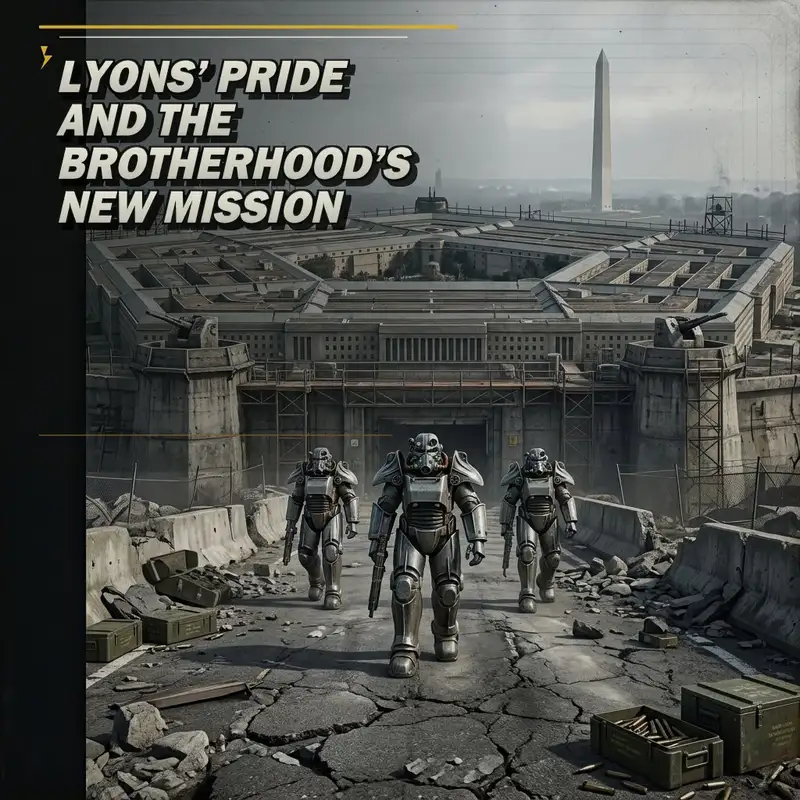
Lyons established his headquarters in the ruins of the Pentagon, which the Brotherhood called the Citadel. It was an obvious military choice. The complex offered thick defenses, old-world infrastructure, workshops, storage, space for scribes and soldiers, and symbolic weight. But the Citadel was not a self-sustaining fortress from a pre-War civil-defense brochure. Its value depended on people who could repair systems, secure approaches, obtain parts, train personnel, move supplies, and make difficult decisions about where scarce resources would go.
The eastern expedition had arrived to recover the remains of American military and scientific power. Instead, it found itself living beside one of the region’s most immediate security crises. The Capital Wasteland’s super mutants were not a surviving branch of the Master’s Unity from California, and they were not simply another variation of every mutant group seen elsewhere. They were a local population shaped by the history of Vault Eighty-Seven and the Forced Evolutionary Virus experiments conducted there. Their origins mattered because they explained why the threat was so deeply rooted in the region rather than an outside army that could simply be driven away.
For ordinary communities, the distinction was less important than the raids. Super mutants moved through the ruins and contested urban corridors. They attacked travelers, seized captives, and made key routes dangerous. The Mall, Chevy Chase, and the corridors around Galaxy News Radio became especially dangerous ground because ruined federal buildings offered cover, elevation, chokepoints, and access to old infrastructure. Dense urban terrain reduced the value of broad maneuver and forced small units to clear streets, buildings, and intersections where visibility was poor and ambush was always possible.
The Brotherhood had superior weapons, power armor, training, and technical knowledge. None of that made it large enough to occupy the Capital Wasteland block by block. A chapter could clear one route and see another become dangerous. It could protect one community and lack the manpower to remain there indefinitely. It could destroy a mutant patrol without solving the larger system that produced more threats. The central military problem was not winning individual firefights. It was deciding where a small force could create enough security to matter.
Lyons’ answer was a doctrinal shift, though not a clean break with everything the Brotherhood had inherited. He came to believe that the technology under his command had an immediate purpose. It could protect people who were alive now. In the Capital Wasteland, recovering weapons and machines while leaving nearby communities exposed to super mutants was not simply an austere reading of duty. To Lyons, it had become a failure to understand why such power should be preserved at all.
That decision had a moral dimension, but it was not merely sentimental. Protecting settlements created operational benefits. Communities could provide local knowledge, warning, shelter, trade, labor, and information about threats moving through the region. A force that defended people could gain cooperation that a sealed military order would never receive. It could also gain legitimacy. In a wasteland where many armed groups took food, demanded tribute, or disappeared behind their walls, an organization that visibly fought super mutants and guarded civilians acquired a political reputation whether it intended to become a government or not.
The difficulty was that the Brotherhood had not been designed as a broad humanitarian administration. It was a hierarchical military and technical order. Its ranks, traditions, and institutional habits were built around preserving knowledge and controlling access to dangerous systems. Lyons did not discard those priorities. His chapter still collected technology. It still sent scribes to examine machines, repair weapons, catalog discoveries, and recover equipment from ruins. It still guarded advanced systems from people it considered incapable of using them responsibly.
What changed was the order of priorities. In Lyons’ interpretation, technology was no longer the final object of the mission. It was a means to a human end. Power armor mattered because it allowed a trained soldier to face threats that ordinary settlers could not. Energy weapons mattered because they gave small units greater combat power. Old-world records mattered because they might reveal a working facility, a medical solution, a source of water, or a military danger. The Brotherhood’s inherited tools were being used to preserve communities, not merely to build an archive behind defended walls.
That distinction sounded manageable in principle. In practice, it altered almost every allocation decision. Every patrol sent to defend a road was a patrol not searching a ruin. Every suit of armor assigned to a civilian-protection operation required maintenance, ammunition, spare parts, trained operators, and recovery capability. Every scribe working on a water system or a local defense problem was not examining some other piece of recovered technology. A chapter with abundant manpower and stable industry might have absorbed those demands. Lyons commanded neither.
The best-known expression of his military approach was Lyons’ Pride. The name is sometimes used too broadly, as if it described the entire eastern Brotherhood. It did not. Lyons’ Pride was Sarah Lyons’ elite field formation, selected from the chapter’s most capable personnel. It represented a scarce concentration of experience, discipline, technical equipment, and combat effectiveness. Its members operated in some of the Capital Wasteland’s most contested areas, including the Mall, Chevy Chase, and the territory around Galaxy News Radio.
Sarah Lyons was the daughter of Owyn Lyons, but her importance cannot be reduced to family connection. She held the rank of Sentinel and served as a senior field commander. The trust placed in her reflected the chapter’s need for officers who could translate the elder’s broad purpose into combat decisions. In a chapter spread thin across dangerous terrain, leadership in the field mattered. Patrols could not wait for every decision to travel back through the Citadel. They needed commanders who understood the threat, could judge risk, and could hold a small unit together under pressure.
Lyons’ Pride gave the Brotherhood a tool for difficult missions. It could reinforce endangered positions, strike super mutant concentrations, escort high-value personnel, and operate where ordinary guards or isolated settlers could not. The formation’s reputation came from that role. It was not a conventional army division, and the surviving record does not provide a complete order of battle, roster, or formal doctrine manual. What it shows is an elite unit used where the chapter needed a reliable answer to urgent danger.
That strength also revealed a weakness. An elite formation is valuable precisely because it cannot be everywhere. If Lyons’ Pride was protecting one approach, clearing one urban route, or preparing for one assault, it was unavailable for another. The Brotherhood’s technology amplified its limited manpower, but it did not abolish the limits. Power armor could make a soldier more resilient. It could not create more trained soldiers. Energy weapons could improve firepower. They could not repair roads, escort every caravan, maintain every outpost, or provide permanent security to a dispersed population.
Sarah’s command therefore became part of a larger institutional pattern. The eastern Brotherhood was increasingly dependent on a small number of exceptional people and exceptional assets. Owyn Lyons provided the strategic interpretation. Sarah Lyons provided visible battlefield leadership. Senior Scribe Reginald Rothchild and other technical personnel made complex systems usable. Lyons’ Pride delivered high-quality field performance. This combination could accomplish a great deal. It also meant that the chapter had little redundancy. When a system depends heavily on a few leaders and specialists, every loss becomes more than a casualty. It becomes an institutional shock.
Not everyone in the Brotherhood accepted Lyons’ new emphasis. By approximately the year twenty-two seventy-six, the disagreement had hardened into a schism. Paladin Henry Casdin and other traditionalists broke from Lyons’ command and established themselves at Fort Independence. They became known as the Brotherhood Outcasts.
The Outcasts were not simply rebels who disliked helping civilians, and Lyons’ loyalists were not a uniform body of saints in power armor. The split concerned authority, doctrine, and resources. Casdin’s faction believed that Lyons had abandoned the Brotherhood’s central obligation by diverting personnel, equipment, and attention toward the defense of wasteland communities. From their perspective, the chapter had been sent east to recover technology and restore contact with the Brotherhood’s western leadership. It had instead become entangled in local conflicts that consumed lives and materiel without advancing the order’s original mission.
That argument had practical force. The Capital Wasteland could absorb an endless supply of security commitments. Every settlement under threat could ask for protection. Every mutant attack could create another emergency. Every rumor of a raider concentration, a dangerous machine, or an unstable facility could demand attention. A military organization without clear limits could exhaust itself trying to become the answer to every local problem. The Outcasts believed that the Brotherhood’s survival required discipline, concentration, and a return to its technological purpose.
Lyons saw the same problem from the opposite direction. An organization that had the weapons to intervene, the training to understand the danger, and the ability to protect people could not claim moral neutrality by refusing to act. Recovering technology while communities suffered around the Brotherhood’s bases would not preserve the Brotherhood’s purpose. It would hollow it out. Lyons did not necessarily see civilian protection as an endless obligation. But he believed the chapter’s power imposed responsibilities that the old mission statement did not fully capture.
The schism made both sides weaker in different ways. The Outcasts lost access to the Citadel’s central command structure and to Lyons’ broader local relationships. Lyons lost trained personnel, equipment, and institutional cohesion. In a larger state, a doctrinal dispute might have been managed through councils, elections, formal review, or a stable chain of command. The eastern Brotherhood had none of those safeguards in a robust form. It was an expeditionary order operating far from its traditional center of authority. Once trust broke down, there was no obvious civilian institution capable of reconciling the dispute.
Fort Independence became more than a separate base. It became a statement about what the Brotherhood should be. The Outcasts concentrated on technology recovery and retained hope of reconnecting with western authority. Lyons’ Brotherhood remained at the Citadel and deepened its ties to the Capital Wasteland’s local struggles. Neither side could entirely escape the other’s argument. Technology mattered. Civilians mattered. The real question was which obligation governed when the chapter lacked the resources to fully meet both. That question became unavoidable when Project Purity moved from aspiration to strategic prize.
Project Purity was not a Brotherhood invention. Its scientific foundation came from James and the other researchers who worked to restore the Jefferson Memorial water purifier. Rivet City mattered as a source of technical knowledge, people, and regional connection. The Brotherhood supplied security, military capacity, and access to equipment. It did not independently create the purifier’s scientific program, and it could not have made the project succeed through force alone. A water treatment system is not a fortress. It requires scientific expertise, functioning components, power, labor, and a network able to move the resulting water to people who need it.
The Enclave understood the purifier’s importance as well. It possessed a more conventional military structure than most Capital Wasteland organizations, along with advanced armor, Vertibirds, Raven Rock, and the remnants of old-world command systems. Yet equipment did not give the Enclave political legitimacy. Its claims to represent the old United States were not enough to make frightened settlements accept its rule. The Enclave’s plan for Project Purity showed the difference between controlling infrastructure and governing a population.
Clean water could become a source of influence, dependence, and coercion. Whoever controlled it could determine who received it, on what terms, and under what political order. The Enclave also pursued a modified Forced Evolutionary Virus plan that would have turned the purifier into an instrument of mass killing. The details of whether that plan was activated depend on player action, but the threat itself demonstrates the stakes. The purifier was not just a machine. It was a regional life-support system vulnerable to capture by an authoritarian military remnant.
For Lyons, the conflict gave his reform its clearest strategic purpose. The Brotherhood could have viewed the Jefferson Memorial as another valuable technological site, one more asset to secure from dangerous hands. Instead, it treated the purifier as infrastructure whose value depended on the people it could sustain. That did not make the Brotherhood a civilian government. It did make its war against the Enclave politically different from a simple contest over salvage.
The campaign required more than direct assault. The Brotherhood and its allies had to identify Enclave positions, understand the significance of Raven Rock, recover technical components, assess reports from scientists and wasteland informants, and determine how the Enclave intended to use the purifier. Information came from many sources, each with limits. Brotherhood personnel understood their own capabilities but not necessarily Enclave intentions. Scientists understood the purifier but could not secure it alone. Civilian broadcasters and local contacts could spread warnings and build awareness, but they were not intelligence agencies. Enclave records and statements could reveal plans while also serving propaganda or internal control.
This was the kind of campaign in which no one source was sufficient. The Brotherhood’s advantage came from combining military discipline, technical expertise, local knowledge, and the intervention of the Vault Dweller whose actions could alter key outcomes. The chapter’s humanitarian orientation gave it a reason to build those relationships. Its traditional technical culture gave it the ability to use recovered systems once they were found.
When the battle for the Jefferson Memorial came, Liberty Prime became the most visible symbol of that combination. The enormous pre-War robot was a decisive local assault asset. It could break through Enclave defenses that would have imposed far greater costs on ordinary Brotherhood troops. Its presence altered the tactical problem. A fortified enemy position that might have required prolonged attrition could be approached behind the protection of an exceptional machine.
But Liberty Prime was not a self-deploying answer to history. Before it could fight, it had to be restored. That required scribal expertise, engineering work, recovered components, power, workshop capacity, and the protection of the people doing the work. It had to be integrated into a plan. Brotherhood personnel still had to secure ground around it, communicate, deal with threats it could not solve on its own, and seize the physical infrastructure at the memorial. Scientists still had to understand and operate the purifier. The Vault Dweller still played a critical role whose exact actions cannot be reduced to one universal account.
In the immediate fight, Liberty Prime helped break the Enclave’s defensive position. Across the wider campaign, victory depended on a broader system of people, intelligence, maintenance, and command. At the level of regional power, the question remained unresolved even after the guns fell silent. Could the Brotherhood convert battlefield success into a durable regional order?
Destroying an enemy position is not the same as governing the people who live beyond it. Capturing a water purifier is not the same as ensuring that water reaches distant communities. A military order can secure a facility, but a regional water system requires transport, handling, protection, repairs, schedules, storage, and some accepted method for deciding who receives supplies first when demand exceeds capacity.
Broken Steel shows the Brotherhood confronting that less glamorous phase of victory. The Enclave had been badly damaged, but surviving forces remained dangerous. The chapter continued operations against Enclave remnants, pursued technology recovery, and attempted to establish water distribution across the Capital Wasteland. Paladin Tristan emerged as an important field commander during this period, reflecting the continued need for capable officers beyond the original assault. The conflict had shifted from one decisive operation to a dispersed campaign of pursuit, security, technical recovery, and protection of infrastructure.
Water distribution imposed its own campaign map. Purified water had to be bottled or otherwise handled, loaded, moved, guarded, and delivered. Technical teams had to keep systems functioning. Routes had to be watched for raiders, super mutants, theft, ambushes, and disruption by surviving Enclave forces. A shipment could be lost not because the purifier failed, but because a road became impassable, guards were diverted, containers were stolen, or a local community lacked the means to store and distribute what arrived.
The Brotherhood’s choice to provide water without charging ordinary recipients strengthened its claim to protect the region. It also increased the burden on the chapter. Free distribution was not free in material terms. Someone had to maintain the equipment. Someone had to move the cargo. Someone had to defend the convoy. Someone had to make hard choices when demand outpaced supply. The water project required personnel who might otherwise have been assigned to combat patrols, repair work, intelligence gathering, or the recovery of advanced technology.
This was the central logistical contradiction of Lyons’ mission. The more successfully the Brotherhood made itself responsible for regional survival, the more responsibilities it acquired. A water purifier could reduce one of the Capital Wasteland’s most severe constraints, but only if an institution could sustain the distribution system around it. The Brotherhood was capable of beginning that effort. It had not become a large civilian administration with broad representation, taxation authority, public works departments, and a stable network of local governments.
Its protection remained paternal. The chapter could decide to defend a settlement, escort a shipment, or share water. It could do so generously and with real courage. But local civilians did not thereby gain equal authority over Brotherhood priorities. They were recipients of security rather than partners in a developed political system. That distinction mattered because durable reconstruction requires more than benevolent command. It requires institutions that can survive changes in leadership, settle disputes, manage resources, and build consent among people who are not members of the military order.
Lyons’ Brotherhood achieved genuine successes. Tactically, it defeated important Enclave positions and reduced immediate threats around critical sites. Operationally, it secured Project Purity and began the difficult work of getting clean water into the region. Strategically, it became one of the Capital Wasteland’s central powers rather than an isolated expedition hiding behind a fortified base. Politically, it gained legitimacy among people who had seen its soldiers fight super mutants, defend positions, and support a water project that could improve daily life.
For civilians, those gains were not imaginary. Clean water could mean fewer deaths from contamination, less dependence on dangerous sources, better prospects for trade, and more resilience for settlements already surviving near the edge. But the improvement was uneven and vulnerable. The Brotherhood did not control every road or settlement. It did not eliminate every super mutant threat. It did not create a stable regional government. The same dangers that made water valuable also made its distribution fragile.
Institutionally, the chapter remained strained. It had lost the Outcasts’ personnel and equipment. It depended on scarce specialists. It had to maintain advanced systems whose replacement parts and technical knowledge could not be assumed. It relied heavily on a narrow leadership circle and on rare assets like Liberty Prime. It had proven that its technology could serve a social mission. It had not solved the problem of how to sustain that mission across years, casualties, leadership transitions, and competing demands.
The later fate of Owyn Lyons and Sarah Lyons makes that weakness clearer. The exact chronology is incomplete, and the surviving record does not provide a detailed account of every transition. What is established is that Owyn Lyons died after the events of Project Purity. Sarah Lyons succeeded him as elder. She was later killed in action. After her death, the Eastern Brotherhood passed through several ineffective elders and became fragmented before Arthur Maxson eventually assumed command and reunified it.
The lack of detail is important. It prevents a neat story in which one battle, one betrayal, or one personal failing explains the decline. The deeper problem was structural. Lyons’ version of the Brotherhood depended on an elder whose authority could hold together a disputed interpretation of the mission. It depended on Sarah’s battlefield credibility, on elite troops such as Lyons’ Pride, on technical specialists who could preserve rare systems, and on the continued ability to allocate limited resources between protection, recovery, repair, and war.
When Owyn and Sarah were gone, unresolved questions became harder to contain. How much of the chapter’s strength should go to civilian protection? How much should go to technology recovery? Who had the authority to decide? Could the Brotherhood remain a regional protector without exhausting itself? Could it reestablish discipline without returning to the isolation that Lyons had rejected? These were not merely philosophical debates. They determined where soldiers went, which machines were repaired, which routes were guarded, and which communities received help.
Arthur Maxson’s later leadership must be understood against that background. By the year twenty-two eighty-seven, the Eastern Brotherhood had become more mobile, more militarized, and more visibly focused on controlling advanced technology. It possessed the capacity for major expeditions beyond the Capital Wasteland. Its airship, Vertibirds, power armor forces, scribal infrastructure, and command system reflected a chapter that had regained cohesion and confidence.
Some Brotherhood accounts from this later period describe Lyons’ administration as excessively charitable or insufficiently faithful to the Brotherhood’s technological mission. Those views are evidence of institutional memory and political restoration. They are not an impartial verdict. Leaders who reunify a fragmented organization often define their legitimacy against the failures of their predecessors. Maxson’s Brotherhood had reasons to emphasize discipline, technological control, and military purpose. That did not mean Lyons’ achievements were imaginary, or that the problems he faced could have been solved by collecting artifacts and ignoring the Capital Wasteland around him.
Maxson also inherited much from the order he reshaped. He inherited the Eastern Brotherhood’s infrastructure, its regional experience, its technical personnel, its military reputation, and the prestige earned through the conflict with the Enclave and the defense of Project Purity. The chapter’s ability to act as a major regional power did not emerge from nothing. It grew from the very expansion of purpose that Lyons had begun, even if Maxson gave that power a harder and more centralized expression.
Lyons’ new mission was neither a sentimental abandonment of the Brotherhood nor a complete answer to the Capital Wasteland’s problems. It was a strategic reorientation that made advanced technology serve immediate human survival. That choice gave the Eastern Brotherhood its strongest victories and its broadest local legitimacy. It also imposed demands that a small expeditionary military order was never designed to sustain on its own.
The lasting lesson is not that Lyons failed because he defended civilians. He demonstrated that technology without a social mission produces isolation, and that military power gains meaning when it protects people from the dangers they cannot face alone. But he also demonstrated that protection needs more than valor, elite troops, and exceptional machines. It needs durable logistics, a reliable succession system, and civilian institutions capable of carrying responsibility beyond the lives of the leaders who first accepted it.