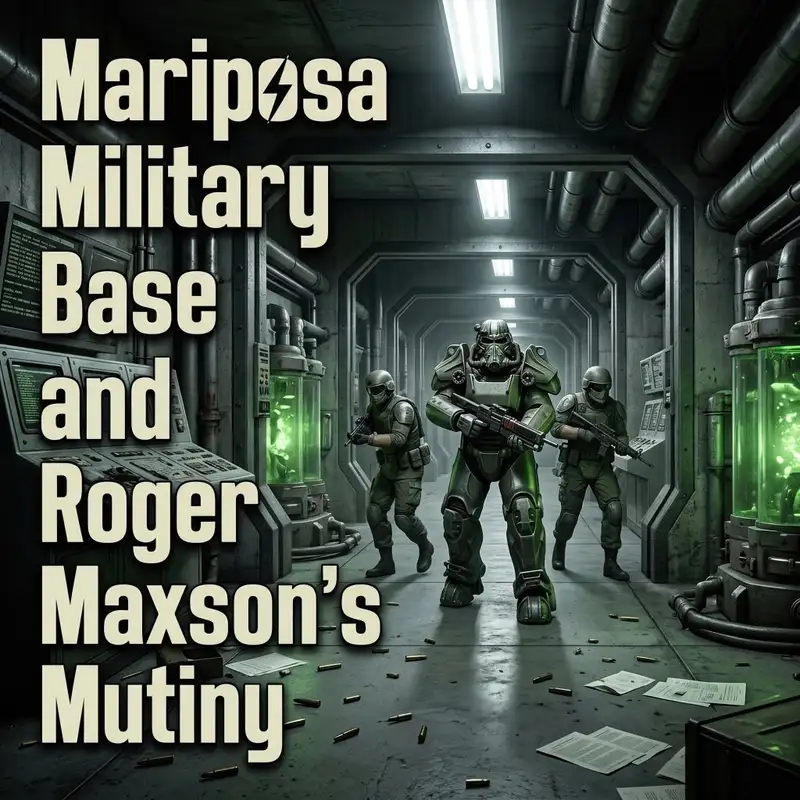
Mariposa Military Base and Roger Maxson’s Mutiny
On October tenth, twenty seventy-seven, a military security force at a classified research base in California discovered what it had been guarding. Behind the restricted doors of Mariposa, human beings had been used as subjects in experiments involving the Forced Evolutionary Virus. The soldiers had weapons, authority over the perimeter, and responsibility for the facility’s security. They had not been given enough information to understand the work inside it. Now that secrecy had failed. Colonel Robert Spindel, the base’s senior officer, withdrew into his office as anger moved through the ranks. Men under his command wanted the scientists dead. Captain Roger Maxson found himself trying to stop a killing before deciding what command, law, or government still meant inside the base. That moment is often remembered as the beginning of the Brotherhood of Steel. At the time, it was something less orderly and more dangerous. It was a breakdown in military discipline caused by the discovery that a military installation had been protecting an atrocity.
Mariposa was not simply a bunker, nor was it merely the ruined site later associated with super mutants and the Master’s Army. In October twenty seventy-seven, it was a military-secured biological research complex tied to West Tek’s virus program. It combined laboratories, containment systems, military security, imprisoned or controlled human subjects, technical staff, and the physical infrastructure needed to conduct dangerous research away from public scrutiny. Its purpose depended on a contradiction common to authoritarian security systems. The guards had to be reliable enough to defend the secret, but uninformed enough not to question it. They were expected to protect a mission whose moral and strategic meaning had been withheld from them.
Mariposa’s security arrangement contained a built-in danger. The soldiers guarding the base possessed weapons and practical control of the perimeter, while the scientists possessed the knowledge that explained what the installation was actually doing. Each group depended on the other, yet secrecy prevented the guards from understanding the moral stakes of the mission until they discovered the evidence themselves.
The program had begun under West Tek with the language of disease resistance and human improvement, then shifted toward military transformation. By the time the work reached Mariposa, the distinction between medical research and weapons development had largely collapsed. The records do not establish every individual order or motive, but they do establish a system in which institutional purpose had outrun moral restraint and human beings were being used as experimental material.
The security personnel assigned to Mariposa were not yet revolutionaries, founders of a new order, or members of anything called the Brotherhood of Steel. They were soldiers stationed at a sensitive installation. Colonel Spindel held senior command. Captain Maxson occupied a crucial subordinate role, close enough to the troops and daily operations to become the practical center of authority once the crisis began. The exact size of the force is not securely established. Neither is a complete unit designation, a detailed order of battle, or a reliable record of every person at the base. That uncertainty is worth preserving. Later legend can make Mariposa seem like the headquarters of a vast military revolt. The released record supports something more local: a security detachment confronting the collapse of trust within its own installation.
The soldiers had been asked to safeguard a facility without meaningful access to the reason it required safeguarding. That did not merely leave them uninformed. It placed them in moral danger. A guard who learns that prisoners have been abused, infected, altered, or killed under the protection of his own uniform may feel betrayed by the institution he serves. Military discipline depends on more than fear of punishment. It depends on confidence that orders fit within a recognizable chain of responsibility. Soldiers can endure hardship, secrecy, and risk when they believe someone above them remains answerable for the mission. At Mariposa, that confidence dissolved.
The discovery also created an immediate security problem. Angry armed personnel, frightened scientists, prisoners or test subjects, dangerous biological material, automated systems, and an officer corps under strain are a volatile combination in any era. The danger was not only that the scientists might escape or destroy evidence. It was that the guards might turn punishment into revenge before anyone had established the facts, secured the laboratories, separated the responsible from the uninformed, or determined whether the program still had outside direction. By October tenth, those distinctions were already beginning to fail.
Maxson’s diary describes a force on the edge of disorder. The troops demanded blood. Spindel had effectively removed himself from the crisis by locking himself in his office. Maxson feared that the base was sliding into anarchy. That word should not be treated as a dramatic flourish. It identifies the central military problem. A security force can lose cohesion before it loses its weapons. The perimeter may remain guarded, the armory may remain locked, and the radios may still function, yet command can collapse when subordinates no longer accept that their superiors have moral authority over them.
On October twelfth, Maxson stopped one of his soldiers from killing a scientist. He ordered interrogations instead. In the immediate sense, this was an act of restraint. It prevented an uncontrolled murder and imposed a temporary procedure on a force whose anger was threatening to become collective violence. Maxson did not simply unleash his troops against the research staff at the first discovery. He recognized that a mob killing would destroy discipline as surely as the experiments had destroyed trust.
Yet this was also the beginning of a more ambiguous authority. Maxson was acting as a commander because the senior commander no longer appeared capable of command. The crisis had not produced a formal transfer of authority, a clear order from higher headquarters, or a functioning military investigation. Maxson’s authority was practical. Armed soldiers followed him because someone had to restore control, not because the legal system had clearly placed the base under his independent command. That distinction would become more important with every day that passed.
At this stage, the events at Mariposa were not a completed ideological rebellion. There was no fully articulated Brotherhood doctrine, no settled creed of technology preservation, and no evidence that the guards had designed a replacement for the United States military. There was a captain trying to prevent a massacre in a sealed facility where the chain of command had become morally compromised and operationally unreliable. His first task was not state-building. It was to keep armed men from killing civilians before he knew what they knew.
Interrogation offered at least the possibility of a different path. Scientists could have been confined. Records could have been secured. The chain of authorization could have been traced as far as surviving communications allowed. A military court, a federal investigation, or some future authority might have judged individual responsibility. Even in a collapsing state, those measures would have mattered. They would have separated refusal to protect atrocity from the assumption that outrage itself grants unlimited power. Mariposa did not follow that path.
Maxson interrogated Robert Anderson, identified as the chief scientist. Anderson claimed that the experiments had been authorized by the government and that he had been following orders. The surviving diary records Maxson’s response: he rejected the explanation and shot Anderson. Anderson’s claim cannot establish the whole chain of responsibility by itself. It does not prove that every experiment had been directed from the presidency, that every federal office knew what was happening, or that a single unified command had personally approved each act at Mariposa. It does, however, fit the broader evidence that the project had state and military sponsorship. Anderson was not describing an isolated private crime hidden from every institution. He was invoking the authority of the government that had placed the work under protection.
The moral force of Maxson’s anger is easy to understand. Human experimentation had been concealed behind classification. The scientists had used the language of national security to defend work that violated the people subjected to it. Anderson’s appeal to orders was not a sufficient moral defense. A government order can explain why someone acted. It does not automatically absolve the act. The soldiers at Mariposa had discovered that obedience was being used as a shield by people whose work depended on helpless human beings.
But Maxson’s killing of Anderson was not a lawful investigation, a court-martial, or a battlefield necessity established by the record. It was a summary execution carried out by a captain in a command crisis. The difference matters because it changed the character of the revolt. A refusal to guard illegal human experimentation can be understood as moral resistance. The moment Maxson assumed the power to interrogate and execute without due process, he moved from resisting institutional crime into exercising personal authority over life and death.
None of this makes the scientists blameless, but neither does it turn summary execution into lawful accountability. A living witness can identify supervisors, procedures, communications, funding channels, and the decisions that produced an abusive program. Killing that witness may satisfy anger while destroying information that could reveal how responsibility was distributed beyond the room in which the execution occurred.
That problem became more serious as Colonel Spindel’s authority collapsed. His death did not amount to a formal transfer of command, yet someone still had to control armed personnel, protect the families and civilians on the base, secure dangerous research, and decide whether contact with outside authorities was possible. Maxson increasingly possessed practical control without a functioning legal framework to define what that control allowed him to do.
The surviving record does not tell us exactly which communications remained available or what higher headquarters knew. That uncertainty matters because isolation can turn emergency discretion into something much larger. As interrogation shifted toward retribution, Maxson’s force was no longer simply preserving evidence or protecting endangered personnel. It was becoming an armed authority making life-and-death decisions on its own.
Government authorization, if it existed as the scientists claimed, would not make the experiments just. It would widen the indictment. It might also distribute responsibility differently among researchers, supervisors, military sponsors, and officials who approved or ignored the work. The record does not settle every individual case, and Maxson’s detachment did not wait for a court or outside investigation that might never arrive.
For civilians at Mariposa, that distinction offered little immediate protection. Scientists, technicians, dependents, and other noncombatants were inside a sealed military crisis whose normal institutions had already begun to fail. Maxson’s revolt was morally understandable as a response to human experimentation, but it was not a clean rescue operation. The force that stopped one abuse was simultaneously creating a new authority whose limits had not yet been defined.
On October twentieth, Maxson made the political break explicit. He declared that his unit had seceded from the United States military. The language was extraordinary. Soldiers are trained to think in terms of orders, transfers, deployments, and disobedience. Secession is the language of political separation. Maxson was no longer merely refusing a mission or denouncing a criminal program. He was asserting that his force had withdrawn from the authority of the state that had created it.
The declaration was both rebellion and a test. Maxson expected the government to react. He did not receive a response. That silence mattered, though it must be interpreted carefully. It does not prove that every level of the federal government had vanished or agreed with him. It does not prove a nationwide military uprising. It proves that, from Mariposa’s perspective, the command system failed to answer an open declaration of disobedience at a moment of severe internal crisis. The soldiers had learned that their mission was morally compromised. Now they learned that the authority they had rejected was either unable or unwilling to respond.
Secession did not create a state. It did not produce a constitution, define civilian rights, settle succession, create courts, establish a tax base, or win broad consent from the people of California. It created a separate armed community claiming that the old authority had failed both morally and functionally. That claim had force because the Mariposa experiments were real. It had limits because the group’s own conduct had already moved beyond lawful restraint.
Maxson’s decision also reveals something about the political environment of the final days before the Great War. The United States had spent years centralizing military power, expanding secrecy, and treating strategic emergency as a permanent condition. Such a system can appear strong from the outside. It has laboratories, bunkers, weapons, security clearances, and elaborate chains of command. Yet it can become brittle when local officers discover that orders are not merely difficult but criminal. The system had demanded obedience without transparency. When obedience broke, it had no visible mechanism at Mariposa for restoring trust.
The next day, October twenty-first, military families were brought into the base for protection. This changed the nature of Maxson’s command. A mutinous security force can imagine itself as a temporary military problem. A force responsible for spouses, children, and other dependents must begin thinking like a community. It needs food, water, shelter, medical care, sanitation, security, information, and a plan for movement. It has to consider not only whether it can fight, but whether it can keep people alive who cannot simply be ordered into formation.
The families also made the secession harder to reverse. A soldier might surrender himself to military justice, report to a new commander, or accept reassignment. A family cannot be treated as a line item in a disciplinary report. Once dependents were inside Mariposa, Maxson’s decisions carried an immediate humanitarian burden. He was no longer deciding only whether to remain loyal to a chain of command. He was deciding what risks civilians under his protection would bear.
Yet the category of civilian was not simple at Mariposa. Later evacuation instructions distinguished between military personnel and their dependents, who were authorized to draw survival equipment, and civilian personnel, who were directed to remain pending instructions from their legal command structure. That distinction exposes the unresolved nature of Maxson’s authority. His secession from the United States military did not automatically make him the uncontested lawful commander of everyone at the base. Scientists, technicians, support workers, and other civilian employees remained caught between a military force that had rejected federal command and a federal system that had not answered.
We do not have a complete account of what happened to every civilian left behind or every person who departed with the former soldiers. It would be wrong to invent one. But the unequal risk is clear. Military families were brought inside the protective perimeter. Military personnel could draw survival gear. Civilian personnel faced uncertainty under a legal structure that had already failed to protect the human subjects of the F E V program and was now failing to communicate with the people trapped inside its secret facility.
Before Mariposa could resolve any of these questions, the larger catastrophe arrived. On October twenty-third, twenty seventy-seven, nuclear war began. The Great War did not cause Maxson’s mutiny. The moral crisis, the executions, the suicide of Spindel, and the declaration of secession had all come first. What the bombs did was remove the institutions that might have judged, suppressed, validated, or reversed the revolt. A court-martial was no longer likely to arrive. Neither was a federal investigative team, a relief force, a replacement commander, or an order clarifying the legal status of the base.
Mariposa survived the immediate exchange better than the surrounding nation. Its hardened facilities protected some of those inside from the first shock and from the worst immediate effects of fallout. But survival underground is not the same as the survival of a functioning government. The base still faced contaminated terrain, uncertain communications, limited decontamination capability, food and water concerns, frightened dependents, dangerous research material, and a command structure that had already broken with the nation it once served.
The nuclear attack also interrupted the effort to understand the F E V program. Maxson had been interrogating Leon von Felden when the destruction of the West Tek facility cut the process short. Whatever information von Felden possessed, the full record did not survive in a usable form. This is one reason Mariposa became so fertile ground for later mythology. The survivors knew enough to understand that the program had committed terrible crimes. They did not possess a complete archive that could establish every responsible official, every scientific decision, or every order behind it. The destruction of war left them with evidence, memory, anger, and gaps.
Those gaps mattered politically. A society founded after catastrophe often turns incomplete knowledge into a moral narrative. That is not always dishonest. It can be a way of preserving a real warning when the files are burned and the witnesses are dead. But it can also simplify responsibility. Mariposa’s survivors had witnessed the consequences of secret military science. They had seen authority hide behind classification. They had also experienced the collapse of formal command. In the years that followed, their memory of the base would become a foundation for a new institutional identity.
On October twenty-four, Maxson ordered military personnel and their families to prepare to leave. The decision was strategically understandable. Mariposa had protected them through the first hours of the war, but it was also the site of a biological research crisis, a massacre of scientists, and an unresolved political break. Remaining in place offered shelter but not a durable future. A military base can store supplies and repel intruders. It cannot automatically become a viable society, especially when the people inside no longer trust its mission and do not know what dangers remain in its laboratories.
The next question was whether the outside world could be entered safely. On October twenty-fifth, Sergeant Platner conducted atmospheric readings beyond the base and reported no significant radiation in the immediate atmosphere. That was useful information, but not a guarantee. Favorable readings in one area did not make movement through a newly devastated California safe. The records also note inadequate decontamination capability. The group could not assume that every road, structure, water source, vehicle, or survivor they encountered would be free of contamination. In the first days after nuclear war, uncertainty was itself a logistical hazard.
On October twenty-six, the executed scientists were buried outside the base. The burial is a small but revealing detail. It marks the end of the immediate crisis without resolving its moral or legal meaning. The dead had been researchers in a program that used human subjects. They had also been people killed without trial by a force that claimed to be rejecting the crimes of the old order. Their graves stood outside the base while the survivors prepared to leave it. Mariposa’s future founders carried both the evidence of atrocity and the record of their own violence into the post-War world.
On October twenty-seventh, Maxson led the former soldiers and their families toward the government bunker at Lost Hills. Later accounts place the group at Lost Hills in November. The precise route, travel time, number of survivors, casualties, and equipment carried are not firmly established. We do not need invented figures to understand the operational problem. The group had to move armed personnel and dependents through a landscape transformed by nuclear war. It needed weapons, food, water, medical supplies, protective equipment, transport where available, and enough internal discipline to prevent fear from becoming another source of collapse.
This was the point at which logistics began to turn the mutinous detachment into a community. A military force can operate for a short period on stored rations, inherited equipment, and command habits formed before the crisis. A population cannot live indefinitely on emergency issue. The survivors needed shelter that could be defended, a way to distribute scarce supplies, maintenance skills, rules for civilians and soldiers, and a reason to remain together once the original United States chain of command no longer organized their lives.
Lost Hills offered defensibility and the possibility of continuity. But a bunker by itself does not create a durable institution. It requires people who can repair systems, teach children, settle disputes, care for the sick, maintain weapons, preserve records, and decide who has the right to command. The Mariposa survivors possessed an unusual inheritance. They had military training, access to technical knowledge, a common trauma, and a story about what had gone wrong in the old world. Those assets could support survival. They could also produce hierarchy, secrecy, and a belief that only a select armed order could be trusted with dangerous knowledge.
The Brotherhood of Steel emerged from that unresolved tension. Later material shows Roger Maxson using surviving military discipline and technical expertise to build a community organized around preservation, defense, and control of dangerous technology. Mariposa had taught the survivors two opposing lessons: advanced science could protect human life, and the same science could become monstrous when secrecy and institutional power removed accountability.
The early Brotherhood answered by making preservation and control into a moral mission. There was real insight in that choice. Some technologies were dangerous enough that careless reuse could recreate the abuses the survivors had just witnessed. But the answer carried its own risk. An armed order that holds the archives, weapons, and technical skills must still decide who is responsible enough to use them, who supervises the experts, and why civilians should trust decisions they are not allowed to examine.
Later Brotherhood chapters would interpret that inheritance differently, so Mariposa should not be treated as a complete explanation for every policy the organization later adopted. What it did provide was a founding story that could serve both as warning and self-justification: secret state research had produced atrocity, and armed technical guardians now claimed the authority to prevent its repetition.
That founding logic left the Brotherhood with the same problem Maxson had faced inside Mariposa. Tactical control can stop an immediate abuse. Survival can preserve a community. Neither automatically produces political legitimacy. The difficult work begins when the emergency is over and an armed institution must explain the rules by which it intends to govern itself and restrain its own power.
Roger Maxson’s mutiny was neither simple heroism nor mere desertion. It began as a morally comprehensible revolt against human experimentation. It became an unlawful exercise of personal power as formal command collapsed and interrogation gave way to execution. Nuclear war then made the break permanent by destroying the state that might have answered for Mariposa, punished Maxson, investigated the scientists, or restored a lawful chain of command. The Brotherhood of Steel was born not from a finished political design, but from survivors who turned a failure of secrecy, command, and scientific responsibility into a lasting claim that dangerous technology must never again be left beyond their control.