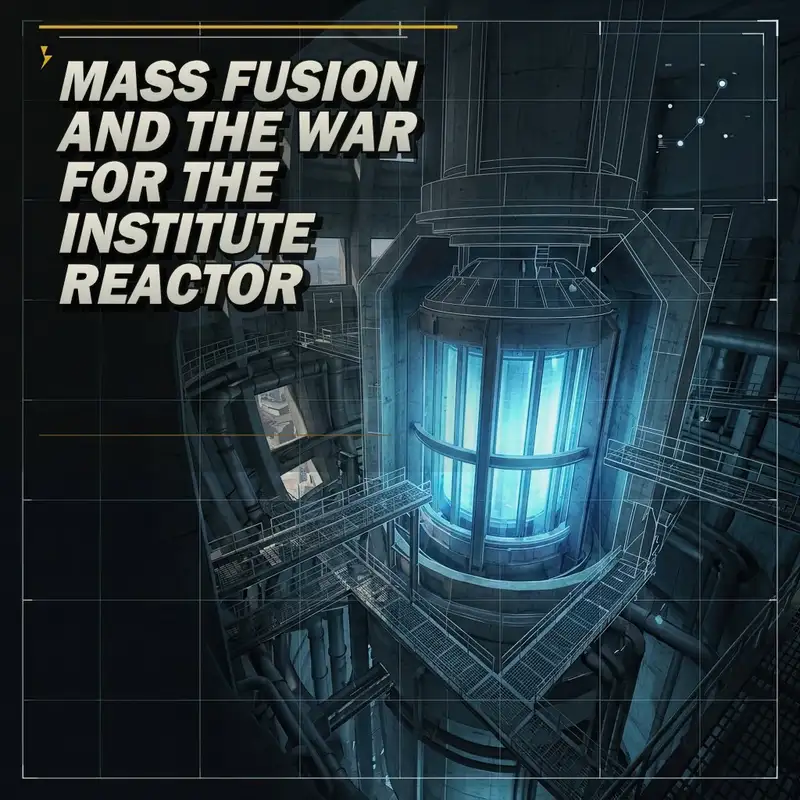
Mass Fusion and the War for the Institute Reactor
Deep beneath the ruined headquarters of Mass Fusion, past executive offices that no longer command anyone and security systems that still obey orders issued before the bombs, a single component waits in an irradiated chamber. It is called the Beryllium Agitator. The name sounds like the sort of thing a pre-War corporation would place in a brochure beside a smiling atom mascot and a promise of limitless progress. What it actually does, in the surviving record, is more important than its technical specification. It is the part required to start a reactor system that another institution cannot afford to leave dormant.
That makes Mass Fusion more than an abandoned skyscraper and more than a salvage site. It becomes the hinge between two separate centers of power beneath and above the Commonwealth. One is the Institute, hidden below the old Commonwealth Institute of Technology, attempting to solve a critical shortage of energy. The other is the Brotherhood of Steel, operating from the Prydwen and preparing a campaign against the Institute itself. Neither side needs the Beryllium Agitator as a trophy.
The distinction matters because several locations and operations are easy to collapse into one story. Mass Fusion headquarters is where the agitator is recovered. The Institute reactor is a separate facility, far below the surface, where the component can later be installed. And the destruction of that reactor, on several possible endgame paths, is yet another event. The contest begins in a corporate ruin, passes through an underground power system, and can end with the deliberate demolition of an entire technological society.
The Beryllium Agitator was developed before the Great War as part of an experimental reactor project associated with Mass Fusion. The exact engineering remains unclear, and the Commonwealth of twenty-two eighty-seven does not have the luxury of treating it as an item from a technical catalog. No surviving faction can simply place an order for another one. The component is scarce, recoverable, and apparently necessary to bring a major reactor online. In a world where manufacturing capacity is fragmented, old industrial artifacts can become more valuable than gold because they preserve capabilities that nobody can quickly reproduce.
This is the difference between technology as an object and technology as power. A rifle found in a ruin may be useful to one fighter. A generator may keep one workshop alive. But a component that allows a major reactor to operate can alter the endurance of an entire institution. It can sustain laboratories, machine shops, communications, medical systems, security networks, fabrication, and command authority. It can make plans that were previously constrained by rationing or uncertainty appear possible. The agitator matters not because it is magical, but because it sits at the narrow point between an existing system and the energy needed to keep that system alive.
Mass Fusion itself has no living corporate authority in this contest. Its pre-War executives are dead, its hierarchy gone, its public promises irrelevant except as artifacts of the culture that built the tower. Yet its building still holds value because old-world industry left behind specialized equipment, protected research, and locked infrastructure. The Commonwealth is full of ruins, but not all ruins are equal. Some are merely dangerous. Others contain a machine, archive, weapon, or reactor component that can change what a surviving organization is able to do.
For the Institute, the power problem is not a minor inconvenience. Its underground society is built around the ability to remain hidden, self-sufficient, and technologically superior to the communities above it. Its facilities require light, life support, water systems, laboratories, manufacturing equipment, computer networks, surveillance systems, teleportation infrastructure, and the extensive scientific apparatus behind its synth program. A shortage of power does not necessarily mean immediate collapse, but it limits what the Institute can maintain, expand, and protect.
Father presents Phase Three as the answer to that vulnerability. The Institute’s reactor, originally built for the Commonwealth Institute of Technology before the war and later improved by the Institute, is intended to resolve the organization’s continuing energy shortage. The claim is not that it will electrify the entire Commonwealth or grant unlimited power in every conceivable sense. The available evidence supports a more focused conclusion. The reactor would greatly strengthen the Institute’s internal energy security.
Reliable power would give the Institute more than brighter corridors and more productive laboratories. It would reduce dependence on fragile systems and allow its leadership to plan with greater confidence. It would support the infrastructure that makes its isolation possible. The Institute’s secrecy is not merely a preference for closed doors. It depends on systems that can move people and materials, maintain a concealed population, direct synths, collect information, and shield its leadership from the consequences of its actions on the surface. Energy is the foundation beneath all of that.
The Institute’s leaders also see power as a form of independence. Their society has survived by withdrawing from the Commonwealth while continuing to influence it through abduction, infiltration, surveillance, and controlled intervention. They do not depend on public taxation, open trade, elected consent, or a visible social contract with the settlements above. A more capable reactor would strengthen the Institute’s ability to survive without asking anyone for cooperation. It would not make the Institute more legitimate. It would make it less vulnerable to the need for legitimacy.
For that reason, the Mass Fusion operation carries an uncomfortable political logic. An ordinary government might seek a critical industrial component through contracts, public works agreements, or negotiations with local communities. The Institute has no such route available to it. It operates in secrecy because its surface reputation is built on fear, uncertainty, and real harm. It cannot openly announce a recovery mission, explain its energy needs, and expect Commonwealth settlements to trust its technicians with a strategic asset. Its method of reaching Mass Fusion reflects the political world it has made for itself.
The Brotherhood of Steel sees the same component through a different strategic lens. Elder Arthur Maxson’s expedition has already entered the Commonwealth with a clear view of the Institute as a threat that must be confronted. The Brotherhood is not simply another scavenging party looking for a valuable piece of machinery. It is an armed technological order with an expeditionary base, air mobility, a hierarchy, technical specialists, and a doctrine that treats certain forms of advanced technology as too dangerous to remain outside Brotherhood control.
For Proctor Ingram, the agitator is essential to completing Liberty Prime. That gives the Brotherhood an immediate military reason to seize it. Liberty Prime is not merely a large weapon or a symbolic relic of the old United States. In the Brotherhood’s campaign, it is a way to overcome a strategic problem. The Institute is hidden, heavily protected, and difficult to reach through ordinary conventional force. The Brotherhood cannot defeat an underground rival simply by patrolling streets, occupying a few buildings, or collecting more rifles. It needs a means to breach defenses and strike at the institution’s protected center.
Liberty Prime represents that means. It offers the Brotherhood a concentrated form of destructive capability, one that can alter the balance between a visible military expedition and an underground scientific power. But the Brotherhood’s interest in the agitator should not be mistaken for a Commonwealth reconstruction plan. The operation is not designed to provide civilian electricity, reopen Mass Fusion as a public utility, or create a regional industrial grid. It is designed to complete a warfighting system. The Brotherhood wants the component because it can help remove a rival that it considers both dangerous and illegitimate.
The Institute and the Brotherhood therefore approach the same object with opposite plans, but with a shared assumption. Each believes the other cannot be trusted to possess it. The Institute sees the Brotherhood as a heavily armed outside force determined to seize or destroy technology it does not control. The Brotherhood sees the Institute as a secretive organization that kidnaps people, manufactures infiltrators, and intends to preserve technical supremacy without public accountability. These are not misunderstandings invented by paranoia alone. Both factions have behavior behind their fears.
A shared reactor project would require trust, technical exchange, security guarantees, and some agreement over authority. The Institute’s entire model rejects open oversight. The Brotherhood’s model places dangerous technology under its own military custody. One side wants insulated scientific control. The other wants armed guardianship and, when necessary, destruction. Neither model begins from the premise that Commonwealth civilians should decide how such power is used. Their conflict is therefore not simply about a machine. It is about who has the right to decide what the future may contain.
Neither side has a demonstrated Commonwealth-wide mandate. The Institute is feared by many surface residents, often for good reason, but it does not ask them for consent. The Brotherhood arrives with military discipline and a coherent campaign plan, but military coherence is not the same thing as civilian authorization. The Brotherhood can argue that the Institute’s practices create an urgent security threat. That argument has force. It does not automatically establish that the Brotherhood should become the final custodian of every advanced system it captures.
Mass Fusion becomes an escalation trap because both factions recognize the agitator’s significance before either can securely possess it. The Institute expects interference from the Brotherhood. The Brotherhood interprets the Institute’s attempt to acquire the component as proof that delay would be dangerous. Each side’s precautions become evidence for the other side’s suspicion. An operation that might have remained a covert recovery mission turns into a test of intent. Once one faction commits to the site, the other can no longer regard the matter as a neutral industrial dispute.
The Sole Survivor stands at the center of that turning point, but not as a fixed historical personality. The survivor’s motives, loyalties, and judgment remain player-defined. What is fixed is the structure of the choice. The Institute can send the survivor to assist Allie Filmore’s recovery effort. Or the survivor can warn the Brotherhood, shifting the operation into the Brotherhood’s assault known as Spoils of War. Support for one side locks the other into open hostility. The choice does not merely decide who gets a component. It decides whether the remaining relationship between two armed institutions can survive at all.
From the Institute’s perspective, the mission begins with an advantage that few Commonwealth forces can match. Its relay system allows personnel to reach Mass Fusion without crossing the ruined streets, exposed roads, hostile territory, and uncertain approach routes that constrain ordinary movement. Teleportation gives the Institute speed, surprise, and a measure of protection from interception. Yet it does not remove the practical problems waiting inside the building.
Allie Filmore, representing the Institute’s Facilities division, is important because this is not a mission that can be solved by force alone. The Institute needs someone who understands what is being recovered and why it matters. The agitator must be located, accessed, removed, and returned in usable condition. The relay can place personnel near the objective, but it cannot replace credentials, technical knowledge, access systems, recovery procedures, or coordination after contact with the site’s defenses. Even the most advanced mobility system still depends on people who understand the infrastructure they are trying to exploit.
Mass Fusion has survived as a dangerous industrial shell. The building’s condition creates friction for anyone entering it. A faction may have superior weapons or better insertion methods, but old locks still need to be opened. Damaged elevators and sealed routes still shape movement. Security robots still present a threat. Radiation still limits what can be done safely and how long personnel can remain in the most hazardous areas.
The Institute’s operation is therefore a study in the limits of technical superiority. It can bypass the outer approach, but it cannot teleport the agitator directly from its containment chamber into the reactor below the Institute. It still has to work through a decaying facility designed to protect valuable property from unauthorized access. The task is not simply to find a rare item.
The Brotherhood’s answer is more visible and more openly military. Rather than appearing through a relay, Brotherhood personnel approach Mass Fusion by Vertibird from the Prydwen. This is a seizure operation, not a clandestine retrieval. The Brotherhood uses air mobility, armed escort, technical expertise, and the ability to project force from its airborne headquarters. Its approach is intended to get people to the target quickly, but it also sends a message. The Brotherhood is prepared to contest the Institute openly for control of strategic technology.
The Vertibird assault demonstrates a different understanding of mobility. The Institute uses its relay to avoid exposure. The Brotherhood accepts exposure and attempts to dominate it. Air transport can bypass many of the obstacles that slow movement through the Commonwealth, but it is not effortless. Vertibirds need crews, maintenance, command coordination, fuel or power systems, secure launch and recovery procedures, and personnel capable of operating after insertion. The Prydwen provides a platform for this capability, but it also ties Brotherhood power to a demanding support system that must be maintained far from the organization’s traditional western centers.
Proctor Ingram’s involvement makes clear that the Brotherhood’s mission is not pure battlefield opportunism. The Brotherhood has identified a precise technical requirement for Liberty Prime, and it has organized an operation around that requirement. This is what mature military institutions do when they are functioning well. The visible personnel at Mass Fusion do not reveal the full strength of the Brotherhood expedition, nor do they provide a complete order of battle. But they show an organization capable of translating a technical bottleneck into a military mission.
The Brotherhood’s operation is also a declaration of intent. If the Institute has tried to seize the agitator, the Brotherhood treats that attempt as a threat requiring decisive action. The Brotherhood does not seek to contain the Institute through negotiation, sanctions, or a limited balance of power. It seeks to deny the Institute a critical capability and then use that denial to support a larger campaign. The Brotherhood believes that waiting will make the Institute stronger. It chooses to act before the Institute’s energy problem becomes a permanent advantage.
Both approaches eventually meet the same physical reality. Mass Fusion cannot be conquered merely by arriving at its roof or appearing inside its offices. The Beryllium Agitator lies deeper in the building, beyond the executive spaces that once displayed corporate authority. Access requires movement through restricted areas, the recovery of credentials or access solutions, and a descent toward the reactor level. The route is a reminder that old-world power was protected by bureaucracy as much as by walls. Even after nuclear war, the dead still govern through passwords, security clearances, and systems built to exclude the unauthorized.
The lower levels are not a conventional battlefield. They are a damaged industrial environment where contamination, automated security, and failed infrastructure affect every decision. Neither the Institute nor the Brotherhood can treat the site as an empty warehouse. The object they need is located in a chamber hazardous enough that personnel must account for exposure and time. The game presents those dangers through combat and survival systems, but the larger historical point is simpler. The environment imposes costs. It turns a retrieval operation into a technical and medical problem as well as a military one.
For that reason, possession is not the same as access. A faction can know the agitator exists and still fail to secure it. It can reach the building and still fail to enter the right level. It can enter the chamber and still fail to remove the component without losing it, damaging it, or being driven away. And even successful removal means little unless the device reaches the system it was intended to serve. The decisive sequence is discovery, access, recovery, transport, integration, and operation.
If the Institute secures the agitator, the next stage takes place in its reactor facility, not at Mass Fusion. The component is installed in the Institute’s improved reactor, and the system is activated. This is the real meaning of Phase Three. The Institute has not merely won a contest over salvage. It has converted a recovered pre-War object into operating capacity. The component becomes part of a living institutional system, one that supplies the energy required to sustain and expand the underground world the Institute has built.
The activation carries political meaning inside the Institute. Father addresses the Commonwealth through a broadcast, presenting the organization’s achievement as a declaration of power and purpose. The Directorate then confronts the changed strategic environment. The Institute has improved its energy position, but the Brotherhood has become an openly hostile military threat. Success in one field does not eliminate danger in another.
For the Institute, that is a recurring institutional pattern. It solves problems through technical control, secrecy, and internal expertise. Those methods can be remarkably effective at preserving the organization’s immediate survival. They can sustain advanced laboratories and protect a hidden population. But they also deepen the distance between the Institute and the people who live above it. A reactor can support more research, more manufacture, and more secure operations. It cannot make abducted families trust the organization responsible for disappearances. It cannot turn covert synth replacement into a public social contract.
The Institute’s new power therefore improves endurance without resolving legitimacy. In fact, it may worsen the political problem by making the Institute more capable of continuing the practices that caused so much fear in the first place. Power is never merely power. It amplifies the institution that directs it.
From the Brotherhood’s perspective, that is precisely why the Institute must not be allowed to consolidate. If the Brotherhood secures the agitator instead, its value lies in the completion of Liberty Prime. The Brotherhood does not need to operate the Institute reactor. It needs a means to defeat the Institute’s hardened defenses and destroy its central infrastructure.
Liberty Prime is an example of how a single technological system can shape an entire campaign. For the Brotherhood, it embodies an old military promise that overwhelming technical superiority can break a difficult problem. Against a hidden enemy protected by underground defenses, that promise has obvious appeal. The Brotherhood’s campaign does not depend solely on Liberty Prime, but the machine can change the practical question from whether the Institute can be reached to how quickly and at what cost.
Yet decisive force is not the same as a political solution. A weapon can breach a fortification, destroy a reactor, or remove a command center. It cannot automatically establish a government that Commonwealth settlements recognize as their own. It cannot decide how synths will be treated after the Institute falls. It cannot repair roads, settle disputes among local communities, distribute food, or convert military authority into consent. The Brotherhood’s theory of security is strong on the destruction of dangerous capability. It is less clear on who gets to define the limits of technological life after the danger is removed.
This does not make the Brotherhood’s threat assessment irrational. The Institute has genuine capabilities and a history of using them without public accountability. The Brotherhood’s fear that an energy-independent Institute could become harder to deter is strategically coherent. But coherence in military planning does not answer every civilian question. A Commonwealth resident may reasonably want protection from the Institute and still hesitate before accepting permanent rule by an armed order that claims broad authority over technology.
On the paths where the Institute does not prevail, the reactor becomes a target rather than an asset. The Brotherhood, the Railroad, and the Minutemen can each reach a version of the operation known as the Nuclear Option. These routes do not all occur in one history. They are alternate outcomes shaped by the Sole Survivor’s alliances. The Institute’s reactor is the center of gravity for its underground system, and destroying it is a way to destroy the institution that depends upon it.
The operation is not simply an attack on a machine. The reactor supports the Institute’s ability to exist as an organized power. Its destruction threatens the energy supply for the facility, its research base, its command structure, its security systems, and the interconnected infrastructure that keeps an underground scientific society functioning. A fusion pulse charge is planted, the attacking force evacuates, and the Institute is destroyed in a final detonation. The attackers seek to eliminate the material foundation of Institute power.
For the Brotherhood, this is the culmination of a campaign against a rival technological authority. The Institute is not just an enemy base. It is a competing vision of who should possess advanced science and how that science should be used. Destroying the reactor removes an institution the Brotherhood considers too dangerous to survive. The Brotherhood does not merely seize a laboratory or recruit a few scientists. It eliminates the center from which the Institute’s system operates.
For the Railroad, the same target has a different moral and political meaning. The Railroad’s struggle is centered on synth liberation and the Institute’s power to create, command, pursue, and reclaim synths as property. Destroying the reactor is part of destroying the system that makes that domination possible. But even here, the operation does not mechanically resolve every question of freedom or survival. The fall of the Institute can remove the central institution of synth control without automatically giving every synth safety, resources, identity, or acceptance in the Commonwealth above.
For the Minutemen, the operation can represent a settlement-centered coalition acting against an organization that has terrorized and destabilized the Commonwealth from the shadows. The Minutemen are not identical to the Brotherhood. But their ability to destroy the Institute still depends on assembling force, gaining access, coordinating an attack, and taking responsibility for what follows. A militia ideal becomes meaningful only when it can connect defense to institutions capable of sustaining peace.
In every non-Institute route, the reactor’s destruction is an act of institutional warfare. It does not merely kill a power source. It breaks the system that turns laboratories, personnel, machines, and secrecy into organized influence over the Commonwealth. The Institute may possess exceptional knowledge, advanced facilities, and formidable scientific skill, but those assets cannot operate in the same form once their central underground infrastructure is destroyed.
The available record does not establish a precise yield for the detonation, a reliable casualty total, or a detailed long-term radiation pattern. Those facts should not be invented from the size of an explosion or the behavior of a game engine. What can be said is already significant. The destruction of the Institute is a major violent event in the Commonwealth. It removes a covert predator from regional politics, but it also destroys a scientific center, endangers or displaces its personnel, and leaves difficult questions about the people and knowledge caught inside its collapse.
The tactical result is clear. The reactor and the target facility are destroyed. The Institute can no longer sustain its central underground system in the form it held before the attack. Strategically, one of the Commonwealth’s major powers has been removed. Eliminating the Institute does not automatically create a Commonwealth government, establish representative law, provide universal security, or determine the future of every settlement, synth, scientist, or former Institute asset.
This distinction matters because post-War history is full of victories that solve the immediate military problem while leaving the institutional problem untouched. A hidden enemy can be eliminated. A dam can be captured. A fort can be taken. A reactor can be destroyed. None of those acts by themselves create a durable order. Government requires more than the removal of an adversary. It requires the ability to protect communities, resolve disputes, secure trade, maintain infrastructure, distribute resources, and persuade people that authority serves more than the interests of those holding weapons.
The destruction of the Institute also creates a loss that cannot be measured simply as the removal of a threat. The Institute holds scientific knowledge, skilled personnel, records, manufacturing techniques, and a population shaped by generations of isolation. Some of that knowledge may have been used for coercive or deeply unethical purposes. Some may have had potential value beyond the Institute’s own ambitions. Once the institution is shattered, so is much of the capacity to direct, preserve, or account for those resources. The Commonwealth gains freedom from one danger while inheriting the consequences of another great rupture.
Mass Fusion therefore reveals a broader truth about the Commonwealth’s struggle for the future. The Institute believes civilization can be preserved through insulated technical control. Its reactor would strengthen that approach by making the underground society more independent, more capable, and less exposed to pressure from the surface. But the Institute’s science has been tied to secrecy, abduction, synth domination, and a willingness to treat outsiders as material for its plans. Its energy problem is real.
The Brotherhood offers a different answer. It believes security requires disciplined force and the custody of technology dangerous enough to threaten human survival. Its pursuit of the agitator is not senseless greed. It is part of a coherent campaign to prevent the Institute from becoming more capable than it already is. But the Brotherhood’s solution also concentrates authority. It puts immense weight on military hierarchy, technical guardianship, and the judgment of an order that has arrived from outside the Commonwealth. Those methods may defeat a dangerous rival without settling who should exercise power afterward.
The Minutemen and Railroad belong to this story chiefly through the later question of what to do with the Institute once it can be reached. They are not equal partners in the initial Mass Fusion contest. The contest is between the Institute’s need to energize its reactor and the Brotherhood’s need to complete Liberty Prime. Different Commonwealth actors can conclude that the underground regime cannot safely continue, even when they disagree sharply about what should replace it.
The Beryllium Agitator is decisive because scarcity gives it leverage. It is one recoverable component at the point where several larger systems depend on a missing capability. The Institute cannot easily substitute another part and proceed as if nothing happened. The Brotherhood cannot easily complete Liberty Prime through general technological enthusiasm. Both need the actual device, recovered intact and integrated into the machinery around it. Not through its appearance, but through the institutions capable of maintaining, defending, and directing it.
Mass Fusion became the breaking point because the agitator transformed latent hostility into a zero-sum contest over energy, military capability, and institutional survival. For the Institute, the reactor promised the independence needed to preserve and expand a secret technological regime. For the Brotherhood, the same component enabled the weapon system needed to prevent that regime from becoming more secure. The later destruction of the reactor proves the larger point. Infrastructure can sustain power, but destroying infrastructure can only remove a threat. It cannot answer who will govern, protect, and rebuild the Commonwealth afterward.