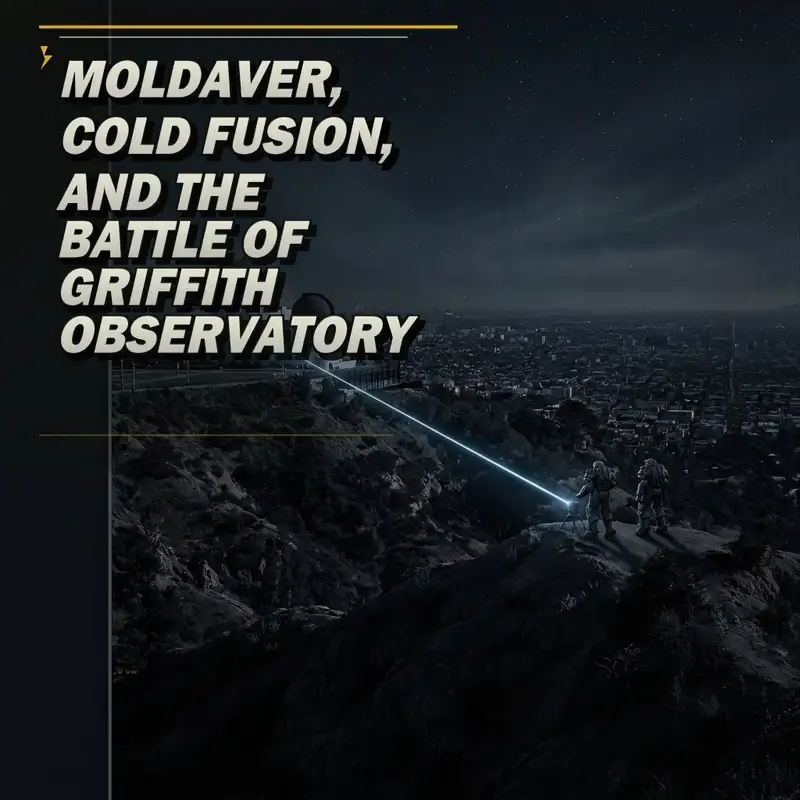
Moldaver, Cold Fusion, and the Battle of Griffith Observatory
By the time the Brotherhood of Steel broke into Griffith Observatory, Lee Moldaver had already lost almost everything required to hold it. Her defenders were being overrun. The settlement around the observatory had become a battlefield. The people who had gathered beneath the banner of the New California Republic were caught between armored attackers, collapsing defenses, and the machinery of a future they had not lived long enough to secure. Moldaver herself was mortally wounded. Yet she returned to the control room. She reached the system the Brotherhood had come to seize, and she activated it. Across the ruins of Los Angeles, lights began to burn.
That image contains the whole paradox of the Battle of Griffith Observatory. Moldaver lost the ground. The Brotherhood seized the installation. Her regional political movement lost its commander, its refuge, and much of its armed protection. But the woman who lost the battle completed the act that made the battle worth fighting. Cold fusion came online. The old city’s darkness was interrupted by light, not everywhere in any clearly mapped or permanent sense, but visibly enough to prove that a different material future was possible.
The battle therefore mattered for more than the destruction of one NCR remnant force. It was a contest over who would control the first credible post-War source of effectively limitless electrical power. Moldaver saw that power as the foundation for reconstruction. Griffith Observatory was not fought over a machine alone.
Moldaver’s project began with a simple but demanding proposition. A society cannot rebuild itself on symbolism, salvage, and courage alone. Those things matter. They can keep a town alive, hold a line, or preserve a memory. But they do not pump water at scale, preserve medicine, run workshops, maintain communications, power transport systems, or support the industrial labor needed to repair a damaged region. A flag can claim legitimacy. Electricity can make that claim practical.
By the year twenty-two ninety-six, the NCR flag at Griffith Observatory represented memory as much as state power. Shady Sands had been destroyed. The wider condition of the New California Republic in California remained uncertain. The observatory’s defenders should not be mistaken for the full NCR Army, nor should their presence prove that a functioning republic still governed the region from coast to interior. What the observatory showed was narrower, but no less important. It showed that people still believed the NCR idea could be revived.
That idea was more than nostalgia for uniforms, institutions, or a vanished capital. It was an argument that the ruins of Southern California could again support public life. The observatory housed armed defenders, but it also sheltered civilians. It functioned as a headquarters, a refuge, and a visible claim to continuity. Moldaver’s community was not merely occupying a defensible hill.
That distinction shaped the military problem. A force defending only a bunker can concentrate on the bunker. A force defending a civilian community must divide its attention. It must man the walls, protect noncombatants, maintain order, preserve food and water, care for the wounded, secure prisoners, and keep essential systems operating under attack. The people inside Griffith Observatory were not just an armed garrison. They were part of the political future Moldaver hoped cold fusion would make possible.
The observatory’s location reinforced that message. Griffith Observatory stood above much of the Los Angeles basin, a place of elevation, visibility, and cultural weight. Before the Great War, it had been associated with science, public education, and a broad view of the city below. In the wasteland, those older associations did not erase its military value. Elevation provided observation. The site offered defensible approaches and a commanding presence over the surrounding ruins. But its symbolism mattered too. Moldaver was not hiding cold fusion in an anonymous industrial vault. She was preparing to bring power back to Los Angeles from a hill built to help the public look outward.
The technical foundation of that project had begun long before the bombs. Later events confirm that Lee Moldaver had once been Kate Williams, a pre-War researcher associated with cold-fusion work. That confirmation clarifies the scale of her ambition. Moldaver was not simply a wasteland leader who had found a useful machine. She understood the technology as part of a suppressed alternative to the old world’s trajectory of scarcity, militarization, and controlled access to energy.
The available record indicates that Vault-Tec acquired and suppressed the cold-fusion technology. The full chain of corporate and political responsibility remains incomplete. A system capable of reducing one of the old world’s central constraints had been buried by institutions that treated security, continuity, and control as assets to be monopolized.
That pattern was familiar in pre-War America. Advanced technology existed alongside resource crisis, political repression, military mobilization, and corporate influence so extensive that private firms could shape public survival. Civil defense was sold as reassurance while shelters became laboratories. Energy research could promise abundance while remaining subject to the same systems of secrecy and competition that had helped make scarcity politically useful. The old world did not lack technical brilliance. It lacked institutions willing to distribute the benefits of that brilliance without turning them into instruments of power.
Cold fusion became important because it threatened that arrangement. The series does not provide a complete engineering diagram, a production history, or a reliable measure of output. It does establish the essential claim. The technology could provide effectively limitless electrical power. In a post-War environment, that is not just a scientific achievement.
Moldaver’s own survival from the pre-War era into the twenty-third century remains unresolved. The evidence confirms her identity as Kate Williams, but not the full means by which she endured for more than two hundred years. That uncertainty matters because it should not be filled with convenient mythology. Her political importance did not rest on an explained miracle of longevity. It rested on what she had learned, what she remembered, and what she attempted to do with knowledge that other institutions had hidden.
By twenty-two ninety-six, the technology could not simply be switched on by anyone who reached the observatory. Its activation depended on several separate chains of access. The rarest object is not always the decisive one. Sometimes the decisive asset is the person who can authenticate a system, interpret a procedure, provide a code, or make an automated facility recognize a human authority that has been dead for two centuries.
The first part of that chain was Siggi Wilzig, an Enclave scientist who fled with the cold-fusion diode implanted behind his ear. Wilzig’s escape exposed a continuing truth about the Enclave. Its surviving personnel and installations retained access to technical knowledge, disciplined security structures, and old-world systems of control. But even highly secretive organizations depend on individuals. One scientist who decides to leave can turn a guarded asset into a moving political crisis.
Wilzig’s flight made the diode the object of several converging pursuits. It was valuable because it was portable, because it had a known connection to the cold-fusion system, and because the parties seeking it understood that its importance went far beyond personal wealth. But the diode alone was not enough. It was a necessary component in a larger system. Its value came from its relationship to a fixed installation, hidden procedures, and the authority required to unlock them.
After Wilzig died, Lucy MacLean became the courier who carried his severed head, and with it the diode, to Griffith Observatory. Lucy did not begin as Moldaver’s political agent. Her immediate purpose was to recover her father, Hank MacLean. That personal objective drove her through a conflict whose full scale she did not initially understand. Yet her role became indispensable. Without Lucy’s arrival, the diode would not have reached Moldaver’s control room when it did.
This is one of the battle’s most important institutional lessons. Great strategic systems often depend on people with no formal command role. Lucy was not an NCR officer, an Enclave scientist, or a Brotherhood commander. But she moved the critical object across the wasteland. Her personal search became part of a struggle over the future of Los Angeles.
Hank MacLean occupied a different position. He was not a battlefield commander either. His authority came from Vault-Tec credentials, from access to systems designed to outlive the public world that had created them. His role demonstrated how corporate continuity could remain strategically decisive long after the corporation’s offices, advertisements, and consumer promises had become ruins. Vault-Tec’s power did not survive merely in old logos. It survived in personnel, access control, hidden infrastructure, and the ability to decide who could use technology designed to shape the future.
Hank’s credentials mattered because the reactor recognized them. That fact gave him leverage even while he was Moldaver’s captive. Cold fusion may have promised abundance, but its access had been fenced behind the authority of a corporation whose public purpose had been civil defense and whose deeper practices included manipulation, experimentation, and the management of human beings as resources.
Lucy’s discovery of her father’s role in the destruction of Shady Sands changed the meaning of the confrontation. It also revealed the fate of her mother, Rose MacLean, whose transformation had been tied to Hank’s actions and the systems he served. Hank could no longer present himself as a father protecting his family from a dangerous outside world. The outside world had been damaged by the very institution he represented.
That collapse of paternal legitimacy helped make cooperation possible. Hank did not become Moldaver’s ally. There was no reconciliation between their projects. His participation was compelled by exposure, coercion, and the loss of moral authority before his daughter. He could still provide access, but he could no longer plausibly define the terms of the story around him. Vault-Tec’s representative had become a key in someone else’s hand.
For Moldaver, this was an operational vulnerability as well as a political one. The reactor was fixed in place. The diode had to be delivered. Hank had to be compelled to authorize access. The defenders had to protect civilians, guard a captive official, secure the approach, and prepare the system for activation. Every requirement created delay. Every delay increased the chance that the Brotherhood would arrive before the project could be consolidated.
Griffith Observatory was therefore both a strongpoint and a trap. Its elevation gave Moldaver’s people visibility. Its buildings and surrounding terrain allowed for improvised barriers, armed guard positions, wrecked vehicles, rocket weapons, and some anti-aircraft capability. Such measures could make an assault costly. They could disrupt an advancing force and impose caution on attackers. They could not guarantee survival against a better-equipped opponent able to choose the time and method of attack.
The observatory did not appear to possess the depth required for a prolonged defense against a concentrated air-ground assault. There was no clearly established relief force moving to reinforce Moldaver. No wider NCR formation arrived to challenge the Brotherhood’s approach. The defenders had no confirmed integrated air-defense network, no demonstrated reserve capable of counterattacking after a breach, and no visible system for relocating the cold-fusion project if the site became untenable.
That last limitation was decisive. The reactor could not be packed onto a caravan and moved through the ruins. Cold fusion was tied to infrastructure. Infrastructure creates power, but it also creates targets. A dam, reactor, refinery, water purifier, missile silo, or industrial plant can give a faction enormous potential. It also fixes that potential to terrain, access routes, maintenance needs, and vulnerable personnel. Moldaver’s project had to be defended where it stood.
The Brotherhood did not approach Griffith Observatory as another raider band looking for salvage. The attacking force was associated with the western Brotherhood command around the Knights of San Fernando and Elder Cleric Quintus. Its immediate objective was not simple destruction. The Brotherhood wanted Wilzig’s artifact and sought to prevent Moldaver from controlling cold fusion. A force ordered only to destroy could bombard from a distance and leave ruins. A force ordered to seize must preserve enough of the objective to use it.
The airship marked Prydwen served in this operation as a mobile platform for transport and command support. Vertibirds provided the Brotherhood with the mobility to move forces rapidly toward the observatory. The exact size of the assault force, the number of aircraft involved, and the full order of battle are not established. They do not need to be. The Brotherhood could bring armored troops and air mobility to a fixed target before Moldaver’s community could build a force capable of matching it.
Power armor was an advantage, but not magic. It gave Brotherhood troops protection, intimidation, and the ability to press an assault through defensive fire that might stop less equipped attackers. The Brotherhood’s success came from the larger system supporting the armor. The airship, vertibirds, personnel, weapons, and command structure allowed it to concentrate force where Moldaver could not.
Quintus’s wider ambitions also need to be distinguished from a unified Brotherhood policy. The Brotherhood of Steel is not one timeless institution acting with a single mind across the continent. Chapters, expeditions, elders, clerics, scribes, and military formations carry shared traditions, but they also compete over doctrine, authority, and resources. Later events make clear that cold fusion became leverage in Quintus’s struggle to alter the Brotherhood’s internal balance of power, particularly in relation to the Commonwealth chapter.
That later conflict reveals the meaning of the mission at Griffith. Quintus was not merely safeguarding a dangerous technology out of abstract principle. He was seeking an asset that could strengthen his own command. The language of preservation can conceal a struggle over possession. The Brotherhood’s claim that advanced technology must be controlled may reflect real concerns about misuse, but control also creates hierarchy. Whoever decides who receives power decides who can build, travel, communicate, manufacture, and defend.
The assault itself was shaped by an unequal set of problems. Moldaver’s defenders had to remain in place. The Brotherhood could concentrate its combat power, exploit air mobility, and attack a known objective. The defenders could resist. They could not choose another battlefield.
Prepared defenses still mattered. The observatory’s fighters were not passive victims waiting for armored troops to arrive. They had weapons, barriers, and enough organization to make the attack a real engagement rather than an execution. Their anti-aircraft and rocket capabilities demonstrated that they understood the threat from above. Their positions showed that Moldaver had anticipated violence. But anticipation is not the same as parity.
A small fortified community can make an attacker pay for every wall and courtyard. It struggles when the attacker can bypass parts of the defensive line, land troops near key approaches, sustain momentum after contact, and exploit superior protection in close combat. Once the Brotherhood gained access to the observatory’s interior, the defensive problem became more severe. The defenders were no longer holding a perimeter.
The Ghoul’s intervention showed the limits of Brotherhood confidence. He was not part of Moldaver’s command structure, nor was he a representative of any organized anti-Brotherhood force. He was an independent combatant with long experience, technical knowledge, and a personal history tied to the old world’s wars. In the chaos around the observatory, he exploited vulnerabilities in Brotherhood power armor and disrupted an advancing element.
That moment did not prove that power armor was easily defeated. It proved something more useful. Complex military systems have weak points. Armor protects only when it is maintained, properly employed, and operated by people who understand its limitations. An experienced opponent who knows where the system is vulnerable can turn technical superiority into overconfidence. The Brotherhood had better armor and greater mobility. It did not have invulnerability.
Still, the broader tactical result was clear. The Brotherhood breached the observatory’s defenses and overwhelmed Moldaver’s force. The military headquarters fell. The defenders were killed or scattered. The settlement was shattered. This was not simply the defeat of soldiers at a fortified site.
The civilian cost matters because cold fusion had been intended to serve civilians. The people sheltering around Griffith Observatory were not incidental to Moldaver’s vision. They were the reason the vision claimed legitimacy. A reconstruction project that promised water, light, medicine, workshops, and stability needed people to receive those things. When the Brotherhood destroyed the community protecting the reactor, it removed much of the social base that could have made the technology part of an NCR-associated recovery.
The Brotherhood’s victory therefore had a contradiction built into it. It captured the asset, but it did not inherit Moldaver’s political coalition. It took control of the facility after killing or dispersing many of the people who had attached that facility to a civilian program. Military seizure can secure a machine.
The battle’s central strategic problem remained unresolved after the breach. The Brotherhood had reached the observatory, but the cold-fusion system still had to be activated. Hank’s credentials remained necessary. Moldaver’s final decision was to prioritize activation despite the destruction unfolding around her. Her actions support a clear conclusion. She believed that bringing the reactor online mattered even if she could not personally survive to govern what followed.
That decision was not the same as a complete victory. Activating a reactor is not the same as operating it reliably. Operating it is not the same as maintaining it. Maintaining it is not the same as reproducing its components. Reproducing the components is not the same as distributing electricity across a damaged region.
But activation was still a profound achievement. The lights spreading across Los Angeles demonstrated that cold fusion was not merely a theoretical promise or a hidden Vault-Tec artifact. It worked. The scene did not provide a technical map of a restored electrical grid. It did not establish that every neighborhood, settlement, or ruined district gained durable power. It did something strategically more immediate. It proved that the old constraints of the wasteland could be challenged.
Electrical power changes the conditions under which institutions operate. It can support water purification and pumping. It can preserve food and medicine. It can keep communications systems active, illuminate roads and defensive positions, power workshops, support manufacturing, and make medical treatment more reliable. It can reduce the labor required for some basic tasks and expand the range of others. A settlement that can generate and distribute power has options unavailable to one dependent solely on scavenged batteries, local generators, and uncertain fuel.
For a military organization, the implications are equally significant. Reliable power can support communications, sensor systems, workshops, defensive installations, transport infrastructure, weapons maintenance, and the repair of advanced equipment. It could strengthen the Brotherhood’s ability to sustain power armor and other energy-dependent systems. Yet none of those outcomes follow automatically from possessing a reactor. The Brotherhood would still need trained labor, secure supply chains, replacement parts, technical knowledge, organizational discipline, and defended routes.
Energy abundance does not abolish scarcity. It changes where scarcity is felt. If a base has power but lacks technicians, its machines still fail. If it has technicians but no secure roads, it cannot distribute the benefits of its energy. If it can power a factory but lacks raw materials, trained workers, quality control, and customers or state demand, the factory remains a possibility rather than an industrial revolution. If it controls a grid by force but cannot persuade communities to cooperate, every power line becomes a potential target.
Moldaver understood at least part of this. Her project was political before it was technical. She was not trying merely to turn on lights as a spectacle. She was trying to establish the material basis for a revived civic order in Los Angeles. The NCR flag, the observatory community, the memory of Shady Sands, and the cold-fusion system were all parts of one argument. Civilization required more than survival. It required institutions that could deliver public goods.
Her death made that argument harder to sustain. Moldaver was not the only person capable of imagining reconstruction, nor was she necessarily the sole surviving NCR leader in California. When she died, the project lost the person best positioned to explain why cold fusion should serve a civilian recovery rather than a military hierarchy.
The immediate aftermath scattered the surviving participants in different directions. Hank escaped. Lucy left with the Ghoul, carrying the knowledge that her father and Vault-Tec’s hidden system had shaped the destruction around her. The Brotherhood took control of Griffith Observatory and the cold-fusion technology. Maximus, found near Moldaver’s body, was wrongly credited by the Brotherhood with killing her.
That misattribution was politically useful precisely because it was false. Institutions at war often prefer clean narratives. A Brotherhood fighter credited with killing the enemy leader offers a simple story of victory, discipline, and martial competence. The actual record was messier. Moldaver had been mortally wounded during the battle, but she completed the reactor activation before she died. The Brotherhood’s apparent hero had not decided the fate of the battle in the way the official account suggested.
The distinction matters because the story told after a battle can shape authority inside the victorious force. Recognition, rank, favor, and legitimacy can attach themselves to a version of events that serves command needs. Maximus became useful to the Brotherhood not only as an individual, but as a symbol. The organization could present him as evidence that its discipline and mission had triumphed, even though the battle had also exposed its dependence on captured technology, confused loyalties, and a narrative it did not fully control.
At the tactical level, the Brotherhood won. It took the observatory and destroyed the immediate defense. At the mission level, it obtained the technology it had come to seize. Moldaver’s reconstruction coalition was defeated. The refuge around the observatory was broken. Yet the power system was activated according to Moldaver’s purpose, not the Brotherhood’s original timing or public program.
At the civilian level, Los Angeles gained the demonstration of possibility while losing the community most visibly organized to make that possibility public. The city’s lights became a symbol without a proven institution to distribute their benefits. A powered skyline can inspire hope. It can also reveal inequality. The question becomes who controls the switches, who receives the current, and who is told that security requires obedience.
Later events confirm that the cold-fusion technology did not remain a local prize at Griffith Observatory. The Brotherhood moved it to Area Fifty-One, where it energized a major base and became part of a larger struggle over Brotherhood authority. The transfer transformed a battle for one hill above Los Angeles into a contest over the direction of a military order with ambitions far beyond the Boneyard.
That movement of technology is strategically revealing. The Brotherhood did not simply guard cold fusion where it had been activated. It relocated the asset to a site it could better control and integrate into its own institutional structure. Such a move makes sense from a military perspective.
But relocation also separated the reactor from Moldaver’s original reconstruction project. At Griffith Observatory, cold fusion had been attached to Los Angeles, to NCR memory, and to a civilian refuge. At Area Fifty-One, it became more clearly attached to Brotherhood command. The same technology could now serve a different purpose. Instead of becoming the foundation for regional recovery, it could become an instrument of military leverage.
The later struggle with the Commonwealth chapter made Quintus’s ambitions unmistakable. Cold fusion gave him a means to challenge rival Brotherhood power, not merely to protect humanity from dangerous technology. That is a recurring pattern in post-War politics. A new resource promises collective strength, and the first question becomes who can monopolize it. The answer often determines whether the resource supports reconstruction or becomes another source of factional conflict.
The ensuing Brotherhood civil conflict showed that superior technology does not resolve institutional weakness. It can intensify it. A rare asset gives commanders incentives to centralize authority, reward loyalists, discipline rivals, and redefine doctrine around possession. Those excluded from its benefits have incentives to resist, defect, or seek their own alliances. Cold fusion could energize a base, but it could not make competing Brotherhood leaders agree on who had the right to control the future.
The technology later became entangled in House-related strategic activity as well. That development confirms its continuing importance without changing the basic lesson of Griffith Observatory. Once cold fusion existed in the open, it could not remain a local matter. Every major power with enough knowledge, mobility, or ambition had reason to seek influence over it. The battle had opened a new phase of competition. It had not settled one.
For that reason, the Battle of Griffith Observatory should not be remembered as a simple Brotherhood victory over an NCR remnant. It was the point at which a reconstruction project and a military custody project collided around the same machine. Quintus and his Brotherhood formation wanted energy to become a source of strategic advantage. Both understood that electricity could change the wasteland. They disagreed on who should direct that change.
Moldaver’s position had its own limits. Her force was too small, too exposed, and too dependent on a fixed installation and a captive Vault-Tec official. Her political community could not withstand a concentrated Brotherhood assault. The NCR symbols around her did not provide reinforcements, secure supply lines, or a functioning state apparatus. Her final success was therefore a demonstration rather than a completed reconstruction.
Yet demonstrations matter. Moldaver proved that Los Angeles could be powered again. She proved that the old world’s buried technology could still be made to serve a purpose other than corporate secrecy or military monopoly. She did not live to determine whether the power would reach homes, hospitals, water systems, workshops, or communities beyond the observatory. But she made it harder for anyone who controlled the reactor to claim that such a future was impossible.
The Brotherhood inherited a harder problem than seizing the observatory. But possession placed new demands on the order. It needed to secure the device, understand it, maintain it, defend it, and decide how widely its benefits would be shared. It also had to manage the rivalries that control of the technology created within its own ranks.
A military order can hold a reactor with soldiers. It cannot build a durable society through custody alone. Durable reconstruction requires labor, public trust, trained technicians, supply networks, rules accepted as legitimate, and some answer to the question of who is protected by the new order. If the answer is only the people behind the armor, then the technology becomes another fortified privilege, powerful but politically brittle.
Griffith Observatory was historically decisive because it separated cold fusion’s promise from Moldaver’s political vision. Her final act showed that Los Angeles could be powered again. The Brotherhood’s victory ensured that, for the immediate future, that power would be administered through military custody, factional rivalry, and institutional ambition rather than through the civilian reconstruction project that had brought Moldaver to the observatory.