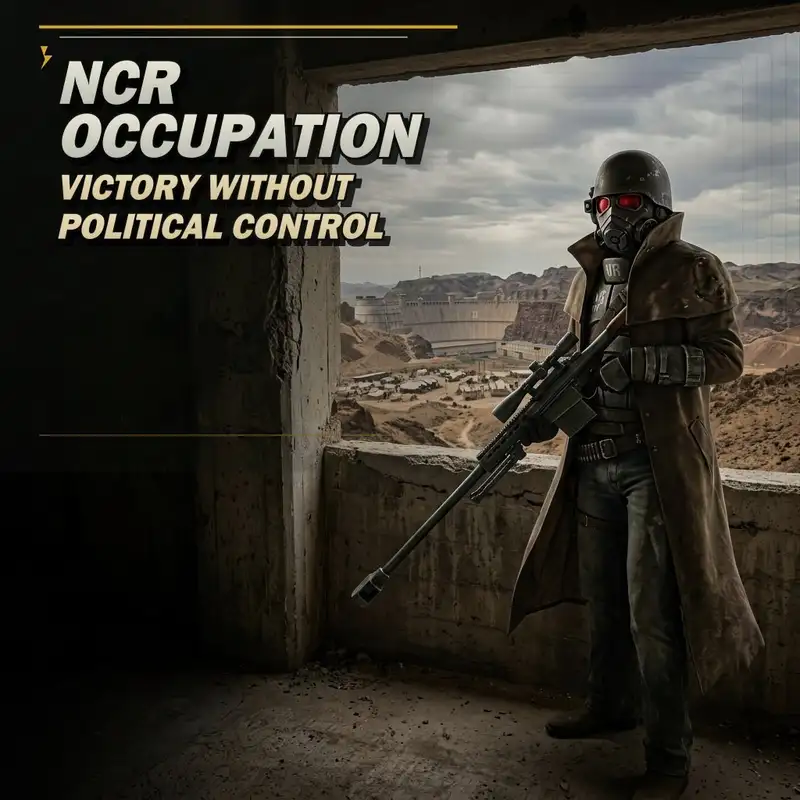
NCR Occupation: Victory Without Political Control
Hoover Dam stood in the New California Republic’s hands in the year twenty-two eighty-one. That fact was real, important, and dangerously easy to misunderstand. The Republic had defended the dam through one major battle. It had troops in a former airport at Camp McCarran, guards on the Long Fifteen, Rangers in scattered stations, diplomats on the Strip, and garrisons along the approaches to the Colorado. It possessed the largest conventional military presence in the Mojave. Yet the Strip remained sovereign under Mister House. Legion agents could penetrate NCR rear areas. Frontier posts wanted supplies and reinforcements. Towns negotiated with the Republic instead of simply obeying it. The NCR held the most valuable machine in the region, but a flag on a dam was not the same thing as authority over the country around it.
That distinction is the heart of the NCR occupation. The Republic did not come to the Mojave with nothing but rifles and slogans. It brought a state, or at least the institutions of one. It had an elected government in California, an Army, Rangers, engineers, a Department of State, merchants, contractors, tax collectors, and a national political class that could imagine the Mojave as part of a larger republican future. But the Mojave was not an empty frontier waiting for an administration to arrive. It already had settlements, armed groups, trade networks, local leaders, old grudges, and independent powers. The NCR could occupy strategic points. It could not automatically turn those points into a political system.
Hoover Dam mattered because it was more than a fortified wall across a river. It offered electrical power, water infrastructure, transport value, prestige, and leverage over the economy of New Vegas. The Republic could direct most of the dam’s power westward toward its core territories. It could use the installation as a defensive anchor against the Legion. It could tell voters at home that the NCR had secured one of the great works of the old world. But none of that answered the harder question. Who made law in the towns outside the wire? Who protected a caravan after it left an NCR checkpoint? Who settled disputes between settlers, merchants, tribes, military units, and local gangs? Who collected taxes in a way that people regarded as legitimate rather than predatory? The dam provided leverage. It did not provide consent.
The NCR’s eastern expansion began with genuine security concerns. According to the official chronology preserved in the New Vegas game guide, the Republic intervened in the Mojave after raiders massacred thirty-eight NCR citizens in the year twenty-two fifty-three. The political consequences in California were severe. President Tibbett was removed amid criticism of the government’s response, and his successor, Wendell Peterson, ordered three battalions eastward. The details are not depicted directly in the game, and the surviving account does not justify a grand reconstruction of the campaign. But the broad political logic is clear. The NCR government faced pressure to protect its citizens beyond its established core.
That original mission was not unreasonable. A republic that could not protect travelers, settlers, and trade from organized violence would find its own borders increasingly theoretical. The Mojave lay along routes linking California to the Colorado River and beyond. It contained salvage, commerce, water, electrical infrastructure, and strategic depth. Raider activity threatened not only individuals but confidence in the state’s ability to govern a widening frontier. Sending troops east could therefore be described as a response to insecurity. It also created a new opportunity. Once an army crossed a frontier, secured routes, and established bases, the question changed from whether the Republic should intervene to what it might gain by remaining.
That is how a security operation becomes a political project. The NCR did not move east solely because it wanted to protect travelers. It increasingly wanted the Mojave’s strategic resources and the status attached to controlling them. Electricity from Hoover Dam mattered to California. Water mattered. Trade mattered. A secure eastern frontier mattered. So did national prestige. A growing republic often discovers that its material ambitions and its public ideals can travel together, at least in speeches. Protection, representation, commerce, civilization, and expansion become parts of the same sentence. The difficulty begins when the people living in the claimed territory do not experience those promises in the same order.
General Aaron Kimball’s political rise shows how the Mojave acquired national meaning. He gained prominence through the NCR’s so-called Pacification of the Mojave, including operations around Bullhead City. The surviving record does not establish a complete order of battle, a detailed account of the fighting, or a precise measure of civilian impact. It framed the Mojave as a disorderly place that the Republic could stabilize through force, administration, and national purpose. It made an eastern campaign legible to voters who might never see the desert themselves.
Pacification is useful political language because it compresses a difficult problem into a reassuring one. It suggests that violence is an obstacle to normal life, and that once the obstacle is removed, normal life will return under competent management. But the Mojave did not have one source of disorder and one obvious remedy. Raider gangs, hostile wildlife, trade competition, local political rivalries, the Brotherhood of Steel, the Great Khans, the growing influence of New Vegas, and later Caesar’s Legion all created different security problems. A military operation might defeat one enemy in one place and still leave the underlying political landscape unchanged. Suppressing threats is not the same thing as creating courts, services, local partnerships, and accepted authority.
The Mojave Outpost, established on the Long Fifteen in the year twenty-two seventy-two, became a practical symbol of the NCR claim. It marked the route from California into the Mojave. It screened movement. It checked travelers and caravans. It served as a logistical gateway for personnel and material coming east. In strategic terms, it was essential. An army cannot sustain a distant campaign through optimism alone. It needs roads, guards, repair work, water, food, ammunition, medicine, spare parts, replacement personnel, messengers, and some way to bring wounded people back toward treatment. The outpost was part checkpoint, part supply gate, part declaration that the Republic intended to remain.
It was also proof of the limits of that declaration. A checkpoint can control passage through a particular gate without controlling the terrain beyond it. A patrol can make one stretch of road safer without making the entire route secure. Every caravan that moved east required protection. Every patrol sent beyond the wire required supplies and a plan for return. Every new camp, Ranger station, and garrison extended the line that had to be maintained from California. The NCR did possess infrastructure. Its problem was that infrastructure created obligations. A frontier outpost was not merely a symbol of expansion. It was another hungry institution at the end of a long and vulnerable chain.
This was the ordinary burden of occupation. A state can take a road junction, repair a building, raise a flag, and assign a unit to stand guard. It still has to decide who pays for that unit, where its food comes from, how its equipment is repaired, how it receives intelligence, and what happens when the unit is needed somewhere else. The Mojave imposed these demands at once. The Republic had to defend its western approach, maintain Camp McCarran, support Ranger stations, hold Hoover Dam, secure caravans, watch the Colorado frontier, and respond to trouble in the towns whose cooperation it wanted. There was no single front line. There was a web of obligations spread across a dry and contested region.
The Treaty of New Vegas in the year twenty-two seventy-four revealed both the NCR’s strength and its restraint. After moving east and occupying Hoover Dam, the Republic did not conquer the Strip. Instead, it negotiated with Mister House. The resulting arrangement gave the NCR control of the dam, access for its citizens and soldiers, the right to maintain a military base at the former McCarran airport, and an embassy on the Strip. The Republic also received the great material prize: ninety-five percent of Hoover Dam’s electrical output could be directed toward NCR territory. From the perspective of an overextended government, that was an impressive settlement.
The treaty allowed the NCR to obtain infrastructure without immediately paying the cost of seizing and governing New Vegas itself. Conquering the Strip would have meant fighting in a dense, economically important urban center, disrupting commerce, confronting House’s defenses, and assuming responsibility for the people who lived and worked there. Both sides had reasons to sign.
But the treaty’s success was also the source of a lasting limitation. The NCR gained access, not sovereignty. Its embassy was a diplomatic presence, not a municipal government. Its soldiers could enter the Strip, but they did not control its laws. Its merchants could spend money there, but the Strip’s political order remained under House. The Three Families profited from NCR soldiers, tourists, traders, and officials while remaining inside a system House controlled. New Vegas turned NCR military presence into commerce without surrendering its independence.
Ambassador Dennis Crocker later acknowledged that earlier NCR diplomats had hoped to bring about the Mojave’s annexation and persuade House to join the Republic. That admission matters because it clarifies the difference between the arrangement the NCR possessed and the arrangement it wanted. Recognition was not absorption. Economic access was not jurisdiction. A treaty could make two powers dependent on one another without making either one subordinate. The Republic had entered the Mojave’s most important city, but it had done so on negotiated terms. It could not simply issue orders and expect the Strip to obey.
That unresolved political problem became more serious after the First Battle of Hoover Dam, fought roughly four years before the events of New Vegas. There is no reliable basis for precise troop totals, casualty figures, or a tidy hour-by-hour reconstruction. What is clear is that the NCR held the dam against Caesar’s Legion. The Legion did not seize the installation. In operational terms, that victory preserved an essential anchor for the NCR presence east of California.
Yet the strategic result was incomplete. Caesar’s Legion remained a major power across the Colorado. It continued to threaten the dam, pressure NCR outposts, infiltrate NCR institutions, and prepare for another confrontation. The battle had prevented a defeat. It had not removed the enemy that made the dam difficult to hold. More importantly, it did not produce a Mojave-wide political settlement. The Republic could point to the dam and say it had defended the region from the Legion. But the towns, the Strip, the frontier communities, and the independent organizations of the Mojave had not become one coherent NCR political order as a result.
This is where military language can conceal political reality. Tactical success means winning the fight in front of you. Operational success means preserving the ability to conduct a campaign. Strategic success means advancing the larger purpose of the war. Political success means creating an outcome that can endure after the immediate fighting ends. The NCR achieved the first two at Hoover Dam. It retained ground and denied that ground to the Legion. But it had not yet achieved the latter two. It still faced an enemy across the river, a sovereign power on the Strip, an uncertain population in the surrounding settlements, and a supply system stretched across a distant frontier.
Camp McCarran was the headquarters that had to manage this contradiction. Colonel James Hsu’s command was not simply a fort full of troops waiting for a final battle. McCarran was a regional hub for allocating forces, distributing supplies, coordinating intelligence, and responding to threats that did not wait patiently in separate categories. A commander at McCarran had to think about Hoover Dam, the Strip, the Fiends, Ranger support, caravan routes, forward camps, Legion reconnaissance, and the morale of personnel who had spent years serving on a harsh frontier. The camp’s importance came from its role as a connector. It tied together installations that could not survive as isolated islands.
But a headquarters can be competently run and still face more demands than it can meet. The NCR Army in the Mojave had to disperse. It could not concentrate every available soldier at Hoover Dam because the road behind the dam also mattered. It could not secure every route because the Legion and local threats could exploit gaps. It could not ignore the Fiends around McCarran because a hostile force near the main logistics center could disrupt operations and threaten civilians. It could not abandon local garrisons without admitting that its authority ended outside a few fortified sites. Every commitment was defensible in isolation. Together, they produced a force thinly spread across a theater it did not fully govern.
Camp Forlorn Hope illustrated the danger of this strain. It remained exposed along the Colorado, short of the security and confidence that a strong forward position requires. Camp Golf showed a different problem. It contained Rangers whose morale and sense of purpose had been worn down by the campaign’s demands. These locations should not be used to manufacture exact estimates of NCR manpower. But the conditions reported there do reveal uneven readiness, uneven confidence, and uneven access to support. The NCR’s presence was substantial. Its ability to sustain that presence everywhere at the same standard was not.
The Legion made this weakness more dangerous because it did not challenge the NCR only through open battle. Caesar’s forces used a political-military method suited to a contested frontier. They gathered intelligence, infiltrated institutions, moved agents across the river, employed intimidation, conducted sabotage, supported raids, and used assassination where it could unsettle an enemy command structure. Their conventional army was a threat at the dam, but their wider method forced the NCR to defend itself in depth. A force concentrating on the next battle could discover that its rear area, its supply system, and its relationships with local communities were already under pressure.
The Legion’s penetration of the McCarran area demonstrates the significance of intelligence failure. An occupying force does not need to know every trail, rumor, and local dispute. But it does need reliable information about the people and organizations capable of disrupting its operations. That information cannot come only from patrol reports and military maps. It depends on informants, trusted local partners, interpreters of political conditions, secure communications, and institutions that civilians consider worth supporting. The NCR knew it faced threats. It did not always possess the local trust or intelligence network needed to neutralize them before they became operational problems.
None of this makes the Legion a more legitimate alternative. Its system of conquest rested on terror, enslavement, forced incorporation, and the destruction of communities that resisted it. Fear can produce obedience in the short term. It can compel labor, silence dissent, and simplify military command by making the consequences of defiance terrible. But coercive control is not the same thing as durable consent, and military discipline built around slavery is not a humane political settlement. The Legion’s methods exposed NCR weaknesses because they were designed to exploit fear and division. They did not solve the deeper problem of how to govern diverse communities without reducing them to subjects.
The NCR’s dilemma was almost the reverse. It possessed a language of law, citizenship, representation, and protection. In some places, that language had real substance. NCR-protected trade could make travel safer. Army posts could discourage raiders. Markets connected to California could provide opportunities that isolated communities lacked. The Republic was not merely an army of occupation in the narrowest sense. It was also a source of commerce, services, legal ideas, and material links to a larger society. Some Mojave residents had reason to welcome those connections.
Others had reason to distrust them. The Mojave was not a blank political map between Camp McCarran and Hoover Dam. Primm faced questions about security and administration that could not be answered by a distant capital alone. Freeside lived beside the wealth of the Strip without sharing fully in that wealth or in the authority that governed it. The Kings held influence through neighborhood identity and mutual protection. The Followers of the Apocalypse operated according to humanitarian and educational priorities that did not neatly fit military command. The Brotherhood of Steel remained an armed and suspicious institution with its own doctrine and grievances.
These groups did not form a single anti-NCR bloc. That is precisely the point. Some might cooperate with the Republic for protection, trade, access, or political advantage. Others might resist particular policies while accepting NCR commerce. Some might distrust the NCR but fear the Legion more. Some might prefer independence because they believed that distant officials would impose taxes, regulations, requisitions, or military policing without offering equal representation or reliable security in return. Local attitudes were conditional. They changed according to who was asking for support, what was being demanded, and whether the promised protection actually arrived.
Political authority is tested in these ordinary transactions. A government becomes real not only when it wins a battle but when people know where to take a dispute, whom to ask for protection, which rules apply, and what they receive in exchange for taxes or obedience. It becomes real when a caravan owner believes a complaint will be heard, when a farmer can expect a contract to mean something, when a town understands the limits of military authority, and when armed men acting in the government’s name can be held accountable. The NCR had parts of this system in California. In the Mojave, it had fragments. The Army could patrol. The Embassy could negotiate. Rangers could gather intelligence. But the Republic had not yet woven these pieces into a widely accepted local order.
This explains why a military map can be deceptive. On such a map, the NCR appears formidable. It holds the dam. It has McCarran. It occupies the Mojave Outpost. It operates Ranger stations and forward camps. It has access to the Strip and connections to major routes. But the political map underneath is divided into overlapping jurisdictions, informal bargains, independent communities, hostile organizations, and spaces where NCR authority exists mainly when soldiers are physically present. A government that must repeatedly demonstrate its authority at gunpoint has not necessarily established authority. It may simply be renting compliance from one patrol to the next.
The argument inside the NCR command reflected this structural problem. General Lee Oliver focused on Hoover Dam and the coming decisive battle with the Legion. From his perspective, this was understandable. If the Legion crossed the Colorado in strength and seized the dam, the consequences for the NCR campaign could be catastrophic. The installation was too valuable to treat as merely another post. A commander responsible for defending it would naturally concentrate forces, prepare fortifications, and seek a clear military decision. Oliver’s approach reflected the logic of conventional warfare. Hold the decisive terrain. Defeat the main enemy. Preserve the central asset.
Chief Hanlon saw the campaign through a different lens. Hanlon believed that the NCR had extended itself too far, supplied its forces too poorly, and sacrificed experienced personnel for a politically valuable but strategically uncertain campaign. His deeper criticism was that the Republic’s leaders had turned the Mojave into a national symbol while failing to provide the resources and realistic objectives needed to govern and defend it properly.
Hanlon’s sabotage campaign is not fixed history. Its discovery and resolution depend on the Courier’s actions, and its consequences cannot be folded into one universal account of the war. But Hanlon’s analysis is established. He believed the NCR was consuming its Rangers and its political credibility in a campaign whose public purpose had grown larger than its practical capacity. That judgment exposed a conflict between two kinds of military reasoning. Oliver wanted concentration at the decisive point. Hanlon saw a theater in which roads, outposts, informants, morale, and local relationships were already fraying.
Neither perspective alone could solve the NCR’s real problem. A state cannot abandon the decisive terrain merely because the frontier is difficult. But it also cannot build political control by concentrating all attention on a single battlefield. Holding Hoover Dam was necessary for the NCR’s Mojave project. It was not sufficient. The Republic needed an answer to what came after the battle. How would it govern the Strip if House’s authority weakened or disappeared? How would it bring Freeside and surrounding communities into a political system they accepted? How would it secure trade without converting every caravan into a military escort mission? How would it distinguish a temporary wartime presence from a permanent claim on local life?
Occupation requires institutions that a field army cannot create by itself. It requires policing that is more trusted than feared. It requires courts that can resolve disputes without every disagreement becoming a factional confrontation. It requires taxation that residents see as reciprocal, connected to protection, infrastructure, and representation rather than merely extraction for a distant capital. It requires reliable administration, local intermediaries, civil authorities with real legitimacy, and agreements that remain enforceable after soldiers move on. It requires intelligence networks rooted in relationships rather than only surveillance. It requires a supply system that does not collapse whenever a road becomes dangerous or a forward camp requires help.
The NCR possessed some of these tools, but unevenly. It had more organized resources than most Mojave communities. Yet Mojave operations still depended on long-distance support from California and on fragile local cooperation. Hoover Dam could generate power, but power did not repair a broken convoy route. Camp McCarran could distribute supplies, but it could not produce every part, meal, medical treatment, and replacement soldier required across the theater. It could not make the desert politically obedient.
Calling this arrangement imperialism can be analytically useful, but only if the term explains rather than replaces description. The NCR sought resources, influence, strategic depth, and eventual political integration. It moved troops through a frontier, made treaties with local powers, collected economic benefit from infrastructure, and expected communities to align themselves with a growing republic. Those are mechanisms of expansion. But the Mojave was not governed by one uniform colonial administration, and the NCR was not a single will. Kimball sought national success. Oliver prepared for battle. Crocker worked within diplomatic constraints. Hanlon feared overextension. Troopers endured difficult postings. Rangers watched a frontier they could not fully cover. Merchants saw opportunity. Local residents saw different combinations of security, pressure, employment, regulation, and risk.
For civilians, the consequences were mixed and immediate. An NCR checkpoint might mean a safer road. A nearby garrison might deter raiders. Access to NCR markets could support a town’s economy. But the same state might arrive with demands for allegiance, land access, taxes, labor, supplies, or compliance with regulations designed far away. Communities outside the protected corridor remained vulnerable to Fiends, raiders, Legion activity, dangerous wildlife, and the ordinary scarcity of the Mojave. If the Republic asked for more than it could reliably provide, resentment was not irrational. It was a political calculation made by people who had learned that distant promises often arrived late, if they arrived at all.
The approaching Second Battle of Hoover Dam therefore represented more than a contest for one piece of infrastructure. It was a test of competing systems and their ability to turn military force into a durable order. The battle itself is a fixed impending crisis in the year twenty-two eighty-one. Its outcome is not fixed. The Courier may contribute to several mutually exclusive futures. The NCR may prevail. Caesar’s Legion may prevail. Mister House may preserve or extend his own authority. An independent New Vegas may emerge through another path. None of these outcomes can be treated as the settled history of the Mojave merely because one is possible in a particular playthrough.
The NCR’s possible victory is especially revealing. Its ending does not describe the Republic simply raising a flag over a conquered and obedient Mojave. It describes negotiations to annex the Strip, Freeside, and surrounding communities. That detail matters. Even after battlefield success, the Republic would still need a political process. It would need to negotiate with institutions it had not created, populations it had not fully governed, and urban communities accustomed to living under different authority. Military victory could create the conditions for annexation. It could not make annexation automatic.
That would remain true even if the Legion were decisively defeated at the dam. Removing the main external threat would ease pressure on the NCR, but it would not answer every question that had been deferred by war. Could the Republic replace House’s authority without damaging the commercial system that made New Vegas valuable? Could it extend policing and justice beyond military installations? Could it support the new responsibilities without further draining California? Could it bring frontier communities into a representative system rather than treating them as territory to be administered for the benefit of the core? Could it maintain local trust once the common danger of the Legion no longer compelled cooperation?
The later record offers a caution, though not a complete answer. By the year twenty-two ninety-six, the television series depicts a fragmented NCR landscape. It shows surviving personnel, remnants of former authority, and a Mojave holdout rather than an uncontested republic stretching confidently across the West. That later condition confirms that the NCR did not retain permanent and unquestioned continental dominance. It does not identify the precise chain of events after the Second Battle of Hoover Dam. It does not tell us which New Vegas ending occurred. It cannot be used to force a single player-dependent outcome into history.
What it does reinforce is the fragility already visible in the Mojave campaign. The NCR could field an army, but armies consume the political and economic strength of the societies that send them. It could capture infrastructure, but infrastructure must be governed, maintained, defended, and connected to a population that sees some reason to sustain the system. It could make treaties, but treaties did not erase rival sovereignty. It could defeat enemies in battle, but battle did not automatically create courts, legitimacy, local representation, or a reliable civil administration. The Republic’s achievement was real. So was its overreach.
Hoover Dam was the clearest expression of that contradiction. The NCR held it because soldiers, Rangers, engineers, and commanders kept an extraordinary piece of old-world infrastructure within the Republic’s military orbit. But the Mojave beyond the dam remained a patchwork of conditional bargains, defended roads, independent authorities, hostile forces, and communities with their own reasons to cooperate or refuse. The decisive weakness was not that the NCR failed to seize enough ground. It was that it tried to extract the Mojave’s strategic value before it had earned, negotiated, or built the political authority required to govern the people living around it.