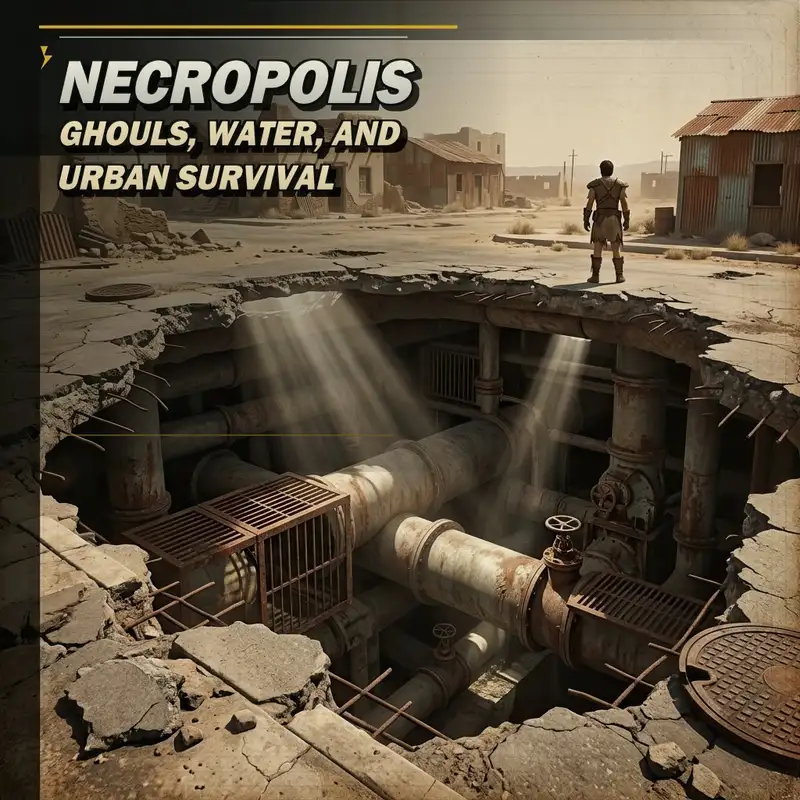
Necropolis: Ghouls, Water, and Urban Survival
At the Watershed in the year twenty-one sixty-one, Necropolis faced a problem more dangerous than the ruins above it. Its water pump had failed. A detachment of super mutants held the installation. Beneath the city, in Vault Twelve, lay a water chip that could save another desperate community, Vault Thirteen. One piece of inherited machinery had become the center of two survival crises.
That is the essential fact about Necropolis. It was not merely a place where ghouls happened to live among broken buildings. It was an urban society built around working remnants of a dead city and a damaged Vault. Its people had endured radiation, isolation, and the hostility of outsiders. None of that made them independent of water, repairs, labor, or defense. The visible ruins of Bakersfield mattered less than the systems beneath them. Water lines, maintenance spaces, sewer tunnels, and access points determined who could live, who could move, and who could rule.
The crisis at the Watershed exposed every weakness at once. A failed pump threatened the city’s supply. Set, the self-appointed ruler of the surface ghouls, had authority only so long as he could protect and distribute essential resources. The Unity, the Master’s expanding super mutant organization, demonstrated that it could pressure the city without occupying every street. And the Vault Dweller arrived with a legitimate emergency of another kind. Vault Thirteen’s own water system was failing, and the replacement component was below Necropolis.
This was not a simple scavenging problem. It was a conflict between two vulnerable settlements, each dependent on old-world technology it could not easily replace. Necropolis had made a city out of ruins, but its survival rested on a few critical systems. When one of them failed, the city’s political order began to look as fragile as its pipes.
To understand why a broken pump could threaten an entire community, it is necessary to begin with the geography Necropolis inherited. The settlement stood amid the remains of Bakersfield, a southern California city devastated during the Great War on October twenty-third, twenty seventy-seven. By the time the Vault Dweller arrived, the streets were shattered, the surface was irradiated, and the old city no longer functioned as a city in any pre-War sense.
But ruins are not empty terrain. They preserve advantages and dangers. They offer shelter, salvage, concealment, underground access, and fragments of useful infrastructure. They also trap communities inside hazardous environments, restrict movement, and concentrate people around the few systems that still work. Necropolis emerged from this landscape with one unusual advantage. Its inhabitants could survive conditions that would have driven many other settlers away.
The ghouls of Necropolis were descended from people who had sought shelter in or around Vault Twelve after the war. Fallout’s surviving evidence establishes the connection between the Vault, radiation exposure, and the later ghoul population. It does not require a fully precise account of every decision that created that outcome. Later material has offered more elaborate explanations for Vault Twelve’s design, but the central historical point is simpler and better supported. People survived the bombs and their aftermath in an environment that transformed them and made ordinary resettlement difficult.
Their ability to endure radiation gave them access to territory that many outsiders feared. That was a real strategic advantage. It allowed Necropolis to inhabit a city other groups might avoid. Yet environmental endurance was not the same as self-sufficiency. Radiation resistance did not create farms, repair shops, spare components, secure trade routes, or political institutions. It did not eliminate the need for drinking water. It simply changed the kind of terrain the population could occupy.
Necropolis therefore became a post-War city not because its inhabitants had escaped the consequences of collapse, but because they had learned to work within them. The ruins of Bakersfield became inherited geography. Vault Twelve became inherited infrastructure. The question was whether a population living inside those remains could turn survival into something durable.
The answer depended first on water. Vault Twelve’s water system formed the practical foundation of Necropolis. The surviving machinery linked the underground Vault to the city’s broader settlement pattern. Its exact engineering is not fully documented, and there is little value in pretending that a few game-era records provide a complete technical diagram. What matters is that the system supplied water to a community with no easy substitute.
A water source is not automatically a water system. A functioning city needs access, distribution, labor, maintenance, security, and rules about who receives what when supplies are under pressure. Someone must understand enough of the machinery to keep it operating. Someone must move through dangerous areas to inspect it. Someone must protect the facilities from raiders, occupiers, sabotage, or internal seizure. Even a small failure can become a social crisis when replacement parts are scarce and no surrounding industrial economy can provide another pump on demand.
Necropolis had another asset that helped it survive the ruined surface. Its sewer network connected districts beneath the rubble. These tunnels were not merely a convenient route for travelers. They were the city’s secondary circulation system. They allowed movement between places that might be difficult or dangerous to reach above ground. They provided concealment, shelter, and alternate approaches to critical sites. They also created boundaries. A population forced underground could remain connected to the city while still being politically separated from those who controlled the surface.
The sewers therefore had military and civic value. In a damaged city, mobility is power. A guard force that knows the routes can regulate access. A dissident community can use the same routes to avoid direct control. Maintenance workers can reach infrastructure without crossing exposed streets. Smugglers, scouts, and infiltrators can exploit spaces that no faction fully controls. The same tunnels that kept Necropolis alive also made it difficult for any one ruler to make the city fully legible.
This is one reason post-War cities cannot be understood by looking only at their skyline. The strategic terrain may be a pump room, a sewer junction, a storage chamber, or the path between a water source and a defensible district. In Necropolis, the most important buildings were not necessarily the largest or most visible. They were the places where infrastructure, movement, and political authority met.
Infrastructure is never politically neutral when access is scarce. Necropolis did not have a single unified ghoul society calmly sharing a common inheritance. It had factions, leaders, guards, resentments, and unequal access to power. The city’s most visible authority belonged to Set, the ruler of the surface ghouls.
Set governed from the Hall of the Dead, a place that functioned as more than an ominous landmark. It was a political center. Set had guards, including the enforcer Garret, and he used them to control access, punish challenges, and establish his authority over the surface community. His rule rested on coercion, but coercion alone was not enough. A ruler in a city with scarce resources must also manage distribution. He must decide who receives water, who receives protection, who is trusted with weapons, and who is pushed to the margins.
Set’s language and behavior make clear that he was not a benevolent civic leader. He ruled through fear and force. Yet it would be too simple to treat him as a man interested only in cruelty. He understood that Necropolis needed people. A city facing external threats could not easily afford to discard every dissident, laborer, or potential defender. His authority depended on keeping enough of the population alive to sustain his own position.
That calculation shaped his relationship with the underground ghouls. This separate community did not share Set’s political outlook. They were more peaceful, more wary of his violence, and effectively excluded from the surface order. They lived below the city, connected to it through the sewer system but denied equal standing within it. Set still provided them with water. The arrangement was not evidence of equality. It was evidence of dependency and military necessity. He believed he might need their numbers if Necropolis had to defend itself.
That detail is important because it reveals the political economy of the city. Water was both a public necessity and an instrument of authority. Set could not simply cut off the underground ghouls without weakening the city’s broader capacity to survive. At the same time, their dependence on water distributed from a system he influenced limited their ability to resist him openly. Their exclusion was not absolute abandonment. It was selective provision under unequal terms.
Such arrangements are common in fragile states and fortified settlements. A ruler may protect a marginal group not because he recognizes its rights, but because its labor, knowledge, numbers, or silence remains useful. The population receives enough to live, but not enough political power to challenge the system that keeps it dependent. This can produce stability for a time. It can also preserve resentments that become dangerous whenever an outside threat or internal crisis weakens the center.
For ordinary ghouls in Necropolis, the result was a compressed version of post-War urban life. They faced prejudice from outsiders who often saw ghouls as monsters before they saw them as neighbors. They faced internal domination by Set’s surface faction. They faced practical dependence on a water system they did not fully control. And they faced the prospect that a hostile force could enter the city through the very infrastructure that kept it alive.
The underground ghouls were not simply passive victims waiting for rescue. Their existence represented a different political position within Necropolis. They wanted a less violent relationship with the world around them. They rejected Set’s methods and survived in spaces that were physically connected to the city but politically subordinate to it. The sewers gave them some protection from direct confrontation, but that protection came at a cost. Life below ground meant reduced visibility, reduced influence, and continued dependence on surface-controlled resources.
The underground network thus mapped Necropolis’s social fracture. Surface and sewer were not merely different locations. They represented different access to authority. Set’s faction held the political center, armed guards, and a stronger claim to public command. The underground ghouls had community, knowledge of their routes, and a measure of insulation from surface violence. Neither side possessed complete security.
Vault Twelve added another layer to this fractured terrain. Within the irradiated Vault were Glowing Ones, dangerous inhabitants shaped by extreme radiation exposure. They should not be confused with the ordinary non-feral ghouls of Necropolis. They were not a civic faction with a common political program. They did not represent all ghouls, and their presence should not be used to erase the distinction between people capable of community life and individuals who had become hazardous through deterioration or irradiation.
That distinction mattered in practice. Outsiders who entered Necropolis could easily see hostile irradiated figures, ruined Vault corridors, and armed surface guards, then conclude that the entire city was a uniform threat. It was not. Necropolis contained different populations, different interests, and different degrees of danger. The city’s tragedy was partly that its complexity was difficult for outsiders to see and difficult for its own inhabitants to govern.
Set’s control was already incomplete before the water pump failed. His guards could dominate a hall. They could intimidate rivals. They could regulate movement through parts of the city. But they could not make a fragile water system invulnerable, and they could not remove the city from the regional struggle unfolding around it. When the Unity moved into the Watershed, it demonstrated exactly how limited local authority could be.
The Unity’s local force was commanded by a super mutant named Harry. Harry and the other mutants at the Watershed did not need to administer Necropolis as a conventional occupation government. They did not need a city council, a tax office, a food program, or a permanent patrol on every street. Their advantage came from holding the critical node. By controlling the Watershed, they could control the infrastructure on which the rest of the city depended.
This is a hard lesson in strategic geography. A small force can exert influence far beyond its numbers if it occupies the right facility. A dam, bridge, radio relay, airfield, waterworks, or power station can give an outside force leverage over a population without giving it the ability to govern that population well. The Unity’s position at the Watershed allowed it to watch Necropolis, pressure Set, and threaten the water supply. It transformed local infrastructure into an instrument of coercion.
Set understood the arrangement for what it was. The Master’s forces did not need to destroy him immediately. Keeping him in place under supervision was cheaper and more useful. A local strongman could manage the city’s daily disorder while the Unity held the decisive asset. This reduced the burden on the occupying force. It also made Set’s government look powerful inside the Hall of the Dead and weak everywhere that truly mattered.
The Unity’s presence was connected to a larger intelligence problem. The Master sought human Vault dwellers for his broader project, and Harry’s detachment was alert to the possibility that someone from a Vault might appear. Necropolis was valuable not only because of water. It was also a point where the region’s surviving populations, buried facilities, and travel routes intersected. A traveler who emerged from Vault Twelve or asked the wrong questions could become intelligence of immediate interest to the Unity.
This links a local urban crisis to a regional campaign without turning Necropolis into a mere footnote of the Master’s war. The city mattered in its own right. Its people were trying to survive. But their position made them vulnerable to the ambitions of a larger organization. The Unity saw infrastructure and population as resources to be controlled, observed, or absorbed. It had little reason to invest in the legitimacy of Necropolis’s government or the well-being of its residents beyond what served its mission.
That distinction between control and governance is essential. The Unity could seize the Watershed. It could intimidate Set. It could search for Vault dwellers. None of that meant it could create a durable civic order in Necropolis. Occupation of one facility gave it leverage. It did not give it the trust, local knowledge, repair capacity, or consent needed to run the city over time. But for the ghouls living under its shadow, the difference offered little immediate comfort. A force that controls the water supply does not need to govern well to be dangerous.
Into this situation came the Vault Dweller. The character’s fixed purpose was clear. Vault Thirteen’s water chip had failed, and the Vault needed a replacement. The Vault Dweller’s identity, methods, companions, politics, and personal motives remain player-defined. Necropolis’s history should not be rewritten around one assumed version of that traveler. What matters is that the Vault Dweller arrived carrying a desperate institutional requirement of another community.
Regional knowledge made the journey difficult before the traveler ever reached the city. Information networks in southern California were uneven, shaped by rumor, trade, prejudice, and fear. Communities such as the Hub knew of Necropolis, but the city’s reputation was often filtered through fear of ghouls and fear of radiation. That reputation could discourage casual intrusion. It could also isolate the city from trade, technical support, and potential allies.
Isolation is sometimes a defense. A settlement that outsiders avoid may suffer fewer opportunistic raids, fewer claims from merchants, and fewer political demands from nearby powers. Yet isolation also has costs. A city dependent on aging equipment benefits from spare parts, skilled labor, medical supplies, and reliable information. A community treated as a place of monsters may find it harder to develop the relationships that make those resources available.
Necropolis’s own water source gave it a degree of independence from the Hub’s water merchants. The city was not simply another customer in a regional water market. That independence mattered. It allowed the ghouls to live in a hazardous location without depending entirely on outside delivery. But independent access to water did not mean independence from the wider world. The city still needed knowledge, security, and some connection to a broader economy. It remained vulnerable to any faction capable of seizing the system it relied on.
The Vault Dweller therefore entered Necropolis as both an outsider and a participant in its crisis. The traveler needed something from the city. The city, depending on the choices made, might need something in return. The ethical problem was not solved by declaring one need more important than the other. Vault Thirteen faced a genuine emergency. So did Necropolis.
The water chip in Vault Twelve was essential to Vault Thirteen’s failing system. The broken pump at the Watershed was essential to Necropolis’s survival. These facts created a collision between communities that had no reason to trust one another and no reserve industrial capacity to soften the loss. Neither settlement could simply order a replacement from a factory. Neither could assume that a neighboring government would provide emergency support. In the post-War economy, a working component could have the significance of a treaty, a harvest, or a military convoy.
The player can produce different outcomes in Necropolis. The chip can be taken. The pump can be repaired. Set can be assisted, resisted, or left in place under varying circumstances. The Unity threat can be encountered under different conditions. These possibilities must remain separate. There is no single fully documented playthrough that can be imposed as uncontested history.
What remains fixed is the structure of the dilemma. Extraction of the water chip could save Vault Thirteen, but leaving Necropolis with a broken pump could condemn its residents to dehydration. Repairing the pump changed that calculation. It restored the city’s access to water while allowing the chip to serve Vault Thirteen’s emergency. In practical terms, repair transformed the act of taking the component from a direct transfer of disaster into a more complicated form of mutual survival.
This is best understood as emergency humanitarian and technical intervention. The Vault Dweller, if the pump was repaired, did not merely perform a favor for a few grateful residents. The repair preserved the immediate life-support capacity of a whole settlement. It reduced the danger that Vault Thirteen’s survival would be purchased at Necropolis’s destruction. It also demonstrated how much political weight rested on a scarce pool of technical knowledge.
Yet even this favorable result had limits. A repaired pump did not create a new waterworks. It did not establish a school for future technicians, a warehouse of replacement parts, or a regional maintenance economy. It did not make the city’s infrastructure young again. It restored a system that remained old, concentrated, and vulnerable. In a society built around inherited machinery, repair is often necessary. It is rarely sufficient.
The pump repair also did not settle the question of power. Set’s authority remained rooted in guards, intimidation, and control over vital resources. The underground ghouls remained politically marginal. The Unity’s broader campaign remained active. The sewers remained routes of refuge and division. A working pump could reduce suffering, but it could not make the people of Necropolis agree on who should govern them or what kind of city they wanted to become.
The pump repair restored water flow. At the mission level, it made the removal of the water chip less directly catastrophic for Necropolis. Across the wider campaign, it preserved the city’s short-term ability to sustain its inhabitants. These were meaningful achievements. They should not be minimized.
The political problems remained. Set could still rule through coercion. The surface and underground communities still lacked a settled relationship. The city still depended on systems controlled by a narrow group of people and vulnerable to outside seizure. A repaired machine does not automatically produce accountable government any more than a captured building produces stable territorial control.
The logistical limits were equally severe. Necropolis could operate inherited systems, but it had little evidence of a robust industrial base capable of replacing them. The city had adapted to scarcity through salvage and improvisation. That is a real form of competence. But salvage economies are vulnerable when the failure involves a specialized component, a skilled technician, or a facility no one can reproduce. Every successful repair may postpone a crisis without removing the conditions that caused it.
Security remained the most immediate concern. The Unity’s control of the Watershed showed how easily a stronger outside force could turn infrastructure into leverage. Set’s guards might be able to impose order within parts of Necropolis, but they could not guarantee the city against a regional military threat. The underground ghouls could provide manpower and local knowledge, but political exclusion weakened the cohesion that a genuine defense would require.
A city can survive a pump failure if someone repairs the pump. It can survive a raid if its defenders repel it. It can survive a period of harsh rule if no external pressure breaks the arrangement. The deeper problem arises when all of those pressures arrive together. Necropolis was not simply short of water. It was short of institutional margin. It had too few systems that could fail safely.
The game’s conditional outcomes show the danger clearly. In one branch, the water chip is removed without repairing the pump. Necropolis then faces a dehydration catastrophe. This is the most direct expression of the city’s dependency. The ghouls’ ability to survive radiation does not protect them from the collapse of their water system. Their city lives because water can be distributed. When that distribution fails, environmental endurance is not enough.
In another branch, the pump is repaired, and Necropolis receives the possibility of continued survival. Later testimony in Fallout Two supports the broad idea that the Vault Dweller repaired the water system and saved the ghouls. Lenny, a ghoul encountered much later in Gecko, remembers Necropolis and speaks of that intervention. His account is valuable as later evidence, but it is not a complete municipal archive. It does not tell us every choice made in the city, every political consequence, or every person who survived.
There is also the danger of the Unity assault. Under certain conditions, Necropolis can suffer a devastating attack by super mutants. Later continuity supports the broad conclusion that the city was badly hit by the Master’s forces. This does not mean every possible ending occurred at once. The exact sequence of the Vault Dweller’s actions, the full scale of the attack, and the fate of every resident remain unresolved. What can be said is that restoring water did not erase the military threat.
That is the limitation of a so-called good ending. The favorable water outcome is good because it prevents an immediate and avoidable disaster. It does not create immunity from later violence. It does not remove the Master’s regional ambitions. It does not turn Set into a legitimate leader. It does not make a divided city united. In a post-War world, one successful intervention can be historically important without being final.
Necropolis’s later history is therefore incomplete, but its lesson is not. The city’s fate was shaped by overlapping vulnerabilities. A broken system could kill people. A local strongman could exploit scarcity. An outside army could seize the critical facility. Outsider prejudice could limit political and economic support. A humanitarian repair could preserve life while leaving deeper structures untouched. These are not separate stories. They are the same urban crisis seen from different levels.
Radiation resistance was never security. The ghouls of Necropolis could inhabit terrain that was dangerous to many humans. That gave them a measure of shelter from the surrounding world. It did not provide food, water, social trust, spare parts, or allies. It did not make them immune to occupation, factional rule, or mass violence.
The assumption that ghouls need less from society because they can survive more from the environment is one of the errors Necropolis exposes. A population may be unusually resilient in one dimension and deeply vulnerable in another. People who can endure radiation still need institutions. They still need a way to settle disputes, protect children and elders, distribute scarce goods, train successors, and organize defense. They still need to decide whether survival will rest on fear or cooperation.
The city’s isolation made this harder. Necropolis’s ghouls lived with the burden of being feared by outsiders and divided among themselves. That did not make their situation hopeless. They had created a functioning community in circumstances that would have destroyed many others. But it did mean that their advantages came with political costs. The irradiated ruins that protected them also marked them as separate. The underground routes that connected them also reflected their exclusion. The water system that sustained them also gave ambitious men and occupying forces a way to control them.
Necropolis was a real city because its inhabitants did more than occupy ruins. They organized water, shelter, movement, labor, and defense around surviving infrastructure. They adapted Vault Twelve’s systems to a new society. They made use of sewers and abandoned districts. They endured a hostile environment and created enough order for factions, rivalries, and collective needs to matter. That is not the story of a monster den. It is the story of urban survival after state collapse.
But the city remained politically fragile because its most important assets were concentrated. Water came through a vulnerable system. Maintenance knowledge was scarce. Access routes could be controlled. Set could turn distribution into authority. The Unity could turn occupation of the Watershed into strategic leverage. The underground ghouls could survive beneath the surface, but they could not escape the broader system of dependency that linked them to it.
The Vault Dweller’s intervention, when it included repair of the pump, mattered because it preserved lives and prevented one community’s emergency from becoming another community’s death sentence. That was a genuine achievement. Yet it was not a constitution. It was not a maintenance economy. It was not a unified defense force. It was not a settlement of the conflict between Set and his opponents. It was not a guarantee that the Master’s forces would leave Necropolis alone.
Necropolis shows that the first stage of reconstruction is often not grand political renewal. It is keeping the water moving. But a city cannot remain secure if every essential function depends on a single aging machine, a handful of technicians, and the mercy of whoever controls the door to the pump room. Survival begins with infrastructure. Durable security requires institutions capable of protecting that infrastructure from both local domination and outside coercion.
The ghouls of Necropolis did not fail because they could not survive the ruins. They proved that they could. Their tragedy was that survival inside the ruins still depended on systems too fragile to defend the people once water became a weapon.