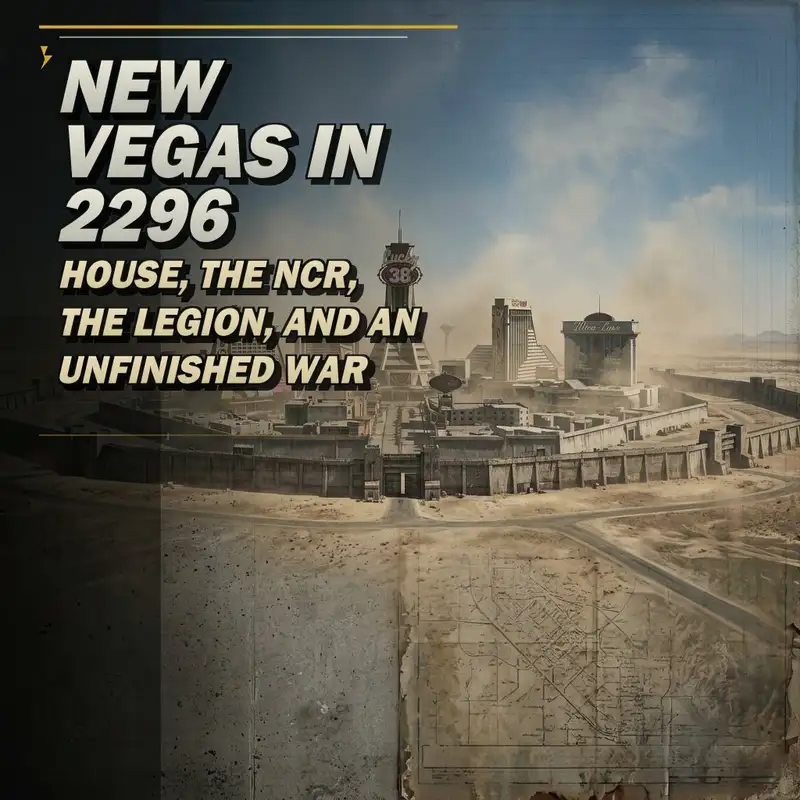
New Vegas in 2296: House, the NCR, the Legion, and an Unfinished War
Deathclaws have reached the Strip. Around the Lucky 38, the symbol of Robert House’s command over New Vegas, creatures now occupy ground that was once guarded by robots, watched by casino families, and treated as the political center of the Mojave. In Freeside, New California Republic personnel fight to recover order after the attack. Inside the Lucky 38, House’s systems return to operation. Beyond the city, a reorganized Caesar’s Legion advances toward New Vegas under the Lacerta Legate. Fifteen years after the Second Battle of Hoover Dam, the Mojave is behaving less like the aftermath of a settled war than the opening of another one.
That is the contradiction at the center of New Vegas in the year twenty-two ninety-six. In twenty-two eighty-one, every major contender understood that Hoover Dam could decide the region’s future. The New California Republic wanted its electricity, trade routes, and strategic depth. Caesar’s Legion wanted to break the Republic’s eastern expansion and turn the Mojave into a conquered frontier. Robert House wanted the dam’s power for a commercial city-state run from the Lucky 38. An independent New Vegas, depending on the Courier’s choices, could reject all three claims. Yet the later record does not identify one final path from that battle to the present crisis.
The absence of a confirmed winner does not mean that nothing happened. It means the surviving record shows consequences without providing a clean campaign map. The Strip is damaged. Freeside is vulnerable. The New California Republic still has organized personnel capable of intervening. House is again available as a political actor. The Legion has survived its internal fracture well enough for one faction to march west. These are not signs of stable rule. They are signs that the political value of New Vegas outlived the battle that was supposed to settle it.
New Vegas matters because it is more than a city of casinos, bright signs, and carefully preserved old-world luxury. It is one of the Mojave’s rare concentrations of infrastructure, symbolism, commerce, and defensible urban space. It sits near Hoover Dam, near major roads, near McCarran, and near settlements whose labor, food, water, salvage, and trade make urban life possible. A faction that holds the city gains more than a flag over a skyline. It gains access to a regional economic node and the prestige of ruling a place that still looks, at least from a distance, like civilization survived.
That value began with the Great War. Robert House prepared Las Vegas for nuclear attack with a mixture of prediction, missile defense, and extreme private investment. His preparations did not leave the area untouched, and they did not preserve a normal pre-War city. But they reduced the direct destruction that struck much of North America. In the post-War Mojave, that difference mattered. Las Vegas retained an unusual concentration of intact structures, functioning systems, and recoverable wealth. The city was not a blank slate. It was a damaged but valuable inheritance.
Hoover Dam amplified that value. Electricity is not simply a convenience in the wasteland. It can support workshops, communications, medical equipment, pumping systems, lighting, defenses, manufacturing, and whatever fragments of public life a settlement can maintain. Control over power does not automatically create prosperity, because power must still be distributed, repaired, guarded, and connected to people who can use it. But a functioning dam offers leverage that few post-War governments can ignore. It can turn a local settlement into a regional power center, if an institution has the capacity to manage it.
McCarran also mattered for reasons more practical than prestige. A major airfield and transport hub can serve as a military base, a logistics point, a communications center, and a symbol of organized authority. Roads through the Mojave linked the city to California, to the Colorado River, to outlying settlements, and to the dangerous approaches from the east. Those roads were never safe merely because they existed. They required escorts, patrols, repairs, intelligence, fuel or pack transport, food stocks, and cooperation from the communities along them. Still, they made New Vegas a prize worth fighting over.
The Strip itself provided another form of power. Its casinos, hotels, defenses, and protected image could attract wealthy travelers, merchants, gamblers, contractors, and political intermediaries. Commerce in the Mojave did not depend on a single institution, and it never belonged solely to House or the casino families. But the Strip concentrated exchange in a way few other places could. It was a place where money, information, security, and spectacle met. In a fractured region, that kind of concentration creates opportunity. It also creates an invitation to conquest.
By the time of the First Battle of Hoover Dam in the year twenty-two seventy-seven, the New California Republic and Caesar’s Legion had already recognized what was at stake. The Republic held the dam after the battle. That was a significant defensive success. It prevented the Legion from crossing into the Mojave on its own terms and preserved the Republic’s immediate position along the Colorado. But holding the dam did not destroy the Legion. It did not erase the Legion’s military system, its eastern base of power, or its ability to return.
The First Battle demonstrated a lesson that post-War governments repeatedly learned at great expense. Possession of a strategic site is not the same thing as control of a theater. A dam can generate power. It cannot, by itself, secure every road, administer every settlement, prevent infiltration, feed every garrison, or make an enemy abandon its political project. The New California Republic had stopped a major offensive, but it had not ended the war’s underlying contest. The Legion remained capable of organizing another campaign, and the Mojave remained too valuable for either side to disregard.
By twenty-two eighty-one, the situation had become more complicated than a conventional border war between two expanding powers. The New California Republic had troops, officials, Rangers, contractors, merchants, settlers, and political interests spread across the Mojave. Caesar’s Legion was preparing to renew its offensive from the east. Robert House ruled the Strip through the Free Economic Zone, the Lucky 38, the casino families, and his Securitron security system. At the same time, the Courier could help create an independent political order associated with Yes Man and the removal of outside claimants.
These were not four versions of the same government. They represented four very different answers to the question of who should rule New Vegas. The Republic offered incorporation into a larger state, with elected institutions, taxation, law, military protection, and the familiar burdens of bureaucracy. The Legion offered conquest, discipline, coercion, and a social order built on subordination. House offered concentrated technocratic and commercial rule, with security directed from a single protected command center. An independent route offered the possibility that New Vegas might avoid becoming the possession of any outside empire, though what durable institutions would follow depended heavily on choices the player could make.
The Courier could alter the balance among these forces, but the Courier’s exact conduct is not a fixed historical record. There is no established account that assigns a single personality, alliance, military program, or private motive to that figure. The Courier may have assisted one claimant, undermined another, or enabled a different future entirely. The important fixed point is that the Mojave crisis in twenty-two eighty-one revolved around the same assets for every path: Hoover Dam, New Vegas, transport routes, security systems, economic access, and the authority to define what came next.
The Second Battle of Hoover Dam could therefore produce a sharp immediate result. The New California Republic could prevail. Caesar’s Legion could prevail. House could emerge as the dominant power. New Vegas could become independent of all three. Those possibilities are mutually exclusive as endings, and later history does not permit them to be combined into a single convenient account. The battle had multiple possible outcomes because the game was built around a political choice, not around one secretly predetermined future.
But even a decisive battlefield result would have answered only part of the Mojave’s problem. An army can be defeated at a dam and still leave behind instability, resentments, divided communities, damaged infrastructure, armed irregulars, and a border that must be defended again tomorrow. A city can be liberated from an occupier and still lack food, medical supplies, public order, reliable trade, and a government trusted by its residents. A ruler can seize a power station and still lack the technicians, spare parts, transport capacity, and social cooperation required to turn electricity into durable authority.
That distinction matters in twenty-two ninety-six. The later evidence does not tell a clean story in which one victory at Hoover Dam produced fifteen years of uninterrupted order. It shows a Mojave that has suffered disruption, decline, and renewed competition. The exact sequence remains unclear. The record does not establish every withdrawal, treaty, betrayal, local uprising, or institutional collapse between the battle and the present. That uncertainty is not a weakness in the history. It is part of the history. War leaves records unevenly, especially in a region where governments are contested, archives are fragile, and every claimant has reason to describe the past in a way that favors its own legitimacy.
House’s political project illustrates the strengths and risks of concentrated power. His intended order was not democratic, and it was not designed around broad public participation. House envisioned New Vegas as a commercially organized city-state, protected by advanced security and directed by superior calculation. The Strip would provide wealth. Hoover Dam would provide power. The Lucky 38 would provide command. Securitrons would provide the force needed to deter rivals and maintain internal order. In theory, House could make the Mojave stable without submitting it to either the Republic’s bureaucracy or the Legion’s brutality.
There was a real strategic logic to that model. House had access to technologies that other Mojave powers could not easily reproduce. His command architecture was unusually durable. The Lucky 38 was a hardened center of authority, and the Securitrons could provide a rapid, disciplined security force without the ordinary problems of recruitment, desertion, personal loyalty, or political faction within the ranks. A robot army does not demand wages, vote against its commander, or ask whether a campaign is popular.
It does, however, require systems. Robots need power, maintenance, replacement parts, repair facilities, programming, communications, and secure command authority. A city protected by automation still depends on human labor beyond its gates. Someone must grow food, move water, maintain roads, operate workshops, treat the sick, unload caravans, negotiate with suppliers, and repair the physical networks that make a commercial hub possible. A Securitron can guard a street. It cannot make a merchant trust a market, persuade a farming settlement to trade, or create political consent among people who see the city as a machine for extracting value from the surrounding Mojave.
House’s greatest institutional strength was also his greatest vulnerability. His government was highly centralized around one physically fragile leader and a narrow technical system. If House was active, informed, and connected to his machines, he could act with extraordinary coherence. If he was isolated, offline, damaged, or deprived of control over critical systems, much of that coherence disappeared with him. There was little room for a broad succession system, a representative political class, or a public institution capable of claiming authority independently of House himself.
His restoration in twenty-two ninety-six is important for that reason. It confirms that House remains available as a present-day force in the struggle for New Vegas. It does not prove that the Courier chose House in twenty-two eighty-one. It does not prove that his Securitron army was upgraded, that the Strip remained continuously under his control, or that every part of his intended political order survived the intervening years. It establishes something more limited but still significant. The old command center is no longer merely a relic. Its owner is again in the contest.
The New California Republic approached the Mojave from the opposite direction. Where House concentrated authority in one tower and one technical hierarchy, the Republic tried to extend a larger political system across difficult terrain. Its ambitions included security, trade, law, taxation, infrastructure, settlement, and the incorporation of frontier territory into a republican order. Hoover Dam mattered not only as a military objective but as part of that broader project. The Republic wanted the dam’s power, the region’s routes, and the denial of those assets to hostile powers.
The Republic possessed advantages that no casino city-state could easily match. It had a broader economic base, established political institutions, an army, Rangers, administrators, merchants, and the ability to draw on communities far west of the Mojave. It could move conventional forces, establish garrisons, regulate trade, and build some of the ordinary machinery of government. It had the potential to connect New Vegas to a larger market rather than treating it as an isolated enclave protected by exceptional technology.
Yet expansion imposed costs. Distance from the Republic’s core created a permanent burden. Every soldier posted in the Mojave needed food, water, ammunition, medical support, replacements, transport, orders, and some reason to remain loyal to a government far away. Every outpost needed patrols and repairs. Every protected caravan route required more than a flag on a map. The Republic could arrive in force, but holding a frontier demanded administrative capacity as well as military presence.
Its political system also produced friction. Elected government, bureaucratic oversight, private commerce, military command, local ambition, and frontier necessity did not always move in the same direction. Officials could be constrained by distant politics. Military leaders could lack clear intelligence. Contractors and merchants could profit from expansion without sharing the risks faced by settlers and soldiers. Local communities could want protection while resenting taxation, regulation, or the arrival of outsiders who treated the Mojave as a resource zone rather than a home.
None of this means the Republic was merely weak, or that its failures made the Legion’s alternative attractive in any humane sense. The Republic represented a serious attempt to create lawful institutions over a large territory. It could provide roads, courts, trade, and protection. But the Mojave exposed the limits of those institutions. A state can have elections and still overextend. It can have an army and still misunderstand the frontier. It can claim legitimacy and still fail to deliver security evenly to the people living beyond its political center.
The New California Republic’s presence around Freeside in twenty-two ninety-six should be understood through that lens. It demonstrates organized capacity. Its personnel can intervene during a crisis, fight to recover ground, and become visible actors in the city’s security. A faction that can respond to a threat has more political weight than one that can only issue claims from afar. But local intervention is not proof that the Republic has restored full authority over New Vegas, much less the entire Mojave. The surviving evidence does not establish its territorial reach, supply network, or degree of public support.
Freeside is also the test of whether intervention becomes legitimacy. Residents may welcome relief from an immediate threat. Merchants may welcome reopened routes. Families may welcome a force that can restore some order after an attack. But emergency action alone does not create durable government. It must be followed by food distribution, medical assistance, predictable law, functioning markets, accountable security, and a relationship with residents that does not reduce them to a garrison problem. If those things do not follow, even a successful defense can become another brief episode in a city accustomed to being used by stronger powers.
Caesar’s Legion offered a third model of order, one built not on civic incorporation or commercial consent but on conquest. Under Caesar, the Legion absorbed communities through military force, compelled labor, imposed discipline, and subordinated local identities to a centralized ideological project. Its soldiers could be disciplined, mobile, and willing to endure hardship. Its intelligence networks could exploit weaknesses in enemy command and local politics. Its leadership understood that military pressure did not always require expensive machinery. Fear, infiltration, coercion, and the threat of exemplary violence could be weapons in their own right.
Those advantages came at a severe human cost. The Legion’s system relied on slavery, forced cultural destruction, gendered subordination, terror, and the treatment of conquered people as material for war. Its logistical model could draw on captured labor and intimidated populations, but that did not make it self-sustaining or morally neutral. It meant the burden of supply fell on people denied the ability to refuse. A road secured by fear may carry an army. It may also carry resentment, flight, sabotage, and the long memory of communities that know what the conqueror has done.
The Legion could seize ground because it was organized for conquest. It was less clearly prepared to govern a diverse and economically complex region like the Mojave over the long term. Destruction can be a military method. It is not an administrative system. Breaking a rival’s army does not automatically create technicians, judges, farmers, traders, engineers, or institutions trusted by people who have every reason to fear the victor. The Legion could impose obedience. Whether it could build a resilient society beyond Caesar’s personal direction was another question.
That question became unavoidable when Caesar’s health declined. The Legion’s political structure placed enormous authority in one founder. Caesar was not merely a commander. He was the source of doctrine, legitimacy, strategic direction, and the claim that the Legion represented something greater than a coalition of armed tribes. Such a system can be powerful while its founder remains active. It can also become dangerously unstable when succession is uncertain. The more authority is concentrated in one person, the harder it is for a successor to inherit without contest.
By twenty-two ninety-six, the Legion is not simply Caesar’s old organization continuing unchanged. It has experienced internal conflict. The Lacerta Legate’s faction has used violence, symbols, and a claim to inherited authority to reunify enough of the movement to march toward New Vegas. That march has an immediate military purpose. The city, the dam, and the Mojave remain valuable prizes. But it also serves a political purpose inside the Legion itself. A successor regime needs a victory that demonstrates it can command loyalty, punish rivals, and make Caesar’s legacy appear continuous.
That makes the Legion’s new campaign especially dangerous and especially fragile. A force moving toward New Vegas may gain cohesion from shared purpose, plunder, ideology, and the promise of conquest. Yet the same campaign can expose weaknesses. It must keep its formations supplied across difficult country. It must prevent internal rivals from exploiting setbacks. It must prove that the Lacerta Legate’s authority is more than a temporary coalition held together by fear and momentum. If the campaign falters, the question of succession returns with greater force.
The fate of New Vegas cannot be understood by looking only at House, the Republic, or the Legion. The Strip depends on the world outside its gates. Freeside, surrounding settlements, merchants, laborers, refugees, the Followers, caravan workers, local guards, and people simply trying to maintain a household all form part of the city’s real political terrain. They provide labor, information, markets, and social continuity. They also carry the costs when a major power decides the Mojave is a strategic opportunity.
For residents, the difference between rival governments is not an abstract argument about flags. It is whether water arrives, whether markets remain open, whether a road can be traveled without being robbed or conscripted, whether a child can receive treatment, whether a family can remain in its home, and whether armed men or machines can be held accountable when they abuse power. A casino tower may glitter over the city, but the people in Freeside judge authority by more immediate measures.
The Deathclaw disruption makes that reality visible. The attack does not provide a complete explanation for New Vegas’s decline, and it does not reveal the exact sequence by which different factions lost influence or withdrew. It does show a failure of public security. A city claimed by powerful institutions has become vulnerable enough that the area around the Lucky 38 can be occupied by predators and Freeside can require a violent recovery operation. Symbolic possession means little if residents cannot move, trade, sleep, or seek shelter safely.
For that reason, the recovery of Freeside carries political significance beyond the immediate fight. Whoever helps restore the district can present itself as a protector. But protection is not only a matter of killing the threat. It is a matter of what comes afterward. If relief is temporary, if the roads remain insecure, if food and medicine cannot be brought in, or if the recovering force treats the population as an expendable buffer around the Strip, then the city’s underlying instability remains. The civilian population is not scenery surrounding a faction showdown. It is the logistical base and political prize of the entire campaign.
Any renewed war for New Vegas will face the same operational realities that complicated the earlier conflict. The Mojave is a desert theater. Water determines movement and settlement. Roads concentrate traffic and create predictable targets. Ammunition, medicine, spare parts, and food have to move through exposed territory. Wounded personnel must be evacuated or treated locally. Radios and command systems depend on equipment, power, trained operators, and secure communication. A force that advances rapidly can still find itself unable to hold what it reaches.
The New California Republic has the strongest claim to conventional reach. It can draw on a larger administrative and economic network, and it has experience with garrisons, patrols, Rangers, and formal military organization. But those advantages are tied to a heavy supply burden. The Republic must maintain the routes that sustain its forces. It must persuade or compel distant institutions to keep supporting the Mojave. It must avoid allowing every crisis to consume more manpower than the territory can justify politically. Its strength is organization. Its weakness is the price of organization over distance.
The Legion has a different profile. It can move through hardship, draw supplies through coercion, and use fear to reduce the immediate cost of policing conquered people. It may be able to exploit gaps in enemy deployment and uncertainty in local loyalties. But coercive logistics are not free. They produce resistance, flight, damaged communities, and an economy distorted around military extraction. A Legion force that takes New Vegas would still have to control a large civilian population, defend routes, manage access to the dam, and prove that its leadership can survive the end of a campaign.
House’s position is more concentrated still. His technology can create a local advantage, especially if his command systems are functioning and his defenses are intact. The Lucky 38 can serve as a strong political and technical center. But House cannot secure the Mojave from a tower alone. His machines need repair. His commercial order needs people willing or compelled to trade. His city needs food, water, labor, and a degree of predictability beyond the Strip. Automation can reduce some manpower problems. It cannot eliminate the political requirement to govern people who do not live inside the command system.
Control of the Strip, then, is not control of the Mojave. Control of Hoover Dam is not control of New Vegas. Control of New Vegas is not necessarily control of the roads, settlements, and communities that sustain it. Each claimant has repeatedly treated one strategic asset as the key to the larger region. Each asset matters. None is sufficient on its own. The dam can provide leverage, but it cannot solve succession. A robot army can defend property, but it cannot create trust by itself. A conventional army can occupy a district, but it cannot make a distant government responsive. A conquering Legion can impose fear, but fear is not the same as durable administration.
What does the year twenty-two ninety-six actually confirm? It confirms that House’s presence has been restored. It confirms that the New California Republic has personnel capable of acting around Freeside. It confirms that the Legion has emerged from internal conflict with a force moving toward New Vegas. It confirms that the city has experienced visible interruption and insecurity severe enough to leave the Strip compromised and civilians exposed. These are major developments. They establish the conditions for a renewed struggle.
What they do not confirm is equally important. They do not identify the winner of the Second Battle of Hoover Dam in twenty-two eighty-one. They do not provide a complete chronology of the fifteen years that followed. They do not establish that House ruled continuously, that the Republic fully regained the Mojave, or that the Legion retained Caesar’s original unity. They do not provide an exact territorial map, a reliable count of surviving forces, or a detailed account of every political arrangement that rose and fell between the battle and the current crisis.
The damaged scenery of New Vegas should be read carefully. It supports the conclusion that security and governance were interrupted or failed. It does not, by itself, prove who abandoned the city first, who defeated whom in a particular year, or how long any faction held authority. Deathclaws on the Strip are evidence of a present security failure. They are not a complete archive. In a region shaped by war, rumor, propaganda, and incomplete records, the temptation to turn every ruin into a simple narrative is understandable. It is also dangerous.
The present confrontation is therefore not a clean rematch of the old battle. The actors have changed. The Republic appears reduced but remains organized enough to intervene. House is restored, but his previous position cannot be assumed from that fact alone. The Legion approaching New Vegas is a successor movement trying to prove continuity after civil war, not simply Caesar’s army marching exactly as it did before. Freeside and the Strip have suffered conditions that make local security an urgent problem before any grand political settlement can be credible.
New Vegas remains at war because the Second Battle of Hoover Dam was never enough to settle the harder question of who could sustain power responsibly in the Mojave. House could concentrate command, but his order depended on fragile systems and one indispensable ruler. The New California Republic could build institutions, but its frontier ambitions could outrun its ability to supply, govern, and earn trust. The Legion could seize territory, but it never solved the problem of succession or transformed conquest into legitimate rule.
The dam, the Strip, and the Lucky 38 can be captured, defended, or reactivated. None of those acts alone can repair institutions, secure trade, resolve succession, or protect the people living beyond the gates. The approaching conflict is not simply a delayed rematch between old enemies. It is the return of an argument that no victor in twenty-two eighty-one had the capacity to finish.