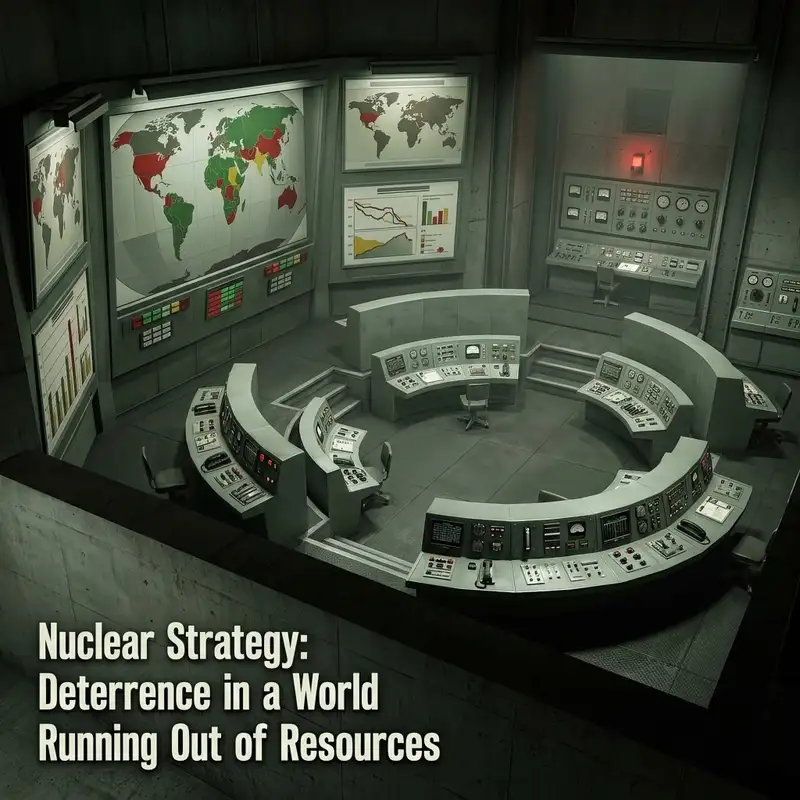
Nuclear Strategy: Deterrence in a World Running Out of Resources
On October twenty-third, twenty seventy-seven, the surviving American record describes a strategic warning system moving from alarm to decision in a matter of minutes. Reports of launches arrived. The United States raised its readiness condition to DEFCON Two. Incoming attacks were confirmed, and a retaliatory order moved through procedures prepared long before the first public warning reached most civilians. The precise sequence remains incomplete. These are records from one side of a war that destroyed much of the evidence needed to reconstruct it. They do not tell us everything China knew, what other actors may have done, or whether every report was accurate. But they reveal the central problem of nuclear deterrence in Fallout. Deterrence is not simply the possession of terrible weapons. It is an attempt to convince an enemy that attack will bring consequences so severe that restraint is the better choice. That effort depends on more than missiles, submarines, bunkers, and launch codes. It depends on communication, intelligence, political discipline, credible command, and a shared belief that there is still a world worth preserving after the crisis passes.
By the time those warnings appeared, the United States and China had spent years building systems meant to survive a nuclear war. They had built fewer systems capable of ending the conditions that made one increasingly likely. Fallout’s Great War was not an inexplicable burst of madness on an otherwise stable planet. It was the final failure of states, corporations, militaries, and elites that had converted scarcity into militarization, secrecy, and increasingly unequal plans for survival. The exchange itself lasted only hours. The strategic collapse behind it had been developing for decades.
The strategic crisis behind those warnings had been building for decades. The Resource Wars turned petroleum, uranium, industrial inputs, transport, and energy security into matters of national survival. International cooperation weakened as states competed for access, while the United States answered scarcity through expansion, military mobilization, domestic control, and technological substitution. Those policies bought time and created real capabilities, but they did not remove the underlying conflict over resources.
The Sino-American War then converted that broader crisis into a prolonged contest between two nuclear powers. China invaded Alaska, the United States mobilized to recover it, and both sides invested in espionage, advanced weapons, hardened facilities, and systems designed to survive escalation. Scarcity did not mechanically force nuclear war. Leaders still made choices, corporations still pursued their own interests, and military institutions still interpreted danger through their own missions. But years of conventional war steadily narrowed the room for political failure without catastrophic consequences.
The common image of deterrence becomes misleading at this point. Nuclear arsenals may discourage direct attack at the highest level while allowing, or even encouraging, brutal conventional competition below that threshold. Each side may assume that the other fears nuclear escalation too much to respond decisively to a conventional move. Yet the more important the conventional war becomes, the more dangerous defeat becomes. A deterrent that restrains one kind of action can coexist with an increasingly reckless struggle in another.
The Battle of Anchorage became one of the great symbols of American wartime memory. Later accounts, especially the Operation Anchorage simulation, present it as a dramatic campaign of courage, technology, and national recovery. But the simulation is not neutral military history. It was built for training and propaganda, and its polished version of the campaign tells us as much about pre-War American political culture as it does about the battle itself. It celebrates decisive action, technical superiority, and a clean restoration of national control. The real strategic situation was less tidy.
An army can retake ground without solving the political problem that made the war necessary in the first place. Troops require food, fuel, medical support, transport, maintenance, replacement personnel, communications, and reliable intelligence. Those needs become more difficult, not less, when the wider economy is strained. The American war effort in Alaska was not sustained by heroism alone. It depended on factories, shipping, infrastructure, command systems, and a public willing to bear the cost. The same was true for China’s ability to continue the conflict. Nuclear strategy existed above this struggle, but it could not escape it.
The longer the war continued, the more both governments had to think not merely about winning, but about avoiding defeat. That is a dangerous transition. A limited war can end in negotiation when both sides believe that compromise preserves something valuable. An existential war produces leaders who fear that a negotiated outcome will leave them exposed, weakened, or politically ruined. At that point, deterrence no longer rests on the promise of mutual survival. It rests on the threat of mutual destruction, delivered by institutions increasingly unsure whether survival is still possible.
In January of twenty seventy-seven, American forces recaptured Anchorage. On the battlefield, it was a major success. The United States regained territory, restored a strategic position, and could present the campaign as evidence that its military system still worked. For the broader war, the result also freed American forces and strengthened the possibility of carrying the war beyond Alaska. But tactical and operational success did not produce a stable peace.
Instead, the conflict continued onto the Chinese mainland. The United States had won an important battle without achieving a political settlement. From one perspective, victory improved American bargaining power. From another, it increased Chinese fears of invasion and national destruction. The same event could be read as a reason for negotiation or as proof that the war had become too dangerous to end on unfavorable terms. This is one of the recurring failures in nuclear strategy. Leaders often assume that military success will create a more favorable diplomatic situation. Sometimes it does. Sometimes it convinces the enemy that diplomacy is no longer safe.
The Alaska campaign also intensified the pressures already affecting American society. Troops remained committed overseas. Military production remained essential. Emergency authority remained politically useful. A state at war can become dependent on the machinery of war, even when that machinery is exhausting the society it claims to defend. The United States had not merely mobilized to defeat China. It had reorganized parts of its economy, domestic security, and political culture around permanent crisis.
China faced its own strategic nightmare. An American victory in Alaska and operations near the Chinese mainland threatened more than territory. They threatened the credibility of the Chinese state and the security of its population. When defeat appears to place the homeland itself at risk, nuclear weapons become more than a distant reserve force. They become an option that leaders may feel compelled to preserve, threaten, or use before their position deteriorates further.
Nothing in that logic makes nuclear war inevitable. It does explain why deterrence becomes unstable when conventional warfare has become existential. The weapons may remain silent for years, yet every defeat, mobilization order, intelligence report, and warning of enemy preparation makes the final restraint harder to sustain. A nuclear balance can freeze a conflict only when the political systems behind it still believe that a future exists beyond the immediate confrontation. In Fallout’s pre-War world, that belief was eroding.
Warheads are the visible part of deterrence. The less visible part is command and control. Nuclear forces need secure communications, trained personnel, maintenance systems, surveillance, intelligence analysis, protected storage, authentication procedures, and some way to ensure that a retaliatory order can reach the weapons after an enemy attack. They also need political judgment. A launch order is not useful merely because it can be transmitted. It must be issued by someone who understands what has happened, believes the information is reliable, and accepts responsibility for what follows.
Real-world terms such as second-strike capability, launch-on-warning, counterforce, and continuity of government can help describe the strategic problems Fallout presents. They should not be mistaken for proof that the setting follows one precise historical nuclear doctrine. Fallout’s technologies, institutions, and political history are its own. The underlying problems are still recognizable: preserving a retaliatory capability after attack, distinguishing a real launch from a false warning, keeping leaders in communication, and retaining control of weapons scattered across bases, automated systems, submarines, and distant bunkers under extreme pressure.
The United States built systems meant to answer yes. It dispersed military assets. It maintained hardened facilities. It relied on automation. It prepared continuity sites. It preserved command structures in places that might survive a wider attack. China also possessed strategic weapons and the means to deliver them, including submarines operating far from the homeland. These measures improved survivability. They also made political control more complicated.
A dispersed force can survive decapitation. It can also fragment. A submarine commander may receive an order without knowing whether the government that issued it still exists. An automated installation may continue to follow procedures after the political authority that created those procedures has disappeared. A bunker may preserve officials who no longer possess the communications, transport, or public legitimacy needed to govern anyone outside its walls. The weapon survives. The state does not necessarily survive with it.
Automation deepened this contradiction. It could react faster than exhausted human institutions. It could keep defenses, silos, factories, and surveillance networks functioning after ordinary administration failed. But an automated system cannot resolve a political crisis merely by processing it quickly. It can preserve an old mission after the circumstances that justified it have vanished. It can enforce a procedure without understanding whether the procedure still serves the people it was meant to protect. The faster an automated system acts, the more important it becomes that humans have designed its purpose wisely before the crisis begins.
Nuclear deterrence therefore depends on an uncomfortable balance. Weapons must be protected from enemy attack, but not hidden so completely that elected or legitimate authorities cannot control them. Launch systems must be ready, but not so ready that false warning or panic can trigger catastrophe. Retaliation must be credible, but the people responsible for it must still believe restraint is possible. Fallout’s pre-War world built formidable machinery for the first half of that equation. It was much less successful at preserving the political conditions required for the second.
Civil defense was supposed to protect the population while deterrence protected the state, but pre-War America distributed that protection unevenly. Shelters, emergency broadcasts, medical plans, and continuity systems could preserve lives. Vault-Tec also turned shelter access into a corporate system shaped by contracts, selection, secrecy, and experiments that residents often did not understand. That changed the meaning of survival. A bunker could protect civilians while simultaneously making them dependent on an institution with extraordinary control over information and daily life.
Unequal protection weakened the political foundation that deterrence was supposed to defend. Ordinary people received warnings and promises, but access to safety depended on location, selection, employment, money, or decisions hidden inside organizations they could not supervise. A society can possess formidable military power while convincing many of its citizens that national survival means the survival of institutions and selected elites rather than the survival of the public as a whole.
Authority was also fragmented before the bombs fell. Military commands, government continuity networks, Vault-Tec, other major corporations, automated facilities, and figures such as Robert House all prepared for catastrophe in different ways. They did not necessarily form one unified conspiracy. Their plans overlapped because each assumed that some form of collapse was plausible and that surviving with command over valuable systems would matter afterward.
That fragmentation made a nuclear crisis more dangerous. Deterrence depends on clear information, credible command, controlled weapons, and leaders who know which signals come from whom. When states, private actors, automated systems, distant submarines, and continuity networks are all operating under extreme pressure, survival planning can compete with de-escalation. Preparing to endure catastrophe is rational at one level, yet the accumulation of separate survival plans can also normalize the expectation that catastrophe will happen.
The Great War should be understood against that background. The surviving American records describe early warnings, escalating readiness, incoming launches, and a retaliatory order under established emergency procedures. They show a system trying to do what it had been designed to do: identify attack, preserve decision-making time, and ensure that an enemy could not strike the United States without consequence. In one narrow sense, the deterrent was credible. The United States possessed the means to answer nuclear attack with nuclear force.
Yet credibility alone did not save anyone. A deterrent can be fully capable of retaliation and still fail to prevent war. It can fail because one side believes it faces destruction if it does not act. It can fail because warning systems are uncertain. It can fail because leaders are operating under minutes of pressure. It can fail because an adversary misunderstands a military deployment, fears a first strike, or assumes that delay will leave its own forces vulnerable. It can fail because decision-makers no longer trust the political settlement that restraint would preserve.
Captain Zao, the commander of the Chinese submarine Yangtze, later states that he launched his vessel’s high-yield nuclear missiles under orders. His account confirms that at least one Chinese nuclear platform participated in the exchange. It does not establish who initiated the wider war. It does not tell us whether all Chinese forces received the same information, whether every launch followed one coherent command process, or what decisions had already been made on the American side.
The canon leaves the first launch unresolved. China may have struck first. The United States may have taken action that has not survived in the record. Vault-Tec’s private plans may have influenced events without directly initiating them. An automated process, a miscalculation, a rogue action, or another actor may have played a role. The absence of certainty is not a gap to be filled with a satisfying conspiracy. It is part of the historical lesson.
Nuclear deterrence requires leaders to make life-and-death decisions based on information that may be incomplete, delayed, manipulated, or simply wrong. In a crisis, no commander sees the entire battlefield. No president, general, corporate executive, or bunker official possesses a perfect view of what the other side intends. The system is meant to compensate through procedures, redundancy, warning networks, and retaliation plans. But those same systems can reduce the time available for caution. A doctrine designed to prevent disarmament can pressure leaders to act before they understand what is happening.
The Great War was therefore not the work of one proven culprit. It was the culmination of resource exhaustion, prolonged conventional conflict, political secrecy, elite survival planning, technological escalation, and institutions that had prepared to retaliate more effectively than they had prepared to compromise. The missiles did not emerge from nowhere. They emerged from a world in which too many powerful people had concluded that ordinary political life was already failing.
Robert House’s defense of Las Vegas is the strongest case in Fallout for the claim that technology can limit nuclear destruction. According to House, his predictive models reached a conclusive result on April fourteenth, twenty sixty-five. Nuclear war, he believed, would occur within fifteen years. He did not wait for the United States government to solve the problem. He built his own answer.
House’s objective was not deterrence in the national sense. He was not trying to convince China that attacking America would be futile. He was trying to ensure that a particular region, centered on Las Vegas and the infrastructure around it, could survive the attack well enough for him to shape the future. That made his system closer to a private active-defense network than to a complete strategic doctrine. It was designed to detect, disable, intercept, and divert incoming threats before they could destroy the city and its surrounding assets.
In the television series, House gives his own accounting of the attack. He says that seventy-seven warheads targeted Las Vegas, Hoover Dam, and the surrounding area. Of those, he claims his network remotely disabled fifty-nine. Roof-mounted laser defenses destroyed nine more. The remainder, he says, failed to strike the city itself. These numbers come from House, who has every reason to emphasize the brilliance of his preparation and the scale of his success. The larger point, however, is consistent with what survives: Las Vegas endured far better than many other American urban centers.
House’s achievement was real, but it was also narrow. It depended on centralized control, pre-positioned systems, advanced automation, specialized technical knowledge, and the ability to act against incoming weapons before they reached their target. It depended on defending a specific geographic area with enormous strategic and economic value. Las Vegas was not a continent. Hoover Dam was not a national electrical grid. House did not need to protect every city, every farm, every highway, every military base, or every civilian population.
Even then, his system was not complete. House states that he was approximately twenty hours short of completing a vital software upgrade when the Great War began. That detail is more revealing than his confidence. A defense system may be brilliant and still depend on one unfinished component, one missed delivery, one failed update, one exhausted maintenance crew, or one assumption that proves wrong. The closer a system comes to perfection on paper, the more severe the consequences of the remaining failure points can become.
House demonstrates that active defense can save a city. He does not demonstrate that active defense can preserve a state. His network could not prevent the destruction of national institutions elsewhere. It could not restore the people killed beyond its protected zone. It could not preserve the United States’ political legitimacy. It could not maintain the roads, supply chains, agricultural systems, communications networks, and public trust needed for a country to remain a country.
His later rule over New Vegas makes the limitation even clearer. A protected city can retain infrastructure, wealth, and technical capacity. It can become a powerful regional actor. But protection does not answer the question of legitimacy. It does not determine who receives security, who performs labor, who controls resources, or whether reconstruction serves the population as a whole or the will of a single surviving planner. House survived the nuclear age because he prepared for it with unusual focus. That is not the same as proving that his preparation produced a just or durable civilization.
The Great War produced tactical survivals but strategic ruin. Some launch systems functioned. Some bunkers endured. Some submarines remained operational long enough to carry out their orders. Some defense networks intercepted or diverted incoming weapons. Some Vaults sealed. Some continuity facilities protected personnel and records. These were real achievements in the narrow language of survival planning.
For the broader war, however, the systems that connected the United States shattered. Infrastructure was destroyed. Communications failed. Transportation networks broke apart. Military commands became isolated. Civilian administration collapsed across much of the continent. A country cannot function through hardened facilities alone. It needs people who can move food, repair water systems, treat the injured, maintain equipment, resolve disputes, and communicate authority beyond a guarded perimeter.
Strategically, deterrence failed in its most important task. It did not preserve the pre-War order. Retaliation may have denied victory to an enemy, but mutual devastation is not the same as security. A state can technically avoid surrender while losing the material and social basis of national life. The Great War did not produce a stable balance. It produced shattered regions, isolated communities, and institutions that often remembered their original mission more clearly than the society they were meant to serve.
Politically, continuity was fractured. The Enclave preserved elements of government, military authority, scientific expertise, and national symbolism. But a surviving leadership cadre is not automatically a legitimate government. It must still communicate with a population, provide security, establish law, secure food and water, and demonstrate that its authority serves more than its own survival. The post-War Enclave repeatedly showed the danger of confusing institutional survival with public legitimacy.
The industrial problem was equally severe. Facilities could survive without being able to produce at scale. A bunker might retain a reactor but lack replacement parts. A military base might retain weapons but lack fuel, technicians, transport, and trained recruits. A factory might remain standing but lose access to raw materials, labor, and distribution networks. Fallout’s ruins are full of useful technology because the old world manufactured extraordinary things. They are also full of dead systems because no machine can sustain a civilization by itself.
The civilian cost was not an incidental consequence. It was the central consequence. Ordinary people endured the fires, radiation, displacement, hunger, disease, family separation, and violence that followed the exchange. Meanwhile, selected institutions retained disproportionate access to shelter, archives, technology, and weapons. The Great War did not simply destroy a government. It redistributed the ability to survive, often toward those who had already possessed the most power before the bombs fell.
Fallout Seventy-Six offers a particularly useful view of deterrence after the state. In Appalachia, missile silos, launch systems, automated defenses, and Enclave-related infrastructure outlived the political order that created them. The arsenal is real within the setting. The silos existed. Their control architecture existed. The systems were built to preserve strategic capability through crisis and attack.
The repeated nuclear launches available to players should not be read as a literal historical count of missiles continuously fired across Appalachia. That is a gameplay loop, not a fixed record of endless post-War exchanges. The important historical fact is more troubling. The machinery of nuclear coercion remained available after the nation that had justified and controlled it was gone.
This changes the nature of deterrence. Before the Great War, nuclear weapons existed within a rivalry between major states, however unstable those states had become. After the war, a silo may be controlled by whoever can penetrate its defenses, understand its procedures, and keep enough of its systems functioning. The weapon becomes inherited power. It can be a threat, a bargaining tool, a local instrument of terror, a means of clearing territory, or a symbol of status. But it is no longer embedded in a stable relationship of mutual restraint.
Possession is not the same as capability. A group may discover a warhead without being able to maintain it. It may activate a launch system without being able to control the consequences. It may threaten destruction without possessing the intelligence needed to choose a target wisely. It may succeed in launching a weapon yet lack the food, medical capacity, transport, and political authority needed to govern the land afterward.
Automated command systems make this worse because they preserve function without necessarily preserving judgment. An installation may still recognize codes. A robot network may still guard a facility. A targeting system may still carry out a sequence. Yet none of those things can determine whether the political purpose behind the launch remains valid. The old state created the arsenal to deter enemies and protect national interests. The post-War world inherits the arsenal without inheriting the stable institutions that made those interests intelligible.
Appalachia shows that nuclear deterrence can decay into a technical residue. The missiles remain dangerous. The command infrastructure remains valuable. But the negotiated relationship that gave deterrence its limited logic has disappeared. What remains is coercive capacity in search of an authority capable of using it responsibly. Fallout is skeptical that such authority emerges automatically from whoever reaches the control room first.
Other post-War examples reinforce the same point. Megaton demonstrates how a single unexploded nuclear weapon can become a political and religious object, a source of fear, identity, leverage, and catastrophic risk. The bomb’s existence shapes the settlement even without deterring a foreign state. It becomes part of local power, local belief, and local vulnerability. Its destructive potential does not provide water, sanitation, food production, or accountable government.
House’s New Vegas shows the opposite side of the equation. A protected strategic enclave can use old-world infrastructure, automation, and concentrated authority to retain regional influence. Hoover Dam matters because it connects energy, water, transport, and political power. Las Vegas matters because it combines location, wealth, infrastructure, and symbolism. But even there, military security does not settle the question of how order is created. A city can be defended while the surrounding region remains contested. A ruler can preserve technology while concentrating power in ways that reproduce the old world’s most dangerous habits.
Across the wasteland, factions repeatedly inherit pieces of pre-War strategic power without inheriting the conditions that made those systems manageable. A bunker may contain weapons but not legitimacy. A reactor may provide energy but not a distribution network. A military archive may preserve doctrine but not the population needed to support an army. An advanced laboratory may retain knowledge but not the ethical restraint to use it well. The old world left behind remarkable tools and very few guarantees that their new owners would use them wisely.
Nuclear weapons cannot rebuild a region, even when they provide temporary leverage. They can destroy a target, threaten an opponent, protect a bunker, or grant temporary leverage over a settlement. They cannot grow crops. They cannot repair roads. They cannot train administrators, settle property disputes, care for refugees, or persuade frightened communities that a new government deserves obedience. Even a successful threat does not create the institutions needed to live with its consequences.
Fallout’s Great War was not proof that deterrence never worked in any limited sense. For years, nuclear arsenals may have helped restrain direct conflict even as conventional war raged elsewhere. Retaliatory forces may have prevented either side from imagining an easy victory. House’s defenses show that preparation could preserve a specific city. Continuity plans saved some people and some knowledge. The problem was that deterrence was asked to carry the burden of a civilization already coming apart.
No missile system could restore exhausted resources. No bunker could repair public trust. No retaliatory order could unify divided authority. No private survival plan could substitute for a society in which ordinary people believed they had a future worth defending. By October twenty-third, twenty seventy-seven, the most powerful institutions on Earth had become highly capable of surviving pieces of the apocalypse, profiting from it, or inflicting it on others. They had become far less capable of preventing it.
That is the enduring strategic lesson of Fallout. Deterrence can delay attack, preserve a command bunker, protect a city, or guarantee retaliation. It cannot make leaders value a living society more than the power they expect to inherit after it dies.