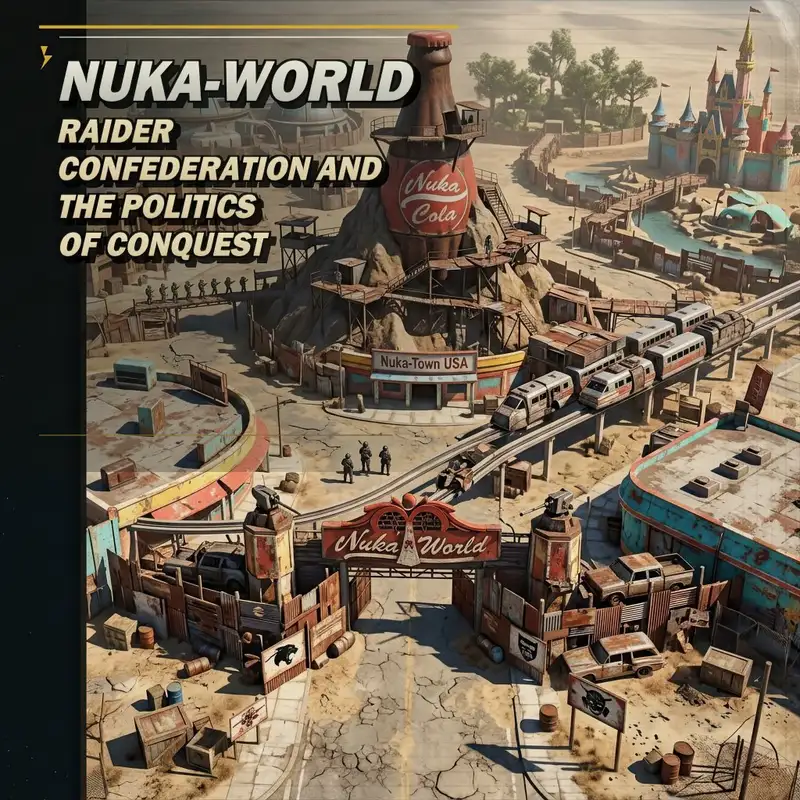
Nuka-World: Raider Confederation and the Politics of Conquest
Colter is dead. The challenger who survived the Gauntlet stands in Nuka-Town U.S.A., surrounded by three armed gangs that have spent years making violence into both livelihood and theater. The immediate fact is simple enough. A new Overboss has taken the old one’s place. The political question is harder. Has this victory created a government, or merely filled a vacancy at the top of a predatory coalition?
The Gauntlet matters because it is more than a collection of traps and murder devices. Under Colter, it became a public test of survival, strength, and usefulness. It selected for the traits the raiders respected most readily, nerve under pressure, tactical adaptability, and the capacity to kill an established ruler. That made it a crude succession mechanism. It was not a constitution. It did not establish a lawful transfer of authority, define the powers of the office, or settle what would happen when the next Overboss became weak, unpopular, or inconvenient.
Porter Gage understood the problem. The exact extent of Gage’s arrangements with each gang leader is not fully documented. What is clear is that Colter’s death was not an accidental interruption of a stable order. Gage and the gang leaders needed an Overboss who could move the alliance forward, distribute rewards, and make the gangs believe that cooperation would pay better than constant internal war.
The challenger inherits obedience, at least for the moment. But obedience is not the same thing as durable authority. The Overboss commands no established civil service, no court, no independent military chain of command, and no recognized law of succession. The office rests on reputation, personal violence, and the practical ability to keep three ambitious gangs satisfied. Rival warlords accept a superior arbiter because fighting one another is expensive. They remain loyal only while that arbiter continues to deliver something worth more than independence.
The setting gives this arrangement unusual advantages. Before the war, Nuka-World was a major amusement complex, a commercial landscape built around Nuka-Cola branding, themed attractions, retail space, entertainment, maintenance facilities, and industrial support. By the late twenty-second century, much of that old purpose had decayed, been damaged, or become dangerous. Yet the physical remains were still useful. Nuka-Town provided enclosed structures, defensible approaches, storage, workshops, and a central gathering place. The surrounding park zones offered territory that could be cleared, occupied, and claimed. The bottling plant, power systems, and other surviving facilities represented valuable inherited assets, even if they did not amount to a restored pre-War industrial economy.
An amusement park also had symbolic value. Most raider camps are temporary, improvised, and vulnerable to the same conditions that threaten every Commonwealth settlement. Nuka-World was different. Its gates, signs, streets, and themed architecture gave the raiders a visible capital. A gang leader operating from a ruined warehouse commands followers. A coalition sitting at the center of a vast commercial park can present itself as something larger, wealthier, and more permanent.
That appearance mattered. But infrastructure could not create a common identity where none existed. The park gave the gangs shelter, choke points, salvage, and prestige. Once the spoils were divided, who would decide whether the division was fair?
Before the confederation could dream of expanding into the Commonwealth, it had to secure its own capital. The three gangs seized Nuka-Town U.S.A. and subordinated the traders who lived and worked there. Politically, however, they are central to the story. They are the occupied population at the heart of the raider system. Their labor, shops, knowledge, and remaining connections to commerce help make Nuka-World more than a fortified camp.
The traders do not appear as equal partners in a new commonwealth of criminals. They live under coercion. The gangs use threats, extortion, and violence to control the town. People who once had some degree of personal autonomy become trapped inside a raider capital. Their work serves the armed groups that conquered them. Their security depends not on rights or impartial rules, but on the shifting moods of gang members and the limited restraint imposed by whoever holds the title of Overboss.
This distinction is important because the capture of a settlement is not the same as governing its people. Raiders can seize streets, occupy buildings, and establish patrols quickly. They can make a market operate by threatening the merchants who depend on it. Yet coercion creates a narrow and brittle form of order. It may suppress open resistance, especially when the occupied population lacks weapons or allies. It cannot easily create trust.
Nuka-Town therefore becomes the first demonstration of the confederation’s governing method. The gangs do not build legitimacy through representation, public services, or consent. They build a protected center for themselves by turning civilians into a controlled commercial population. The park’s traders become a source of supplies, information, and routine labor. The raiders become consumers, enforcers, and masters. That arrangement can function for a time. Nuka-World does not begin as a state-building project that becomes harsh under pressure.
The three gangs cooperate because each brings something valuable to the coalition. They do not cooperate because they agree about what the coalition should become. The Operators, led by Mags Black and William Black, are the most openly commercial of the three. They treat violence as an instrument of profit. Their ideal raider operation is not random destruction. It is controlled extraction. They value caps, valuable goods, discretion, discipline, and the careful application of fear. Their home, the Parlor, reflects that self-image. The Operators want to look less like desperate scavengers and more like an organized criminal enterprise.
That does not make them civilized in any generous sense of the word. Their preference for planning and profit does not soften the coercion at the center of the Nuka-World system. An Operator leader can understand why a merchant must remain alive, why a supply route must remain usable, and why indiscriminate cruelty can reduce future revenue. They are interested in a stable flow of wealth, even if that stability rests on extortion and armed domination.
The Disciples operate according to a darker political economy. Under Nisha, with figures such as Dixie and Savoy holding influence within the gang, fear itself becomes a form of currency. The Disciples do not merely use violence to acquire food, territory, or caps. They cultivate cruelty as reputation. A victim frightened into submission today may discourage resistance tomorrow. A leader capable of inspiring terror can maintain authority over followers who might otherwise challenge her. In this culture, brutality is both external policy and internal discipline.
Nisha’s position is therefore more complicated than that of a simple sadist at the head of a gang of sadists. A group built around personal violence creates a permanent problem of command. Its members are dangerous because danger is what earns them status. A leader must direct that danger outward without appearing too weak to control it. Fear is useful, but it is difficult to regulate. The Disciples have an obvious place in a raider confederation. They can intimidate rivals and terrorize occupied communities.
The Pack, led by Mason, is built around a different kind of cohesion. Its identity centers on strength, predation, loyalty to the group, and status earned through dominance. Its members adopt a deliberately animalistic social style, but it would be a mistake to dismiss them as irrational. The Pack has an internal culture. In the fragmented world of the Commonwealth, that kind of group loyalty is a real military resource. Fighters who believe they belong to something larger than themselves may endure hardship, obey leaders, and stand together more reliably than a crowd held together only by immediate loot.
Yet the Pack’s cohesion is not the same as administrative capacity. A culture that prizes strength can recognize a powerful Overboss. Mason’s followers can be formidable in a confrontation because their social order is built around competition and loyalty. The same values make it difficult to persuade them that another gang should receive more territory, more tribute, or more influence simply because the coalition requires balance.
Together, the Operators, Disciples, and Pack create a useful but unstable division of labor. The Operators can think in terms of revenue. The Pack can supply cohesion and aggressive manpower. Those qualities complement one another during conquest. They become liabilities when the time comes to divide the proceeds. Profit, terror, and status do not provide the same standard of fairness. A leader who satisfies the Operators with a profitable arrangement may offend the Pack’s sense of prestige. A leader who indulges the Disciples may frighten away the traders and settlers needed to sustain the whole enterprise.
For that reason, the three gangs should not be understood as branches of one unified raider ideology. They are separate political communities joined by a common opportunity. They agree that Nuka-World can provide shelter, loot, and a base for expansion. They agree that civilians can be coerced into supporting raider life. They do not agree on how much violence is useful, how wealth should be distributed, or which gang deserves primacy. Their confederation is strongest when an external target gives them a shared purpose.
Colter’s failure exposed that weakness. His problem was not simply that he became distracted by the Gauntlet, though that distraction mattered. He had inherited a coalition with armed followers, a secure headquarters, captive traders, and a formidable pool of violence. Instead of organizing the gangs to clear the wider park, establish reliable claims over its territory, and push outward into the Commonwealth, he became increasingly absorbed in his deadly spectacle.
The result was stagnation. The gangs were gathered around the capital, restless and dissatisfied. Their leaders had agreed to follow an Overboss because the alliance promised more than survival. Colter offered a throne without a campaign. For a coalition of raiders, that was an invitation to conspiracy.
This was an operational failure before it was a personal one. A force can be safe behind defended gates and still be politically weak if it has no way to reward its followers, no supply system beyond immediate plunder, and no plan for managing rival commanders. Colter could hold the center. He could not turn control of the center into a durable program of conquest or administration.
It would be too simple to blame him alone. Even a more energetic Overboss would have faced the confederation’s underlying contradictions. The gangs had no established mechanism for making policy together. No council with recognized authority appears capable of binding the leaders. No code defines how territory should be divided. Colter’s inaction accelerated the crisis, but the crisis existed because the alliance depended on a ruler continually proving that he could deliver more than any individual gang could seize for itself.
The Overboss system attempts to solve that problem through personal supremacy. The ruler stands above the gangs and receives their formal obedience. But the gang leaders retain their own bases, followers, armed power, and internal authority. Mags and William Black do not become ordinary administrators. Nisha does not surrender control of the Disciples. Mason does not dissolve the Pack into a unified army. The Overboss directs the coalition, but does not fully absorb it.
This arrangement resembles a confederation of warlords more than a conventional military state. Central authority establishes broad priorities. Local leaders maintain the loyalty of their own people and preserve distinct identities within the larger project. Such a system can move quickly when the leader is strong and the opportunities are obvious.
Gage is essential in this environment because he functions as political staff. He understands the rivalries, personalities, and vulnerabilities of the gang leaders. He advises the Overboss, helps translate broad ambition into practical assignments, and provides the kind of interpersonal intelligence without which a coalition like this cannot function. He is not the head of a professional intelligence agency. Nuka-World does not show a bureaucracy capable of systematically collecting, evaluating, and distributing intelligence across a broad territory. Its information system is more personal and more precarious.
RedEye’s raider broadcasts play a related but narrower role. The radio gives the confederation a voice. It celebrates raider identity, broadcasts intimidation, and turns violence into a public culture. Propaganda can reinforce morale and make a faction appear larger than its immediate patrols. But a radio host is not a ministry of information, and a broadcast signal is not a state communications network. RedEye can help create atmosphere, loyalty, and fear.
The first major test of the new Overboss comes with the effort to clear and claim the wider park. In the path represented by the Grand Tour, the five major zones are secured and assigned among the gangs. This sequence is player-dependent. It should not be treated as a single fixed history of Nuka-World, because the identity of the Overboss and the distribution of territory can vary.
Territory is the currency of this new order. A park zone is not merely a place to plant a flag. Giving a territory to the Operators, Disciples, or Pack signals that the recipient is favored. It gives that gang a visible stake in the Overboss’s regime.
The arithmetic is unforgiving. There are five major park zones and three gangs. No distribution can be perfectly equal. At least one gang will receive less than another. The Overboss can try to compensate through future promises, tribute, prestige, or access to other rewards. But every allocation creates a record of favor and exclusion. In a system with no accepted neutral standard of justice, unequal rewards are not merely administrative inconveniences. They are potential causes for rebellion.
A durable government might manage such a problem through rules, budgets, offices, legal procedures, and institutions that make unequal outcomes appear legitimate or at least predictable. Nuka-World has none of those protections. The ruling logic is personal. The Overboss gives territory because the Overboss has the strength to give it. The gangs accept the decision because they calculate that obedience remains advantageous. This can work while the rewards are expanding.
The park assignments are therefore the confederation’s first real administrative act, but they are not ordinary administration. They do not create stable civil districts governed for the benefit of residents. They distribute conquered ground among armed factions. The system is closer to patronage than public government. It rewards allies with access to resources and status.
That limitation becomes clearer when the confederation turns toward the Commonwealth. In the player-dependent path represented by Home Sweet Home, Nuka-World’s raiders do not simply launch isolated raids for immediate loot. They attempt a more ambitious system of external control. Raider outposts are occupied sites, populated by raiders and used as forward positions. Vassal settlements remain productive communities, but they are compelled to provide food and other supplies to support the outposts.
The language of vassalage can make this arrangement sound more orderly than it is. These settlements are not voluntary allies who have entered a reciprocal compact with a stronger power. They are communities forced to provision armed occupiers. Their apparent role in the confederation is economic. They produce. The raiders consume, command, and enforce. If the settlers comply, they may avoid immediate violence. If they resist, the system has coercive tools ready to make an example of them.
This is the point at which the Nuka-World raiders move beyond ordinary banditry and toward a crude tribute network. A raider gang that attacks a farm and carries away supplies has to repeat the raid when hunger returns. A raider confederation that compels the farm to keep producing and deliver food on demand is attempting to create a predictable flow of resources. Settlers do the labor. Raiders claim the output.
From the raider perspective, the model has obvious appeal. Nuka-World is defensible and symbolically powerful, but it does not provide the agricultural base needed to sustain a growing armed population. Commonwealth settlements have land, crops, water access, local knowledge, and people accustomed to maintaining their own survival. By taking over outposts and subordinating nearby communities, the confederation can extend its reach without asking its own members to become farmers, laborers, or responsible administrators.
That is also the system’s central contradiction. The raiders want the benefits of settled production while rejecting much of the work, restraint, and mutual obligation that make settled production sustainable. They need farmers to plant, repair, store, and distribute food. They need traders to keep goods moving. They need technicians to maintain equipment and inherited infrastructure.
The tactical effects of this policy can be immediate. A divided or lightly defended settlement may submit when confronted by a larger, more aggressive force. A nearby outpost can project intimidation into the surrounding area. Raiders with a reputation for cruelty can make resistance appear too dangerous, at least in the short term. For the confederation, this is a way to create depth beyond Nuka-World and reduce dependence on a single enclosed capital.
The operational effects are more demanding. Every outpost requires people to hold it, discipline to keep its members from becoming an uncontrolled burden, communications with the wider coalition, and some means of receiving supplies without simply consuming the surrounding area into collapse. Each new position stretches the confederation farther from its center. Each coerced settlement creates a new point of friction. The raiders must monitor compliance, deter escape, respond to defiance, and prevent rival factions from exploiting local resentment.
The civilian effects are even more direct. Settlers face loss of self-government, extortion, fear, displacement, and the possibility that a refusal to provide food will be treated as rebellion. Communities that once made their own decisions about planting, trading, defense, and alliances find those decisions subordinated to the needs of an outside armed force. The raiders may call this order. For the people compelled to sustain it, order arrives as a demand backed by weapons.
Nuka-World’s inherited facilities help support this venture, but they should not be mistaken for proof of industrial sovereignty. The park contains workshops, commercial structures, old power systems, and valuable salvage. The bottling plant and other facilities have practical value precisely because functioning technology is scarce. But the gangs do not demonstrate a capacity for large-scale manufacture, standardized replacement parts, or an industrial economy capable of sustaining indefinite expansion.
They inherit and adapt. They do not necessarily reproduce. Salvage can maintain a force for a while. Captured equipment can make a gang look formidable. A secured facility can reduce the immediate cost of occupation. None of these things guarantee that damaged weapons can be replaced, that power systems can be kept running indefinitely, or that specialized machinery can be repaired once the remaining technical expertise is exhausted.
Conquest therefore expands both resources and burdens. More territory may mean more food, more tribute, and more places from which to intimidate rivals. A raider coalition can be very effective at taking what already exists. It is less well designed to preserve the conditions that allow that wealth to continue existing.
This is where logistics becomes political. The confederation cannot treat food as a pile of loot that will remain available forever. Food depends on planted fields, water, labor, tools, local knowledge, storage, and a degree of security. If raiders take too much, kill or displace the people who produce it, or create enough fear that farmers abandon their land, the tribute system begins consuming its own base. The same logic applies to trade. Caravans can be robbed once. A trade network can only be exploited repeatedly if enough merchants remain alive and confident that movement is worth the risk.
The gangs are not blind to material needs. The Operators, especially, understand the value of regular revenue. Gage understands that an army of raiders cannot live indefinitely on pride and spectacle. Yet individual competence cannot fully solve the structural problem.
Its intelligence methods reflect the same limitation. Gage’s knowledge of the gang leaders is valuable because the greatest immediate threat to the regime often comes from inside the coalition. He can read grievances, ambitions, and personal rivalries. Shank can help identify opportunities for expansion. Raiders can observe weak defenses, exploit isolated settlements, and use reputation to pressure targets into compliance.
But they are not a substitute for the information that a legitimate government receives from its population. Settlers who trust local institutions may report threats, warn neighbors, identify infiltrators, and cooperate in defense because they believe the system protects them. Occupied communities have little reason to share useful information with their occupiers. They may provide only what is necessary to avoid punishment. They may hide supplies, mislead patrols, assist escapees, or quietly seek outside help.
That makes fear a blunt instrument. A community terrified of its rulers may appear calm right up until the moment it sabotages a supply line, refuses a demand, or joins a force moving against the occupiers. The Commonwealth contains many possible sources of resistance, including settlers, caravan interests, local militias, and larger factions whose interests may be threatened by raider expansion. The evidence does not establish one inevitable unified anti-raider coalition.
A raider outpost may be strong enough to dominate a nearby settlement. Each act of forced provisioning creates enemies. Each captured site offers a target. Each new demand teaches civilians that their survival depends on either submission or resistance. The confederation’s strength lies in concentrating violence against vulnerable communities. Its weakness lies in multiplying the number of communities with a reason to oppose it.
The political crisis eventually returns to the question that the park assignments made unavoidable. In the player-dependent path represented by Power Play, the gang that receives the least favorable share of the confederation’s rewards turns against the Overboss. The exact gang varies according to the distribution chosen during the campaign. Nuka-World does not identify one faction as uniquely destined to betray the alliance.
The immediate event is a struggle for survival and control. The disfavored gang can be defeated or marginalized, while the Overboss retains the loyalty of the other two. The rebel gang loses its claim to a share of Nuka-World’s future. The Overboss emerges with a narrower but potentially more unified command.
Yet the deeper lesson is not that the system has solved its problem. There is no neutral tribunal to hear the grievance. There is no accepted process of arbitration. There is no protected opposition and no predictable appeal against the Overboss’s decisions. When distribution becomes intolerable, the dispute becomes armed conflict. When the Overboss prevails, victory does not establish justice.
This kind of consolidation can make a regime appear stronger in the short term. Fewer gangs mean fewer rival leaders and fewer immediate arguments over territory. The surviving coalition may be easier to coordinate. But the cost is substantial. The destruction or exclusion of a gang proves that membership in the confederation offers no lasting security. It teaches every remaining leader that favor depends on continued usefulness and personal loyalty.
More importantly, violence becomes the only final language of politics. The Operators’ concern with revenue, the Disciples’ investment in fear, and the Pack’s obsession with status can all be contained temporarily by a strong Overboss. They cannot be reconciled through institutions that do not exist. A victorious ruler may silence one challenge. The ruler cannot make unequal rewards cease to matter. As long as the confederation grows by dividing loot, every successful conquest creates another argument about who deserves the larger share.
Open Season presents a different possible ending. In that player-dependent branch, the gang leadership can be eliminated and the raider alliance destroyed. This is not a universally established outcome for Nuka-World. It is one of several incompatible paths available within the add-on’s structure.
Destroying that coercive center can break the raiders’ hold over the park. But removing a regime is not the same thing as creating a replacement order. Nuka-Town’s traders still need security. The park’s dangerous zones and inherited infrastructure still require maintenance, labor, and decisions about access. The surrounding region does not automatically become stable simply because the gang leaders are gone. A successful revolt, purge, or liberation ends one system of authority.
That distinction is central to Nuka-World’s politics. The raider confederation is morally abhorrent because it rests on domination, extortion, and terror. Open Season exposes the same difficulty from the opposite direction. Breaking a predatory order may be necessary. Building a durable alternative requires more than battlefield success.
Nuka-World therefore offers a compact case study in raider state formation. The confederation has several attributes associated with political order. It controls a defined center. It has a hierarchy, however unstable. It coordinates armed groups. It controls civilians. It distributes territory. It uses propaganda and reputation. It attempts to extend authority beyond its original base through tribute, occupation, and delegated operational control.
Calling it a proto-state is useful because it recognizes those capacities without granting it the qualities it does not possess. Nuka-World has a ruling structure, but not predictable law. It has revenue extraction, but not legitimate taxation. It has a capital, but not an integrated administration. It has a military coalition, but not a fully unified command. It has infrastructure, but not demonstrated industrial self-sufficiency.
Its deepest weakness is not the condition of the park or the quality of its weapons. The Overboss can coordinate them only by continually proving dominance and distributing rewards. Gage can advise. Shank can organize operations. RedEye can turn raider identity into a public performance. None of them can replace institutions capable of making authority predictable when personal relationships fail.
The confederation also cannot escape its dependence on people it refuses to recognize as political partners. Traders keep commerce alive under occupation. Settlers grow food under threat. Workers, farmers, and caravan networks provide the material foundation that raiders themselves do not create. Nuka-World’s leaders may imagine that conquest makes them independent. In reality, conquest ties them more closely to the labor of communities whose interests are directly opposed to their rule.
For that reason, expansion does not solve the confederation’s internal crisis. More territory creates more rewards, but it also creates more opportunities for unequal distribution. More tribute provides more food, but it also expands the network of people who can resist, flee, sabotage, or appeal to outside powers. More outposts extend reach, but they require more manpower, discipline, communication, and protection. Every success increases the system’s appetite and its vulnerabilities at the same time.
The park itself is not the beginning of a durable raider nation. It is a fortified headquarters for a coalition that has learned how to concentrate violence, divide plunder, and exploit productive communities. Its rulers seek order only to the extent that order enriches them. They reject the restraints, obligations, and shared protections that make order last. Nuka-World can conquer because it holds guns, territory, and frightened civilians. It cannot become stable merely by conquering more ground, because every victory creates a new dispute over who gets paid, who does the work, and who must live under the gun.