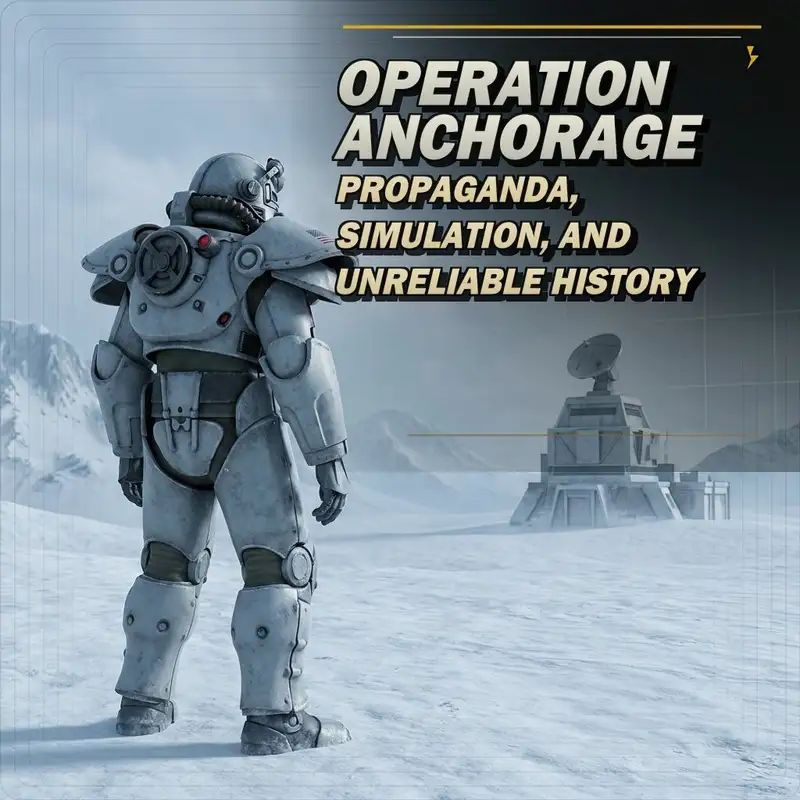
Operation Anchorage: Propaganda, Simulation, and Unreliable History
The chamber opens onto a version of Alaska with no room for doubt. Snow lies clean across the ground. American troops wait for orders. Chinese positions are marked as clear objectives. Every hill has a purpose, every bunker a weakness, every obstacle a solution. The trainee is given a squad, a mission, and a war that can be won through courage, firepower, and sound target selection. In the year twenty-two seventy-seven, the Lone Wanderer enters this frozen world not to study history, but to open an armory for the Brotherhood of Steel Outcasts. The simulation is a lock, and military memory is the key.
That practical purpose matters. The Outcasts do not need a reliable account of the Alaskan campaign. They need the weapons, armor, and equipment sealed behind the Virtual Strategic Solutions facility’s security systems. Yet the archive they uncover raises a larger question. The Anchorage Reclamation simulation looks like evidence. It has named commanders, tactical briefings, military hardware, enemy formations, and a confident final victory. It feels more immediate than a damaged report or a patriotic poster. But the surviving records make clear that it was not a neutral reconstruction. Its own designers warned that it had been altered beyond historical fidelity.
That does not mean the Battle of Anchorage was invented. It means the simulation must be read like any other military artifact: with attention to who commissioned it, who controlled it, what it was meant to accomplish, and what it leaves out. A preserved record is not automatically a trustworthy record. Sometimes the distortion is the most revealing part.
The broad outline of the Alaskan campaign is secure. China invaded Alaska during the winter of twenty sixty-six, in the escalating crisis that became the Sino-American War. Alaska mattered because it sat on the northern edge of the Pacific theater, because it contained vital oil infrastructure, and because the Trans-Alaska Pipeline represented something larger than fuel. It represented the remaining industrial life of the United States at a time when energy scarcity had already become a strategic emergency.
The conflict over Alaska was not simply a struggle for a cold and distant territory. It was a contest over resources, routes, prestige, and the ability of two exhausted superpowers to keep their economies and militaries functioning. For the United States, losing Alaskan territory to a foreign invasion was also a political humiliation. It exposed the limits of national defense and challenged the government’s promise that military power, advanced technology, and patriotic unity could secure the homeland.
The American response became a long reclamation campaign. The available record does not give historians a complete operational diary, and it does not support confident claims about every unit, battle, or route. It does establish that American forces fought to recover occupied territory over years rather than days. Anchorage was eventually liberated in January of twenty seventy-seven. General Constantine Chase is associated with the American command in the simulation and its surrounding records. General Jingwei is associated with the Chinese defense of Anchorage. Those points belong to the historical outline. Much else belongs to the simulation’s version of events.
The liberation of Anchorage was a real military and political victory. It returned a major city to American control and gave the United States a powerful symbol in the final months before the Great War. But recovering a city did not settle the wider Sino-American War. It did not end the competition for resources, repair the international order, or remove the danger of nuclear escalation. The victory proved that the United States could retake ground. It did not prove that it had found a durable way out of the crisis that had brought the world to the edge.
That distinction is easy to lose inside the simulator. There, the campaign becomes a chain of missions that can be completed in an afternoon. The trainee attacks a position, destroys a target, retrieves intelligence, breaches a defense, and advances toward a final confrontation. The structure is satisfying because it turns war into a sequence of problems with identifiable solutions. It is also misleading if treated as a literal account of how Anchorage was actually recovered.
A long Arctic campaign would have depended on systems the simulation can barely represent. Soldiers had to be moved, fed, clothed, supplied, treated, replaced, and directed across a harsh theater. Weapons and vehicles required maintenance. Roads, airfields, depots, ports, communications networks, and fuel infrastructure had to remain usable or be repaired. Engineers mattered. Medical evacuation mattered. Winter shelter mattered. A force could capture a ridgeline and still fail if it could not bring ammunition forward, evacuate casualties, or hold its supply routes against attack.
The years between the invasion and Anchorage’s liberation also imply institutional endurance. A campaign of that length requires more than brave troops and advanced equipment. It requires a state capable of moving resources from factories, farms, depots, laboratories, and transportation networks toward a distant front. It requires commanders who can coordinate formations across time and terrain. It requires workers who maintain vehicles and weapons, staff hospitals, process intelligence, repair infrastructure, and keep the machinery of war moving when the headline battle is over.
The simulator does not deny that such systems existed. It simply makes them disappear. Terrain is compressed into useful combat spaces. Movement is immediate. Supply arrives when the mission requires it. Communications are clear. Objectives are isolated from the larger campaign around them. These are normal abstractions in a training environment. A simulation must reduce complexity if it is to teach particular tasks. But those abstractions become dangerous when later audiences mistake them for a map, a campaign log, or a transparent historical record.
The same problem applies to civilian history. The simulation is almost entirely soldier-centered. It offers little dependable evidence about the people who lived in Alaska before the invasion, endured the occupation, fled the fighting, worked around military infrastructure, or returned after liberation. It does not tell us enough about displaced families, local authorities, Indigenous communities, labor systems, occupation policy, food distribution, or the condition of Anchorage after it changed hands. That silence does not prove that civilians were unimportant. It proves that the simulator was not designed to preserve their experience.
A military operation can be described as liberation from the perspective of national command while remaining a period of fear, displacement, and uncertainty for the people living through it. A city is not merely a target on a map. It is housing, water, food, roads, hospitals, workplaces, and families. An army that retakes it still has to secure it, feed it, repair it, and govern the aftermath. The Anchorage Reclamation simulation has little interest in these questions, because its purpose is not to explain how a society survives a campaign. Its purpose is to make combat legible.
Virtual Strategic Solutions built that combat environment for the United States Army. The company was a military contractor, not a public archive or an independent historical commission. Its product had legitimate military uses. Simulations can train soldiers to recognize threats, rehearse decisions, test tactical judgment, and build familiarity with terrain or equipment. A training system does not need to reproduce every uncertainty of war to be useful. In fact, too much uncontrolled complexity can prevent trainees from learning the specific skills the system was built to teach.
But useful training realism is not the same thing as historical reconstruction. A simulator can simplify terrain, reduce force size, or structure an attack around discrete objectives without claiming that every detail happened exactly that way. The difficulty begins when simplification turns into retrospective argument. The surviving Virtual Strategic Solutions records indicate that the project’s developers had concerns about revisions demanded by General Chase. They understood that the system was moving away from a plausible representation of the campaign and toward a version shaped by command preference.
That conflict reveals a familiar institutional reality. Contractors may possess technical knowledge, but the customer controls the contract, the requirements, the access, and the final approval. A simulation designer can warn that a scenario is inaccurate, expensive, unstable, or poorly suited to its stated purpose. A senior commander can still demand that it be changed. Military organizations are built on authority, and authority is often necessary in war. Yet the same hierarchy that allows an organization to act decisively can also make it difficult for subordinate specialists to challenge a preferred story.
General Constantine Chase stands at the center of this problem. The available records do not allow a confident diagnosis of his private motives. There is no need to invent one. The key point is what his interventions demonstrate. Chase pressed for revisions. He sought a particular representation of Anchorage. The developers’ objections did not stop him. The resulting simulation preserved not only a battle scenario, but a command-approved interpretation of that battle.
That interpretation presents American victory as the product of determined soldiers, superior technology, aggressive action, and decisive leadership. It is a version of history in which uncertainty can be defeated by confidence. The enemy is formidable enough to make the victory impressive, but orderly enough to be overcome through a set of well-defined missions. The American side suffers pressure, but not the kind of confusion that might force listeners to question whether command itself made mistakes. The campaign becomes a clean test of skill rather than a prolonged national effort shaped by logistics, politics, weather, industrial capacity, and loss.
It would be too simple to describe this as a struggle between honest engineers and a dishonest general. Military training always edits reality. It must choose what to emphasize, what to omit, and what to turn into a repeatable lesson. A trainee cannot be asked to experience ten years of war before learning how to assault a fortified position. The issue is not that the simulation is selective. The issue is that the records suggest its selectivity was driven beyond practical abstraction and toward a version of the past that flattered the commander’s preferred memory.
The structure of the simulated campaign makes that visible. The trainee moves through a series of attacks against Chinese positions. Artillery and armored assets are identified as targets. Intelligence can be recovered. Defenses are breached. A pulse field is disabled. The scenario culminates in an assault on a final Chinese compound and the defeat of General Jingwei. Each task reinforces a simple lesson: identify the critical node, strike it hard, maintain momentum, and victory will follow.
As training drama, this structure has obvious value. It teaches target prioritization. It rewards initiative. It gives the trainee clear feedback. It can test whether a small unit recognizes the relationship between enemy fire support, defenses, intelligence, and maneuver. It also gives the Army a story in which individual soldiers can see themselves as active agents rather than anonymous pieces in a vast campaign. That is useful for morale and recruitment. It is useful for a military culture that wants soldiers to believe their decisions matter.
As history, however, the small strike team is a severe distortion. No isolated team can represent the years of reconnaissance, artillery coordination, engineering, transport, air defense, maintenance, relief rotations, and command decisions required to reclaim a major city. A team may destroy an important asset. It may seize a document, clear a bunker, or open a route. But the ability to capitalize on that local success depends on larger formations and institutions that the simulation pushes beyond the edge of the screen.
The intelligence cases scattered through the scenario show the same tension between instruction and evidence. Intelligence collection was certainly important in a campaign like Anchorage. Armies need information about defenses, supply routes, command locations, communications, and enemy intentions. But the simulator turns intelligence into a simple reward structure. A trainee finds a case, receives a benefit, and moves on. That tells us more about how the system encouraged player behavior than it does about the amount, quality, or use of intelligence gathered in the real campaign.
Real military intelligence is rarely so tidy. Reports conflict. Sensors fail. Prisoners lie. Maps are outdated. Commanders receive information too late, misread it, or reject it because it contradicts their expectations. A simulation can represent some of those problems, but the Anchorage scenario is designed around clarity and momentum. It assumes that the right information will lead directly to the right action. That is a flattering assumption for any command system, especially one reconstructing a victory after the fact.
The simulation’s treatment of General Jingwei and Chinese forces demands even greater caution. Jingwei is associated with the Chinese defense of Anchorage, and the name belongs to the broader historical tradition surrounding the campaign. But the final confrontation inside the simulation does not establish that the real battle ended with a lone American soldier or small team personally defeating him in that manner. Simulated dialogue is not a wartime transcript. A dramatic encounter is not an archival confirmation.
The Chinese force inside the program is an American-designed enemy. It is visually distinct, tactically predictable, centrally organized, and vulnerable to decisive American initiative. It is dangerous enough to justify the heroism of the trainee, but simple enough to be defeated through a sequence of correct choices. This is not unusual in a training system. Military organizations often create standardized adversaries so that trainees can learn recognizable patterns. Yet standardization can become a form of intellectual comfort.
The enemy in propaganda must perform two contradictory jobs. It must appear powerful enough that victory seems glorious. It must also appear limited enough that victory seems inevitable once the proper national virtues are applied. The simulated Chinese forces serve both functions. They justify American fear and American confidence at the same time. Their presence makes the Alaskan campaign seem necessary. Their defeat makes the American system appear vindicated.
That is not a reliable way to understand the Chinese war effort. China had strategic reasons to contest Alaska. Energy, geography, access to infrastructure, and the wider balance of the Sino-American War all mattered. The surviving American material does not provide a complete Chinese perspective, and historians should not fill that gap with invented Chinese plans or private motives. But it is still possible to reject caricature. Chinese soldiers and commanders were not merely props in an American redemption story. They were participants in a major conflict shaped by pressures that extended far beyond one simulated battlefield.
Enemy behavior in a military simulation may therefore reveal more about the institution that designed the scenario than about the enemy it depicts. If the enemy is always rigid, always visible, always centralized, and always vulnerable to bold assault, the training system may teach confidence while narrowing imagination. An army that trains against its own stereotype of an adversary risks reinforcing the very blind spots that real opponents can exploit.
The same caution applies to the simulator’s technology. Anchorage occupies an important place in American military memory because of its association with power armor, especially the T fifty-one series. Later accounts confirm the broad connection between the battle and the development or introduction of that armor. It became part of the national story of Anchorage, a symbol of the United States applying industrial and technological power to reverse an invasion.
But broad association is not proof of every depicted deployment. The simulator presents power armor where it is most dramatic and useful. It also includes conspicuous equipment such as Chimera tanks, Vertibirds, Fat Man launchers, and pulse-field technology. Some of these systems may be consistent with the era. Some may reflect prototypes, limited use, experimental concepts, or the designers’ desire to create a more compelling training environment. Their presence in the simulation does not establish that they were fielded in exactly that form, at exactly that place, or with exactly that operational importance.
Technology has stages. A design can exist on paper. A prototype can be tested. A small number of systems can reach a theater. A unit can receive them without fully integrating them into doctrine. A machine can be impressive in a demonstration and unreliable in sustained operations. None of those stages are equivalent to mass issue or decisive effect. The distance between invention and battlefield transformation is usually filled with factories, spare parts, trained crews, repair teams, power supplies, transport, command arrangements, and hard lessons learned under pressure.
The simulator compresses that distance. Its machines appear ready when the story requires them. Their maintenance burden is invisible. Their availability is certain. Their tactical effect is immediate. This is a familiar feature of heroic military storytelling. Advanced equipment becomes not merely a tool, but evidence of national superiority. The machine seems to guarantee victory because it allows the narrative to avoid more difficult questions about production, sustainment, doctrine, and cost.
Power armor did not matter simply because it was powerful. If it contributed to American success in Alaska, it did so within a larger system capable of building, transporting, maintaining, and employing it. An armored soldier still requires command, ammunition, communications, medical care, recovery support, and a supply line. A weapon can change a tactical balance without eliminating the political and institutional burdens of war. The Anchorage simulation remembers the armor. It has much less interest in the industrial structure that made armor possible.
That selective memory helped turn Anchorage into a national myth. By the final months before the Great War, the liberation of the city had become a potent symbol of American resilience. It could be presented as proof that the United States had absorbed a devastating challenge, mobilized its resources, and driven an enemy from American soil. In a society already saturated with military imagery, civil-defense messaging, corporate patriotism, and fear of foreign threat, Anchorage offered an exceptionally useful story.
Later references preserve that importance. Anchorage remained recognizable as a recently liberated city and a major military achievement in the pre-War public imagination. But symbolic importance should not be confused with strategic resolution. The war continued. Diplomatic efforts did not produce stable peace. Nuclear fear remained present. The international crisis that had grown from resource scarcity, militarization, and great-power competition was not solved because one city had been recovered.
Recovering territory is not the same as ending a war. A battlefield victory can restore morale, strengthen a government’s domestic standing, and influence enemy calculations. It can also encourage leaders to believe that military success has answered problems that are political, economic, or diplomatic in nature. Anchorage gave the United States a victory worth celebrating. It did not remove the structural pressures that made the world more dangerous with every passing month.
The Anchorage Reclamation simulation preserves that victory after stripping away much of its uncertainty. It offers a past in which the right commander, the right technology, and the right soldiers can force a clean conclusion. That story may have been emotionally useful to a nation facing escalating crisis. It may have been useful to an Army preparing future troops for combat. It may even have contained training lessons worth preserving. But it also trained its users to remember the campaign as simpler than it was.
What disappears in that simplification is as important as what remains. The simulator does not provide a serious account of American casualties, command disagreements, operational failures, supply breakdowns, exhausted units, damaged infrastructure, or difficult post-liberation governance. It does not document environmental damage. It does not preserve Chinese perspectives. It does not explain how military occupation affected ordinary people. It does not show the contractors, mechanics, medics, engineers, drivers, laborers, and local residents whose work and survival would have shaped the campaign.
Absence is not evidence that none of these things occurred. Historians cannot responsibly invent atrocities, political disputes, or civilian experiences simply because the simulation ignores them. But absence does reveal the limits of the record. The program does not tell us enough about those subjects because it was never designed to tell us enough. Its creators selected a version of Anchorage in which the act of liberation mattered more than the human and institutional costs of making liberation possible.
That is how institutional memory often works. Commanders remember decisive moments. Governments remember flags raised and territory recovered. Military organizations remember successful doctrine and heroic initiative. Civilians may remember evacuation, hunger, ruined neighborhoods, missing relatives, or the slow return of basic services. Contractors may remember deadlines and changing requirements. Soldiers may remember cold, fear, exhaustion, and confusion. Each perspective is partial. A simulator built under command authority tends to privilege the perspective of the institution that paid for it.
The post-War rediscovery of the facility gives this story one final irony. In the Capital Wasteland, the Brotherhood Outcasts are not trying to preserve an old American national myth for its own sake. They want access to military technology. The simulation has survived because it still performs a security function. It remains an obstacle between outsiders and a sealed armory. A pre-War training narrative, built around a stylized victory, becomes a gatekeeper for post-War weapons and armor.
The Outcasts’ presence does not make them identical to the pre-War Army, and it does not justify broad claims about every Brotherhood chapter. Their immediate objective is practical. They need technical assets in a dangerous and fractured region. Yet the situation reveals how old institutions continue to shape new power. The government that commissioned the simulator is gone. The war it commemorated ended in nuclear catastrophe. But the hardware, security systems, and official memories of that state remain valuable enough for later factions to risk lives over them.
The armory is useful regardless of whether the simulated battle is accurate. That is the unsettling part. Propaganda does not need to be true in every detail to have material consequences. A distorted archive can still grant access, confer prestige, shape doctrine, and influence political imagination. Automated systems preserve the priorities of the people who built them. Long after the institutions themselves collapse, their assumptions can remain active inside doors, databases, training programs, and weapons caches.
So the Anchorage Reclamation simulation is not useless to historians. It simply answers different questions than it appears to answer. It reliably supports the broad reality of the Alaskan campaign. China occupied Alaska. The United States mounted a long reclamation effort. Anchorage was liberated in January of twenty seventy-seven. The battle became a major American symbol. The military establishment considered it important enough to turn into a training environment for future soldiers.
It is much less reliable for exact battlefield geography, force composition, equipment deployment, enemy tactics, mission sequence, command dialogue, or the claim that a small elite force personally decided the campaign. Its Chinese adversary is filtered through American military assumptions. Its technology is arranged for narrative and instructional effect. Its heroic structure replaces years of institutional effort with a chain of decisive actions. Its omissions remove civilians, logistics, uncertainty, and political consequences from the center of the story.
Those distortions are not failures of historical value. They are historical evidence in their own right. They show how a military institution transformed a difficult, costly, and incomplete campaign into a usable legend of technological mastery, aggressive initiative, and decisive command. The simulation does not offer a window onto Anchorage as it happened. It offers a window onto how the United States Army wanted future soldiers to remember why it won.