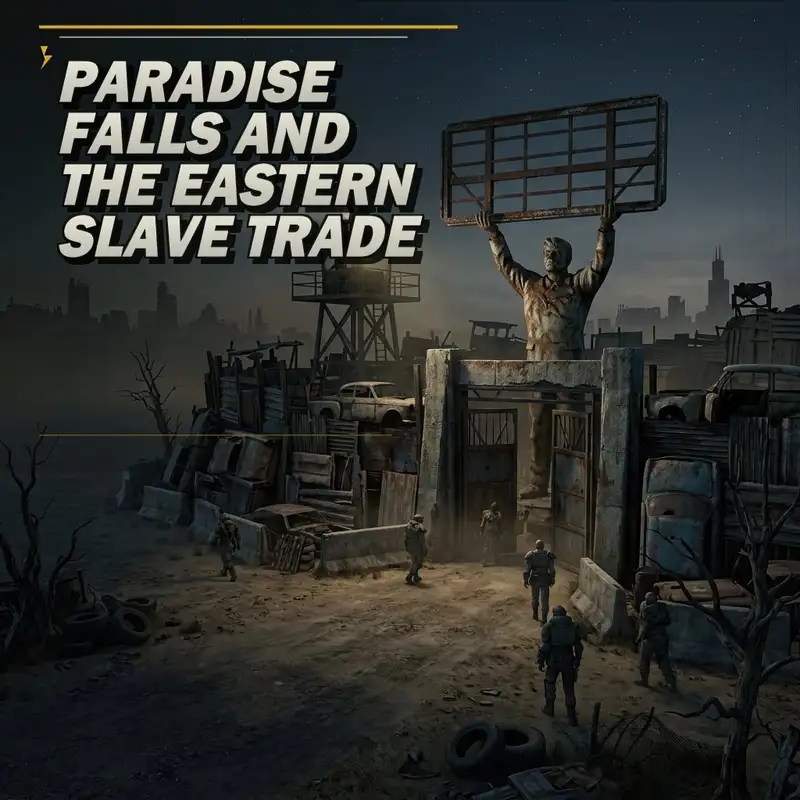
Paradise Falls and the Eastern Slave Trade
At the gate of Paradise Falls, the first question is not who you are, where you came from, or whether you need water. It is whether you arrive as property or as someone prepared to profit from property. That blunt division explains more about the compound than its walls, guards, or ruined storefronts ever could. Paradise Falls occupies the remains of a pre-War shopping center, but it has converted the old language of commerce into something far more direct. People are acquired, confined, priced, transferred, and sold.
In the year twenty-two seventy-seven, Paradise Falls is notorious across the Capital Wasteland. Under Eulogy Jones, it is the region’s principal known slaver headquarters, a fortified place with armed guards, slave pens, and an internal order built around coercion. It may resemble a raider camp from the outside, and its personnel use many of the methods associated with raiding. But random violence does not require a gatekeeper, holding facilities, buyers, screening procedures, or a system for moving captives onward. Paradise Falls has all of those things.
That raises the larger question. Was Paradise Falls merely a local gang of kidnappers operating from a convenient ruin, or was it a logistical hub in a wider eastern slave economy? The available evidence supports a careful answer. It was not a territorial slave state. It did not govern a defined province, maintain mapped borders, or command a proven continent-wide empire. But it did serve as a regional collection and sales center, converting vulnerable people from the Capital Wasteland into coerced labor for local customers and, most importantly, for the industrial regime in the Pitt.
Its authority was commercial and mobile rather than territorial. Paradise Falls did not need to occupy every settlement from which it took people. It only needed to know which places were weak, which travelers were isolated, which individuals might bring a buyer’s interest, and which routes could carry captives back to the compound. The walls around Paradise Falls mattered. So did its guards. Yet the business depended just as much on information, intimidation, and the wider failure of the Capital Wasteland to build a regional system capable of suppressing slave raiding.
The Capital Wasteland is not an empty wilderness. In twenty-two seventy-seven, it contains settlements, farms, scavenging operations, caravan traffic, religious communities, military forces, and places trying, with varying degrees of success, to establish law. Rivet City has civic institutions. Megaton has its own rough political life. Arefu maintains a small community above the Potomac. Big Town shelters people who have escaped other forms of captivity. Little Lamplight protects children in an underground settlement. Even isolated ruins can contain organized groups with rules, loyalties, and memories.
That uncertainty is part of the slavers’ advantage. Slavery does not require every town to be constantly attacked. It only requires enough successful captures, enough fear, and enough weakness in the response. A family deciding not to travel alone, a caravan hiring extra guards, a settlement refusing strangers entry after dark, or a refugee abandoning a vulnerable home all reflect the wider cost of slave raiding. Paradise Falls can destabilize communities it never formally controls because every disappearance changes how people assess risk and whom they trust.
The Capital Wasteland also lacks a strong regional government with a demonstrated commitment and capacity to abolish the trade by force. Rivet City is influential, but it is not a state capable of policing the entire region. The Brotherhood of Steel fields disciplined forces and fights major threats, especially super mutants around the ruins of Washington. Yet the Brotherhood is not shown conducting a sustained campaign against Paradise Falls as a regional anti-slavery mission. That absence does not prove approval, protection, or alliance. It shows something simpler and more troubling. The slave trade survives in the spaces between other institutions’ priorities.
Paradise Falls exploits those spaces. Its slavers do not need the manpower to hold a city district or administer a county. They need a few armed people, reliable local knowledge, a secure place to bring captives, and buyers willing to pay for human labor. That is why a relatively small compound can matter so much. It is not merely a prison. It is the point where scattered acts of violence become an organized market.
The clearest view of that market appears in Grouse’s recruitment arrangement. Grouse serves as Paradise Falls’ gatekeeper and operational intermediary. He can determine who enters, who is useful, and who is turned away. For a prospective slaver, he offers a Mesmetron, slave collars, and a list of specific targets. The targets are Arkansas of Minefield, Susan Lancaster of Tenpenny Tower, Red of Big Town, and Flak of Rivet City.
The Lone Wanderer may choose to participate in this arrangement, refuse it, rescue captives, attack the compound, or pursue entirely different priorities. Those choices remain variable. There is no basis for claiming that all four named people were canonically enslaved, or that the Lone Wanderer became part of Paradise Falls’ organization. But the existence of Grouse’s list is fixed evidence of how the slavers think. They do not simply wander into the wasteland hoping to find victims. They identify people by name, know where those people can be found, and judge them as worthwhile targets.
The list also reveals the value of social vulnerability. Arkansas lives in Minefield, a place whose isolation is itself a defense and a trap. Susan Lancaster lives in Tenpenny Tower, where wealth and security exist, but so do class divisions and dependence on a narrow leadership structure. Red is associated with Big Town, a settlement already vulnerable to kidnapping and repeated predation. Flak lives in Rivet City, one of the stronger communities in the region, which suggests that even an established settlement cannot guarantee protection for every individual beyond its secure spaces.
None of this means Paradise Falls can seize anyone, anywhere, whenever it chooses. A target can resist, escape, receive help, or simply become too difficult to take. Slaver dialogue makes clear that captures fail, victims get away, people become sick, and the work is dangerous. The supply of captives is not infinite. The organization is not an omnipotent conspiracy. It is a predatory enterprise operating under risk, which makes its access to information all the more important. A failed raid wastes ammunition, exposes personnel, and may provoke armed retaliation. A successful capture produces a saleable human being.
Grouse’s arrangement also shows that Paradise Falls can recruit outside labor. It does not need every kidnapper to be a permanent resident of the compound. It can issue equipment, define a task, and reward results. That is a crude but recognizable form of contracting. The slavers reduce their own exposure by pushing some of the dangerous acquisition work outward. The person who delivers a captive has already absorbed much of the immediate risk. Paradise Falls receives the result at a guarded destination built to control the next stage of the transaction.
The Mesmetron and the slave collar are central to that next stage. They are not merely weapons in the ordinary sense. Together, they convert a violent seizure into a portable system of coercion. The Mesmetron incapacitates a target. The collar then makes escape a matter of life and death. A captive can be forced to walk, to follow instructions, and to remain under pressure even when a slaver cannot keep both hands on a weapon.
The collar’s importance is administrative as much as tactical. One guard cannot physically drag every prisoner across dangerous terrain. A system that compels captives to move under threat reduces the number of people needed at the immediate point of capture. It gives the slaver a way to relocate human beings without building a wagon train for every victim. It can also create terror among those who see it used. The device does not merely restrain the body. It makes resistance appear futile by placing lethal force at the edge of every decision.
That does not make slavery efficient in any simple or effortless sense. A collar cannot scout a route. It cannot find clean water. It cannot stop a prisoner from collapsing, becoming ill, fighting back, or attracting attention. It cannot feed people, treat injuries, repair damaged equipment, or secure a compound. Captives still require confinement, guards, discipline, transport planning, and at least enough care to keep them alive until sale. If Paradise Falls intends to profit from a person, it has an economic reason to prevent that person from dying before delivery.
The collar therefore reveals both the strength and the limitation of the system. It allows a small armed organization to control more people than brute force alone might permit. But it also makes the organization dependent on specialized coercive technology and on the social conditions that allow kidnapping to remain profitable. The device is not evidence of modern administration or technological sophistication in the broader sense. It is a tool for making a crime more manageable.
There is no moral ambiguity in the labor relationship it creates. This is not employment. It is not debt service. It is not a criminal sentence imposed through any recognizable legal process. The captive has not agreed to work and cannot leave. The entire arrangement rests on kidnapping, confinement, and the credible threat of remote killing. Paradise Falls does not sell labor contracts. It sells people.
That fact helps explain why it maintains a permanent compound. A slaver can seize a person in the field, but the sale requires a place to hold that person, sort buyers from sellers, establish control over guards, and absorb the delays between capture and transfer. Paradise Falls is where the scattered violence of the wasteland is gathered, processed, and made legible to a market.
Eulogy Jones appears to hold de facto authority over that market. He is not presented as the elected head of a government, nor as the commander of a conventional army. His power rests on control of the compound, command over its guards, and influence over the human property held within it. He presides over a place where rank is informal but real. Some people guard the perimeter. Some conduct captures. Some handle access and recruitment. Some manage the enslaved population. Others seek status through proximity to the leadership.
Grouse’s role shows how that hierarchy works in practice. He controls the entrance and evaluates potential recruits. He turns admission into a commercial test. A person who arrives without value is not simply a visitor. They are a possible captive. A person who demonstrates the ability to bring in targets becomes useful to the organization. It is an ugly but coherent system of incentives. The compound does not need a formal personnel office when fear, profit, and access to captives can serve many of the same functions.
The details remain incomplete. The surviving record does not establish Paradise Falls’ exact manpower, payroll, profits, annual sales, or internal chain of command. It would be easy to invent the appearance of a larger criminal bureaucracy from the compound’s visible routines. That would go beyond the evidence. What can be said is that Paradise Falls has enough organization to operate as more than a temporary gang. It has a leadership center, a recruitment mechanism, armed security, holding facilities, and access to buyers.
A collection center is valuable because supply and demand rarely appear in the same place at the same moment. A local raider gang may want one captive. A wealthy customer may want domestic labor. Another buyer may need workers for a dangerous industrial task. The slaver who captures a person outside Big Town or Rivet City may not know who will buy that captive immediately. Paradise Falls reduces that uncertainty. It gives sellers a place to deliver people and buyers a place to acquire them.
The compound also concentrates risk. Instead of every slaver keeping prisoners in a separate hideout, captives can be held behind a common perimeter. Instead of every buyer searching the wasteland for victims, they can deal with a known market. This concentration makes Paradise Falls vulnerable if challenged directly, but it also gives the trade a degree of continuity. A raid can fail. A specific slaver can die. A target can escape. The market remains possible as long as the compound, its personnel, and its buyer relationships survive.
The Capital Wasteland contains evidence of local demand. Paradise Falls buys and sells individual slaves to customers in the region. Its clientele appears limited rather than universal, and raiders form an important part of that market. Raiders may seek forced labor, sexual exploitation, status, household control, or simply the ability to dispose of captives through resale. Their motives need not be identical for the trade to function. The important consequence is that Paradise Falls can turn human captivity into a transaction.
Still, local buyers help explain why Paradise Falls can survive. A slave market does not require universal consent. It requires enough buyers, enough sellers, and enough impunity. The moral revulsion of distant settlements means little if no one can reach the compound, protect witnesses, and sustain pressure on the people who run it. The trade survives through uneven power. Some communities have enough strength to condemn slavery. Others have enough desperation to avoid confrontation. Some individuals can purchase protection. Others become the price of that protection.
Yet local household buyers and raider customers do not entirely explain the scale implied by Paradise Falls’ organization. The strongest evidence for its wider importance lies to the north, in the ruins of Pittsburgh. There, the Pitt has become a demand center for coerced labor on an industrial scale that most Capital Wasteland buyers could not match.
But machinery alone cannot produce that future. Furnaces, mills, workshops, and scrap piles are useless without labor. The Pitt’s industrial environment is brutal, contaminated, and dangerous. Breaking down metal, moving it, sorting it, and reforging it requires sustained human work. A regime trying to restart steel production needs people who can be forced to remain at the task even when the work injures them, exhausts them, or offers them no meaningful share in the product.
That is where imported slaves become strategically important. Wernher, a former associate of Ashur and later an opponent of his rule, states that the Pitt has been supplied through the regional slaver operation and that Ashur has increasingly imported slaves as labor demand has grown. Wernher is not a neutral observer. He has his own ambitions, his own grievances, and his own desire to seize control of the Pitt. His account must therefore be treated with care. But it is supported by the broader structure of the Pitt’s economy and by other evidence of contact with Paradise Falls.
Ashur’s stated reasoning makes the arrangement especially revealing. He presents the Pitt’s system as a harsh necessity, a temporary sacrifice imposed by a damaged city struggling toward recovery. But the moral language of necessity does not change the material reality. His government depends on people who were abducted, transported, and forced to work in conditions they did not choose. A regime may call this survival. The enslaved people living under it experience it as captivity.
The Pitt’s industry also creates a feedback loop. More coerced labor can support more steel production. More steel can support weapons, defenses, and political influence. Greater military capacity can make the Pitt more secure, more aggressive, or more independent. That increased capacity can then reinforce demand for labor. Paradise Falls profits from the first link in the chain. Ashur’s regime profits from the last. Between them stand the guards, brokers, routes, collars, and human beings forced to carry the burden.
The route between Paradise Falls and the Pitt is important precisely because it is not fully mapped for us. The games establish recurring contact. Pitt raider dialogue directs personnel south toward Paradise Falls, which supports the existence of an ongoing relationship rather than a single accidental transaction. But the exact roads, distances, shipment schedules, staging sites, escort strength, and payment arrangements are not documented in sufficient detail to reconstruct a complete route plan.
What can be inferred is the logistical problem. Captives moving north require people who know the terrain, armed escorts capable of deterring attack or preventing escape, food and water sufficient to keep prisoners alive, and some means of controlling discipline during movement. The route must account for ruined infrastructure, radiation, hostile wildlife, raiders, weather, and the possibility that a captive may resist, become injured, or simply be unable to continue.
The slavers also require an exchange system. Paradise Falls must receive something for the people it supplies. That payment could take many forms in a wasteland economy, including caps, goods, weapons, supplies, or political favors. The games do not establish the precise terms, so it would be wrong to invent a price list or claim that a standard rate governed the trade. But no regular connection can endure without some arrangement that makes continued delivery worthwhile for both sides.
A central collection point becomes especially valuable under those conditions. A northern buyer does not want to dispatch an industrial workforce across the Capital Wasteland every time it needs another laborer. A field slaver does not want to negotiate separately with every distant customer. Paradise Falls reduces the friction. It accumulates captives, consolidates control, and makes transfer more predictable. The dangerous route is one reason the compound matters. It turns scattered kidnappings into a supply that can be moved in larger, more organized ways, even if the exact scale remains unknown.
The journey also underscores the difference between capture and exploitation. At Paradise Falls, a captive is a person held for sale. In the Pitt, that captive becomes an industrial input. The language is cold because the system itself is cold. A human being is transformed from a neighbor, traveler, merchant, guard, or settler into labor measured by endurance and output. The value of the person lies not in consent, skill, family, or future, but in how much work can be extracted before the system discards them.
That division of labor does not reduce Paradise Falls’ responsibility. It clarifies it. The slavers of the Capital Wasteland make the Pitt’s system easier to sustain. They help solve one of Ashur’s central problems, the acquisition of workers willing to do nothing because they are not willing at all. In return, the Pitt gives Paradise Falls a powerful customer whose need for labor is tied to a larger strategic project.
That dependence is visible in the resistance networks operating against Paradise Falls. The Abolitionists, led by Hannibal Hamlin, are not a conventional army. They do not have the resources to occupy the Capital Wasteland, patrol every road, or storm every fortified compound through overwhelming force. Their movement is built largely by escaped and formerly enslaved people, which gives it a direct understanding of the trade’s human mechanics. They know that freedom is not achieved at the moment someone slips out of a cage.
The Temple of the Union provides a focal point for that effort. It is a refuge, a political symbol, and part of a wider attempt to protect people who have escaped slavery. The Abolitionists rely on secrecy, trust, concealment, intelligence, and selective armed action. They need safe places to sleep, food for people who arrive exhausted, medical help for those injured during escape, and routes that do not simply deliver fugitives into another slaver patrol.
This is the counter-network to Paradise Falls. The slavers use information to identify vulnerable people. The Abolitionists need information to find fugitives before the slavers do. Paradise Falls uses collars to make captivity portable. The Abolitionists need tools, contacts, and plans that make freedom portable. The slavers benefit from isolation and fear. The Abolitionists must overcome both by convincing people that escapees will not be abandoned once they leave the compound.
The Abolitionists’ limitations are equally important. They can organize resistance, protect some people, and challenge the political legitimacy of Paradise Falls. But they are not shown possessing the manpower or resources to enforce abolition throughout the Capital Wasteland. Their struggle is asymmetric. They contest the trade where it is vulnerable, in escapes, recruitment, memory, and public moral opposition. They cannot simply replace the entire regional security order that would be necessary to make kidnapping unprofitable everywhere.
Their use of the Lincoln Memorial shows that this is a battle over legitimacy as well as survival. Hannibal Hamlin treats Abraham Lincoln as the Great Emancipator, drawing on an old-world memory of abolition to give the movement language and purpose. The memorial is not valuable because a ruined statue can physically protect anyone. It is valuable because political symbols can organize people. They tell frightened individuals that slavery is not permanent, natural, or beyond challenge.
Paradise Falls understands the threat in its own way. A slave system depends on more than armed guards. It depends on the normalization of domination. It needs captives to believe that no one will help them, settlements to believe resistance is too costly, and buyers to treat human beings as merchandise rather than neighbors. A symbol of emancipation challenges all of that. It introduces the possibility that slavery is not simply a condition of the wasteland, but an institution built and maintained by people who can be opposed.
The conflict around the Lincoln Memorial, known through the events of “Head of State,” is therefore not just a struggle over control of a ruin. It is a dispute over what kind of political memory the Capital Wasteland will preserve. The Lone Wanderer can influence the immediate outcome in different ways, and no single result should be treated as fixed history. But the underlying conflict exists regardless of that choice. The Abolitionists see the memorial as a foundation for a free community. Paradise Falls sees it as a challenge to the institution from which it profits.
There is a grim irony in this. The pre-War United States left behind monuments, slogans, and promises of liberty while also leaving behind militarization, corporate power, repression, and the conditions that ended in nuclear war. The Abolitionists do not inherit a perfect past from Lincoln’s image. They inherit a political weapon. They use it to insist that the old world’s ideals can still be turned against the old world’s cruelties.
That insistence matters because Paradise Falls and the Pitt both claim, in different ways, that brutality is practical. Paradise Falls calls it business. The Pitt calls it necessity. The Abolitionists answer that survival purchased through enslavement is not neutral pragmatism. It is a choice to make a permanent political order out of someone else’s captivity. Their movement may be small, but it refuses the idea that the region has no alternative but to accept the market at Paradise Falls.
The wider problem is that neither moral condemnation nor isolated rescue automatically dismantles a labor system. Paradise Falls can be tactically threatened. Its guards can be killed, captives can escape, and its leader can lose control, depending on the actions taken during the events of Fallout Three. But its deeper strength comes from a chain of relationships. Intelligence identifies targets. Armed kidnappers seize them. Coercive devices control them. A fortified compound confines them. Buyers purchase them. Escorts move them. Industrial masters extract their labor.
Breaking one link can save lives. Breaking the whole chain requires more. It requires settlements willing to share intelligence, defend routes, shelter fugitives, punish traffickers, and deny buyers the social and material space to continue. It requires institutions with enough legitimacy to protect people beyond their own walls. The Capital Wasteland has fragments of that capacity, but no demonstrated regional anti-slavery authority capable of sustaining it everywhere.
For the balance of power, the Pitt gives that system a wider purpose. Imported labor supports steel production. Steel supports military and political ambition. The connection does not prove a vast, centrally managed eastern slave empire. The evidence does not support that claim. But it does show how a compact market in the Capital Wasteland can feed an industrial regime far beyond it. A kidnapping operation becomes part of a reconstruction project, and that reconstruction project becomes inseparable from coercion.
Politically, neither Paradise Falls nor Ashur’s Pitt creates legitimate consent among the people forced to sustain it. Paradise Falls offers fear and profit to its personnel, not a durable public order. The Pitt may produce steel, but it does so by treating human beings as replaceable inputs. Both systems can generate short-term power. Neither solves the deeper problem of how to build security, prosperity, and law without recreating the extraction and dehumanization that destroyed the old world.
The Abolitionists offer a different kind of institution. They are limited, vulnerable, and unable to guarantee freedom across the entire region. Yet their safehouses, escape plans, mutual aid, and political memory address the trade at its human foundation. They recognize that a person freed from a cage still needs shelter, food, protection, and a place within a community. Their resistance is not only an attack on slavers. It is an attempt to build the social infrastructure that slavery tries to destroy.
For ordinary civilians, the cost of Paradise Falls is measured long before anyone reaches the slave pens. It appears in missing relatives, abandoned homes, guarded roads, suspicious settlements, broken trade ties, and communities that must spend scarce resources on defense rather than farming, repair, or education. Slavery weakens the region even when its victims are taken elsewhere. It turns insecurity into an economic condition and teaches people that strangers may be buyers, informants, or kidnappers.
Paradise Falls was a regional slave-trade hub rather than an isolated raider camp, a compact but organized enterprise that turned intelligence, coercive technology, fortified confinement, and dangerous transport into profit. Its decisive connection to the Pitt shows how a kidnapping market in the Capital Wasteland could feed an industrial regime far beyond it. The trade’s weakness was the same as its cruelty: it could seize bodies and produce steel, but it could not create legitimacy, security, or a durable political order for the people forced to sustain it.