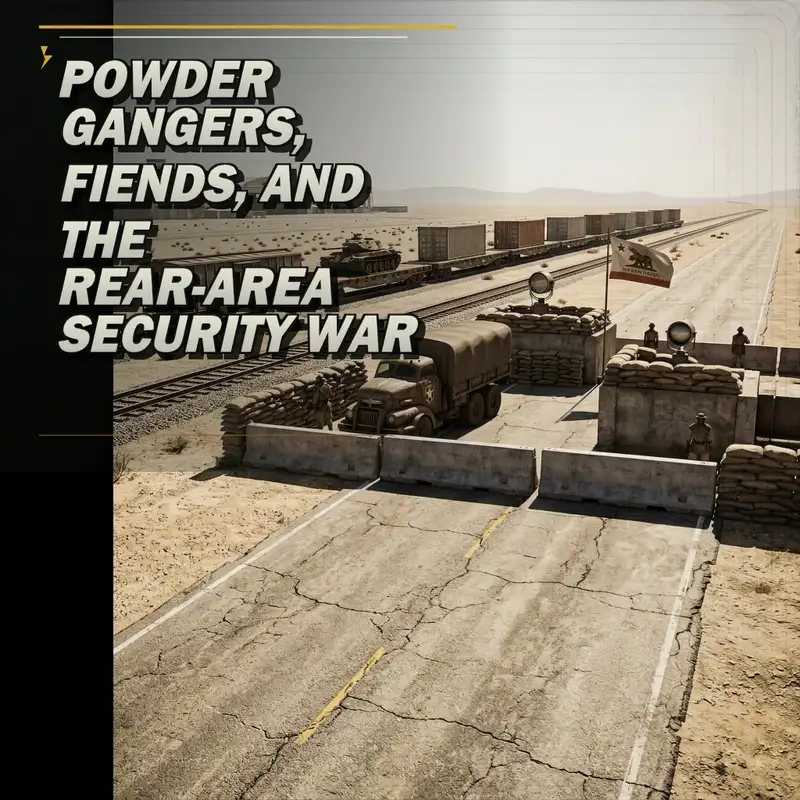
Powder Gangers, Fiends, and the Rear-Area Security War
Camp McCarran was preparing for a battle that could decide the Mojave, yet its commanders could not reliably reach a raider leader hiding in a vault across the battered approaches of New Vegas. The New California Republic had soldiers, Rangers, artillery, a major airfield, and a headquarters full of maps and radios. It also had a hostile sanctuary nearby, surrounded by ruins, civilians, narrow routes, and people who had learned that an NCR uniform did not guarantee safety.
Farther south and west, the same contradiction appeared in a different form. The NCR Correctional Facility had been meant to confine prisoners and extract useful labor from them. Instead, it had become an armed stronghold occupied by men who had used the Republic’s own explosives against it. A prison built beside a crucial road had become a threat to that road. The state had not vanished from the Mojave. It was visibly present. But presence and control are not the same thing.
This was the NCR’s rear-area security war in the year twenty-two eighty-one. The main military danger lay east, where Caesar’s Legion threatened the Colorado River line and Hoover Dam. Yet the Republic also had to move troops, mail, food, ammunition, medical supplies, merchants, officials, and civilians through territory it did not fully secure. It had to protect camps, roads, rail lines, mines, settlements, and the approaches to its own headquarters. Those jobs rarely produce the glory of a decisive battle. They are the work that determines whether an army can reach that battle in condition to fight.
The Powder Gangers and the Fiends were often placed in the same broad category because both preyed on the Mojave and both fought the NCR. That description is true, but it is too simple to explain the problem. The Powder Gangers emerged from a failure of custody, prison labor, and infrastructure security. The Fiends were a chem-dependent raider organization rooted in the southwestern ruins of New Vegas, close to urban communities and close to Camp McCarran itself.
The NCR did not struggle because it lacked rifles or disciplined soldiers. It struggled because its forces were dispersed, its political authority had uneven local foundations, and the two threats required different answers. A prison recapture could not solve an urban intelligence problem. Killing a few raider leaders could not restore a damaged transport corridor. Every guard posted at a prison gate, every Ranger sent into ruined streets, and every patrol assigned to escort caravans was a soldier or specialist not concentrating on the Legion.
Rear-area security is sometimes mistaken for an afterthought, the dull portion of warfare that begins after the important fighting is finished. In reality, it includes the protection of routes, depots, installations, labor systems, local authorities, civilian movement, and intelligence networks. It is the part of a campaign where military power meets ordinary life. A force can hold a dam and still lose the confidence of the settlements behind it. A government can impose laws and still fail to protect the people expected to obey them.
The Mojave made that task especially difficult. Roads passed through open desert, but they also narrowed around settlements, old highway interchanges, quarry approaches, ruined suburbs, and industrial sites. The remains of pre-War infrastructure offered shelter and concealment as readily as they offered utility. A vault could become a fortified hideout. A prison could become a gang headquarters. A ruined neighborhood could make surveillance difficult and movement dangerous. The NCR’s problem was not empty land. It was a landscape crowded with choke points, abandoned structures, armed communities, and competing claims to authority.
The Correctional Facility stood near Interstate Fifteen, in the broad corridor between NCR territory and the Mojave. Its importance was larger than its walls. The nearby Long Fifteen connected the Mojave to the Republic’s western heartland, including the Boneyard. That route mattered for reinforcement, administration, trade, and the simple ability of the NCR to treat New Vegas as more than a distant military adventure. A republic cannot govern a frontier solely by issuing orders from far away. It must be able to move people and supplies with some regularity.
The prison had been part of that effort. It held inmates in a work-release arrangement that put prisoners to labor on railroad maintenance along the Long Fifteen. The arrangement reflected a familiar state logic. In practice, it concentrated resentful men near an important route, gave them access to work tools and explosives, and placed the burden of control on a guard system operating in a wartime frontier.
Supplementary accounts indicate that guards were drawn away toward the Colorado River as the conflict with Caesar’s Legion intensified. The released game firmly establishes the result, even if it does not document every detail of the reduction in security. The Correctional Facility fell to its inmates. The prison’s custodial arrangements proved inadequate at precisely the moment when the NCR had stronger demands elsewhere. A state preparing to fight an interstate war had accepted risk in its own interior, and that risk matured into a revolt.
Samuel Cooke was central to the breakout. This was not a case of a few inmates slipping through a neglected fence. The same dynamite used in railroad labor could breach barriers, intimidate guards, and equip a new criminal force. The NCR had assembled the people, the tools, and the strategic location. The Powder Gangers supplied the decision to use them against the institution that had gathered them.
There is a temptation to treat that revolt as a simple story of criminals becoming raiders. That is partly true. Powder Gangers attacked travelers, threatened settlements, and turned explosives against people who had no responsibility for their imprisonment. Their violence cannot be excused by the flaws of the prison-labor system. But the revolt also revealed the political cost of that system. It moved outward onto roads, work sites, and civilian communities.
The name Powder Gangers suggests a unified organization. The evidence does not support that picture. The prison-centered group at the Correctional Facility was led by Eddie. Cooke did not remain under Eddie’s control. He moved north with another group toward Vault Nineteen. Other escapees dispersed into smaller bands operating along the roads and around nearby settlements. Joe Cobb’s crew, associated with the pressure placed on Goodsprings, is another reminder that a common origin did not create a single chain of command.
That fragmentation made the Powder Gangers both weaker and more difficult to eliminate. They were weaker because they lacked the cohesion, discipline, and shared command structure of a conventional military force. They could not easily mass for a large battle or coordinate a campaign across the Mojave. But they were difficult because the Republic could not solve every problem by retaking one building. A successful assault on the Correctional Facility, in any branch where such an assault succeeds, would remove one headquarters. It would not automatically locate Cooke’s group, disarm scattered escapees, or make isolated roads safe.
The facility itself gave Eddie’s group defensible ground. It had perimeter walls, elevated positions, limited approaches, and a layout originally designed to control people through confinement. Once the prisoners controlled it, those same features complicated retaking it. Sentries could observe approaches. Explosives could make an assault costly. The site also had symbolic value. A state facility had been seized by the people the state had intended to dominate. It was not merely a hideout. It was evidence that NCR authority could be challenged on its own ground.
This mattered because the prison was not isolated from the local economy. The Powder Gangers could raid travelers, intimidate workers, and interfere with the movement of goods around the Interstate Fifteen corridor. They did not need to destroy the Long Fifteen or defeat an NCR field army to create military consequences. They only needed to make movement less predictable. A caravan delayed by fear, a work crew unable to operate, or a patrol redirected to escort duty imposed costs that accumulated across the region.
The incident at Sloan shows how those effects could spread. Powder Gangers stole the settlement’s dynamite supply. That theft disrupted quarry work, and the resulting loss of activity helped leave Quarry Junction vulnerable to occupation by deathclaws. The Powder Gangers did not command the deathclaws, and they did not gain strategic control of the entire corridor. The causal chain was more limited, and more revealing. A local act of raiding removed a crucial industrial tool. That disruption constrained civilian work and contributed to a wider obstacle along an important route.
Sloan’s quarry was not simply a collection of laborers with pickaxes. It was part of the Mojave’s material base. When insecurity interrupted that work, the cost reached beyond the quarry itself. Workers lost safety and livelihood. Caravans faced altered routes. The NCR had another local problem demanding attention. Infrastructure in the wasteland is often fragile because it depends on a small number of tools, skilled workers, protected routes, and functioning institutions.
The Powder Gangers therefore created an operational problem out of acts that could appear minor on a map. They threatened rural movement, exploited the gaps between settlements, and used explosives that imposed disproportionate danger on people traveling light or working in exposed locations. It only needs to become risky enough that merchants travel less often, settlers avoid it, and officials require escorts. It is a calculation made every day by people deciding whether a journey is worth the danger.
Goodsprings and Primm stood close enough to these pressures to feel them directly. Joe Cobb’s group may attack Goodsprings depending on the Courier’s actions, so that attack cannot be treated as one settled event in Mojave history. What is fixed is the vulnerability that made such coercion possible. A small settlement with limited armed capacity could be threatened by a mobile band without requiring any grand campaign. The gang did not need to occupy Goodsprings to shape its choices. The possibility of attack was itself a form of power.
Primm faced a related problem. It lay along an important route and depended on traffic, trade, and the ability of outsiders to arrive without being robbed or killed. In a stable state, road security is often invisible. In the Mojave, its absence was conspicuous. Travelers learned which routes were dangerous. Merchants adjusted prices and schedules. Communities had to judge whether the NCR could actually protect them or merely claim jurisdiction over them. That judgment mattered because the Republic’s authority in the Mojave depended not only on flags and camps, but on whether ordinary people experienced order.
The NCR did attempt to answer the prison crisis. The events surrounding the planned retaking of the Correctional Facility show that the Republic recognized the danger of leaving the site in hostile hands. Lieutenant Hayes and Sergeant Lee represent an effort to restore control through a limited military operation. The objective was practical. Retake the prison, remove an armed gang from a key position, and reestablish security around a major corridor. That was a reasonable mission. It was also narrower than the broader political and operational problem.
The exact outcome is conditional. The Courier can warn Eddie, help the Powder Gangers defend the prison, or work with NCR personnel against them. The NCR had to devote command attention and combat capability to a threat created by the failure of its own custodial system. Instead of using the facility as a means of enforcing law and maintaining infrastructure, it now had to consider it an enemy-held position.
Even a successful retake would have had limits. Tactical success means control of the prison compound. Operational success means dependable movement along nearby routes, reduced threats to workers and caravans, and the ability to prevent dispersed gangs from replacing one local danger with several smaller ones. Political success means that civilians again believe the NCR can enforce order fairly and consistently. Those are not the same achievement. A cleared building does not repair damaged trust, reopen a quarry, or explain why a work-release prison was allowed to become vulnerable in the first place.
The prison also exposed a deeper contradiction in the Republic’s frontier system. The NCR claimed to bring law, citizenship, commerce, and public order to the Mojave. Yet one instrument of that order rested on coercive labor, inadequate custody, and the assumption that prisoners could be exploited without producing a larger security risk. States have used prison labor throughout history because it appears efficient. It can also create incentives to treat people as disposable labor inputs rather than as human beings who remain capable of organizing, resisting, escaping, and retaliating.
The Fiends presented a different problem. Their origins are not clearly established, and the available record does not support a neat founding story. By twenty-two eighty-one, however, they were a recognizable raider organization operating in the southwestern ruins of New Vegas. Their identity was shaped by chem use, extreme violence, territorial familiarity, and predation against the people living around them. They were not an accidental byproduct of one NCR institution in the same direct sense as the Powder Gangers. Their danger came from what they had made of a particular urban environment.
Vault Three became central to that danger. When the Vault opened and its residents began trading with the outside world, Fiends entered it and massacred the inhabitants. Motor-Runner then established the Vault as the gang’s principal stronghold. The event was a catastrophe for the people who had survived underground only to be killed after contact with the surface. It also created a new security problem for every nearby community. A vault designed to preserve a population had become a protected base for those who preyed on the surrounding population.
Vault Three offered practical advantages. It had shelter from the desert, interior spaces difficult to observe from outside, storage capacity, controlled entrances, and a structure that could complicate a direct assault. It also stood near Westside, Outer Vegas, and Camp McCarran. That proximity mattered more than any imagined number of Fiends. Distance is a form of security. The NCR did not have much of it in South Vegas.
The Vault was not an impregnable fortress, and the Fiends were not a conventional army capable of defeating the NCR in open battle. Their strength lay elsewhere. They could exploit ruined terrain, strike where local movement was exposed, retreat toward familiar cover, and make every operation around them more dangerous because civilians and hostile fighters occupied the same broad urban space. A large army can be powerful and still reluctant to launch a sweeping clearing operation where information is poor, routes are constrained, and the political cost of collateral harm is high.
Motor-Runner was the principal figure at the center of this network. He operated from Vault Three and exercised the kind of authority common to violent organizations that lack formal institutions. His authority appears to have rested on personal dominance, control of access, fear, reputation, and the ability to distribute or deny resources. The Fiends did not have a documented table of organization, a professional officer corps, or a stable military doctrine. Their cohesion was more immediate and more fragile than that of an army.
Violet, Cook-Cook, and Driver Nephi served as major subordinate leaders or local commanders within the Fiend threat. Each mattered because raider organizations often depend on recognizable violent specialists who control particular followers, locations, or forms of intimidation. But it would be a mistake to imagine them as officers in a conventional chain of command. They were part of a leadership network whose bonds were likely maintained by power, chem access, intimidation, and shared opportunities for predation rather than formal law or impersonal discipline.
That structure made leadership decapitation attractive to the NCR. If a gang depended heavily on a handful of feared figures, removing those figures might scatter followers, weaken coordination, or reduce the organization’s ability to attack in strength. Such an approach used fewer regular forces than a sustained clearing operation. It also fit the NCR’s strategic position. Camp McCarran could not ignore the Fiends, but it also could not freely strip personnel from a theater shaped by the Legion’s threat at Hoover Dam.
The difficulty was that identifying a leader is not the same as reaching that leader. Colonel James Hsu understood that hostile activity around South Vegas mattered. The NCR had information about Motor-Runner and knew that Vault Three served as the gang’s command center. Yet knowledge of a hostile sanctuary did not create a safe approach, an internal map, a reliable informant network, or a dependable method of extraction.
Ranger Bryce Anders’ experience demonstrates that gap. He attempted to penetrate Vault Three and was wounded and lost inside. The Courier’s possible involvement in finding Anders, helping him withdraw, or using the circumstances for an attack is conditional. The fixed lesson is not. The NCR could send a skilled Ranger toward the Fiends’ center of gravity and still lose contact with him. A nearby base with radios, weapons, and trained personnel did not automatically possess usable access to the objective.
This is an intelligence problem in the full military sense. Intelligence is not simply knowing a name, a location, or the rough shape of an enemy organization. It requires reliable information about routes, entrances, watches, civilian patterns, internal resistance, terrain, leadership habits, and the likelihood that a person can enter and leave without compromising the mission. A force may know exactly where danger resides and still lack the means to act against it without unacceptable risk. Firepower cannot fill every gap created by poor access and uncertain information.
For the NCR, a direct assault on Vault Three would have raised hard questions. How many troops would it require? Who might be trapped inside? How would the force distinguish hostile resistance from civilians or captives? How would it maintain communications in confined underground spaces? What would happen if Fiends scattered into Westside and the surrounding ruins rather than remaining in the Vault? The questions themselves explain why a simple assault was not automatic.
The NCR instead relied in part on targeted counter-leadership measures. Major Dhatri’s standing bounties on Violet, Cook-Cook, and Driver Nephi were more than a local employment program for armed drifters. They were an attempt to focus violence on identifiable members of the Fiend leadership network while limiting the number of regular troops committed to the task. A bounty transfers much of the immediate risk to whoever pursues it. For a military command under pressure, that can appear efficient.
There were advantages to this approach. It allowed the NCR to direct attention toward people it believed were operationally important. It encouraged initiative. It could exploit local knowledge held by Rangers, scouts, mercenaries, or independent actors. It also made use of specialist capability. First Recon’s involvement against Driver Nephi shows how reconnaissance and sniper skills could be directed toward a specific local threat. Such units could observe, identify, and engage targets in ways ordinary patrols might not.
But a bounty is not a security system. Killing a leader can weaken a gang. It can also scatter armed followers into less organized forms of violence. A dispersed raider group may be easier to defeat in a direct confrontation, but harder to monitor across a wide area. The result depends on the organization’s internal cohesion, the availability of replacements, and whether local security forces can protect civilians after the strike.
The bounties also reveal the NCR’s priorities. A full-scale clearing campaign in South Vegas would consume troops, equipment, planning, medical support, and command attention. It might produce casualties and damage relations with the communities living near the area of operations. Targeted action offered a cheaper method, at least in the short term. That did not make it irrational. It made it a response shaped by scarcity. The NCR was fighting on more than one line at once, and every choice reflected that divided attention.
For Westside and Outer Vegas, the distinction between a successful bounty and durable security was especially important. Residents needed more than the removal of notorious raider leaders. They needed predictable access to markets, safer roads, the ability to work without extortion or attack, and confidence that security would still exist after the immediate operation ended. A government’s counter-raider campaign can look successful on a report while civilians remain afraid to travel after dark. Security becomes real only when ordinary activity no longer requires exceptional courage.
The Powder Gangers and Fiends therefore confronted the NCR with two different operational problems. The Powder Gangers emerged from a failure at a state-controlled institution. They were linked to explosives, prison escape, rural raiding, and the disruption of labor and transport corridors. Their threat was partly concentrated at the Correctional Facility and partly dispersed across former inmates and small gangs. The NCR needed to retake or contain the prison, protect routes, secure work sites, and prevent a local revolt from becoming a permanent pattern of insecurity.
The Fiends were different. Their organization had an uncertain past but a clear presence in South Vegas. They were territorially concentrated around Vault Three, tied to a leadership network, and positioned near dense civilian areas and Camp McCarran. Their threat required intelligence penetration, targeted action, containment, protection of urban approaches, and persistent cooperation with nearby communities. Destroying one Fiend patrol would not settle the problem. Neither would retaking the Correctional Facility. The NCR faced distinct threats that happened to exploit the same overstretched system.
The shared burden was manpower and attention. A major campaign against Caesar’s Legion required soldiers at the river, logistical support behind them, reconnaissance, command coordination, and the protection of critical installations. Meanwhile, the rear required guards, escorts, road patrols, prison security, scouts, Rangers, and local intelligence. These functions compete for the same limited pool of trained people. An army can concentrate combat power only by accepting risk somewhere else. In the Mojave, the Republic’s strategic focus on Hoover Dam created opportunities for threats that did not need to defeat the main army.
This does not mean the NCR should have ignored the Legion. The Legion was a genuine interstate military threat, and the Dam had immense political and strategic value. There is no perfect distribution of forces in a contested frontier. There are only choices about which risks are accepted, which communities bear them, and whether the state can repair the damage when those risks become real.
The political consequences extended beyond military inconvenience. The NCR claimed a right to govern the Mojave through law, commerce, public institutions, and the promise of a larger republican order. That claim weakened when its prison became a gang fortress, when routes became unsafe, when quarry labor stalled, and when raiders operated close to one of its largest bases. They measured authority through practical questions. Will anyone come if armed men threaten my town?
The prison revolt was particularly damaging because it exposed an institutional contradiction. The NCR had a legitimate duty to protect people from violent offenders and to maintain public order. The revolt does not make the Powder Gangers sympathetic victims once they begin attacking civilians. But it does show that a state cannot treat custody as a cheap source of labor while neglecting the security and political consequences of that arrangement.
The burden fell unevenly. Quarry workers and railroad laborers bore the danger created when explosives and security failed. Caravan crews bore the risk of the roads. Settlers in Goodsprings and Primm faced pressure from armed groups they could not easily deter. Westside and Outer Vegas lived near Fiend territory. They were the people asked to keep trading, working, and believing in order while the institutions responsible for that order were stretched thin.
This is why rear-area conflict is always also a contest over legitimacy. Raiders can survive without broad popular support if they possess fear, mobility, shelter, and access to resources. Governments need more. If people view the government as distant, coercive, or unreliable, they may not support raiders. But they may also refuse to risk themselves for the state.
The possible ending outcomes in the Mojave underline this uncertainty. They are conditional projections shaped by player action and by the outcome of the Second Battle of Hoover Dam. They cannot be combined into one clean history. Their value lies in showing what factors mattered. For the Fiends, the removal of Motor-Runner, Violet, Cook-Cook, and Driver Nephi can lead to the gang’s dispersal. That suggests leadership mattered. The organization was not an impersonal machine that would function unchanged after the loss of its major figures.
Other possible paths show the danger of leaving the Fiends sufficiently intact. They may attack Camp McCarran during the battle for Hoover Dam. Such an attack does not need to win a campaign against the NCR. It only needs to strike at a moment when the Republic cannot comfortably redirect forces, when communications are strained, and when the loss of an installation could ripple outward.
The Powder Gangers have similarly varied possible futures. Their prison-centered faction may be crushed by NCR action, disappear under certain conditions, suffer under Legion violence, or continue raiding when the larger war prevents a concentrated response. These branches do not establish one final fate. They demonstrate that local security depends on more than the local gang. The outcome of the broader war shapes whether the NCR can devote attention to prisoners, roads, and scattered raiders, or whether it must accept disorder while concentrating on survival against a larger enemy.
The conditional endings also warn against treating leader killings or facility recapture as complete solutions. Tactical victories can matter greatly. Killing a raider leader may fracture a network. Securing a route may restore trade. Strategic success requires enough stability that the NCR can concentrate on the Legion without its interior coming apart. Political success requires civilians to conclude that NCR rule delivers more protection than extraction.
Institutional success would demand even more. The Republic would have to learn from the Correctional Facility that coercive systems can create enemies when poorly supervised and treated as cheap substitutes for governance. It would have to learn from Vault Three that major bases and visible firepower do not replace intelligence, local relationships, and access to contested urban space. It would have to protect routes without assuming that patrols alone could solve the economic and social damage caused by insecurity.
The Mojave’s security war was not a sideshow to Hoover Dam. It was part of the same campaign environment. The Legion shaped NCR priorities from the east, while Powder Gangers and Fiends exploited the gaps left behind and beside the main line of conflict. One threat grew from a prison-labor system that turned custody and infrastructure into rebellion, explosives, and road raiding. The other exposed the limits of conventional military concentration against a violent urban network protected by terrain, proximity, and poor intelligence.
The NCR could mass soldiers for Hoover Dam and still fail to produce durable control in the places where civilians lived, worked, traveled, and judged whether the Republic was worth having.