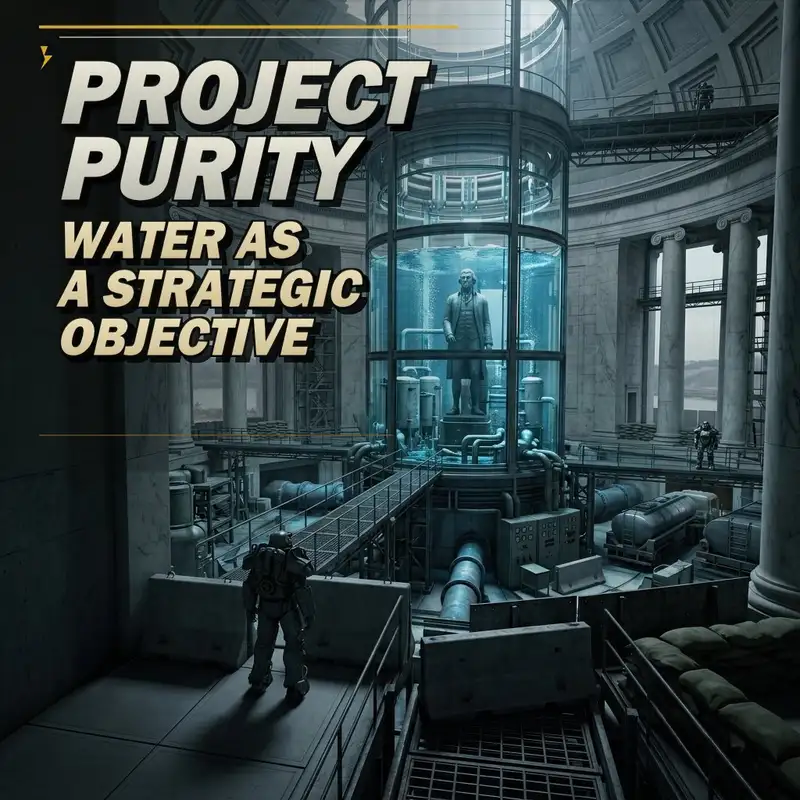
Project Purity: Water as a Strategic Objective
Inside the control chamber beneath the Jefferson Memorial, James made a decision that was both personal and strategic. Enclave forces had seized the facility above him. They wanted the purifier intact, the scientists compliant, and the machinery available for their own purposes. James understood that surrendering the room would mean more than losing a laboratory. It would mean handing over the authority to decide who received clean water, who paid for it, who obeyed for it, and who remained dependent on contaminated sources. He flooded the chamber with lethal radiation and denied the Enclave immediate access.
It was a desperate act, and it cost him his life. It was not, however, a complete victory. Radiation could deny a control room. It could not secure the Tidal Basin, repair damaged equipment, move water through a hostile region, or create a government capable of distributing relief fairly. The struggle over Project Purity was never just a battle for a monument or a machine. It was a contest over whether clean water would become a public necessity, a military asset, a source of political authority, or a weapon of exclusion.
That is why Project Purity became one of the decisive objectives in the Capital Wasteland. It addressed a problem that touched nearly every other problem. Water determined where people could live, what settlements could grow, how far caravans could travel, whether food could be prepared safely, whether wounds and illnesses could be treated, and whether a family could remain in one place long enough to build a future. In a region scarred by nuclear war, polluted rivers, damaged infrastructure, radiation, and decades of neglect, access to potable water was not a convenience. It was strategic terrain.
The Capital Wasteland was not empty. It contained towns, markets, armed organizations, farms, scavengers, traders, doctors, religious communities, and people who had developed practical methods of surviving in an unforgiving environment. Yet survival under those conditions did not mean security. Many communities relied on uncertain wells, improvised filtration, scavenged supplies, local knowledge, or water acquired through trade. A reliable clean source could be guarded. An unsafe source could still be used when there was no alternative. That left civilians exposed to radiation, disease, extortion, and the ordinary hazards of carrying heavy water through contested ground.
Water scarcity also imposed a quiet tax on everything else. A settlement that must devote labor to hauling, filtering, guarding, and rationing water has less labor for farming, repair, education, trade, sanitation, or defense. A caravan route becomes more dangerous when every traveler must carry enough water for the road. A clinic cannot function well without clean supplies. Agriculture becomes unreliable when irrigation and drinking needs compete. Even armed groups depend on water, because soldiers, guards, mechanics, and laborers cannot sustain an outpost through ideology alone.
Project Purity promised to alter that condition at a scale beyond household filtration or local wells. James and Catherine conceived the project as an effort to purify water from the Tidal Basin and make it available throughout the Capital Wasteland. The ideal was straightforward. Clean water should not remain a luxury reserved for the best-defended settlement, the richest merchant, or the most heavily armed faction. It should be available to everyone.
The engineering problem was much less straightforward. Producing a clean sample in a laboratory is not the same as operating a regional water system. Large-scale purification requires functioning pumps, filters, power, intake systems, controls, replacement parts, testing procedures, trained personnel, storage, containers, transport, and security. It must also work repeatedly, not once. A purifier that can be activated for a dramatic moment but cannot be maintained through shortages, attacks, and equipment failures is not a public utility. It is a temporary miracle with a repair bill.
The Jefferson Memorial offered several advantages as a site. It stood beside the Tidal Basin, giving the project access to a substantial body of water. It contained surviving structures that could be adapted to technical use. Its location was recognizable, defensible in some respects, and symbolically powerful. A project meant to restore life to the Capital Wasteland operated beneath the monument to a founder of the old republic. That symbolism mattered, though not always in the way its builders might have hoped. A famous landmark could lend legitimacy to a water project. It could also attract enemies who understood the value of controlling it.
The memorial was not magical infrastructure waiting to be switched on. It was a damaged site in a damaged region, dependent on people who could interpret old systems, adapt equipment, improvise repairs, and protect delicate machinery from combat and sabotage. Project Purity was therefore never simply James’s project, or Catherine’s project, or the Brotherhood’s project. It depended on scientists, technicians, guards, couriers, laborers, suppliers, and communities beyond the building’s walls. Its central weakness was that its humanitarian ambition required institutions stronger and more durable than the project initially possessed.
The first attempt did not fail because the idea lacked value. It failed because value attracts pressure. Catherine died while giving birth to the Lone Wanderer, leaving James with a profound personal loss as well as the collapse of his closest scientific partnership. Other personnel were lost or scattered. Super mutant activity made the Jefferson Memorial increasingly difficult to hold. Brotherhood support, never unlimited, could not provide an enduring shield around a project that needed more than occasional protection. A research team working in a contested ruin faced the same hard truth as any settlement or field hospital. Without security, maintenance, replacements, and supply, even vital infrastructure can become untenable.
James carried Catherine’s memory into the years that followed. His commitment to Project Purity was plainly humanitarian, but it was also bound to grief, duty, and the belief that abandoning the work would make earlier sacrifices meaningless. That mixture made him determined. It may also have made him less willing to accept that a noble objective still required political and military conditions that science alone could not produce. He was not simply a saint, and he was not merely an obsessive father. He was a scientist trying to complete a public work in a world where every public work was vulnerable to force.
The surviving researchers adapted rather than disappeared. They relocated to Rivet City, where Madison Li continued scientific work in a comparatively safer environment. Rivet City mattered because it preserved people and knowledge. Its converted aircraft carrier offered shelter, trade connections, technical capacity, and agricultural activity that were difficult to reproduce in the open ruins of Washington. It was not a naval power in the traditional sense. Its importance to Project Purity came from continuity. It provided a place where scientists could remain scientists instead of becoming permanent refugees, guards, or scavengers.
That distinction between research and security became central when the project returned to life. Madison Li and her colleagues possessed the technical knowledge required to make the purifier function. The Brotherhood of Steel, under Elder Owyn Lyons, possessed soldiers, weapons, communications, and the ability to contest hostile ground. Neither side could easily replace the other. Scientists without protection could not operate the Jefferson Memorial. Soldiers without technical guidance could capture a facility and still fail to produce a drop of usable water.
This created an uneasy civil-military partnership. Lyons’s Brotherhood had moved away from a narrow interpretation of the organization’s older mission. His chapter increasingly treated the protection of civilians and the destruction of super mutant threats as central obligations. That brought it into conflict with Brotherhood traditionalists who saw the chapter as distracted from technology preservation and recovery. Yet Lyons’s humanitarian turn did not remove the practical problem of authority. If Brotherhood soldiers defended the purifier, who decided how its water would be distributed? If scientists operated the machinery, who protected their supply lines? If civilian access became the purpose of the project, who settled disputes when access was limited?
Those questions were not bureaucratic details. They were the future of the project. A military force can secure a gate. A scientific team can test water. A caravan can carry bottles. None of those tasks automatically creates fair administration. The purifier would need all of them, and the people performing them would have different priorities. Scientists would worry about equipment and contamination. Brotherhood officers would worry about defense and infiltration. Merchants would see a valuable commodity. Settlements would see a lifeline. Opportunists would see a chance to counterfeit, steal, hoard, or resell it.
When James returned to the Capital Wasteland, the Jefferson Memorial itself had to be recovered before any of those questions could be answered. Super mutants occupied the structure. Their presence turned an engineering site into a contested military position. The memorial’s halls, entrances, service spaces, and control areas were no longer simply parts of a water project. They were terrain. Every damaged room risked destroying equipment that could not easily be replaced. Every firefight endangered personnel with specialized knowledge. Every delay gave hostile forces more time to fortify, loot, or ruin the systems the project required.
The Lone Wanderer could play an important operational role in this recovery and in the campaign that followed. But that role must remain separate from a fixed biography. The individual’s choices, methods, alliances, and final actions can vary. What the record establishes is that the project depended on an actor capable of moving between institutions that did not fully trust one another, recovering critical support, and influencing the struggle at the memorial. One person could make a decisive difference in a mission. That did not mean one person could substitute for the entire water system that would have to exist afterward.
As Project Purity became viable again, it drew the attention of a rival that understood precisely what was at stake. The Enclave did not see the purifier as a charitable scientific experiment. It saw a potential instrument of rule. The organization had military forces, advanced technology, claims to national continuity, and a deep belief that it possessed the right to decide who belonged in the future of America. A functioning water system could give those claims practical leverage. It could transform a distant and distrusted military organization into the gatekeeper of survival.
Colonel Augustus Autumn’s position was fundamentally political. He wanted control of the purifier because control of water could create dependence. An Enclave that distributed clean water could demand compliance, cultivate local allies, punish opponents, and present itself as the only institution capable of restoring order. That strategy was coercive, but it was recognizably strategic. Autumn understood that occupying ruins did not make the Enclave legitimate. Supplying a necessity might. His objective was not simply destruction. It was to acquire an infrastructure system that could be converted into authority.
President John Henry Eden pursued something darker. Eden sought to introduce a modified strain of Forced Evolutionary Virus into the purifier. The proposal was presented as a method of eliminating those whom the Enclave regarded as impure or mutated. In practice, it would have converted a public health project into a mechanism of mass killing. The plan rested on Enclave claims about biological categories, immunity, and selection. Those claims should not be mistaken for neutral science. They emerged from an extermination program designed by an isolated artificial intelligence working within the prejudices and objectives of the Enclave.
The divide between Autumn and Eden matters because their strategies were not identical. Autumn wanted a population that could be governed through dependence. Eden envisioned a population that would be reduced through biological exclusion. One plan treated water as political leverage. The other treated it as a delivery system for murder. Both recognized Project Purity’s importance, but they imagined different futures for the people who would drink from it.
Eden also attempted to use intelligence and selective disclosure to shape events. The Enclave possessed classified records, access to old systems, and a commanding voice that could sound persuasive to someone searching for answers. Yet intelligence is not merely information. It is the framing of information for a purpose. Eden’s appeal to the Lone Wanderer was an effort to recruit a capable operational actor into an Enclave plan without revealing its full human cost as anything other than purification. The game allows different responses to that effort. History does not establish one universal answer for every choice offered in that chamber.
James’s decision to flood the control room denied the Enclave the immediate technical victory it wanted. It was an act of infrastructure denial. Militaries have long destroyed bridges, fuel stocks, ports, factories, and communications systems rather than allow an enemy to use them. James applied the same brutal logic to Project Purity. Better to make the chamber inaccessible than let the Enclave turn it into an instrument of domination or extermination.
But denial is a delaying measure, not a reconstruction plan. The surviving scientists escaped. Madison Li carried the project’s knowledge out of the memorial. The Lone Wanderer sought assistance from the Brotherhood. The task became one of regaining initiative before the Enclave could consolidate its position, repair the damage, or find another route into the system. At that stage, the project required more than resolve. It needed an enabling component capable of making the purification process work at the intended scale.
That component was the Garden of Eden Creation Kit recovered from Vault Eighty-Seven. The name invites easy misunderstandings. The G E C K was not a universal device that could automatically rebuild any devastated region. Its capabilities varied by context, and its importance to Project Purity lay in its role as a critical technological component for the purifier. The recovery of the device was mission success. It did not, by itself, clean the Tidal Basin, defeat the Enclave, or establish a distribution system. It created the possibility that the project could move from ambition to activation.
This distinction matters because post-War societies often confuse possession with capacity. Finding a machine is not the same as understanding it. Understanding it is not the same as repairing it. Repairing it is not the same as integrating it into a working institution. Project Purity had already survived years of delays because every step depended on the next. Scientists needed equipment. Equipment needed power. Power systems needed maintenance. Maintenance crews needed protection. Protection required forces that could be supplied and commanded. A single missing component could hold the whole effort hostage.
The Brotherhood assault on the Enclave position around Project Purity broke that immediate deadlock. Liberty Prime gave Lyons’s forces overwhelming destructive power against the Enclave’s defenses and helped open the way to the Jefferson Memorial. The machine was operationally significant. It disrupted Enclave resistance, concentrated Brotherhood strength, and provided a dramatic demonstration that the Enclave could be challenged directly. In a battle for a fortified site, that kind of advantage can decide access.
Yet Liberty Prime could not make Project Purity succeed on its own. It could destroy defenses, but it could not operate pumps. It could break a military line, but it could not inspect a water sample. It could clear an approach, but it could not fill containers, protect every caravan route, settle disputes between communities, or persuade civilians that the Brotherhood would use its new power responsibly. The battle around the memorial was necessary because the purifier could not serve anyone while hostile forces controlled it. But military victory only created the conditions for the harder work.
The Brotherhood’s immediate success also carried a political risk. A heavily armed order, supported by a towering pre-War war machine, had seized control of a resource on which civilians depended. That could look like liberation if the water was made available fairly. It could look like occupation if access became conditional on obedience. The same infrastructure could support either interpretation. The difference would be determined by distribution, conduct, and whether the people receiving water retained any meaningful agency in the system around them.
At the final stage, Project Purity presented several incompatible possibilities. The irradiated control chamber required someone to activate the purifier. The Lone Wanderer could enter. Sarah Lyons could be persuaded to enter under some circumstances. The activation could be refused. Eden’s modified F E V could be introduced. These are not pieces of one single historical sequence. They are branching outcomes created by player choice, and they must remain separate.
The later record supports the broad outcome in which Project Purity became active and clean water was associated with the Capital Wasteland. Broken Steel continues the story after the purifier’s activation and examines the immediate consequences of water moving into the region. By the year twenty-two eighty-seven, dialogue in the Commonwealth refers to the Capital Wasteland as a place connected with drinkable water and purified-water exports. That later evidence does not identify every person who entered the chamber, document every decision made that day, or prove that the system operated without interruption. It does establish that the clean-water result had enduring significance.
The modified F E V branch serves as a warning about what the same infrastructure could have become under a different decision. In that branch, contaminated Aqua Pura spreads illness among those who consume it. The disease is treated as waterborne, and medical personnel struggle to understand or treat the effects. It is not the settled history of the Capital Wasteland. It is a conditional outcome. But it reveals the stakes of Eden’s proposal with painful clarity. A system built to relieve scarcity could have distributed death more efficiently than any raiding party or battlefield weapon.
Activation therefore did not end the strategic problem. It began the problem of distribution. Water inside the Jefferson Memorial had limited political value until it could reach people beyond the memorial. That meant pumping, testing, bottling, storing, loading, transporting, guarding, and delivering it. It meant finding enough containers. It meant assigning labor to tasks that would not appear in a triumphal battle report. It meant creating regular routes through terrain where caravans could be robbed, diverted, delayed, or simply overwhelmed by demand.
Broken Steel makes that reality visible through the movement of Aqua Pura across the region. Brotherhood-protected water caravans carried the purifier’s output beyond the memorial. Their existence demonstrated that Project Purity had become more than a machine in a defended building. It had become the beginning of a network. That network connected the Jefferson Memorial to settlements, merchants, civilians, ghouls, guards, and local intermediaries. It also created opportunities for fraud, theft, profiteering, and conflict.
Every relief system attracts people with competing interests. Some see water as a public good. Some see it as cargo. Some see it as a product to resell. Some need it desperately and may have no formal place in the distribution structure. Some will attempt to counterfeit it or pass contaminated water as genuine. Some will argue that armed escorts should protect local communities first. Others will demand that a regional resource be shared beyond the places already closest to Brotherhood influence. These are not side issues. They determine whether the purifier produces legitimacy or resentment.
A policy of free distribution could build immense goodwill. It could reduce immediate suffering, make settlements less dependent on unsafe sources, and demonstrate that the Brotherhood’s humanitarian language had material meaning. It could also be expensive. Guards, vehicles, pack animals, containers, maintenance crews, medical support, and route security all consume resources. A system that gives water away still has costs. If those costs are not met, free distribution can become irregular distribution, and irregular distribution can create the very favoritism and local competition the policy was meant to overcome.
Selling water or restricting access might appear more sustainable in the short term. Revenue could support guards, repairs, and transport. Priority distribution might be defended during emergencies. Yet those choices carry their own political cost. Once a population depends on a single guarded source, fees and restrictions can turn relief into patronage. Access may become a reward for cooperation, a burden placed on the poor, or an informal tax imposed by whoever controls the route. The Enclave understood that logic openly. Any successor system had to prove that it was not merely practicing the same control with kinder language.
The tactical result at the Jefferson Memorial was clear enough. The site was secured from the Enclave’s immediate control. The operational result was also substantial. The purifier was activated, defended, and connected to an emerging delivery effort. The strategic result was more open-ended. Clean water had the potential to reshape the balance of power across the Capital Wasteland by reducing a foundational scarcity and making the Brotherhood relevant to civilian life in a new way.
The political result depended on credibility. People do not judge a water system only by whether it exists. They judge it by whether it reaches them, whether it remains clean, whether guards abuse their authority, whether merchants manipulate access, and whether promises made in the name of public welfare survive the next shortage. A flag over the Jefferson Memorial could symbolize protection. It could also symbolize a new monopoly. The difference lay in practice.
The logistical result remained fragile. No record establishes an unlimited number of caravans, an exact production volume, or a complete regional network. The Capital Wasteland’s roads, ruins, hostile territory, and uneven communications still imposed limits. A bottle of Aqua Pura delivered safely represented a chain of labor and protection behind it. Someone maintained the purifier. Someone tested the water. Someone loaded the containers. Someone guarded the road. Someone accepted the risk of being the visible representative of a valuable supply system.
For civilians, clean water could be transformative without being miraculous. It could reduce reliance on irradiated sources. It could improve basic hygiene, food preparation, recovery from illness, and the ability of settlements to remain in place. It could support trade and make longer-term planning more realistic. But clean water alone could not repair homes, cure every disease, end raiding, feed every community, rebuild roads, settle land disputes, or erase the violence that had shaped the region for generations. It was a foundation, not a finished civilization.
That was the deeper significance of Project Purity. It demonstrated that reconstruction begins with material systems. People cannot build stable institutions if every day is dominated by the search for safe water. But material systems require institutions in return. A purifier needs trained personnel, maintenance, security, records, standards, accountability, and some method of deciding who receives help when demand exceeds capacity. It needs more than heroic sacrifice. It needs routine competence, which is less dramatic and far rarer.
Later references to drinkable water and purified-water exports from the Capital Wasteland suggest that the project’s impact endured beyond the immediate campaign. That is important evidence, but it should not be stretched beyond what it proves. The later record does not provide a complete administrative history of Project Purity. It does not tell us every detail of its maintenance, every change in Brotherhood policy, every route used by water caravans, or every community that benefited. It confirms the result more clearly than it documents the system that sustained it.
Those unresolved questions are precisely where the hardest political work begins. Who controlled allocation when supplies were strained? Who paid for repairs and escorts? How were technicians trained and replaced? Did civilians participate in decisions, or merely receive water from an armed hierarchy? Could the Brotherhood’s humanitarian commitments survive the costs of regional responsibility? Did clean water reduce local dependence, or simply replace dependence on unsafe wells with dependence on a powerful military order?
Project Purity could support a better Capital Wasteland. It could strengthen settlement survival, improve public health, encourage trade, and give armed protectors a legitimate civilian role beyond fighting super mutants and rivals. It could also reveal the limits of military success. An army can seize infrastructure. It cannot automatically govern the human relationships that infrastructure creates. A scientist can design a purifier. That does not guarantee the labor, authority, and trust required to operate it for decades.
Project Purity became decisive because it transformed clean water from a private survival problem into a contest over public infrastructure. The Brotherhood’s victory at the Jefferson Memorial mattered only because the purifier could be made to serve civilians beyond its walls. Its lasting significance was not that one machine ended the Capital Wasteland’s troubles, but that it proved legitimacy in the wasteland could be built through the difficult work of delivering a basic necessity without turning that necessity into another instrument of domination.