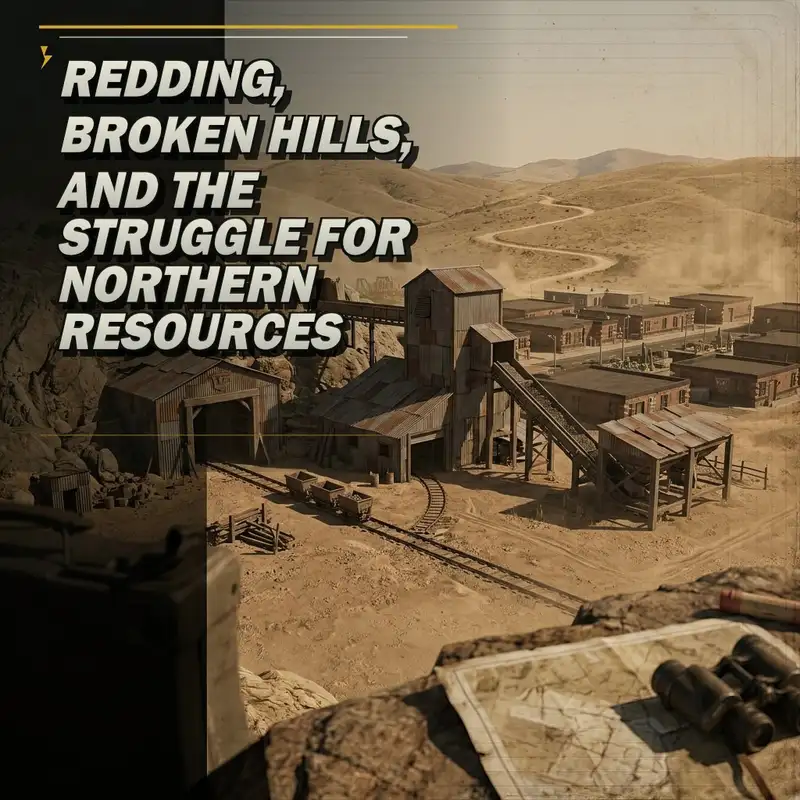
Redding, Broken Hills, and the Struggle for Northern Resources
Underground, a mining town can fail long before anyone sees a flag lowered or a militia retreat. A tunnel fills with poison. A machine stops for want of one component. A crew cannot work because its members are sick, frightened, addicted, or fighting one another. Above ground, merchants, mine owners, officials, and criminals may still argue over who owns the future. But below ground, the practical question is simpler. Can anyone still reach the ore, keep the equipment running, and bring workers home alive?
In the year twenty-two forty-one, Redding and Broken Hills stood on the northern resource frontier of the post-War West. Both were built around buried wealth. Redding had gold. Broken Hills had uranium. Each resource drew trade, ambition, and outside attention. Yet neither settlement was defined by mineral deposits alone. Their fate depended on labor, machinery, medicine, security, and the political rules that determined who received protection and who absorbed the risks.
Redding became a contest over external capture. Its gold attracted rival patrons whose influence extended well beyond the town. Broken Hills attempted something more difficult. It held together humans, ghouls, and super mutants around a mine whose operations depended on all three communities, but especially on workers whom much of the wasteland treated with suspicion or fear. One town had wealth without reliable civic control. The other had a fragile civic compact built around a resource that could not last forever.
Their histories answer a hard question about reconstruction after the Great War. What turns a resource strike into a durable society? Gold and uranium could finance trade, attract skilled workers, and purchase security. They could also deepen dependency, sharpen social divisions, and invite stronger powers to decide that a small town’s future was too valuable to leave in local hands.
Redding was already more than an isolated camp by the time of Fallout Two. It had mines, merchants, residents, saloons, local disputes, and enough economic activity to matter to powers farther south and east. But it did not possess the kind of cohesive public authority needed to control the consequences of its own prosperity. Its institutions existed. Their reach was another matter.
Mayor Ascorti held formal office, but office did not make him the unquestioned master of Redding’s economy, police, or political future. Mine owners had their own interests. Outside networks had their own clients. Criminal influence could be applied through money, drugs, intimidation, and access to trade. A mayor could speak for the town while other people determined who worked, who profited, who received protection, and whose debts could become dangerous.
That gap between formal authority and practical power is central to Redding’s story. The town had a mayor, but no stable monopoly on force. It had mines, but no uncontested agreement about who should benefit from their output. It had law enforcement, but Sheriff Earl Marion’s incapacitation weakened the ability of the town to handle crime, raider pressure, and disputes between powerful local interests. In a frontier economy, a sheriff who cannot act is not merely a personal tragedy or a side matter. He represents an institutional vacuum.
A functioning law officer does not make a settlement secure by himself. But when law enforcement fails, every other conflict grows more expensive. Merchants must seek private protection. Miners become vulnerable to coercion. Raiders can operate with greater confidence. Wealthy interests can settle disputes through hired muscle, bribery, or imported allies. Residents who cannot trust public authority begin looking for protection from private patrons, and patrons seldom provide it without expecting influence in return.
Redding’s gold did not cause all of these problems. The problems were already present in the town’s divided authority and limited capacity. Gold made them more consequential. It made Redding worth competing over.
The most important object in that competition was not a gold bar, a mine deed, or a shipment of weapons. It was an excavator chip. On its own, the component was not a strategic wonder. It did not create wealth from nothing. Its importance came from the machinery it could help restore and the production it could make possible.
The Great Wanamingo Mine contained deposits that could not simply be collected by anyone willing to carry a shovel. Access depended on confronting a dangerous obstacle within the mine and on restoring the equipment needed to exploit what lay below. That is the real meaning of the excavator chip. It represented a bottleneck. Whoever could help reopen or expand productive access to the mine would gain more than immediate profit. They would gain leverage over hiring, commerce, transport, credit, and the town’s future political alignment.
In post-War economies, specialized equipment often mattered more than raw material. A region could sit above valuable ore and remain poor if it lacked pumps, ventilation, repair skills, transport, guards, medicine, and buyers. Salvage was not an endless industrial base. A recovered machine required someone who understood it, parts that could fit it, power that could run it, and a secure enough environment for workers to maintain it. The excavator chip mattered because Redding had a resource but needed technical access to turn that resource into sustained wealth.
Two local figures embodied competing answers to the question of who should gain that access. Dangerous Dan McGrew, connected to the Morningstar Mine, stood within an orbit of influence tied to New Reno. Marge LeBarge of the Kokoweef Mine was aligned with New California Republic interests. Neither was simply a symbol. Each represented a local actor with a direct stake in the mines. But their competition also linked Redding to wider systems of power.
If McGrew’s side gained the advantage, New Reno’s criminal and commercial networks could strengthen their position in the town. If LeBarge’s side gained it, the New California Republic could expand a foothold in a northern settlement already useful for its mineral wealth and regional trade. The decision was not about choosing between a local future and an outside future. Both factions had local intermediaries. The question was which external network would become most deeply embedded in Redding’s economy.
The New California Republic operated through a different vocabulary. It was a growing republic with an elected government, expanding institutions, commercial interests, military forces, and an appetite for strategic depth beyond its established core. Redding’s gold could matter to the Republic’s economy and political ambitions. But the N C R was not one mind. National expansion, local mine ownership, merchants seeking contracts, frontier officials, and ordinary settlers did not necessarily want the same thing or benefit equally from incorporation.
Vault City represented another form of leverage. Its influence rested less on territorial expansion through a republican frontier and more on technical competence, medical capacity, and controlled access to valuable knowledge. In a town where sickness could weaken the workforce and machinery could determine production, medical and technical aid had political force. Assistance could relieve suffering. It could also create dependency, establish obligations, and open a path toward incorporation under terms set elsewhere.
These were competing resource regimes. New Reno could capture a town through dependence and criminal patronage. The N C R could draw it into a growing state through trade, political affiliation, and territorial incorporation. Vault City could use medical and technical advantage to reshape local choices. None of these powers needed to declare that Redding lacked agency. They only needed the town’s institutions to be weak enough that accepting outside help became the least bad option available.
Redding’s struggle was therefore not a simple morality tale in which one outside power offered corruption and another offered civilization. New Reno’s methods were deeply coercive, and its drug trade imposed direct harm on workers and families. But incorporation into a larger government could also reduce local autonomy, expose residents to outside taxation, and allow distant commercial interests to benefit from local extraction. Protection and markets had value. So did the ability of a town to set its own terms. Redding’s difficulty was that it lacked the strength to negotiate confidently with anyone.
The clearest example came through Jet. The crisis surrounding the town’s miners was not merely a public-health emergency. It was an economic-security problem. A mining settlement depends on workers who can show up, make decisions, handle tools, endure hardship, and sustain households outside the mine. Addiction compromises all of those things. It weakens labor discipline without creating legitimate authority. It burdens families. It expands debt. It leaves workers vulnerable to people who control supply, treatment, or access to credit.
The Mordino-linked Jet operation exploited those vulnerabilities. The exact scale of addiction is not established, and there is no need to turn Redding into a ledger of doses and victims. The strategic point is clear enough. A workforce can be valuable precisely because it is vulnerable. If miners become dependent on a drug supplied through an outside network, the mine owner, mayor, sheriff, and local merchants all become less important than the people who control the dependency.
That is a form of labor control. It does not require formal ownership of every mine. It does not require a flag above city hall. It works by making workers less independent and making the town’s economy harder to separate from a criminal supply chain. In that sense, Jet was not simply sold into Redding. It was used to alter the balance of power within Redding.
The possible role of Doctor Johnson and an antidote shows the other side of the same political equation. Medical relief could restore workers, reduce suffering, and give families a chance to recover from a crisis deliberately worsened by outside influence. But the game also permits circumstances in which such assistance becomes linked to a Vault City annexation outcome. That possibility should not be treated as a single settled history. It is one branch among several. Still, it reveals something important. Public health and political incorporation were connected.
A town whose people need treatment may welcome the institution capable of providing it. That is not necessarily manipulation. It may be necessary and humane assistance. Yet the ability to distribute medicine also creates leverage. Whoever restores the labor force can claim gratitude, demand influence, or demonstrate that local authorities failed where an outside power succeeded. In Redding, the health of miners became part of the contest over who could govern.
The civilian consequences were immediate. Miners paid through illness and dependency. Families paid through instability, fear, and reduced income. Small businesses paid when labor and trade became unreliable. Residents with no stake in the mine claims still lived with the effects of criminal influence, weak policing, and political bargaining conducted over their heads. Resource competition rarely remains inside the mine office. It enters kitchens, clinics, saloons, and the streets where people decide whether it is safe to walk home after dark.
Redding’s problem was a workforce compromised through addiction and external patronage. Broken Hills faced a different labor struggle. There, the issue was not merely whether workers could continue to labor. It was whether a community would accept the workers on whom its economy depended.
Broken Hills was founded around a uranium mine in a landscape where pre-War industrial ruins still offered opportunity to anyone capable of operating them. The town brought together humans, ghouls, and super mutants. That fact alone made it unusual. The post-War West contained many communities where different peoples traded, fought, avoided one another, or lived uneasily side by side. Broken Hills went further. Its economy required some degree of shared civic life.
The uranium mine was hazardous. Toxic gas made underground labor dangerous and, without functioning air purification, potentially impossible. Super mutants held a particular advantage in those conditions. Their physical resilience made them especially valuable workers in an environment that imposed severe risks on ordinary humans. That did not make them machines, expendable labor, or a naturally unified political bloc. It made their position in the town’s economy impossible to ignore.
Broken Hills therefore rested on a practical bargain. Humans, ghouls, and super mutants did not need to agree on every grievance, history, or belief. They needed the town to function. The mine created jobs and trade. The workers needed food, shelter, repair, markets, and security. Residents who never entered the shafts still depended on the wealth that emerged from them. Coexistence had a moral dimension, but it also had an economic one. The town could not easily afford to waste or expel a labor force crucial to its survival.
Marcus stood at the center of this arrangement. In Broken Hills, he served as sheriff and as a political guarantor of the settlement’s uneasy peace. His authority mattered because he was respected, capable, and able to act across lines of species and faction. But it would be a mistake to describe him as the ruler of a modern state with a deep bureaucracy, reliable courts, professional police, and a permanent administrative system behind him.
Marcus’s authority was personal as much as institutional. It depended on his reputation, his ability to enforce order, and the willingness of residents to accept his judgment. That gave Broken Hills a valuable stabilizing figure. It also created a vulnerability. A political settlement anchored in one trusted person can endure for a time. It becomes fragile when crises exceed that person’s capacity, when evidence becomes contested, or when the economic basis of compromise begins to fail.
The town’s pluralism was not permanent harmony. Human residents did not all hold identical opinions about mutants. Ghoul residents did not all stand outside the conflict as neutral observers. Super mutants were not one disciplined political party. Some residents supported coexistence because it was just. Others supported it because it was profitable. Some resented the arrangement, feared it, or believed that their community bore an unfair share of the risk. Those tensions did not make Broken Hills a failure. They made it a real society.
A settlement becomes politically meaningful not when it eliminates disagreement, but when it develops ways to survive disagreement without turning every grievance into violence. Broken Hills was trying to do that under unusually difficult conditions. Its mining economy brought people together. It also created the pressure points through which opponents of coexistence could attack.
The most important pressure point was the air purifier. In a conventional military campaign, an enemy may seek to seize a bridge, disable a rail line, destroy a fuel depot, or cut a communications relay. At Broken Hills, the air-purification system served a similar operational role. It was a piece of inherited infrastructure whose failure could close access to the mine and cripple the town’s economic heart.
The threat from toxic gas was not abstract. If the mine could not be ventilated, workers could not safely continue at the same level of access, and the uranium economy could not operate as intended. The town might still have buildings, people, weapons, and merchants. But its productive center would be failing. A mine without usable air is not an asset. It is a sealed liability beneath the ground.
Sabotage of the purifier was therefore a political attack carried out through maintenance failure. No invading army needed to storm Broken Hills. No artillery had to level its homes. Damaging a critical system could create unemployment, fear, and conflict among residents. It could make the mutant workforce appear burdensome or suspicious. It could encourage people already inclined toward prejudice to argue that coexistence had become too costly.
The crisis also exposed the limits of Broken Hills’ industrial depth. The town could operate inherited machinery. It had people capable of working the mine and residents able to engage with its systems. But operating a pre-War installation is not the same as possessing the manufacturing base to replace every specialized component, rebuild every filter, or train an unlimited number of technicians. In the wasteland, maintenance is a form of strategy. A machine that cannot be repaired eventually becomes a monument to someone else’s industrial capacity.
Restoring the purifier, where it is possible, is a tactical success. It reopens access and buys time. But tactical success does not eliminate the political reasons someone wanted the system disabled. Repairing the machine does not automatically repair trust between neighbors. It does not settle who will be blamed for the crisis, who will work underground, or who will benefit from the mine once operations resume.
Those questions lead upward from the shafts into Broken Hills’ campaign of fear, deception, and political sabotage. The conflict associated with Jacob the chemist and the anti-mutant conspiracy was not merely a feud between prejudiced individuals and their intended victims. It involved disappearances, murder, concealed bodies, manipulated evidence, and efforts to destabilize the town’s economic and social order. The aim was not simply to express hatred. It was to make coexistence appear impossible.
The intelligence problem was severe. Residents of Broken Hills did not possess a neutral archive, a modern forensic service, or an unquestioned judicial system capable of resolving every allegation beyond doubt. They relied on testimony, rumors, personal reputation, physical evidence, and the judgment of local authorities. Each source could be incomplete, self-serving, or deliberately deceptive. In that environment, the ability to control a story could be almost as powerful as the ability to control a weapon.
The anti-mutant conspirators exploited this weakness. Their actions threatened individual lives, but they also attacked the town’s political foundation. If humans could be convinced that mutants were responsible for every disappearance and every danger, then the labor arrangement at the mine could become a source of panic rather than mutual dependence. The conspirators did not need to prove that all mutants were dangerous. They needed enough people to believe that the risk of coexistence outweighed the economic value of maintaining it.
But Broken Hills cannot be understood through a simple picture of innocent mutants against uniformly malicious humans. Some mutant residents had their own grievances, rivalries, and capacity for retaliation or deception. Francis, among others, demonstrates that the super mutants were not a single moral category or political faction. Their experiences shaped their fears and resentments, but those experiences did not erase individual responsibility or make every claim automatically true.
This complexity did not weaken the case against anti-mutant violence. It strengthened the historical lesson. A pluralist settlement cannot survive if it demands that one population be perfect before it receives equal protection. Humans, ghouls, and mutants all contained individuals capable of fear, anger, courage, manipulation, and self-interest. The purpose of civic institutions is not to certify that every resident is virtuous. It is to investigate wrongdoing without turning collective identity into collective guilt.
Broken Hills lacked the institutional depth to make that task easy. Marcus could intervene. Local residents could provide evidence. The Chosen One could uncover information and alter the immediate balance. Yet the town remained vulnerable because its system for resolving disputes depended heavily on individual judgment at precisely the moment when evidence had become difficult to trust.
Ordinary residents bore the consequences. A human family could fear that a relative had disappeared. A ghoul could watch neighbors become more suspicious and less willing to cooperate. A super mutant miner could be essential to the town’s prosperity while still being treated as a potential enemy. Workers could lose income when the mine shut down. Merchants could lose customers. People who had no part in a conspiracy could find themselves judged by the species, neighborhood, or job they happened to belong to.
The Chosen One can enter both Redding and Broken Hills as a mobile outside actor. That role matters, but it has limits. In Broken Hills, the Chosen One may be able to repair the air purifier, investigate disappearances, expose conspirators, and influence the treatment of suspects. These are not fixed events in one universal history. They are possible player-dependent outcomes. Different actions can produce different futures for the town.
What matters analytically is the distinction between decisive intervention and durable governance. A capable outsider can restore a machine, carry evidence, defeat an immediate threat, or force hidden actors into the open. Such intervention can save lives and prevent catastrophe. But it cannot, by itself, create a maintenance corps, a trusted court, a public-health system, a stable labor settlement, or an economy capable of surviving the exhaustion of its principal resource.
The same limitation applies in Redding. A traveler may influence mine ownership, public health, local security, and the balance between external powers. But one person cannot permanently solve the structural problem of a town whose wealth has attracted patrons stronger than its own institutions. The Chosen One can shape the branches of history. The Chosen One cannot replace the institutions that history requires.
Redding’s possible outcomes make that clear. The town can fall more deeply under New Reno influence. It can move toward N C R-aligned control. Under particular conditions connected to medical intervention, it can be incorporated by Vault City. It can also decline toward abandonment. These are alternative endings, not chapters in one continuous sequence. They should not be combined into a single account in which Redding is successively captured by every outside power and then restored.
Each branch reveals a different vulnerability. Stronger New Reno influence would show the consequences of criminal capture, where productive wealth feeds networks of dependency and coercion. N C R alignment would show the pull of a larger state able to connect mines to broader markets and territorial administration. Vault City incorporation would show how technical and medical assistance can become a route into political control. Abandonment would show that ore in the ground has little value when security, labor, machinery, and local confidence collapse.
By the year twenty-two eighty-one, later evidence places Redding within the broader sphere of the New California Republic. The Van Graffs are headquartered there, and the town is associated with N C R territory and commerce. That later condition confirms a broad result. Redding became linked to the Republic’s political and economic order. It does not establish every decision that produced that result. It does not prove one specific Fallout Two branch occurred exactly as a player might have experienced it.
That uncertainty is important. History often preserves the later arrangement more clearly than the path that created it. Redding’s N C R association by twenty-two eighty-one tells us that the town did not remain outside regional state-building forever. It does not tell us precisely which mine owner prevailed at every stage, which local bargains were made, or how much coercion, consent, medical relief, commercial pressure, and political calculation lay behind incorporation.
Incorporation could offer real advantages. A larger republic could provide access to wider markets, more predictable trade, greater security on regional routes, and connections to a growing political system. Yet it could also subordinate local priorities to distant decisions. A gold town might become an extraction zone whose profits, contracts, and strategic value were shaped elsewhere. Local residents could receive roads, trade, and law while losing some ability to determine who governed them and how the gains of the mines were distributed.
That is the central ambiguity of Redding. It needed stronger institutions. But the institutions most capable of stabilizing it came from outside and would have their own interests. The town’s weakness did not make external rule automatically illegitimate. It made the terms of external rule decisive.
Broken Hills offers the inverse lesson. Its greatest danger was not immediate absorption by a powerful regional government. It was the possibility that its internal social compact would fail before the town developed a more durable economic foundation. The original trajectories of the settlement show two broad futures. In one, the destruction of its mutant population undermines the mine’s viability and the town collapses. In another, coexistence survives long enough for Broken Hills to prosper temporarily, only for its uranium supply to be exhausted and its people to disperse.
These are conditional trajectories, not a single chronology. They nevertheless reveal the same underlying relationship. The town’s social order and its economy depended on each other. Removing the workforce most capable of sustaining hazardous mining could destroy both the productive system and the civic compact built around it. Protecting that workforce could preserve the town for a time, but it could not create new uranium once the reserves were exhausted.
The mine gave Broken Hills a reason to cooperate. It did not guarantee that cooperation would survive every crisis. Nor did it guarantee that the settlement could diversify into a different economy once uranium ceased to sustain trade. A town can have a sheriff, a market, working machinery, and a temporary peace, yet still remain vulnerable if its entire livelihood rests on one finite resource and one difficult set of technical conditions.
Later, Marcus appears at Jacobstown in the Mojave. He remembers Broken Hills as part of his earlier life and confirms that the settlement remained important enough to be remembered beyond its own decline. His survival and later movement eastward establish continuity between the former mining town and the later community at Jacobstown. They do not canonize every detail of Broken Hills’ earlier conflicts. They do not prove exactly which suspects were punished, which crisis was resolved, or which ending branch occurred in full.
Nor does Broken Hills’ later disappearance prove that its mutants were universally expelled or massacred. The stronger evidence supports a more restrained interpretation. The settlement’s economic foundation weakened as uranium ran out, and its residents dispersed over time. That outcome is not less significant because it lacks a final battlefield. It is, in many ways, more revealing. Communities often end not with one dramatic defeat, but with a gradual loss of the material conditions that made their social arrangement possible.
Redding and Broken Hills were not failures because they lacked valuable resources. They were fragile because valuable resources intensified conflicts their institutions could not fully manage. Redding’s gold drew powerful patrons, while weak security, divided authority, and a compromised workforce limited the town’s ability to set terms. Broken Hills created a more ambitious local arrangement across human, ghoul, and super mutant populations, but its peace relied on personal leadership, vulnerable infrastructure, and a mine with finite reserves.
The civilian stakes were never secondary. Miners endured addiction and manipulation. Families absorbed the instability created by competition among mine owners and outside patrons. Humans, ghouls, and super mutants in Broken Hills lived under suspicion while their livelihoods depended on a settlement fragile enough to be shaken by sabotage and rumor. Resource wealth gave others reasons to take interest in these towns. It did not guarantee that the people living there would control the terms of that interest.
The mine is not the town. A mine can finance power, but it cannot create durable society by itself. That requires institutions capable of protecting labor, maintaining machinery, providing care, settling disputes, restraining predation, and sharing the gains of production with the people whose work makes those gains possible. Redding and Broken Hills show that the struggle for northern resources was never only about what lay beneath the ground. It was about who would decide how the living above it would endure.