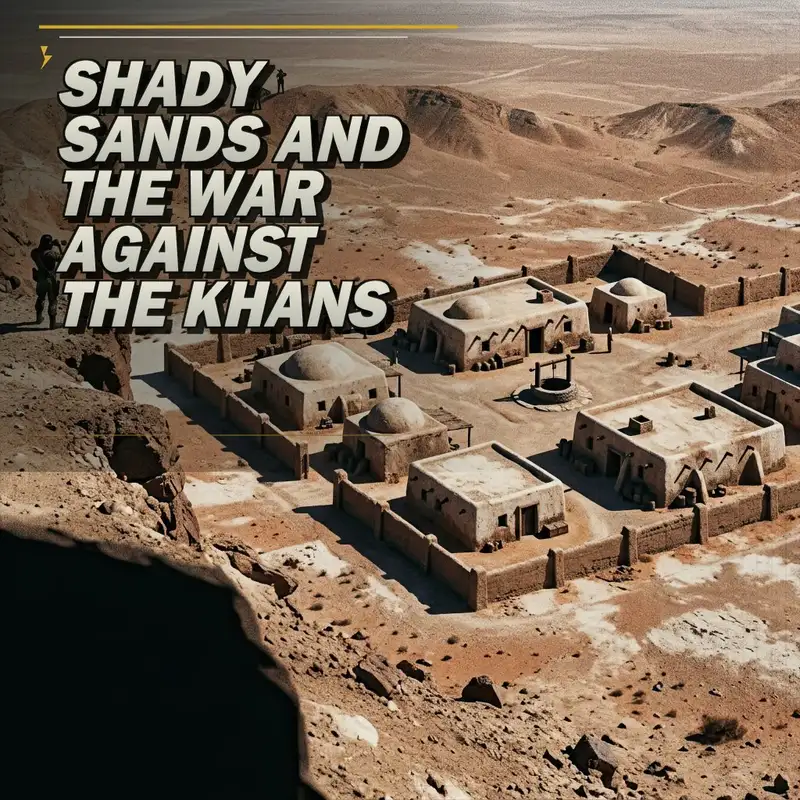
Shady Sands and the War Against the Khans
At Bitter Springs, the question was not simply who held the ground when the shooting stopped. The more enduring question was who was trying to leave it. In the year twenty-two seventy-eight, New California Republic forces moved against a Great Khan position in the Mojave. The Khans had raided Republic targets, and the N C R had reason to regard them as an active threat. But as the fight developed, civilians fled with the force. Children, elderly people, and sick people were among those moving through confusion, difficult terrain, and broken command arrangements. Khan survivors remembered what followed as a massacre. N C R accounts described a disastrous failure of communication and control during an assault on a hostile camp.
The exact order of battle is not firmly established. Neither is a reliable casualty total, nor a complete minute-by-minute account of who fired at whom, from where, and under what orders. What is clear is that the operation became more than a clash between armed opponents. People attempting to escape were killed. The N C R broke the Khan position, but the political memory created at Bitter Springs outlived the tactical result. For the Great Khans, it became proof that the Republic’s talk of law and civilization did not extend to them. For the N C R, it became a reminder that a force can meet its immediate military objective and still fail at the harder work of distinguishing enemy fighters from the people caught in their wake.
That battlefield did not appear from nowhere. More than a century earlier, Shady Sands was not yet the capital of a republic with troops, administrators, merchants, taxes, and ambitions beyond its horizon. It was a farming settlement trying to keep its crops, livestock, water, and families alive in a hostile region. The long conflict between Shady Sands, the New California Republic, and successive Khan societies began there, with a small community facing the most basic political problem in the postwar world. Could it protect ordinary life from people who saw its food and labor as prey?
In the year twenty-one sixty-one, Shady Sands had a few advantages that many postwar communities lacked. It had agricultural knowledge, access to water, leadership, and people willing to cooperate around a permanent settlement. Those were not minor achievements. In a land shaped by radiation, insecurity, damaged infrastructure, and predators both human and animal, a field under cultivation was an act of confidence. It assumed that someone would be alive to harvest it. A herd of brahmin assumed that raiders would not drive it away overnight. A home assumed that families could sleep without taking turns standing guard.
Aradesh led Shady Sands during this vulnerable period. His authority was practical before it was grand. He was responsible for the survival of a settlement whose resources were useful precisely because they were visible. Food, water, animals, tools, and labor attracted people who lacked them. The original Khans, alongside other raider groups in the region, were part of that pressure. Accounts from the period describe the Khans as attackers who stole food and shot residents. They were not conducting a conventional campaign against a recognized state. They were raiders exploiting the weakness of isolated communities.
The difference matters. A raid does not need to capture territory to alter a society. It can force people to keep weapons near the fields, limit travel, abandon outlying land, and devote scarce labor to defense instead of planting, repairing, teaching, or trading. It can turn every stranger on the road into a possible scout for a hostile camp. For Shady Sands, the Khans were not an abstract security concern. They were a direct threat to the settlement’s ability to remain a settlement at all.
The kidnapping of Tandi, Aradesh’s daughter, made that danger painfully personal. Tandi was not merely a political figure in waiting. At the time, she was a young woman taken from a community that did not possess the resources of a formal state. Her abduction exposed the limits of Shady Sands’ defensive reach. The settlement could maintain guards and walls, but it could not guarantee security across the surrounding countryside. The crisis also demonstrated how raiding worked as a political weapon. A hostage could pressure leaders, frighten civilians, and show that the raiders could reach into the life of a community whenever they chose.
The precise role played by the Vault Dweller in resolving that crisis depends on player action. The individual’s name, methods, companions, and choices are not fixed history. What the broader record establishes is that Shady Sands survived the immediate danger, Tandi returned to its political life, and the original Khan threat was broken as a force capable of dominating the settlement. The settlement’s future was not guaranteed by one confrontation, but that period gave Shady Sands breathing room. It could invest in something other than immediate survival.
There is a temptation to tell this as a clean founding legend. Raiders threatened a village, an outsider intervened, the village grew into a republic, and civilization defeated savagery. The real historical pattern is more difficult. The original Khans were defeated, but the material conditions that fed raiding did not vanish. Scarcity, displacement, weak institutions, and armed groups competing for survival remained part of the region. Nor did defeat automatically erase memory. A destroyed camp can remove a threat from one road while leaving survivors, imitators, relatives, rivals, and stories behind.
The later New Khans and Great Khans should not be treated as one unchanged organization marching through a hundred and twenty years of history. Fallout’s surviving record does not support that kind of simple lineage. Leadership changed. Locations changed. Economies changed. Generations changed. The original Khans near Shady Sands, Darion’s New Khans beneath Vault Fifteen, and the Great Khans of Red Rock Canyon were related by names, symbols, grievances, and inherited traditions, but they existed in very different strategic environments.
Shady Sands, meanwhile, possessed an advantage that raider groups usually lacked. It had continuity. Its people could preserve crops, skills, leadership, and social relationships across years. It could turn a successful harvest into trade, trade into alliances, alliances into wider security, and security into confidence. That process was neither automatic nor free of coercion. Communities had to decide who could join, who could claim land, who would bear arms, and whose labor supported the common defense. But a settlement that could make those decisions through durable institutions had a different future from a mobile band that depended on the next successful raid.
Under Aradesh and then Tandi, Shady Sands developed into the political nucleus of the New California Republic. The early institutional chronology is not fully dramatized in surviving game accounts. Official guide material commonly places the renaming of Shady Sands as the New California Republic in the year twenty-one eighty-six, and the formation of a federation a few years later, in twenty-one eighty-nine. Those dates are useful markers, but they should not be mistaken for a complete constitutional archive. The important point is that Shady Sands became more than a town. It became a center from which several communities could imagine common law, common defense, and common political membership.
A republic is not created by changing a sign over a settlement gate. It requires ways to collect resources, settle disputes, protect movement, and make authority credible beyond one leader’s immediate presence. The N C R built legitimacy through representative claims, written law, trade, landholding, public offices, and the promise that people inside its system would receive more predictable security than they could obtain alone. It also built power through taxation, armed forces, Rangers, bureaucrats, caravan protection, and the ability to make decisions that affected people far from Shady Sands.
That expansion solved some of the problems that had once endangered the original settlement. A larger political order could protect roads more effectively than one village militia. It could establish patrols, coordinate information, punish raiders, and support markets over greater distances. Farmers could send goods farther with a reasonable expectation that a caravan might arrive. Communities on the frontier could appeal to something larger than their own walls. The N C R’s existence demonstrated that the postwar world was not merely a collection of ruins. It was a place where institutions could grow, organize resources, and project authority.
But each success created a new problem. A government capable of reaching beyond Shady Sands could also punish beyond Shady Sands. A force sent to protect trade could become an occupying force in the eyes of people living along its route. A republic that promised law had to decide how law applied to communities that did not trust it, did not recognize its authority, or had harmed its citizens. Frontier security required information, discipline, and restraint. Those are harder to maintain than a flag, a uniform, or a formal declaration of citizenship.
It is also important not to speak of the N C R as if it possessed one mind. Tandi’s long political project was not identical to the interests of every merchant, settler, soldier, Ranger, bureaucrat, landowner, or local official. Elected institutions did not erase the pressures of distance. Field commanders faced problems that legislators in the capital did not see directly. Frontier communities wanted protection, but they might also resist taxes, regulations, or the arrival of outsiders claiming to act in the Republic’s name. The N C R’s strength was institutional scale. Its weakness was that scale could create blind spots as easily as it created capacity.
By the year twenty-two forty-one, the conflict with Khan successors had changed form. Darion’s New Khans operated from a base beneath Vault Fifteen, one of the old subterranean sites tied to the region’s earlier history. They were not simply riders looking for vulnerable farms. Their hostility toward the N C R had become more organized, more political, and more attentive to the machinery of a growing state. They sought revenge against Tandi and the Republic that had emerged from Shady Sands.
Their methods reveal an important shift. The New Khans gathered information on N C R production, caravan schedules, security rosters, congressional proceedings, and presidential appointments. That is the intelligence picture of an enemy that understood where state power actually lived. The N C R did not depend only on soldiers with rifles. It depended on predictable movement, records, offices, supply chains, officials, and the confidence that caravans could travel on known schedules. The New Khans recognized that a republic could be attacked through its routines.
This was a more sophisticated threat than opportunistic raiding, even if it remained limited in scale. A raid takes what is available. An intelligence operation asks what the enemy needs in order to function tomorrow. Caravan schedules reveal where commerce is vulnerable. Security rosters reveal where a guard force is thin. Production reports reveal which workshops and farms matter most. Political records reveal who holds authority and which decisions may fracture a government. Darion’s organization did not possess the N C R’s administrative depth, but it understood the value of attacking administration.
The New Khans also show how defeat can become political inheritance. The group’s hostility was directed not merely at travelers carrying valuables, but at the authority represented by Tandi and the Republic. In their view, Shady Sands had grown from a settlement that defeated the earlier Khans into a state that could impose its power across the region. Whether every member shared the same historical memory is impossible to know. But the organization’s strategy indicates that revenge had become attached to a larger anti-Republic project.
The Chosen One can destroy Darion’s organization in Fallout 2. That result is possible and significant within the game, but it must remain a player-dependent outcome. It should not be treated as an unavoidable event in a single fixed history. More importantly, even if Darion’s New Khans were destroyed, that would not prove that every later Great Khan was a direct survivor of his group. Names and traditions can travel farther than organizations. A political identity can survive through fragments, stories, families, and people who inherit a grievance without having stood in the original battle.
The N C R generally possessed advantages that Khan formations could not match. It had more agricultural depth, broader markets, larger pools of labor, and a growing ability to replace losses. It could sustain soldiers, police routes, draw revenue from settled territory, and integrate armed power with civilian administration. Its resources were not limitless, and its institutions were not always competent, but they gave the Republic endurance. A Khan group could strike a caravan. The N C R could organize the next caravan, recruit guards for it, investigate the attack, and send a force after the attackers.
The Khan advantage lay elsewhere. Mobility mattered. Local knowledge mattered. A force accustomed to moving through rough country could choose when and where to strike. Small groups could evade a larger army, exploit weak patrol patterns, and make a road expensive to use without holding it permanently. Raider experience could produce skilled fighters and adaptable scouts. Trade networks, including illicit ones, could provide weapons, food, information, and influence. Most important, a shared memory of defeat could create cohesion among people who had little else.
That cohesion had limits. A mobile society may be difficult to catch, but it is also difficult to supply in a long war. It can raid a settlement without possessing the farms, workshops, hospitals, and administrative systems needed to govern one. It can hold a hidden camp without being able to replace every loss suffered in a major battle. Trade may sustain a community, but trade is vulnerable to blockade, disruption, changing markets, and the decisions of stronger neighbors. Chem production could make later Great Khans wealthy enough to matter, but it did not create the institutional depth of a territorial state.
The N C R could therefore win repeatedly in the military sense while failing to end the political conflict. This is a familiar problem in frontier warfare. A stronger state sees an armed group as a security threat to be suppressed. The group sees each suppression as proof that the state is hostile to its existence. Neither interpretation is entirely false. The Khan raids created real victims, disrupted trade, and endangered civilians. N C R reprisals and military campaigns could also create displaced families, dead noncombatants, and memories of collective punishment. The more each side defined the other through its worst acts, the harder reconciliation became.
By the year twenty-two eighty-one, that inherited conflict had moved eastward into the Mojave. The Great Khans were established at Red Rock Canyon, far from the original farming settlement that had first confronted the Khans in the year twenty-one sixty-one. They were a distinct later formation, living in a different world. The N C R was now a large republic operating across difficult territory. Caesar’s Legion had become an expansionist threat from the east. New Vegas, Hoover Dam, caravan routes, water, energy, and the possibility of regional control had altered the stakes for everyone.
The Great Khans were not merely a relic from the N C R’s early history. They had their own leadership, economy, internal arguments, and political choices. Chem production and trade helped sustain them. That economy connected them to the Mojave’s markets and gave them a source of influence that did not depend entirely on raiding. Yet it also had limits. A profitable trade can support a community without giving it secure land, reliable food production, broad diplomatic recognition, or the ability to administer a large population. The Great Khans had resources, but not the depth enjoyed by the states around them.
Papa Khan represented one powerful interpretation of Khan history. His account of the past did not deny that the Khans had attacked N C R targets. He acknowledged that they had expected the Republic to be easy prey and had raided its caravans, towns, and camps. That admission is important because it prevents Bitter Springs from becoming a story in which the Khans were innocent spectators of a war started entirely by others. They were armed actors who had imposed real costs on N C R civilians and commerce.
But Papa Khan’s memory of Bitter Springs centered on what happened when the military encounter became a civilian catastrophe. He described children, elderly people, and sick people being killed as they fled. His language was the language of betrayal and slaughter, not simply defeat. He was not a neutral historian. He was a leader shaped by the event and invested in preserving its meaning for his people. Yet his account cannot be dismissed merely because it is partisan. Other evidence confirms that Bitter Springs involved a catastrophic failure in the N C R operation, one whose civilian consequences became inseparable from the battle’s legacy.
The Great Khans themselves were not politically uniform. Regis represented a more cautious and practical current within the group. He could see that continued pursuit of revenge might lead the Khans into another disaster. Diane’s role in trade showed that the group’s survival depended on relationships beyond the battlefield. Jack and Melissa represented technical knowledge and ambitions that did not fit neatly into a culture defined only by raiding or old losses. These figures do not make the Great Khans harmless or politically uncomplicated. They demonstrate something more important. A society that outsiders describe as a single hostile tribe contains workers, specialists, pragmatists, elders, and people who imagine different futures.
Bitter Springs explains why the most destructive option could still seem attractive. The N C R’s military force had broken the Khan position, but it had not broken the emotional and political meaning of Khan resistance. Tactical victory had produced dispersal and loss. Operationally, the attack had failed to control the movement of civilians or maintain adequate communication as the situation changed. Strategically, the N C R weakened a hostile force but did not eliminate Khan identity or the grievance that sustained it. Politically, the Republic damaged its own claim that it represented a superior form of order.
Intent matters in any historical judgment. There is no settled proof that the N C R entered Bitter Springs under a clear policy of exterminating Khan civilians. The available accounts support a picture of a military assault that went disastrously wrong amid confusion and failed communication. That may explain the mechanism of the killing. It does not erase responsibility. An attacking force bears responsibility for how it identifies threats, secures escape routes, controls fire, and responds when noncombatants are moving through the area of operations. A communications failure is not a magic phrase that turns dead civilians into an unavoidable fact of weather.
For Khan survivors, the distinction between deliberate murder and catastrophic indifference may have had little practical comfort. Their families were still dead. Their community was still displaced. The survivors still had to explain to children why the Republic’s soldiers had fired on people who were fleeing. In such circumstances, political memory becomes more durable than military detail. Few later listeners remember a unit’s original objective. They remember whether their grandparents were treated as people or as obstacles.
This is why Bitter Springs mattered more than a normal battlefield loss. It provided a story that could bind later generations together. A people who have been scattered can use shared trauma as a map. It tells them who they are, who cannot be trusted, and what they owe their dead. That can be a source of resilience. It can also become a trap. If every future choice is judged only by whether it satisfies revenge, then a community may become vulnerable to anyone willing to flatter its anger.
Caesar’s Legion understood that vulnerability. In the Mojave, Caesar did not need to create Khan resentment. It already existed. His representative, Karl, only needed to offer it a direction. The Legion promised the Great Khans status, a role in the coming conflict, and land west of New Vegas. For a group that had been beaten, displaced, and humiliated by the N C R, the offer had obvious appeal. It presented alliance with a powerful army as a chance to turn victimhood into influence.
But the offer was structurally deceptive. The Legion did not build equal partnerships with independent peoples. Its system rested on conquest, hierarchy, forced absorption, slavery, and the destruction or subordination of communities that could not be safely controlled. Caesar could use the Great Khans as fighters against the N C R because their knowledge, mobility, and hatred were useful. That did not mean he intended to preserve their autonomy after the campaign. A power that demands loyalty while treating identity as raw material for conquest is not offering national restoration. It is recruiting expendable auxiliaries.
Papa Khan’s attraction to the Legion revealed a strategic blind spot. He correctly understood that the N C R had harmed his people and that the Republic remained powerful enough to threaten them. He did not adequately reckon with the difference between an ally of convenience and a patron preparing to absorb him. Revenge can sharpen a leader’s attention to one enemy while blinding him to another. In this case, the Legion’s promise of land and respect required the Great Khans to ignore the evidence of how the Legion treated the peoples it conquered.
The Courier can influence several possible outcomes for the Great Khans in the year twenty-two eighty-one. They may remain aligned with Caesar’s Legion. They may break from the Legion under different leadership. They may seek some form of arrangement with the N C R. They may leave the Mojave in search of a new future. They may be destroyed. These outcomes cannot be combined into one universal history. Fallout: New Vegas deliberately leaves the future contingent on player action, and no single ending slide supplies a complete political destiny for the Khans.
Still, the alternatives reveal the real institutional stakes. Continued Legion alignment might provide immediate purpose and military employment, but at the cost of independence. The Great Khans would be joining a system built to erase the political autonomy of its subjects. A break with Caesar could preserve more freedom of action, but it would require the Khans to build a future around something other than inherited war. That is emotionally difficult for any community whose identity has been shaped by loss.
Accommodation with the N C R could reduce immediate violence, but it would not succeed through a ceremony or a promise from a distant official. It would require practical guarantees. Khan communities would need security from reprisals, some recognized place in the regional order, and evidence that the Republic’s law applied to them as people rather than merely as a defeated problem. The N C R, for its part, would need to protect settlers and caravans while resisting the temptation to treat every Khan as permanently guilty for the acts of prior generations. Without that discipline, accommodation would become another pause before the next war.
Departure from the Mojave might offer the most space for a new identity, but migration is not a romantic escape. A people leaving familiar territory need water, food, transport, security, guides, and some prospect of land where they can live without immediately colliding with another stronger power. They must carry skills, families, animals, equipment, and memories over dangerous routes. A fresh start is still a logistical operation. It demands more than courage. It demands organization.
Shady Sands remained central to that story because it was more than a symbol. It was the place where the original security problem began. It was a farming community where raids threatened food, families, and the possibility of a settled future. It became the political center of a republic that could protect some communities far more effectively than a handful of local guards. And later, in the early twenty-two eighties, it became a mature N C R city with homes, schools, clean water, civilian life, and a regular military presence.
The later television record is important because it restores Shady Sands as a living place. It should not be remembered only as the modest settlement seen in the first Fallout or as the ruins discovered generations later. By the early twenty-two eighties, it had become a real city, one whose people possessed routines, institutions, education, and expectations of public order. Its development was the long-term answer to the insecurity that Aradesh had faced in the year twenty-one sixty-one. The people of Shady Sands had not merely survived. They had built enough stability for ordinary life to become possible on a larger scale.
That city was eventually destroyed in a nuclear attack ordered by Hank MacLean. Its destruction belongs to a different conflict, rooted in hidden old-world power, Vault-Tec’s legacy, and the willingness of powerful institutions to treat living communities as expendable. It was not an act of Khan revenge. Bitter Springs did not cause the destruction of Shady Sands, and the Great Khans did not bring down the N C R capital. The classroom timeline that once appeared to place the fall of Shady Sands in the year twenty-two seventy-seven cannot, by itself, settle the date of the nuclear destruction. Later events depict the city intact around the year twenty-two eighty-three, after the events of New Vegas.
The difference matters because it prevents a false lesson. The N C R did not lose Shady Sands because it was unable to defeat raiders. It had long since developed the capacity to do that. Nor did the Khans prove their strength by surviving the Republic’s campaigns. Their endurance was real, but it did not produce the destruction of the city that had first resisted them. Shady Sands fell to a different kind of threat, one hidden behind the machinery and secrecy of the old world.
Yet the Republic’s frontier wars also showed that military capacity without disciplined civilian protection and credible reconciliation can manufacture the very enemies it claims to pacify. The Great Khans carried the memory of earlier defeats because those defeats were not only military. They involved displacement, humiliation, and, at Bitter Springs, the deaths of people who should never have been treated as battlefield targets. The Khans, in turn, showed that memory without a constructive political future can leave a people vulnerable to stronger states and predatory allies.
Shady Sands began as a place trying to defend a harvest. It became a republic capable of projecting power across a continent of fractured societies. But the history of its war against successive Khan groups shows that security is not exhausted by winning battles. A state must also decide whom its protection includes, what limits it places on its own violence, and whether its victories leave behind citizens, neighbors, or only survivors waiting for the next chance to settle old accounts.