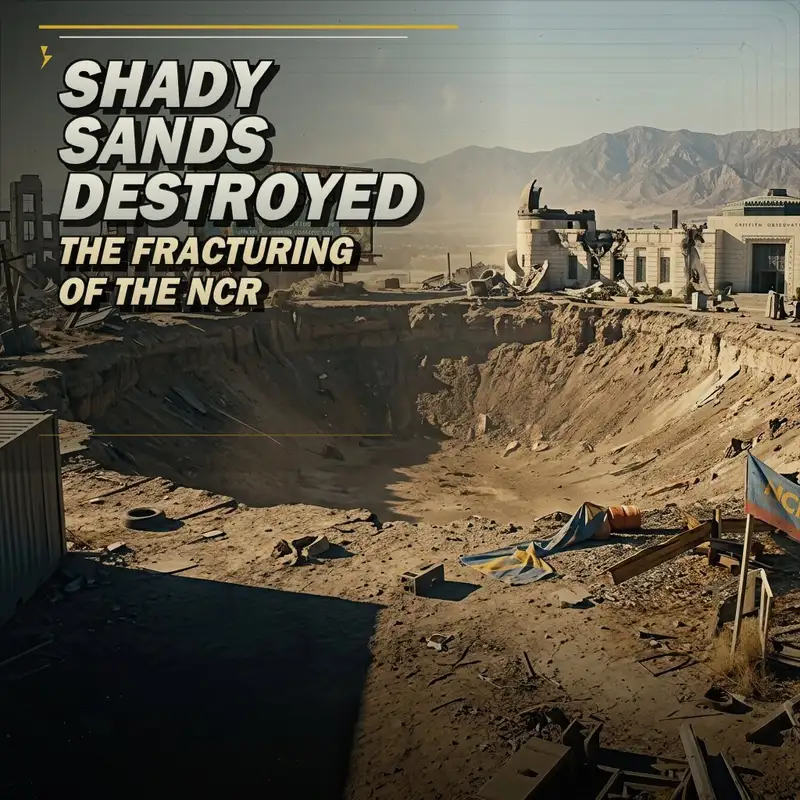
Shady Sands Destroyed: The Fracturing of the NCR
By the year twenty-two ninety-six, Shady Sands is not a capital city. It is a crater, a field of ruins marked by radiation and memory. For Maximus, it is the place where childhood ended beneath a nuclear flash. For the people who survived it, Shady Sands is also evidence that the New California Republic could be wounded in a way that no battlefield defeat had managed. A state can lose soldiers, forts, roads, and even territory. It can often replace them. Losing a capital is different. A destroyed capital raises practical questions before it raises philosophical ones. Who can issue orders? Who can confirm that an official still holds office? Who keeps the records of property, law, citizenship, debts, military postings, and supply contracts? Who tells distant units whether the republic still exists, and why should anyone believe them? Shady Sands was not the whole NCR. But it was the place where the NCR had learned to describe itself as a nation rather than a collection of defended settlements.
That distinction matters because the destruction of Shady Sands is often described as the end of the New California Republic. The available evidence does not support such a clean conclusion. The NCR survives in fragments. By the time the conflict around New Vegas reappears, NCR-associated forces are still capable of taking part in regional competition. Yet survival is not the same as recovery. A surviving patrol is not a functioning state. A surviving flag is not a legislature. A military unit with ammunition and a mission may still have no reliable source of pay, replacements, lawful orders, or civilian consent. The better question is not whether Shady Sands vanished. The question is what its loss did to the institutions that depended on it, and to the people who had expected the republic to provide a shared future.
Shady Sands began as one of the earliest and most important reconstruction communities in post-War California. In the year twenty-one sixty-one, it was still a small settlement in a dangerous landscape. Its people had connections to the survivors of Vault Fifteen, but they were not protected by a functioning national government, a regular army, or an intact economy. They had to create security and stability from local resources. That meant agriculture, water, shelter, practical medicine, trade, defense, and rules that could outlast a single armed family or charismatic leader.
The settlement mattered because it represented more than survival. Many communities could survive for a season, or even a generation, behind a wall and a few armed guards. Shady Sands developed the habits of continuity. It could make decisions collectively. It could enforce rules. It could produce food rather than live entirely from salvage. It could defend itself without becoming merely a raiding band with better fences. Those are not glamorous accomplishments. They are the slow work of making tomorrow predictable. In the Fallout world, predictable water matters more than a patriotic speech. A functioning harvest matters more than a recovered military uniform. A settlement that can settle disputes without shooting everyone involved has already done more to rebuild civilization than most pre-War corporations managed in their final years.
By the year twenty-two forty-one, Shady Sands had become something much larger. It was commonly known as NCR, the capital of the New California Republic. At that point, dialogue places its population at roughly three thousand people, a useful indication of its growth at that particular time, though not a reliable measure of its later size. More important than the number was the change in function. Shady Sands had become the seat of a republic with laws, elected institutions, law enforcement, commerce, and ambitions beyond its original valley. The New California Republic was no longer only defending a town.
That transformation gave Shady Sands unusual political weight. It was a place where the NCR’s history could be told as a success story. The republic could point to it and say that the bombs had not ended public life. The old world had destroyed itself through resource panic, militarization, corporate power, and national vanity. Shady Sands, by contrast, appeared to offer a different model. The claim was never as simple or as innocent as the propaganda suggested. The NCR would develop inequality, corruption, frontier resentment, and expansionist habits of its own. But the existence of Shady Sands gave the republic a physical demonstration of its promise. It was proof that a community could become a city, and that a city could become the center of a state.
A capital does not need to control every field, outpost, or caravan route to matter. Its importance often lies in concentration. In the NCR’s case, Shady Sands was associated with Congress, national political decision-making, and the civilian institutions that distinguished the republic from a temporary military coalition. The Army and Rangers could hold a road, patrol a frontier, or fight a battle. They could not by themselves establish who had the lawful authority to levy taxes, recognize property, negotiate agreements, commission officers, or decide where national resources would go next.
In a post-nuclear society, this administrative role was even more fragile than it would have been before the Great War. Communications existed, but they were uneven. Radios could link some outposts and settlements, yet range, maintenance, interception, damaged infrastructure, and local power supplies all imposed limits. Couriers remained important. Roads remained dangerous. Mountain passes, deserts, hostile territory, raider activity, weather, and old-world ruins could delay both people and information. A message from the capital was not an instant electronic fact shared by every soldier, merchant, and citizen. It was something that had to travel, be authenticated, and be trusted.
That meant the destruction of Shady Sands would create confusion far beyond the blast zone. A distant NCR officer might hear rumors before receiving verified orders. A local official might not know whether taxes should still be collected, where supplies should be sent, or who had authority to approve an emergency decision. Merchants might hold goods rather than risk sending them toward a government whose institutions appeared uncertain. Communities dependent on NCR patrols could begin making their own security arrangements. None of that requires every person to renounce the republic. The first casualty of a decapitation strike is often not territory.
By the year twenty-two eighty-one, the New California Republic was undeniably a major power in the western wasteland. It possessed an elected government, a bureaucracy, currency, trade networks, an Army, Rangers, and the ability to project influence far beyond its original core. It could recruit, equip, and move forces over long distances. It could make claims about law and citizenship that smaller settlements could not easily match. It had farms, workshops, merchants, officials, and civilians whose livelihoods were tied to the continued functioning of the republic. Whatever its flaws, the NCR was not an empty slogan painted on a rusted sign.
Its power, however, came with obligations. A growing republic had to defend routes, protect settlements, collect revenue, resolve disputes, maintain infrastructure, and persuade frontier communities that its laws were worth obeying. It had to supply soldiers and replace losses. Expansion can make a state stronger. It can also create a permanent bill that the state lacks the capacity to pay.
The Mojave campaign revealed this problem with unusual clarity. The NCR had powerful reasons to care about Hoover Dam and the region around New Vegas. Control of it could strengthen the republic’s economic future and deny vital infrastructure to rivals. The Mojave also sat at the edge of NCR influence, where military expansion, trade, settlement, and competition with other powers met. No serious state would regard such a place as unimportant.
But the campaign was expensive. Supplying troops across difficult territory required food, ammunition, medical support, repair capacity, transport, intelligence, and dependable command. The NCR had these capabilities in some measure, but not without strain. Rangers, regular Army formations, civilian contractors, merchants, settlers, and officials did not all experience the campaign in the same way. For a frontier soldier, it could be an under-supplied post far from home. For local communities, the NCR could appear as protection, taxation, bureaucracy, occupation, opportunity, or some mixture of all four.
The republic also carried the consequences of earlier conflict with the Brotherhood of Steel and other regional rivals. Its resources were not unlimited. Its institutions could be durable in one area and weak in another. A state may have enough strength to win individual engagements while lacking enough administrative depth to govern every place it claims. The NCR’s difficulties did not prove it was doomed. But they did make the loss of a capital more dangerous. A confident, centralized government can absorb bad news. A government already stretched across contested frontiers may find that one catastrophe turns routine strain into systemic crisis.
This is where the chronology requires care. A classroom timeline seen in the year twenty-two ninety-six lists the fall of Shady Sands in the year twenty-two seventy-seven. Taken alone, that wording might appear to place the city’s destruction before the events of the Mojave campaign. Later clarification makes that interpretation untenable. The nuclear destruction occurred after the events of Fallout: New Vegas. The phrase “the fall of Shady Sands” should therefore be treated as a broader decline, a political crisis, or a separate event whose full meaning has not been explained. It should not be treated as the date of the bomb.
The exact date of the nuclear attack remains less certain than many retellings suggest. Material connected to the first season provides an approximate inference that places the bombing around the year twenty-two eighty-three. That is useful for orientation, but it is not the same as a precise public date established in dialogue. Shady Sands remained associated with the NCR capital after the Mojave crisis of twenty-two eighty-one. Something had already gone wrong, or was going wrong, when people began speaking of its fall. But the destruction that turned the city into a crater came later.
There are tempting ways to fill the gap, and most of them go beyond the evidence. It is possible to imagine a formal relocation of the capital, an evacuation, a constitutional collapse, or a quiet transfer of power before the blast. None of those possibilities has been established clearly enough to become history. A sign referring to Shady Sands as the first capital may imply political change, but it does not explain when that change occurred, whether it was complete, or what institution replaced it. The absence of a complete answer is part of the story. Fragmented states often leave fragmented records. The people who survive may remember the event more clearly than the paperwork that once explained it.
Whatever the preceding decline involved, Shady Sands was not an abandoned shell when it was destroyed. Later scenes show a living city with civilians, NCR security personnel, infrastructure, and practical work underway to improve its future. It was not merely a monument to an earlier republic. People were raising children there. Workers were maintaining systems. Residents expected water to move through pipes, goods to arrive, and public authority to remain meaningful. Even in a world accustomed to ruins, a functioning urban center carries a different kind of value. It contains skills, routines, relationships, workshops, schools, archives, and the accumulated knowledge of people who have learned how to make difficult systems work.
Water is especially revealing. Clean water is not simply a utility. It is public health, agriculture, sanitation, trade, and population stability. A water project requires technical knowledge, labor, tools, pipes, pumps, security, and some authority capable of deciding that the work should continue after immediate emergencies pass. People must believe that contributing labor or accepting regulations will produce a benefit that lasts. That is what a reconstruction society looks like when it is functioning. Not perfection. Not luxury. A system in which ordinary people can invest in tomorrow because they expect tomorrow to arrive.
The destruction of Shady Sands therefore eliminated more than buildings and political symbols. It destroyed a civilian environment that had taken generations to build. The dead included people who had never held office, carried a rifle, or made a national decision. Children, workers, families, technicians, farmers, traders, and residents were caught in an attack directed at a populated city. Survivors faced radiation, displacement, grief, and the loss of the social networks that make recovery possible. A person can flee a blast zone with a weapon or a bag of supplies. They cannot carry an entire water system, municipal archive, neighborhood, or family history across the wasteland.
For Maximus, the event remains a personal trauma. A nuclear strike against a city is not a private tragedy enlarged by coincidence. The blast did not merely remove an obstacle from someone’s path. It remade the lives of people who had no role in the conflict that produced it. Its effects continued in refugee communities, in survivor anger, in the distrust of distant authority, and in the knowledge that the place held up as proof of reconstruction could be erased by someone who believed reconstruction itself was the threat.
That someone was Hank MacLean. The first season establishes that Hank caused or ordered the destruction of Shady Sands after Rose MacLean left Vault Thirty-Three and built a life on the surface. Rose had encountered a civilization that contradicted the assumptions of the Vault-Tec world. The surface was not simply a barren graveyard awaiting proper management. For Hank, that discovery became intolerable.
Hank’s responsibility should not be simplified into the story of one angry husband acting alone. His decision came from a larger ideology. Vault-Tec’s continuity project was built around the idea that survival should be managed from above, through controlled populations, sealed environments, corporate authority, and carefully limited choices. It presented itself as civil defense, but its deeper logic treated human beings as subjects in a controlled experiment and the future as a market to be owned. Independent surface civilization was dangerous to that logic because it proved that people could build a future outside the company’s command structure.
The exact chain of authorization behind the attack remains incomplete. The evidence does not establish the delivery system, the weapon’s origin, the full role of any corporate council, or the precise extent to which other Vault-Tec figures knew what Hank intended. A historian should not manufacture a boardroom order merely because the broader organization had monstrous ambitions. But uncertainty about the chain of command does not erase responsibility for the act.
That is the essential crime of the bombing. It was not an attack on a military bunker isolated from the population. It was not a battlefield strike against an advancing army. It destroyed a city because the city represented an alternative to Vault-Tec’s controlled future. The target was not only the people living there, though they paid the immediate price.
From a strategic perspective, the attack was a decapitation strike. But it was not clean conquest. Decapitation can remove leadership, disrupt communications, destroy records, and terrify a population. It does not automatically create a replacement government. It can leave a state less capable of coordinating itself without making the attacker capable of governing the ruins. Vault-Tec’s project was built for control through enclosure and secrecy, not for administering the millions of practical problems created when a major surface society is shattered. Destroying Shady Sands could weaken the NCR. It could not, by itself, make the survivors obedient.
The immediate institutional consequences would have been severe even without a complete public record. The capital’s destruction likely removed officials, archives, offices, communications equipment, financial connections, procurement arrangements, and the people who understood how different parts of the state fit together. A military command may have lists of units and supply depots. A civil bureaucracy holds different knowledge: land claims, court decisions, taxation systems, trade agreements, licenses, censuses, infrastructure plans, and the accumulated correspondence that prevents government from becoming permanent improvisation. When such records vanish, authority becomes harder to prove and easier to imitate.
The intelligence problem would have been equally serious. In the first days and weeks after a catastrophe, information travels unevenly. Rumors move faster than verified orders. Some reports are false. Others are true but incomplete. A local commander may receive a message claiming that the government has fallen, another claiming that a successor has taken power, and a third ordering troops to remain in place. How does that commander authenticate any of them? Who controls the radio relays? Who has access to official codes? Who can prove that an order was issued before the capital was destroyed rather than afterward by someone seeking control?
The same uncertainty affects civilians. A caravan master deciding whether to cross dangerous ground needs to know which roads are protected and which authorities will honor a contract. A farmer deciding whether to sell grain needs confidence that payment will arrive and that armed requisition will not replace law. A town that once relied on NCR rangers may decide to strengthen its own militia, negotiate with a neighboring power, or close itself to outsiders. Such choices may be sensible. They may even be necessary.
Soldiers also require more than courage and rifles. They need food, water, medical care, ammunition, repairs, replacement parts, officers with recognized authority, and a reason to believe that their sacrifice serves a continuing institution. An NCR formation far from Shady Sands might remain disciplined and capable for some time. It might have local stores, experienced leaders, and strong ties to nearby communities. But its long-term position would depend on networks that the capital had helped coordinate. A patrol can survive without a capital for a while. An army cannot remain a national army indefinitely if nobody can reliably define the nation it serves.
For that reason, fracture is a more accurate term than instant extinction. The NCR could survive in many pieces at once. Local officials might continue enforcing NCR law because it remained familiar and useful. Army units might retain their insignia, traditions, and chains of command where those chains still functioned. Rangers might continue their work because threats to roads and settlements did not disappear when the capital did. Refugees might preserve NCR identity precisely because they had lost the place that embodied it. Yet these different forms of continuity could diverge. They could compete for resources, disagree about legitimacy, or adopt different priorities based on local circumstances.
A fractured republic is not necessarily an anarchic wasteland. One region may preserve a military command. Another may preserve civil administration. A third may survive through trade networks and local councils. The danger is that no single institution can coordinate the whole. When a crisis arises, everyone may claim to act in the republic’s name while nobody possesses the capacity to speak for all of its people.
This loss of common authority would be especially damaging in frontier areas. The NCR’s distant communities had already been asked to accept taxation, regulation, military recruitment, and political decisions made far away. Those demands are easier to sustain when the state can provide security, infrastructure, courts, trade, and a credible future. They become harder to justify when the capital itself has been annihilated. A frontier settlement may ask a brutal but reasonable question: if the republic could not protect Shady Sands, what exactly is it offering us now?
The answer would differ from place to place. Some people might see the NCR as a failed promise. Some local authorities might use the crisis to establish greater independence. Some commanders might claim emergency powers in the name of continuity. Some communities might reject all external authority after watching the most developed city in the region become a radioactive grave. None of these responses need be treated as inevitable. They are the predictable pressures created when a centralized state loses the place that made its authority visible.
Lee Moldaver’s movement demonstrates both the endurance and the limits of NCR political memory. Moldaver is not simply a figure seeking revenge against Hank MacLean. She is a political opponent of Vault-Tec’s ideology and a leader among the people connected to Shady Sands. Her project at Griffith Observatory links the memory of the NCR to a practical reconstruction goal: cold fusion. In a region damaged by scarcity, instability, and the uneven survival of old-world technology, abundant energy appears to offer more than comfort. It offers the possibility of water systems, workshops, communications, medicine, transport, and productive civilian life.
But energy alone does not rebuild a republic. A functioning power source requires technicians, maintenance, security, distribution networks, agreements over access, and institutions capable of preventing the strongest armed group from taking everything for itself. Cold fusion could become a public utility, a military asset, a source of trade, or the foundation of another hierarchy. Moldaver’s project mattered because it attempted to join technological recovery to a civic vision.
The Griffith Observatory group had enough organization to defend its position and pursue that objective. It was not a random gathering of survivors. Yet it was also not evidence that the entire NCR government had reconstituted itself there. The group represented a regional remnant, shaped by the specific trauma of Shady Sands and dependent on exceptional leadership, scarce technology, and a defensible site. Its existence shows that NCR identity survived outside the capital.
The Brotherhood of Steel’s assault on the Observatory is strategically significant for that reason. The Brotherhood benefited from a fragmented California in which no unified NCR could easily challenge its position. But the Brotherhood did not destroy Shady Sands. The bombing occurred earlier, and the responsibility for it lies with Hank MacLean. Treating the Brotherhood’s later attack as the cause of the NCR’s collapse confuses two different events. One shattered the republic’s central city. The other helped eliminate a surviving regional effort to turn that catastrophe into a new beginning.
The Observatory’s fall also illustrates the brutal arithmetic of post-War state formation. A movement can possess a compelling idea, committed followers, and valuable technology, then still fail because it lacks strategic depth. The wasteland rewards organizations that can hold a building. It rewards states that can hold a system.
Season Two makes clear that the NCR’s story does not end in the ruins around Los Angeles. Surviving NCR personnel continue to appear in the Mojave, and NCR involvement remains part of the struggle around New Vegas. This matters because it rules out the simplest version of the story: that one nuclear blast made every NCR soldier, official, and settlement disappear. The republic’s institutions had grown too large and too geographically dispersed for that. There were people carrying NCR authority, experience, equipment, and loyalties beyond the reach of Shady Sands even before the bombing.
The Mojave is also precisely where the republic’s fractured condition becomes strategically dangerous. Control of the area has never been only about holding a casino district or a dam. It is about who can influence movement across the region, who can draw revenue from trade, who can protect or threaten settlements, and who can claim to offer order where other governments have faltered. A weakened NCR cannot simply ignore such a theater. But committing forces there may deepen the very strain that made the loss of Shady Sands so devastating.
The renewed competition includes NCR-associated forces, Caesar’s Legion, and the forces connected to Robert House. Their presence should not be used to declare a canonical outcome to the earlier Mojave conflict. The survival of House does not prove one particular Courier decision. The continued existence of the Legion does not prove that it won every earlier contest. NCR forces in the region do not establish that the republic restored its old authority.
For the NCR, military activity in the Mojave is evidence of survival, not proof of recovery. A regional force can fight effectively while the larger government remains divided. Commanders may retain professional traditions long after the civilian system that appointed them has been damaged. Soldiers may defend a route because their community depends on it, because their officers remain loyal, or because no better alternative exists. These are meaningful forms of continuity. They are not substitutes for a functioning national center capable of reconciling regional interests, sustaining logistics, and making decisions that people across the republic recognize as lawful.
The destruction of Shady Sands changed the NCR at several levels at once. Tactically, it destroyed a populated city. It killed people, ruined infrastructure, and contaminated the ground. Strategically, it weakened the NCR’s capacity to manage expansion, sustain distant commitments, and deter rivals who could now see a divided opponent. The republic had lost the place most closely associated with its claim to represent a shared civic order.
Institutionally, the bombing damaged more than leadership. Governments depend on records, procedures, offices, trained personnel, and the boring machinery that allows people who do not know one another to cooperate across distance. When that machinery is destroyed, charismatic figures and armed groups often become more important because they are visible and immediate. But visible authority is not always legitimate authority, and immediate authority is not always durable. The NCR’s fragments could preserve parts of the old system, but each fragment faced pressure to become something more local, more militarized, or more dependent on whoever could provide security.
For civilians, the loss was even more direct. The destruction of a capital is often discussed in terms of leaders and strategy because those are the parts of history with surviving records. The people of Shady Sands experienced it as death, separation, illness, displacement, and the disappearance of a place where they had expected to live ordinary lives. A city is also schools, work, friendships, family routines, neighborhoods, and the confidence that a child might grow up knowing more than their parents did. Hank MacLean’s strike destroyed that confidence along with the city.
Much remains unknown. The full extent of surviving NCR territory is not established. Neither is the shape of any post-bomb national government, the precise relationship between different military remnants, or the degree to which local authorities still recognize a common chain of command. The available record does not support a neat map with clean borders and a single successor capital.
Shady Sands did not vanish because it had been weak. It vanished because it had become important enough to symbolize a future that Vault-Tec’s ideology could not tolerate. Its destruction did not automatically erase the New California Republic. It destroyed the city that concentrated the republic’s civic memory, administrative authority, and claim to a shared future. Because the NCR was already managing distant commitments and uneven regional confidence, the loss transformed a major state into a fractured political landscape of surviving forces, local authorities, refugees, and competing claims of continuity. The NCR lived on, but no longer as a republic whose center could reliably speak for all the people carrying its name.