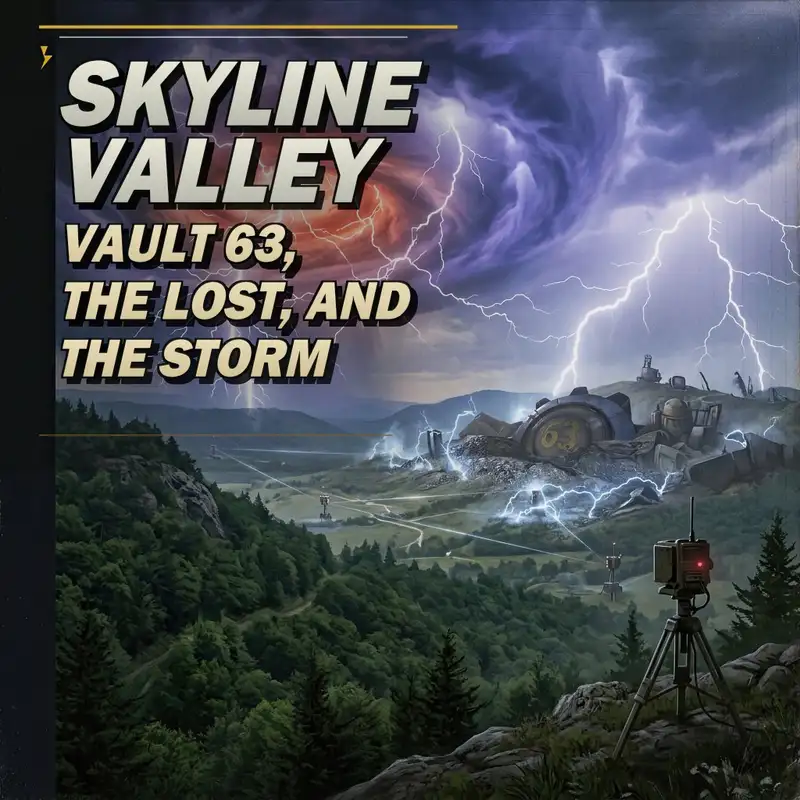
Skyline Valley: Vault 63, the Lost, and the Storm
Around the year twenty-one oh five, deep beneath the ruined remains of Shenandoah National Park, Hugo Stolz made the same decision he had made before. He turned the weather machine on again. His wife Cassidy remained comatose. The condition he had hoped to reverse had not yielded to his earlier experiment. Yet Hugo did not read that failure as a warning. He believed that he had reached her somehow, that the strange connection he sensed was proof that the machine was beginning to work.
Above him, Skyline Valley answered with thunder.
Electrical disturbance spread across the region. The ground itself became unstable. Routes through and around Vault Sixty-Three were damaged or cut off. Altered residents escaped the containment of the Vault and emerged into the valley, changed by an experiment that had already gone far beyond treatment. The Lost became a danger to anyone moving through the storm, but they were also evidence. They were the visible result of a shelter that had failed its residents, a research program that had confused damage with progress, and a ruler who could no longer tell the difference between saving people and controlling them.
That is the real history beneath Skyline Valley’s strange weather. The storm is not merely a regional hazard, and the Lost are not simply another hostile population produced by the post-War world. Both lead back to Vault Sixty-Three. Both lead back to Hugo Stolz. And both expose a familiar Fallout problem. An institution built to manage catastrophe became dangerous when the people running it refused to accept limits on their authority, their knowledge, or their right to experiment on those who depended on them.
To understand why Hugo could make such a decision, it is necessary to begin before the Great War, when Vault Sixty-Three was not yet a damaged underground refuge. It was a project shaped by private wealth, political influence, and the assumption that protection could be purchased, directed, and distributed from above.
Hugo Stolz was not simply an Overseer who happened to inherit an unusual facility. He was a wealthy businessman, the head of Stolz Enterprises, and a member of Vault-Tec’s board. Those positions gave him influence over land, construction, access, and expectations. In the Shenandoah region, his power was rooted in more than technology. It rested on property and on a promise that was increasingly valuable as the world moved toward war. Stolz could offer local people a future inside the Vault, or at least the hope of one.
The precise legal arrangements behind Stolz Enterprises’ acquisition of local land are not entirely clear. The surviving accounts do not provide a neat case file with every contract, payment, and signature intact. What they do show is a pattern. Hugo Stolz and his family used the approach of nuclear crisis to pressure, persuade, and reassure people whose bargaining position was far weaker than their own. Local residents were offered informal promises of protection and access. Some accepted a handshake arrangement rather than a formal agreement. In a stable society, that might still have been reckless. In a society preparing for nuclear war, it was a profound imbalance of power.
The people of Shenandoah had reason to fear exclusion. Vault access was not merely a housing decision. It was a decision about who might survive the end of the world. A corporation or wealthy family that controlled access to a shelter could exercise authority that looked almost governmental. It could decide whose labor mattered, whose property could be acquired, whose concerns could be deferred, and whose future remained negotiable. The language of civil defense made that authority sound benevolent. The practical effect was more selective. Protection became a privilege administered by people who had already accumulated wealth and influence.
When the bombs fell on October twenty-third, twenty seventy-seven, Vault Sixty-Three was not ready. Construction had not been completed. Its systems were unfinished, its protective integrity was compromised, and the boundary between the Vault and the radioactive world outside was not secure. The facility had been designed on an ambitious scale, with scientific, engineering, security, meteorological, and biological functions. It was supposed to be an advanced refuge, perhaps even a research center capable of carrying knowledge through the catastrophe. Instead, its incompleteness turned survival into an improvised emergency.
Radioactive contamination entered the Vault. The residents survived the initial nuclear exchange, but survival did not mean safety. Over time, many became ghouls. Their condition was not the clean outcome of a fully controlled Vault-Tec experiment, at least not on the available evidence. Vault Sixty-Three should not be reduced to a single confirmed experimental design with one tidy purpose. Its disaster was messier than that. A shelter failed to provide the protection it had promised. The people inside endured exposure they had not meaningfully chosen. They became survivors of institutional failure, and then, as their conditions worsened, subjects of the research that followed.
The people exposed inside Vault Sixty-Three therefore faced a double confinement. They were physically enclosed by the damaged shelter and politically enclosed by the people who controlled its laboratories, security systems, and access to information. The Vault was not simply a home after the bombs. It became a medical crisis zone with a hierarchy attached.
As the years passed, the immediate challenge was no longer just radiation exposure. It was deterioration, fear, and the threat of feralization. Fallout has never provided one universal explanation for how every ghoul changes over time. Conditions differ by region, origin, individual biology, and the uneven limits of surviving knowledge. Vault Sixty-Three does not resolve that larger question. It presents one afflicted population confronting the possibility that its members might lose memory, judgment, or the ability to remain part of their community.
For Hugo Stolz, that general crisis became intensely personal through Cassidy. Her worsening condition transformed the problem from an institutional responsibility into an obsession. A husband’s fear is understandable. Watching someone decline while possessing advanced facilities and no certain cure would test almost anyone. But personal grief did not give Hugo a reliable scientific method. Nor did it authorize him to turn every afflicted resident into part of an escalating experiment.
Vault Sixty-Three had people capable of offering alternatives. Audrey Stolz, Hugo’s daughter, led work connected to the meteorological side of the facility. Hilda Stolz, his niece, worked in the organics sector and studied the biological condition of the Lost and the wider problem of ghoul deterioration. Chief James Oberlin represented another kind of competence. He was responsible for security and invoked a continuing connection to military authority and order. Each of them understood part of the crisis. Audrey understood the machinery and the danger inherent in its use. Hilda sought medical understanding rather than domination. Oberlin focused on containment, reporting, and continuity of command.
But expertise and authority were not the same thing. Hugo remained the person with the greatest practical access to the system that mattered most. He had the family position, the Overseer’s power, the institutional prestige, and the confidence of someone accustomed to treating access as proof of entitlement. The Vault contained technical specialists, security personnel, and surviving residents. It did not contain an effective system for restraining the man who controlled the decisive infrastructure.
That distinction became critical when Hugo turned toward the weather machine.
The machine was not a portable weapon that could be carried into the valley and switched on at will. It was part of a larger complex of facilities, research systems, power demands, specialized knowledge, and damaged access routes. It appears to have been connected to ambitious pre-War ideas about atmospheric control and pacification. Hugo also linked it to military interests and the ATLAS system. Those claims should be treated carefully. They tell us something about the project’s intended importance and about Hugo’s own view of it. They do not provide a complete, neutral account of every original purpose behind the machine.
What matters is that the system could alter the environment in ways that were powerful, difficult to predict, and impossible for Vault Sixty-Three to govern safely. It was a large technical apparatus embedded in an unfinished shelter. It depended on personnel, repairs, surviving components, power, and access to parts of the surrounding region. It was not an answer to every problem merely because it was impressive.
Around the year twenty ninety-five, Hugo activated it for the first time in an effort to help Cassidy. The result appeared to offer him exactly the kind of evidence he wanted. Exposure connected to the machine seemed to interrupt, suppress, or alter the process of feralization. It suggested that a condition believed to be irreversible might be managed through controlled energy and environmental intervention.
But what emerged was not a cure.
The first activation created the earliest Lost. These were ghouls altered by the machine’s effects, electrically charged and profoundly disturbed in body and mind. Their condition was not a normal stage of ghoulification, and Skyline Valley should not be used to explain every ghoul elsewhere in Appalachia or the wider wasteland. The mechanism remains uncertain. The available evidence does not establish a precise neurological model, a radiation dose, or a clean medical pathway from exposure to transformation. What it establishes is consequence. The machine changed people. It did not restore them to their former state.
Hugo himself was changed as well. Unlike many of the Lost, he retained functional awareness and developed unusual sensory abilities. To him, this was proof that the machine had opened a path forward. He had survived the exposure. He could perceive and influence conditions in ways he had not before. Cassidy’s condition, and perhaps his apparent connection to her, gave him reason to believe he had found a means to reach people slipping beyond ordinary communication.
Rather than treating those outcomes as a warning, Hugo chose escalation.
The critical mistake was to treat influence as treatment. A person whose behavior can be altered is not necessarily healed. A population that can be calmed, redirected, or temporarily suppressed is not necessarily safe. The difference is not academic. Treatment asks what will restore a person’s health, dignity, and agency. Control asks what will make that person manageable. Hugo increasingly chose the second question because it offered him the illusion of a solution.
Vault Sixty-Three’s command structure made that illusion difficult to challenge. On paper, the facility had multiple centers of authority. Hugo held the position and influence of an Overseer. Audrey directed technical work related to the meteorological system. Hilda pursued biological research. Oberlin held responsibility for security and looked toward military reporting channels as a source of legitimacy and outside oversight.
In practice, Hugo controlled the flow of information. Oberlin could prepare reports, invoke protocol, and seek help from a larger chain of command. Yet a report is only useful if it reaches someone independent enough to act on it. Hugo’s interference with those channels turned formal authority into a kind of theater. Oberlin could claim responsibility for protecting the Vault, but he lacked secure communications and the ability to ensure that his warnings traveled beyond Hugo’s reach.
The surviving records and testimony must be handled with caution. Hugo had reason to justify himself. Oberlin had reason to emphasize the collapse of proper authority. Audrey and Hilda saw the crisis through their own professional and family loyalties. Other accounts were damaged, partial, or shaped by fear. But the broad pattern is difficult to miss. Hugo used the Vault’s structure to protect his own access to the weather machine while limiting the ability of others to stop him.
By around twenty-one oh five, that failure had become regional.
Cassidy remained comatose. The machine had not produced the recovery Hugo had sought. Yet he believed he had established a usable mental connection with her. Whether that connection was real in the full sense Hugo imagined is less important than the decision it enabled. He treated it as proof that another activation was justified.
The second activation intensified the storm over Skyline Valley. Electrical disruption spread outward. Geological disturbance damaged access routes and contributed to the collapse or disruption of parts of the Vault’s approaches. The Lost, no longer contained within the institution that had created them, escaped into the surrounding valley.
On the ground, containment failed. A population already altered by the first experiment could now move through a hazardous and unstable landscape. Across the wider campaign, the Vault’s damaged routes, difficult terrain, and dangerous weather made movement, communication, repair, and security more difficult. The problem was no longer confined to laboratories and controlled sectors below ground. It affected anyone attempting to travel through Skyline Valley, maintain a settlement, recover equipment, or understand what had happened.
In the larger struggle, Hugo transformed a local medical emergency into a regional crisis. The storm affected more than weather. It disrupted the ordinary conditions under which people can live together. Roads and paths matter in post-War Appalachia. They connect settlements to trade, scavenging sites, water, shelter, and one another. When movement becomes dangerous, communities become more isolated. Isolation makes medical care harder, weakens commerce, complicates defense, and gives fear room to become its own political force.
The second activation also exposed the weakness of Hugo’s reasoning. A responsible experiment measures results against its stated purpose. If the objective was to cure Cassidy or prevent feralization, then her continued coma and the growing number of altered residents should have counted as evidence of failure. Hugo instead treated each destructive outcome as a technical milestone. The storm grew stronger, so the machine was more powerful. The Lost reacted, so they might be controllable. He sensed Cassidy, so she might be reachable. Every warning became proof that he needed more power and more authority.
The Lost are the human record of that escalation. They are dangerous. Any settlement, patrol, or traveler encountering electrically altered ghouls in a storm zone has reason to fear them. Their condition threatens lives. But treating them only as monsters repeats the moral failure that created them. They were once residents of Vault Sixty-Three, people caught first by an unfinished shelter and then by a program that made their suffering part of a technical project.
Not every Lost appears to retain the same awareness, motive, or capacity. The evidence does not support a simple claim that they are all secretly unchanged people waiting to be restored, nor does it justify treating them as a uniform enemy force. Their transformation has fractured the ordinary categories through which a community understands membership, danger, and care. Some may be unreachable. Some may respond to stimuli or influence in ways others do not. The exact boundaries are uncertain.
What is clear is that they did not meaningfully consent to becoming proof of Hugo Stolz’s theory. Their existence forced Vault Sixty-Three to confront a question it was poorly prepared to answer. What obligation does a community have to people who have become dangerous through the community’s own failures? Is containment protection, punishment, or abandonment? Is behavioral influence a form of care if it strips away what remains of autonomy? Can a technical solution be called humanitarian when the people subjected to it had no real ability to refuse?
The storm made those questions impossible to keep underground. Its regional effects were not measured only in electrical strikes or damaged facilities. The cost also fell on people who could no longer travel safely, maintain routes, reach shelter, or rely on the valley’s familiar geography. A storm zone does not have to destroy every building to change civilian life. It can make a road unreliable. It can turn a routine supply trip into a risk. It can isolate a small community from information and trade. It can make every unfamiliar sound outside a wall seem like the approach of something altered and hostile.
Skyline Valley therefore became a forensic landscape. Its hazards pointed back toward the Vault, but the damage spread beyond the Vault’s original residents. Hugo had created a crisis in a space he controlled, then pushed its consequences outward onto people who had never accepted his authority.
That wider political history mattered to Alex Guerra and the people aligned with her. Alex’s faction emerged in the environment of Mothman-associated belief and ritual, but it should not be dismissed as a simple religious mob or treated as a conventional army. It was better understood as a loose coalition of aggrieved local people, displaced residents, infiltrators, and individuals committed to revenge against Hugo Stolz.
Their grievances reached back before the storm and before the Lost. The history of Stolz Enterprises in Shenandoah included pressure on local communities, promises of protection, and the unequal transfer of land and expectation. From Alex’s perspective, Hugo had not merely failed as an Overseer after the Great War. He had exploited people before it. He had taken homes, claimed authority over a region, and then failed to honor the assurances that helped establish that authority.
The group around Alex did not possess the structure of a modern military force. It had no clearly established order of battle, no reliable industrial base, and no evidence of a unified command system comparable to the Vault’s formal hierarchy. But insurgent and resistance movements do not require those things to matter. They can draw strength from local knowledge, memory, concealment, anger, and the ability to identify an enemy who has made himself politically vulnerable.
Alex’s movement had an intelligence advantage of a kind Hugo never fully understood. Its members knew that the Vault’s crisis was rooted in a longer history of dispossession. They did not see Hugo as a tragic scientist struggling to save his wife. They saw him as a powerful man whose promises had repeatedly served his own interests. That interpretation may not capture every complexity of the Stolz family or every participant in the conflict, but it identifies a political truth. The storm did not create all the anger surrounding Vault Sixty-Three. It exposed anger that had been building for decades.
This does not make every act committed in the name of revenge justified. Grievance can explain violence without excusing it. A coalition built around anger can also become trapped by anger, unable to distinguish between accountability and destruction. But the resistance dimension of Skyline Valley matters because it prevents the story from becoming a closed family tragedy. Hugo, Cassidy, Audrey, Hilda, and Oberlin were not the only people affected by Vault Sixty-Three. The people outside the Vault had claims of their own, and they had been denied meaningful influence over decisions that now threatened the entire valley.
The external investigation begins when a Vault-Tec broadcast draws attention toward Vault Sixty-Three and the strange conditions in Skyline Valley. The outside investigator who follows that lead becomes important not because of a fixed identity or personal motive, but because an external actor can move between institutions that have ceased to trust one another. The investigation brings together evidence from damaged facilities, surviving records, family disputes, security failures, and the altered population moving through the storm.
What the investigation reveals is not a single secret hidden in one locked room. It reveals dependency. The weather machine requires components, technical expertise, functioning access routes, and labor. Even after two centuries of ruin, advanced systems do not maintain themselves because a console still has power. A required part may be located beyond the Vault’s immediate reach, in facilities connected to the old Shenandoah infrastructure. Recovering it depends on surviving paths, knowledge of where to look, and the ability to move through a hazardous region.
That logistical reality should have encouraged caution. If a machine is so difficult to maintain, so dependent on scarce components, and so dangerous when activated, then any responsible institution should ask whether it can operate the system safely over time. Vault Sixty-Three could activate the weather machine. That did not mean it could govern the consequences. It could repair parts of the system. That did not mean it had a plan for the people altered by its earlier use.
Within the Vault, the competing remedies become clearer. Hugo seeks renewed activation and stronger behavioral control. He increasingly believes that the Lost can be directed through him, perhaps even gathered into a form of collective order. Hilda searches for understanding, communication, and a genuine cure. Her approach accepts that the Lost are patients and persons before they are a security problem. Audrey, despite her technical involvement in the meteorological work, comes to recognize the scale of the danger in her father’s plan. She understands that a machine capable of altering an atmosphere can also magnify an existing disaster beyond anyone’s ability to contain it.
Oberlin represents yet another response. He wants security, reporting, and accountability through a surviving framework of military continuity. That framework is imperfect. The old United States military did not emerge from the Great War as a clean source of legitimacy. Its pre-War history was tied to militarization, secrecy, and the same political culture that allowed corporations like Vault-Tec to wield extraordinary influence. Still, Oberlin’s concern identifies something Hugo has rejected: decisions about the weather machine cannot remain a private family matter or an Overseer’s personal project.
None of these alternatives is simple. Hilda cannot promise a cure. Audrey cannot repair the machine without confronting the fact that repair may enable further misuse. Oberlin cannot invoke command authority without proving that an actual, independent command structure still exists. Alex’s followers cannot turn justified anger into stable governance merely by opposing Hugo. But uncertainty does not make every option equally dangerous. Hugo alone consistently treats incomplete knowledge as a reason to take greater risks with other people’s lives.
The confrontation at the Eye of the Storm brings those tensions together. Hugo attempts a third activation of the weather system. By this point, his objective has expanded beyond Cassidy. He no longer speaks only as a husband desperate to reach his wife or as an Overseer trying to protect a failing Vault. He believes that he can become a focal point for the Lost, shaping their collective behavior and imposing order on the very population his earlier actions helped create.
The machine’s third activation is a fixed part of the crisis. The storm, the damaged Vault, the Lost, and the conflict among the surviving authorities all converge around that decision. What follows, however, is not one settled historical ending. The available paths allow different outcomes for Hugo Stolz. He may be killed. He may be turned over to Oberlin’s custody. Or the final activation may be permitted. No single one of those choices should be presented as the universal conclusion to Skyline Valley’s story.
Each path reveals a different limit.
Killing Hugo can remove the immediate architect of the escalation. It can deny him another chance to use the weather machine and prevent his private obsession from continuing under his direct control. But it cannot undo the first two activations. It cannot restore the Lost by itself. It cannot repair the storm, reconstruct damaged routes, or resolve the grievances of people displaced by Stolz power before and after the War. Removing a leader can end an immediate threat. It does not automatically create a capable institution in the space he leaves behind.
Turning Hugo over to Oberlin offers a different answer. It places emphasis on custody, procedure, and the claim that the Vault’s crisis should be subject to rules beyond Hugo’s personal will. That has value. Accountability requires that powerful people be denied the ability to define their own innocence. But Oberlin’s authority is constrained by the very breakdown the crisis has exposed. His reporting channels were compromised. His security role existed within a system Hugo had dominated. Custody can restrain Hugo, but it does not by itself rebuild trustworthy command, independent investigation, or public legitimacy.
Allowing the final activation offers the most seductive outcome because it promises order. If Hugo can direct the Lost, perhaps they can be calmed. Perhaps the storm can be managed. Perhaps the terrible results of earlier experiments can be turned into a functioning system. Yet that option repeats the central logic that caused the disaster. It assumes that a population harmed by coercive experimentation can be made safe through more sophisticated coercion. It mistakes a capacity to influence behavior for a right to rule the people affected.
Even if that control produces short-term stability, it remains a poor substitute for care. A medical crisis is not solved because its victims become quiet. A security crisis is not solved because one man becomes more capable of directing those he helped transform. And a regional disaster is not resolved because the machine at its center has produced a more orderly pattern of harm.
Vault Sixty-Three failed on several levels at once. It failed medically because it confused suppression with treatment. Cassidy’s condition did not become a sound basis for an expanding experiment simply because Hugo wanted it to be. The Lost were not evidence that the machine had cured anyone. They were evidence that the intervention created new and grave harm.
It failed institutionally because authority was concentrated while dissent and reporting were weakened. Audrey, Hilda, and Oberlin each had knowledge Hugo needed. None had enough independent power to stop him before the crisis spread. The Vault had the appearance of a technical organization, complete with sectors, specialists, security roles, and procedures. But its real structure was personal. Hugo’s access mattered more than oversight. Family loyalty complicated professional judgment. Security depended on communications that could be manipulated. The institution functioned as long as its central figure chose restraint. He did not.
It failed politically because it treated the people around it as subjects rather than partners. The original residents of Shenandoah had been asked to trust a powerful family’s promises. Many appear to have received neither the protection nor the voice they were led to expect. Later, the Vault’s own residents became objects of research and control. The Lost bore the most visible cost, but local communities bore the wider consequences of a storm they had no role in authorizing.
It failed strategically because no weather machine, however powerful, could replace legitimacy. Hugo could alter an environment. He could influence conditions inside a damaged Vault. He might even affect the behavior of the Lost. None of that created a durable plan for safe habitation, medical recovery, accountable command, or reconciliation with the people his family had harmed. Technology amplified his reach, but it did not correct his assumptions.
Skyline Valley’s storm is the physical scar of Vault Sixty-Three’s experiment. The Lost are its human scar. But the deeper disaster began before the machine was activated. It began when Hugo Stolz converted a failed shelter into a private laboratory of authority, treated desperate people as variables to be managed, and mistook his ability to affect them for the right to govern them.