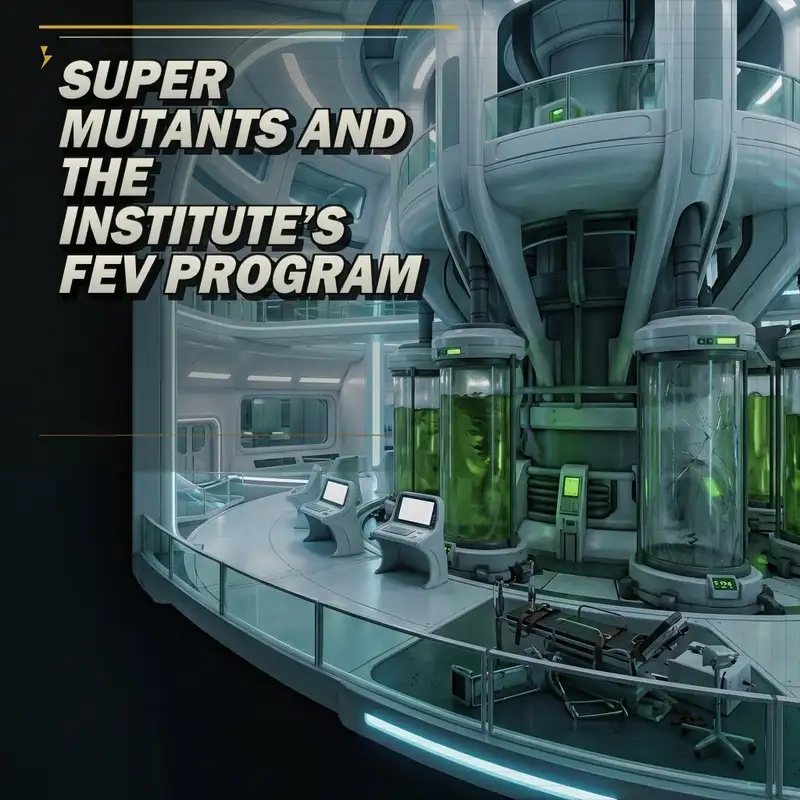
Super Mutants and the Institute’s FEV Program
In February of the year twenty-two eighty-seven, Doctor Brian Virgil reached a conclusion that should have ended a research program. For ten years, he believed, the Institute’s Forced Evolutionary Virus project had produced no useful results. The laboratory had not solved the problem it was supposed to solve. It had not opened a path toward a better form of human life. It had continued to consume subjects, equipment, labor, and secrecy. Its records reduced people to observations: physical growth, aggression, mental deterioration, death, termination, disposal. Virgil filed a formal complaint. The Institute’s director, known as Father, refused to close the program. That refusal set the final crisis in motion.
The contradiction was plain. The Institute presented itself as humanity’s future, a hidden society preserving science beneath a damaged Commonwealth. Yet one of its longest-running projects depended on abducting Commonwealth residents, exposing them to an experimental agent, and treating the survivors as laboratory waste. The Institute did not begin this program in order to build a conventional super mutant army. The evidence points instead to biological research tied to its search for synthetic humans. But intention does not erase consequence. Whether the mutants were designed as weapons or discarded as failures, they became part of the Commonwealth’s security problem. They attacked settlements, threatened travelers, and added another layer of fear to a region already divided by scarcity and distrust.
That is the central issue. Super mutants are not one unified people, one army, or one historical event. They are the result of different Forced Evolutionary Virus programs, carried out in different places, with different strains, aims, and consequences. The Commonwealth’s history is its own history. It is not a footnote to every other mutant population in North America.
Forced Evolutionary Virus, usually called F E V, is one of the most consequential scientific inheritances in Fallout’s world. Its name suggests a single, orderly technology. Its history is anything but orderly. Different strains and facilities produced different outcomes. The super mutants associated with the Master in California came from the Mariposa military base. The Capital Wasteland’s mutants were linked to Vault Eighty-Seven. Appalachia has its own history of West Tek experimentation and the Huntersville disaster.
The Institute’s super mutants belong to the Commonwealth’s post-War political history. They were created through a hidden research program conducted beneath the ruins of the Massachusetts Institute of Technology. They were not shown to operate under a stable Institute command structure. There is no solid evidence that the Institute fielded them as disciplined troops, supplied them as units, or directed their attacks as a conventional army would direct an operation. The available record supports something more disturbing and, in its own way, more revealing. The Institute created them in pursuit of another goal, failed to obtain the result it wanted, and allowed the resulting danger to spread outward into the Commonwealth.
That distinction does not make the Institute less responsible. A government or scientific institution does not escape the consequences of violence merely because it did not issue every later order. If it creates a threat, releases or abandons that threat, and then retains the means to understand what it has done, the absence of a formal command chain is not innocence. In the Commonwealth, the people facing mutant attacks did not need access to the Institute’s research notes to understand that something powerful and hostile was moving through their world.
The documented Institute program begins in August of the year twenty-one seventy-eight. At that point, the Great War had been over for a little more than a century. The Institute was already an established underground society with specialized labor, scientific infrastructure, internal leadership, and enough security to preserve projects that surface communities could neither see nor challenge. A researcher named Doctor Elliott reported to the Directorate that Doctor Frederick possessed F E V samples and that research had already received preliminary approval.
That report matters because it identifies institutional responsibility at the beginning. The virus was not a forgotten vial discovered by one reckless scientist in an abandoned room. The Directorate had pre-approved research. Senior authority had allowed the work to proceed. The Institute’s own scientists were not uniformly blind to the danger. But concern inside a bureaucracy is not the same as control over a bureaucracy. The project moved forward.
What the surviving records do not tell us is where Doctor Frederick acquired the original F E V samples. That absence matters. It would be easy to fill the gap with a theory about military stockpiles, corporate archives, or some forgotten pre-War transfer. But the source is not established. The Institute had the material. Its Directorate had approved research. Beyond that, the beginning remains incomplete. Historical discipline sometimes requires leaving an empty space empty, especially when the missing detail does not change the larger conclusion.
The larger conclusion is that the Institute possessed both the virus and the institutional capacity to use it. It had laboratories, containment systems, technical staff, records, power, medical equipment, and an underground environment protected from ordinary Commonwealth oversight. These were not trivial assets in a post-nuclear world. Most settlements had to devote their labor to food, water, security, repair, and trade. The Institute could sustain specialized research across generations. That capacity gave it extraordinary advantages. It also gave it extraordinary obligations, obligations its leadership chose not to recognize.
Once the Institute possessed F E V, the decisive requirement was human test subjects. The laboratory records make the result visible, even if they do not preserve every step of the process. Men and women from the Commonwealth were abducted. They were exposed to the virus, observed, classified, and recorded. The entries track physical and mental change. They note growth, aggression, cognitive deterioration, death, termination, and disposal. Some subjects are marked as discarded. The language is bureaucratic, clinical, and almost bloodless.
A person who has been taken from a settlement is not merely a research subject. That person may be a parent, trader, farmer, guard, laborer, friend, or someone whose absence rearranges the life of a small community. In an isolated settlement, one missing adult can mean less food planted, fewer hands on a wall, a lost caravan route, or a family left without protection. The Institute’s records do not usually preserve those connections. The laboratory saw biological material. The Commonwealth lost people.
The lack of names is part of the violence. The subjects were measured for useful traits and undesirable effects. Their consent was irrelevant. Their histories were irrelevant. Their futures were relevant only if they produced data. A society can become capable of remarkable technical achievement while narrowing its moral field until the people outside its walls appear only as raw material.
The Institute’s secrecy gave it an intelligence advantage. It knew the laboratory existed. It knew the subjects were being taken. It possessed internal reports, trained scientists, and secure communications. Commonwealth communities saw a very different picture. They saw disappearances, rumors, strange attacks, and the gradual accumulation of evidence that someone or something beneath the region was harming them. That gap in knowledge was strategically useful in the short term. But secrecy does not prevent consequences. It only determines who must live with uncertainty.
The Institute also had to acquire subjects somehow. The records establish abduction, but they do not document every route, team, method, or transport procedure. It would be wrong to invent a complete covert service from the gaps. A clandestine biological program requires a way to identify, seize, move, contain, and observe people. It requires security. It requires a chain of authorization, even if that chain is obscured. It requires personnel willing to perform work that cannot survive public scrutiny. The program was not an isolated scientific mistake.
The effects of that system did not remain underground for long. By the year twenty-one eighty, only two years after the program’s documented beginning, super mutants had become important enough in Commonwealth memory to be linked to the rise of the Minutemen. A loading-screen account states that the Minutemen first gained prominence after defending Diamond City from a super mutant attack. The game does not provide a full battle history. It does not give a precise number of attackers, casualties, defenders, or command decisions. But it establishes an important fact.
For Diamond City, the immediate issue was survival. A settlement cannot develop markets, public authority, or confidence in its own future if people believe armed attackers may descend on it without warning. A successful defense therefore had political value beyond the tactical result. It showed that organized local action could protect a major community. It gave the Minutemen a reputation as defenders. In a fractured region, that reputation could be as important as rifles or barricades. Security is not only the absence of attack. It is the belief that someone will respond when attack comes.
For the Institute, however, the attack was not necessarily a planned operation. That is the grim asymmetry at the center of the story. The Institute did not need to issue a formal order for super mutants to destabilize the surface. It only had to create or release beings whose behavior and survival imposed costs on everyone around them. Settlements had to organize watches. Traders had to consider safer routes. Farmers had to think about whether distant fields could be defended. Militias had to spend manpower on threats that no one could negotiate with or reliably predict.
The Commonwealth had no unified authority capable of investigating every disappearance or coordinating a regional response. But the Institute’s own actions also helped preserve that weakness. A population repeatedly forced into local defense has less capacity for cooperation, trade, infrastructure, and long-term politics. The super mutant problem did not single-handedly prevent Commonwealth unity. Raider violence, poverty, environmental danger, and factional rivalry all mattered. Yet the Institute’s program added pressure to every effort at reconstruction.
The strange feature of the program is how long it endured. The Institute possessed enough institutional continuity to maintain F E V research for more than a century. That requires more than a locked room and a few surviving machines. The Institute had preserved an impressive share of old-world technical capacity. It could sustain projects that would have been impossible for nearly any surface settlement.
But capacity is not wisdom. A laboratory can remain active long after its central question has stopped producing meaningful answers. A secret program can survive because no outside authority can inspect it, no victim can testify safely, and no ordinary citizen can demand to know why resources are being spent. Inside such a system, continuation can become its own justification. Research has been authorized. Personnel have been assigned. Equipment has been built. Records have accumulated. Closing the project may require an official admission that years of work produced suffering without success.
That is the logic of sunk cost, though in the Institute it was more than a budgeting problem. Every additional subject could be framed as one more chance at a breakthrough. Every bad result could be treated as an anomaly. Every objection could be delayed in the name of future utility. The records do not establish that every scientist shared the same motives. Some may have believed the research still mattered. Some may have followed orders. Some may have avoided asking what happened beyond the laboratory doors. But the institution as a whole continued to convert people into experiments.
By March of the year twenty-two twenty-four, the technical limitation had become explicit. Doctor Elliott reported that the two most promising F E V strains had been adapted to what he considered an ideal state. Yet the project had reached an impasse. Surface subjects carried too much radiation damage. That damage prevented the researchers from making the progress they wanted in synthetic-organics work. The problem, in other words, was not simply that the Institute had failed to produce better super mutants. Its deeper objective lay elsewhere.
The Institute was trying to solve a biological problem connected to the creation of synthetic humans. F E V research and the later Generation Three synth program were related because the Institute was searching for a viable basis for advanced synthetic organics. The virus was part of an effort to understand, alter, or overcome limits in human biological material. The surface population, shaped by generations in a radioactive and damaged world, did not meet the Institute’s requirements. The people being abducted were not viewed as citizens with rights. They were viewed as flawed inputs.
It is important not to confuse radiation and F E V. In the Institute’s records, radiation damage is an obstacle to the synthetic-organics project. The virus caused the transformations under discussion. The Institute’s scientists believed the damage carried by surface subjects limited their ability to achieve another objective. Their response was not to abandon the project. It was to search for a human being untouched by the post-War environment.
That choice reveals the Institute’s priorities with unusual clarity. A scientific limitation became an extraction problem. Rather than reconsider whether the experiment should continue, the Institute looked for a more suitable source of human genetic material. The logic was technically focused and ethically catastrophic. The people of the Commonwealth had already been used as test subjects. Now their perceived biological inadequacy became a reason to seek someone beyond the Commonwealth’s ordinary population, someone preserved from the conditions that the Institute considered contamination.
In the year twenty-two twenty-seven, the Institute abducted Shaun from Vault One Hundred Eleven. Shaun was an infant at the time, preserved in cryogenic suspension with other residents of the vault. His genetic material had not been shaped by more than a century of post-War radiation and environmental exposure. The Institute saw this as an extraordinary opportunity. Shaun’s undamaged pre-War DNA became the biological foundation for the Institute’s Generation Three synth development.
That abduction is often remembered chiefly as a family tragedy, and it is one. The Institute had encountered a research obstacle. It identified a human resource that could solve the obstacle. The target’s identity, family, and future mattered only in relation to the project. Shaun was not taken because he had chosen to participate in the Institute’s vision of scientific progress. He was taken because he was useful.
The success of Generation Three synth development confirms the connection between the F E V program and the Institute’s synthetic-organics research. The relationship was more complicated. F E V research helped define a biological problem. The Institute’s inability to solve that problem with irradiated surface subjects drove it toward Shaun’s genetic material. His DNA helped the Institute move beyond the impasse.
The breakthrough should have raised a difficult question inside the Institute. If the primary biological obstacle had been overcome, why continue the F E V program at all? The available record does not provide a complete answer. It does show that the research continued. That continuation is one of the most damaging facts in the Institute’s history. The project was no longer merely an early-stage gamble undertaken before the Institute found another path. It became a durable activity with unclear utility and continuing human cost.
By July of the year twenty-two seventy-seven, another report described a round of testing as routine. Doctor Syverson recorded results that did not appear to represent a major breakthrough. Doctor Zimmer was dissatisfied. The surviving evidence does not explain precisely what Zimmer expected or what requirement still drove the program. There are limits to what can be reconstructed from internal reports. But routine testing, managerial dissatisfaction, and continued experimentation suggest an organization still searching for something it could not clearly define.
Secret institutions often preserve programs because no one wants to close an option. A research division may believe that a failed line of inquiry could become useful later. A director may resist admitting that resources were wasted. A scientist may fear that ending work will eliminate future influence or funding. An administrator may assume that another department understands the purpose. In a closed system, ambiguity can be enough to keep a harmful program alive. Nobody must persuade the public. Nobody must explain the cost to the families of the people taken.
This does not require a theory that every Institute official was driven by cruelty for its own sake. Bureaucracies can produce terrible outcomes through obedience, compartmentalization, ambition, fear, and institutional habit. That is not a defense. It is a warning about how responsibility becomes diluted. One researcher may handle data. Another may handle containment. Another may approve supplies. Another may authorize security. A Directorate may approve the program in broad terms. By the time the consequence reaches a Commonwealth road or settlement, no single official may claim ownership of the whole chain. Yet the chain exists.
The Institute’s secrecy also made internal accountability weak. Surface victims could not bring evidence before an Institute court. Commonwealth communities could not inspect the laboratory. Even the people inside the Institute who objected had to work through a hierarchy that had already approved the program. The same concealment that kept the Commonwealth powerless also made it easier for the Institute to mistake its own procedures for legitimacy. A project can be orderly, documented, and technically sophisticated while remaining profoundly illegitimate.
Doctor Brian Virgil inherited that burden in April of the year twenty-two eighty-six, when he succeeded Syverson as head of the F E V project. Virgil was not an outsider who stumbled into the laboratory and immediately destroyed it. He had worked within the Institute. He understood the research, the chain of command, and the scientific culture that had allowed it to continue. His later testimony is therefore valuable, but it does not absolve him of participation. He recognized that he had been part of the system he came to oppose.
By February of the next year, Virgil concluded that the program had produced no useful results for a decade. That assessment was not simply a moral objection, though moral revulsion was clearly part of his eventual decision. The research was stagnant. The laboratory continued to harm people without generating knowledge that justified its continuation. Virgil filed a formal complaint with the Directorate. He attempted, at least once, to use the Institute’s own procedures to stop the work.
Father refused to end the program. The record does not expose every part of his reasoning. It would be reckless to invent a private monologue for him or pretend that one order explains every Institute decision. But the essential fact is clear. As director, Father insisted that the program continue despite Virgil’s objections. The Institute had found its path to Generation Three synths long before.
Virgil then chose sabotage. He destroyed research material and equipment and escaped the Institute. The Institute referred to the event as Incident V, a label that has the familiar bureaucratic quality of a file name attempting to make catastrophe sound manageable. The broad outline is confirmed. Sabotage occurred. The laboratory was damaged. Subjects died. Virgil escaped. The exact sequence, the full extent of the destruction, and every action taken during the incident are not completely documented. It should not be turned into a clean, cinematic liberation story.
Sabotage was an act of resistance, but it was not a complete repair. Virgil could halt or damage the machinery in front of him. He could not restore the people already taken. He could not recall the mutants already released or abandoned in the Commonwealth. He could not erase the fear built over generations. He could not fully separate himself from his earlier participation. That is what makes his decision morally serious. He did not become innocent when he acted. He accepted danger and exile because continued compliance had become intolerable.
At the tactical level, the sabotage struck the laboratory and interrupted a research program. The Institute had already helped create a surface environment in which many people believed it was a hidden and existential threat. Virgil’s escape did not create that distrust. It confirmed the possibility that the rumors had substance. A scientist fleeing his own institution is not proof of every accusation, but it is not the behavior of a system at peace with its own work.
Virgil’s method of escape also demonstrates the strange limits of Institute science. He traveled toward the Glowing Sea, one of the Commonwealth’s most hazardous regions. To survive there, he deliberately exposed himself to a specialized F E V strain and transformed into a super mutant. The decision was not evidence that all mutants are products of one predictable process. It was evidence that the Institute possessed more than one formulation and that Virgil believed a particular strain offered him a chance of survival under extraordinary conditions.
His transformation should not be treated as a general medical model. Fallout’s F E V history does not provide one universal outcome. Different strains, subjects, environments, and experiments produce different results. Virgil’s later search for a serum does not establish a cure for every super mutant. If he recovers, that outcome depends on player action and a highly specific treatment. Even in the most favorable possible outcome, it would concern one person and one specialized case, not the population harmed by the Institute’s program.
Virgil’s existence in the Glowing Sea is therefore not a triumph of Institute medicine. It is a measure of desperation. He used the same family of experimental tools that had helped destroy so many other lives because he believed he had no safer route to survival. The scientist who finally rebelled against the program could escape only by making himself into one of its products.
The wider Commonwealth did not have such options. A settlement attacked by super mutants could organize a defense, flee, fortify, or seek allies. It could not study the source of the threat from beneath the Institute’s walls. A family whose member disappeared could search, mourn, or hope, but it could not demand access to laboratory records. The people harmed by the F E V program lacked the information necessary to identify the danger and the power necessary to stop it. They were forced to live with the consequences of decisions made by people who considered themselves more advanced than the society they exploited.
This is where the Institute’s strategic failure becomes visible. For decades, the laboratory remained hidden. The Institute protected its researchers, preserved its equipment, and continued its work without submitting to Commonwealth law or public consent. It did not need to occupy Diamond City, govern every settlement, or deploy a visible army. Its underground position, advanced technology, and intelligence advantages let it act at a distance.
But a hidden program can still lose the larger political contest. The Institute wanted to shape humanity’s future while avoiding accountability to the humans living around it. Every abduction reinforced fear. Every unexplained disappearance weakened trust. Every super mutant attack made the Commonwealth more dangerous and more fragmented. The Institute may not have intended every consequence, but it created the conditions under which those consequences became normal.
A conventional army seeks command, supply, discipline, and a political objective. The Institute’s mutants had none of those qualities as a reliable force. They did not offer the Institute territory it could administer. They did not provide stable occupation. They did not create loyal populations. They were not an efficient instrument of state power. If anything, their uncontrolled violence made the Commonwealth harder to govern by anyone. They consumed attention, forced local militarization, and deepened the sense that civilization remained permanently under siege.
That result was strategically self-defeating. A society hoping to emerge from concealment would need some basis for coexistence with its neighbors. It would need trade, trust, agreements, or at least a credible claim that it did not regard surface people as disposable. The F E V program destroyed that possibility. It made the Institute’s technical superiority look less like stewardship and more like predation. A people who have been abducted, replaced, attacked, or forced to defend against the consequences of hidden experiments are unlikely to greet the experimenters as legitimate leaders.
The Institute’s problem was not simply that it lacked good public relations. Propaganda cannot repair a relationship built on secret coercion. The problem was material. Commonwealth people disappeared. Super mutants existed. Settlements had to defend themselves. Roads became more dangerous. Local organizations had to spend scarce manpower on survival. These were not misunderstandings that could be dissolved by a speech from the Directorate. They were lived conditions.
The program also exposes a deeper contradiction in the Institute’s understanding of humanity. It possessed advanced laboratories, teleportation, artificial humans, and generations of accumulated expertise. Yet it failed to recognize that civilization is not measured only by technical capacity. The Institute preserved knowledge while discarding responsibility. It treated the Commonwealth as a degraded environment from which it could extract material, not as a society whose people possessed claims on one another and on the future.
That outlook made the Institute politically blind. It could see radiation damage in a genetic sample. It could not see the damage created when a settlement loses one of its people. It could quantify aggression in an altered subject. It could not calculate the political cost of making every surface community fear hidden kidnappers. It could maintain a laboratory for a century.
The record does not support the idea of a disciplined Institute super mutant army. The Institute did not conquer the Commonwealth through super mutants. It made the Commonwealth more difficult to live in, more difficult to unite, and more convinced that the Institute itself had no rightful place in the region’s future.
For that reason, the F E V program matters beyond the laboratory. It was not only a biological failure. The Directorate authorized research despite early warnings. Researchers continued to use abducted civilians as subjects. Leaders preserved a program after its purpose had become uncertain. Father insisted on continuation when Virgil argued that the work had yielded nothing useful. The institution had enough knowledge to recognize failure and enough power to ignore it.
Virgil’s sabotage ended one part of that story, though not all of it. It demonstrated that moral agency remained possible inside the Institute, even after years of complicity. But it also demonstrated how late that agency arrived. By the time he acted, the Commonwealth had already paid for the program in missing people, dead subjects, mutant violence, fear, and distrust. Destroying a laboratory can stop future experiments.
The Institute’s Forced Evolutionary Virus program reveals that its deepest failure was not insufficient scientific knowledge. It was a political and moral structure that treated Commonwealth people as expendable inputs. The project did not produce a useful super mutant army, and it did not solve the Institute’s biological ambitions. It produced abducted victims, uncontrolled violence, and a century of evidence that extraordinary technology becomes a threat when the people who control it abandon every obligation that might make it legitimate.