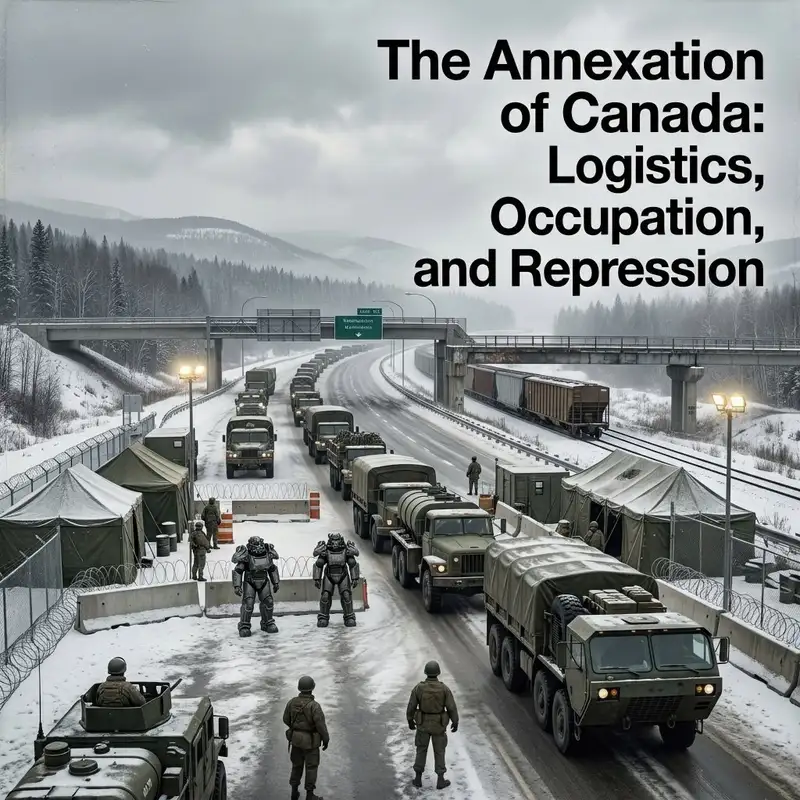
The Annexation of Canada: Logistics, Occupation, and Repression
Steph Harper and her mother Joan were fleeing the Uranium City Internment Camp when the occupation revealed its true character. A United States Marine in T-45 power armor moved to force them back into detention. A Vertibird gave the operation reach from above, able to track movement across ground that frightened civilians could not cross quickly or safely. An armed Canadian intervened with an explosive. The attack gave Steph and Joan a chance to run. Joan was mortally wounded in the escape, but she pushed her daughter south, toward the United States, and away from the territory America had claimed as its own.
That scene is small beside the scale of the Sino-American War. It is one family, one camp, one Marine, one aircraft, and one desperate flight. But it captures the contradiction at the heart of the annexation of Canada. The United States publicly described its northern expansion in the language of security and peace. Yet its armed institutions treated Canadian civilians as people who could be confined, pursued, and prevented from crossing a border that annexation was supposed to have erased. The camp was not the cause of annexation. It was the human result of a decision made when access to Alaska became more valuable to Washington than Canadian sovereignty.
The immediate military problem began in Alaska. China invaded the state in the year twenty sixty-six, during an age already shaped by resource scarcity, energy anxiety, and increasingly aggressive national policy. Alaska mattered for more than prestige. It was tied to petroleum, uranium, northern infrastructure, and the broader struggle to sustain a resource-hungry American war effort. The conflict was not fought in an empty Arctic wilderness. It was fought around installations, supply routes, fuel systems, airfields, ports, communications, workers, and the industrial networks that allowed distant forces to remain in the field.
An army operating in Alaska had to be fed, armed, repaired, reinforced, and connected to command. Personnel had to reach the theater. Ammunition, medicine, fuel, replacement parts, construction equipment, radio gear, and food had to move north. Damaged vehicles and exhausted soldiers had to move back out. Even in a setting full of fusion technology and advanced weapons, distance remained a strategic fact. Power armor did not repair a bridge. A Vertibird did not replace a secure transportation network. An energy weapon did not produce spare parts, preserve roads, or solve the problem of moving heavy equipment through a continent under wartime pressure.
Canada stood between the contiguous United States and Alaska. That geography made it strategically important before any formal annexation was announced. The United States could not treat Canadian territory as a decorative strip of land on a map. It was part of the northern approach to the Alaskan theater. Its roads, rail lines, air routes, industrial sites, communications infrastructure, and access to the Trans-Alaskan Pipeline all mattered because they shaped whether American power could move reliably toward the north.
The exact convoy routes are not established. The surviving record does not provide a complete map of American depots, garrisons, pipeline-security units, or Canadian transport hubs. It does not tell us how many troops crossed Canadian territory, how much material they moved, or which facilities became essential. Those missing details matter, because they limit what can honestly be reconstructed. But the broad logic is clear. A modern war cannot be sustained by flags and speeches. It requires access. It requires jurisdiction over the routes that carry supplies. And it requires confidence that a neighboring government cannot delay, restrict, inspect, or deny the movement of military power at the moment that movement becomes most important.
An ally can grant transit rights. An ally can cooperate on border security. An ally can permit access to airfields, pipelines, roads, railways, and supply depots. But a government under wartime pressure may come to see cooperation as an intolerable uncertainty. Negotiation creates limits. It creates paperwork, domestic politics, legal objections, and the possibility that another sovereign government may decide its own interests do not perfectly match those of the larger power beside it. In a healthy alliance, those limits are the price of mutual respect. In a militarized state facing scarcity, they can be recast as obstacles.
That was the strategic temptation behind annexation. By turning Canada from an allied country into claimed American territory, Washington could remove the formal distinction between moving through a neighbor’s land and moving within its own jurisdiction. It could treat transport corridors as internal routes. It could take direct control over infrastructure. It could impose security measures without asking a foreign government for permission. And it could redefine Canadian opposition. Resistance to American military movement would no longer be described as a sovereign state defending its authority. It could be labeled internal disorder, sabotage, criminality, or a threat to national security.
This was not merely a question of tactical movement. A road is useful to an army only if the army can keep it open. A rail line is useful only if it can be repaired, guarded, staffed, and supplied. A pipeline is strategically valuable only if its facilities can be protected and maintained. A northern airfield matters only if aircraft can land, refuel, receive maintenance, and communicate with the larger war effort. Military mobility depends on a system. That system includes infrastructure, labor, security, technical knowledge, and political authority.
The Trans-Alaskan Pipeline belonged to that larger system. Fallout’s surviving material connects the resource conflicts of the age, the war in Alaska, and the annexation of Canada. It does not provide a detailed account of the pipeline’s role in each operation. It would be wrong to claim that one facility or one route explains the entire annexation. But it is reasonable to see the pipeline and the northern infrastructure around it as part of the strategic environment that made Canada more than a neighboring country. To American planners, Canadian territory increasingly looked like military depth, a supply corridor, and a resource-security zone.
That logic may explain the decision. It does not make the decision voluntary, lawful, or politically durable. Military need can explain why leaders act. It cannot erase the fact that the act was imposed on another population. The distinction is important because pre-War American propaganda often blurred it. A government could speak of defense while expanding its control. It could describe coercion as administration. It could treat a neighbor’s sovereignty as an inconvenience, then present its removal as a practical necessity.
The clearest released-game marker for the public formalization of annexation comes from a Capital Post headline dated June third, twenty seventy-two. The paper reported that the United States would annex Canada. That date should be treated carefully. It establishes a public threshold. It does not prove that American pressure began that morning, or that every part of Canada came under effective American control at once. It does not reveal the full diplomatic process, if there was one. It does not identify a Canadian leader who accepted or rejected the move. Nor does it supply a complete military chronology.
Annexation is not one event. It can begin as pressure at a border, then become military access, emergency regulation, economic control, deployment, legal proclamation, territorial reclassification, and occupation. A newspaper headline tells us that Washington publicly asserted a new relationship with Canada. It does not tell us whether that claim was accepted on the ground. A government may announce authority long before it can enforce it. It may enforce authority in selected cities and corridors while facing resistance elsewhere. It may control military infrastructure without controlling the political loyalties of the people living around it.
The available evidence also does not establish that Canada became a fully integrated fifty-first state. The language more safely supports annexed territory, American jurisdiction, and military occupation. Those are not trivial distinctions. Statehood would imply a defined constitutional relationship, representation, public institutions, and some settled form of political membership. Annexed territory can exist under far more ambiguous conditions. It can be governed through emergency authority, military administration, corporate contracts, security regulations, and temporary measures that have a way of becoming permanent when war continues.
Declaring annexation created an American claim. Enforcing it across a vast country required institutions. Roads and railways had to be kept open. Airfields and communications nodes needed protection. Workshops, depots, and transport facilities needed labor and maintenance. Pipeline-related infrastructure needed security. Military units needed intelligence about sabotage, local opposition, weather, terrain, and population movement. None of this is glamorous. It is the ordinary machinery of control. It is also where occupation becomes most demanding, because a force can seize a place quickly but cannot govern it merely by arriving first.
The later evidence from Canada suggests a security architecture built around classification, mobility, detention, and coercion. Identification documents marked individuals as residents of the annexed territory of Canada. Internment camps existed. U.S. military personnel operated in power armor. Vertibirds extended the reach of armed patrols and rapid response. These details do not give us a complete occupation order of battle. They do not establish how many camps existed, where every garrison stood, or how American command was organized. But they show the tools of rule used when ordinary consent is absent or distrusted.
Power armor offered obvious advantages. A T-45-equipped Marine could dominate a civilian encounter through protection, firepower, and intimidation. The armor made the soldier a moving symbol of state capacity. It announced that resistance would meet not simply a policeman or border guard, but the industrial force of the American war machine. Vertibirds added another layer. They could move personnel quickly, observe open terrain, support patrols, and make escape more difficult. Together, armored troops and aircraft could impose control over specific places and moments.
But neither system solved the deeper problem. Armor cannot tell an occupier who is loyal, who is frightened, who is hiding a relative, who is passing information, or who has decided that escape is safer than obedience. Aircraft can pursue movement, but they cannot manufacture trust. Detention can remove people from circulation, but it can also teach their families and neighbors that the occupying power sees them as a population to be managed rather than a public to be represented. Technology can increase the reach of coercion. It cannot transform coercion into legitimacy.
The occupation’s official language becomes especially revealing here. The opening cinematic of the original Fallout presents American troops in newly annexed Canada through a patriotic lens. Power-armored soldiers stand as symbols of national strength. The scene is staged for an audience. Then a restrained Canadian figure is executed before the camera. The person’s exact identity is not established. We cannot say with confidence whether this was a civilian detainee, a combatant, a protester, or a member of some larger resistance organization. The image does not provide that information.
What it does provide is a political message. The United States did not merely exercise force. It displayed force. The execution was framed within a narrative of order, discipline, and national resolve. Occupation violence was made presentable to viewers at home by placing it inside the language of peacekeeping. This is one of the oldest functions of wartime propaganda. It takes an action that might otherwise appear brutal or destabilizing and presents it as necessary protection against chaos.
The phrase “keeping the peace” carries a familiar institutional trick. It suggests that peace already exists and that armed intervention merely preserves it. But in annexed Canada, the American military was not simply preventing disorder in its own settled territory. It was enforcing a new political reality against people who had not necessarily accepted it. The language converted conquest into maintenance. It made the occupier appear as a guardian, while making the occupied population’s refusal appear as the source of instability.
That propaganda mattered because the United States was already under strain. Resource scarcity, war with China, domestic militarization, and the demands of the Alaskan campaign all created pressure on political legitimacy at home. Annexation could be sold as decisive leadership. It promised security over northern routes, control over strategic space, and a forceful answer to the uncertainty of wartime dependence. The image of armored troops in Canada reassured American viewers that their government still possessed the will and power to act.
Yet propaganda could not remove Canadian identity. A flag could be lowered. A border could be redrawn on American maps. An arsenal could be relabeled. A person could be issued documents identifying them as a resident of annexed territory. None of that guaranteed that the population would understand itself as American, accept American authority, or forget that a sovereign country had been absorbed by force. Political identity is not erased by administrative language. It is often hardened by it.
The Uranium City Internment Camp provides the clearest released depiction of what that gap meant for civilians. Steph Harper and Joan were not shown participating in a broad military campaign. Their story does not establish the scale of Canadian resistance or the exact purpose of the camp. It does not tell us how many people were detained, how long they were held, or what legal process, if any, governed their confinement. It should not be treated as a demographic survey of every Canadian experience.
But it does establish certain facts. Internment was part of the occupation. Armed American personnel enforced confinement. Escape was dangerous. A Marine attempted to return fugitives to detention. A Vertibird supported the pursuit. An armed Canadian helped create an opening for escape. Lethal violence followed. Joan died from her wounds, and Steph became a child displaced by the institutions claiming to secure the territory around her.
The sequence also shows why resistance cannot be reduced to a single category. A detainee is not automatically an insurgent. A mother fleeing a camp is not necessarily a combatant. A child crossing a militarized border is not a political leader. The armed person who intervened may have been part of a resistance network, an escape effort, or a local act of defiance. The evidence supports the existence of armed opposition. It does not establish one nationwide command, one ideology, or one unified Canadian liberation army.
That uncertainty should not obscure the larger point. Occupation creates its own intelligence problem. The more an occupying power relies on detention and coercive classification, the more it must decide who is dangerous before it truly knows. It must sort civilians into categories of loyal, suspect, useful, hostile, detained, permitted, and excluded. Such systems can produce information. They can also produce false information, fear, silence, and resentment. People who might have remained neutral may flee. People who know nothing may be treated as threats. People who have reason to distrust authorities may stop sharing information with them.
The result is a vicious cycle. Security forces use harsher measures because they fear sabotage, escape, and armed resistance. Civilians fear the security forces because detention and violence appear arbitrary or unavoidable. That fear makes cooperation more difficult. The lack of cooperation produces more suspicion. The occupation becomes more dependent on patrols, camps, documents, informants, and rapid military response. None of this proves that every Canadian resisted American rule. It does show that American rule could not rely on simple acceptance.
The annexation also changed the meaning of industry. In Fallout: New Vegas, an inscription identifies the Long Branch Arsenal in Ontario as being in “USA Territory.” It is a small piece of evidence, but a meaningful one. The designation shows that American authority did not stop at military movement corridors. It extended into the classification of Canadian industrial space. Ontario was no longer presented as foreign territory beside the American war effort. It had been rhetorically folded into the American state’s economic and military geography.
That does not prove that the arsenal was operating at full capacity. It does not tell us what weapons it produced, whether its workers cooperated, whether its supply chains remained intact, or how much of its output reached American forces. A factory can be captured, reclassified, and celebrated long before it becomes a reliable part of wartime production. Industrial capacity is not a sign on a wall. It depends on workers, skilled management, raw materials, power, machine tools, transport, security, and a chain of command capable of turning ownership into output.
Still, the territorial label reveals a central ambition. Annexation was meant to convert Canadian assets into American strategic depth. The United States did not merely want passage through Canada. It wanted the authority to define Canadian roads, facilities, labor, and industrial sites as parts of its own war system. In the language of military planning, this makes sense. A government at war wants secure access to resources and infrastructure. In the language of politics, it is imperial absorption. The same action can be both strategically intelligible and morally coercive.
Vault-Tec’s activity points to a similar effort at normalization. A rejection letter from the company advertises Vault facilities in newly annexed Canada. The wording matters. Vault-Tec did not describe Canada as a distant occupied zone beyond the reach of ordinary American institutions. It presented annexed territory as an expanding market, an administrative frontier, and a place where its civil-defense business could operate. Corporate language often makes political change sound routine. Where soldiers see a security zone, a corporation sees customers, contracts, property, and future development.
That evidence should also be handled with restraint. The advertisement does not establish how many Canadian Vaults were built, where they stood, who was admitted, or what purposes they served. It does not prove that every Canadian community received access to shelters. Vault-Tec’s public claims were never a reliable measure of public welfare in the first place. The company specialized in presenting survival as a purchasable product while operating inside a political culture that treated civil defense, corporate power, and social inequality as closely related matters.
But the reference still shows how occupation can be normalized beyond the battlefield. A military annexation becomes more durable when maps change, contracts change, property records change, identification changes, and corporations begin speaking as if the new order has always existed. The population is not asked whether it accepts the transformation. It is expected to adapt to it. The state claims the territory, and the commercial system begins treating that claim as a business opportunity.
Steph Harper’s identification makes this process personal. Her documents described her as a resident of the annexed territory of Canada. That may sound like bureaucracy, but bureaucracy is one of the ways power becomes real in daily life. A document can determine where a person is allowed to travel, which authority can detain them, where they may seek protection, whether they are treated as a citizen, a resident, a foreigner, a security risk, or an administrative problem.
Identity papers are especially important in an occupation because they turn political ambiguity into a system of individual decisions. A soldier at a checkpoint does not need to resolve the history of Canada. The soldier needs to know what the document says. A camp administrator does not need to settle questions of sovereignty. The administrator needs a category for who can be confined. A transport official needs to know who may cross a border, board a vehicle, enter a restricted area, or be returned to detention. Paperwork becomes the quiet companion of armed force.
For Canadians, this meant that annexation reached beyond flags and military operations. It entered the movement of families, the security of homes, access to work, and the danger of being seen as out of place in one’s own country. We do not know the citizenship law imposed on all Canadians. We do not know voting rights, property rules, or the full legal status of annexed territory. The evidence does not support sweeping claims about every aspect of civil administration. But it does show a government asserting the right to classify Canadian people under American authority.
That classification did not dissolve the border in the minds of those subject to it. Joan’s final act was to send Steph south into the United States. The direction is revealing. Canada had been annexed, at least in the language of American power, yet the United States still represented another side of a political and military divide. The old border had not vanished. It had become unstable, militarized, and dangerous. It remained meaningful precisely because annexation had not created an accepted common political community.
This is why the annexation is not best understood as a clean expansion of national territory. It was a logistical and resource-security operation that became a project of domination. At the point of contact, American forces possessed formidable advantages. A Marine in power armor could control a confrontation. Vertibirds could support pursuit and rapid deployment. Detention facilities could hold people who might otherwise evade control. Checkpoints and identity systems could regulate movement. These were real capabilities.
Across the occupation, annexation likely gave the United States greater freedom to secure selected routes and infrastructure connected to the northern war. It reduced the need to negotiate access with an independent Canadian government. It allowed American planners to treat Canadian territory as part of the rear area supporting Alaska. It may have improved the ability to protect transport networks, industrial facilities, and communications nodes. The precise extent of that improvement cannot be measured from the available record, but the strategic purpose is plain enough.
For Washington, control over Canadian space appears to have promised a way to reduce the vulnerability of the Alaskan campaign. This was the central calculation. The United States faced a war in the north, a broader crisis of resources, and an increasingly authoritarian political atmosphere. Annexation promised certainty. It promised that a critical corridor would no longer be subject to another state’s consent. It promised that military planners could turn a neighboring country into depth, access, and claimed capacity.
Politically, however, the annexation failed to demonstrate integration. There is no evidence of broadly accepted consent. There is no established record of a settled constitutional arrangement, representative institutions, or a political compact that persuaded Canadians to regard American rule as legitimate. Instead, the surviving evidence points toward coercive administration. Propaganda celebrated military power. Documents categorized Canadian residents. Industrial sites were reclassified. Internment camps confined civilians. Armed personnel pursued escapees. Resistance existed, even if its full structure remains unknown.
For civilians, the cost was immediate and unequal. Some Canadians may have accommodated the new order. Some may have benefited from contracts, employment, security arrangements, or proximity to American institutions. The available canon does not allow us to generalize their experiences. But the experiences that are directly shown are severe. Families could be separated. Movement could become a matter of military permission. Detention could replace ordinary civil life. Escape could carry the risk of death. A state that claimed to be securing the north had made the security of individual Canadians conditional on obedience to occupation.
Repression is not proof that an occupation controls nothing. In fact, repression often appears where an occupier controls important places but cannot obtain dependable consent. The United States could dominate selected encounters. It could hold camps, patrol corridors, and mobilize advanced equipment. It could project force rapidly. But these tools addressed symptoms of political resistance, not the underlying cause. Canada had not become a territory through a negotiated union. It had become one through an American decision backed by military power.
The final limit on the entire project was time. The public annexation announcement came in the year twenty seventy-two. The Great War followed on October twenty-third, twenty seventy-seven. That is only a few years in which to transform a neighboring country’s political status, secure its infrastructure, absorb or suppress opposition, organize administration, integrate industry, and persuade a population that its future now belonged to the state that had taken control over it.
Durable political integration requires more than a military victory. It requires institutions that people can use and, at least in part, trust. It requires rules that are predictable rather than arbitrary. It requires public services, economic reciprocity, local participation, courts or equivalent mechanisms of dispute settlement, and a political settlement that gives people some reason to believe they have a future inside the new order. It requires time for soldiers to become administrators, emergency measures to become law, and law to become accepted practice. Wartime occupation rarely provides those conditions.
The nuclear exchange ended any possibility of seeing how the annexation would have developed. There is no complete released account of whether American control would have hardened into permanent colonial administration, faced a larger Canadian insurgency, produced some negotiated settlement, or collapsed under the same pressures consuming the rest of North America. Postwar Canada remains largely undocumented in official Fallout canon. It would be irresponsible to fill that silence with invented governments, factions, survivor states, or maps of destruction.
But the absence of a final outcome does not prevent a clear judgment about the prewar occupation. The evidence shows a state trying to solve a northern war problem by eliminating the sovereignty of an ally. It shows military power used to secure territory, infrastructure, and movement. It shows propaganda converting conquest into peacekeeping. It shows corporate institutions treating annexed land as a normal commercial frontier. And it shows civilians who could be detained, classified, pursued, wounded, and driven across a militarized border.
The United States annexed Canada because wartime scarcity and the Alaskan theater transformed Canadian territory into a logistical and resource-security problem. Washington wanted more than cooperation. It wanted assured access. It wanted authority over corridors, facilities, industrial space, and the northern approaches to Alaska. Annexation converted a sovereign neighbor into claimed military depth. It made movement easier to command on paper, and it gave American institutions the power to treat Canadian infrastructure as part of their own war system.
Yet the same act destroyed the consent that political integration required. The United States gained access, but it did not gain demonstrated legitimacy. It gained jurisdiction, but it did not gain a settled public. It could use documents, camps, patrols, power armor, Vertibirds, propaganda, and lethal force to enforce compliance in particular places. It could not make those instruments resemble voluntary union. The need for repression was not an accidental excess at the edge of an otherwise peaceful process. It was evidence that occupation had become the method of rule.
Canada’s annexation exposed the prewar United States as a state willing to preserve its northern war effort by turning an ally’s sovereignty into a supply line, and its civilians into subjects of occupation.