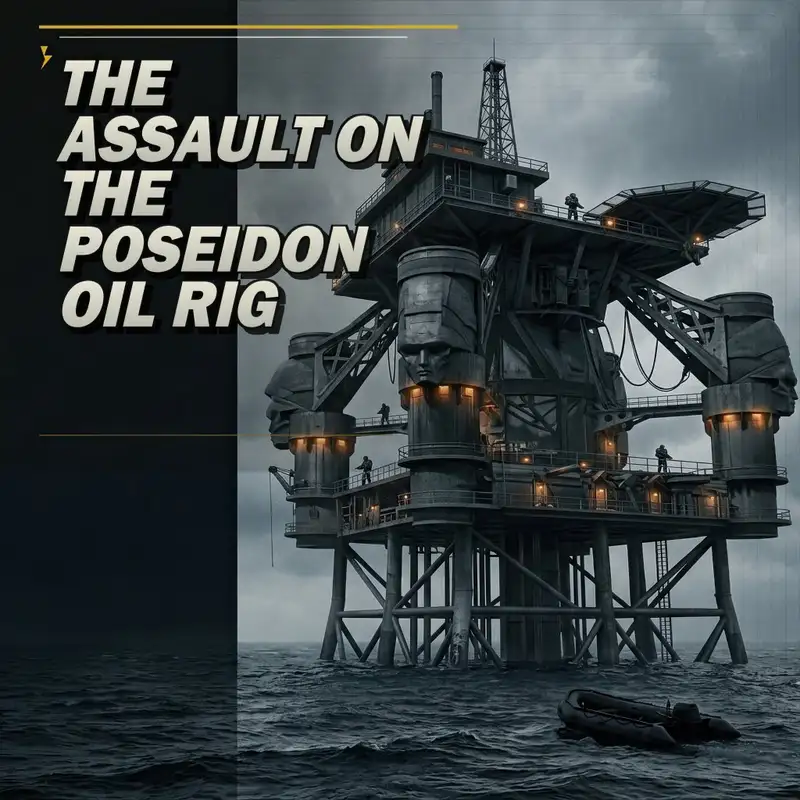
The Assault on the Poseidon Oil Rig
Alarms are sounding across Control Station ENCLAVE. Somewhere above the detention levels, a reactor crisis has turned an offshore fortress into a failing machine. Doors that were meant to control prisoners, technicians, and soldiers now control evacuation routes. The people taken from Arroyo and Vault Thirteen are trying to reach the tanker that brought their rescuers to the rig. The Enclave’s security apparatus is still armed, still dangerous, and still able to kill. But it is no longer acting with the confidence of a government that believes it has complete control.
At the route out stands Frank Horrigan, the Enclave’s most intimidating instrument of force. He is heavily altered, heavily armored, and personally tied to President Dick Richardson’s authority. He is also the final barrier between the captives and escape. The exact details of that confrontation can vary. The Chosen One may arrive with different allies, use different weapons, persuade some Enclave personnel to help, or turn parts of the presidential security system against him. Those are possible paths through the crisis, not one fixed historical record.
What is fixed is the result. The oil rig is destroyed. Richardson dies. Horrigan dies. The captives are freed. The Enclave’s West Coast plan to use a modified Forced Evolutionary Virus against the post-War population is stopped. It is tempting to remember the event as the defeat of one monstrous operative at the end of a desperate mission. That makes for a clean story. It is also too small.
The real event was the collapse of a political headquarters, a biological weapons program, a detention system, a military command center, and a national myth, all concentrated inside one isolated installation. The Enclave had built the rig to survive a ruined continent. Its defenses were formidable against outsiders. Its end came because an outsider gained access to the systems that made the installation function.
Control Station ENCLAVE was commonly known as the Poseidon Oil Rig, but that name can make it sound like an abandoned industrial relic with a few soldiers hiding on top. It was much more than that. The rig functioned as the West Coast Enclave’s principal center of political authority. It housed senior officials, military and security personnel, laboratories, computer systems, detention facilities, and the infrastructure needed to sustain a protected offshore community. It was a sanctuary, but it was also a state in miniature.
The installation’s value came from integration. A bunker can preserve records. A laboratory can conduct research. A military base can protect personnel. A detention site can hold prisoners. A command center can direct operations. The oil rig combined those functions. It brought political leadership, scientific expertise, armed force, communications, and essential services into one controlled environment. That made the Enclave efficient in one sense. Orders could move quickly. Sensitive projects could remain compartmentalized. The leadership could work close to the people and systems carrying out its policy.
It also made the rig vulnerable in a particular way. The Enclave had reduced its exposure to mainland threats, but it had not escaped dependence. An offshore facility still requires power, technicians, supplies, communications, transport, maintenance, and reliable internal security. Isolation limits the number of people who can reach a target. It also limits reinforcement, evacuation, and recovery when something fails. A mainland army might have needed heavy equipment, transport, and a great deal of luck to attack the rig directly. A small force that reached the right control points could cause damage out of proportion to its own size.
The offshore location also shaped the Enclave’s knowledge of California. It could observe, raid, infiltrate, and dispatch aircraft. It could maintain mainland facilities and recruit or coerce personnel. But it did not live among the communities it claimed the right to rule. Its leaders were physically separated from the farms, towns, trade routes, droughts, rivalries, and improvised governments that had grown up after the Great War. They possessed technology, archives, and command systems. They did not possess broad consent.
The difference mattered because the Enclave’s claim was political before it was military. President Dick Richardson presented the organization as the lawful continuation of the United States. In one narrow institutional sense, the Enclave did preserve elements of pre-War government. It retained officials, procedures, military ranks, classified programs, and the symbols of federal continuity. It had flags, uniforms, committees, secure facilities, and the language of constitutional authority. In a world of scattered settlements and damaged records, those things could carry psychological weight.
But inherited symbols are not the same as legitimacy. A government is not made legitimate simply because its leaders possess an old seal, a secure radio network, or access to a classified bunker. It must also establish some relationship with the people it governs or claims to govern. It must provide security without treating the population as raw material. It must create rules that others recognize as more than the preferences of the armed people enforcing them.
Arroyo had not elected Richardson. Vault Thirteen had not asked the Enclave for protection. Neither community had consented to being absorbed into a restored United States. When Enclave forces seized them, their experience of national continuity was not law, representation, or public service. It was armed abduction, confinement, medical scrutiny, and the threat of death. The gap between the Enclave’s rhetoric and its conduct was not an unfortunate side effect of an otherwise legitimate restoration project. It was the core of the project.
Richardson’s authority rested on hierarchy, secrecy, and control of exceptional technology. His administration could issue orders within the rig. It could direct military units. It could fund scientists and enforce compartmentalization. It could use the language of the old republic while denying the post-War population any standing within it. In practical terms, it treated most surviving Americans not as citizens to be recovered, but as a biological and political problem to be removed.
That approach gave the Enclave a form of internal cohesion. Personnel who accepted its assumptions could see themselves as custodians of a lost civilization, surrounded by contamination and disorder. It also encouraged a fatal strategic blindness. The Enclave’s leaders mistook separation from the wasteland for superiority over it. They assumed that people outside their protected system were incapable of becoming political actors, technical partners, or military threats. The Chosen One’s campaign would prove that the opposite was true.
The immediate reason for the Enclave’s campaign was its plan for a modified strain of Forced Evolutionary Virus, usually called F E V. The virus had a long and destructive history before the Great War, and its post-War legacy included super mutants, failed experiments, and generations of fear. On the oil rig, Enclave scientists developed a version intended to kill people who carried the mutations and genetic changes associated with life after the bombs. The Enclave leadership regarded itself as sufficiently genetically pure to survive the release.
The plan was exterminatory. It was not a quarantine policy, despite the scientific language surrounding it. It did not seek to isolate a disease, protect a population from infection, or negotiate coexistence with altered communities. It proposed to use biological warfare against the overwhelming majority of people living in the post-War world. The Enclave intended to clear the continent of those it considered contaminated, then inherit what remained.
Charles Curling and the research establishment were central to that program. The scientists on the rig were not merely technicians working in a vacuum. Their research had political purpose. The laboratory work translated Richardson’s vision of national restoration into a weapon. The military provided the means to capture people and protect the facility. Security personnel kept prisoners contained. Administrators preserved secrecy. Each part of the institution made the others possible.
The people of Arroyo and Vault Thirteen were therefore more than hostages. They were captives caught inside a system that classified them as research subjects, threats, and disposable obstacles to a future Enclave state. Their kidnapping was not just leverage against the Chosen One. It revealed how the regime understood ordinary people. Communities that had survived for generations after the bombs were not evidence that civilization could return from below. In Enclave ideology, they were evidence of a world that needed to be purified.
The moral horror of that policy is clear. Its strategic poverty deserves equal attention. Even if the Enclave had succeeded in killing vast numbers of post-War inhabitants, destruction would not have automatically produced a functioning country. Agriculture still requires labor and local knowledge. Trade requires people willing to move goods, repair equipment, and trust exchange networks. Roads, water systems, workshops, and settlements need maintenance. A government cannot rule empty territory through slogans and laboratory access alone.
The Enclave had preserved advanced systems, but it had not solved the ordinary problems of political reconstruction. It had not demonstrated that it could feed, employ, govern, and gain the consent of the people it meant to replace. Its biological weapon promised control through depopulation. That is not state-building. It is an attempt to avoid state-building by eliminating the population whose cooperation would otherwise be necessary.
The capture of the Arroyo and Vault Thirteen communities demonstrated that the Enclave did possess real operational reach. Its Vertibirds gave it mobility that most California settlements could not match. Armed units could strike a target, seize prisoners, and withdraw before local defenders could organize an effective response. This was a serious capability. The Enclave was not merely hiding offshore and issuing empty proclamations.
Yet a raid is not occupation. The ability to descend on a community, take people by force, and fly away does not mean a faction governs the roads between settlements, collects taxes, settles disputes, protects markets, or sustains a permanent presence across a region. The Enclave could project violence selectively. It did not visibly administer broad stretches of California as a normal territorial government would.
Its mainland facilities reveal the difference. Camp Navarro served as an important support node, connecting the oil rig to the coast through personnel, equipment, access systems, and transport. Such facilities extended the Enclave’s reach. They also created points of vulnerability. Every mainland node needed guards, technicians, supply arrangements, intelligence, and some means of communicating with the offshore headquarters. A secret organization cannot operate entirely without contact with the society it despises.
The Enclave’s technology gave it an advantage in those contacts, but not omnipresence. It could not watch every road. It could not seal every wrecked installation. It could not ensure that every subordinate understood the full purpose of the F E V program or remained loyal when confronted with its consequences. Its personnel were protected by armor and procedure, but procedure works only while the system behind it remains coherent.
For the Chosen One, the response to the Enclave was never simply a matter of finding a battlefield and winning a firefight. The strategic problem was access. The oil rig lay offshore, defended by water, identification systems, armed personnel, and controlled infrastructure. A direct assault by a conventional army was not available. Arroyo did not have one. Vault Thirteen did not have one. The Chosen One did not command one.
Instead, the campaign became an exercise in intelligence, salvage, logistics, and technical improvisation. The path to the rig required the means to cross the water, navigate to the installation, and approach a security state that expected outsiders to be stopped long before they reached its leadership. The PMV Valdez tanker became essential because it provided a route that no ordinary wasteland caravan or militia could offer.
Getting that tanker moving was not a glamorous military operation. It involved fuel, repair, navigation capability, local expertise, and access technology associated with the Enclave’s mainland network. San Francisco and other communities mattered because they held knowledge, equipment, and people capable of making old-world systems function again. This was not a campaign conducted by a unified national army. It was a coalition of necessity, built from local competence.
That fact is easy to overlook because the final scenes occur inside the Enclave’s headquarters. But the preparation was the real opening phase of the assault. Someone had to understand what the tanker needed. Someone had to recover or restore components that had survived in damaged places. Someone had to identify how Enclave credentials and access systems worked. Someone had to connect scattered pieces of information into a route toward the rig.
The Chosen One’s fixed historical role was to lead that effort toward the rescue of the captives and the termination of the Enclave program. The exact journey, the people involved, and the methods used remain player-dependent. What matters is that the operation depended on knowledge distributed outside the Enclave’s control. The organization that claimed exclusive ownership of America’s technological future was penetrated through technology preserved, repaired, understood, or repurposed by the people it considered unfit to survive.
That is one of the assault’s deepest ironies. The Enclave believed that technical sophistication separated it from the wasteland. In practice, technical skill existed far beyond the rig. It existed among mechanics, navigators, scavengers, traders, tribal communities, Vault dwellers, and people who had learned to keep broken systems working because no central government was coming to do it for them. The old world had left behind machinery. Post-War people had learned how to make use of it.
Reaching the rig did not mean the Enclave had been militarily conquered. The facility retained layered defenses. Its personnel included trained soldiers and security officers. Its advanced power armor provided protection and intimidation. Automated turrets, force fields, internal computer systems, controlled doors, and restricted movement created a defensive environment designed to slow, identify, isolate, and destroy intruders. The Enclave had not neglected physical security.
But every security system rests on assumptions. It assumes that identification remains secure. It assumes that uniforms, credentials, and electronic access are not compromised. It assumes that personnel obey procedures. It assumes that computer systems can distinguish a threat from an authorized user. It assumes that isolated compartments will prevent local failures from spreading. Those assumptions can be powerful. They can also become liabilities when an adversary reaches the interior.
The Chosen One may have entered through deception, through direct combat, or through some combination of both. The released events support more than one route. It would be wrong to turn one player’s approach into official military history. The broader point is that the Enclave’s defensive boundary failed. The Chosen One reached the locations where political authority, scientific work, prisoner control, and critical infrastructure intersected.
This was penetration, not conquest. The Chosen One did not arrive with an army capable of occupying the rig, holding its decks, policing its corridors, and administering its surviving population. There was no conventional beachhead followed by a methodical clearing operation. The assault worked because it did not need to seize every room. It needed to disrupt the system that made the rig function as a coherent state.
That distinction explains why a small operation could have such disproportionate strategic consequences. The Enclave had concentrated crucial functions behind the same security perimeter. Once that perimeter was compromised, a person who could move between detention areas, command systems, laboratories, and reactor controls could threaten far more than the guards in the next corridor.
The detention and research levels made the human stakes impossible to ignore. Arroyo and Vault Thirteen were not abstract populations on a planning map. They were families, elders, workers, children, and survivors taken from communities that had already endured the collapse of the old world. Their confinement demonstrated what Enclave power meant when applied to people who had no place within its definition of purity.
Freeing them mattered first because they were in immediate danger. The Enclave’s program treated their deaths as acceptable, and possibly necessary, for a future in which the Enclave alone would define humanity. Rescue was therefore a humanitarian objective in the most direct sense. It removed people from captivity and denied the regime the victims it needed for its policy.
It also mattered operationally. Prisoners understand their own confinement. They know what they have seen, what they have been told, and what must happen if they are to escape. Their liberation created urgency around the tanker, the protective systems, and the rapidly narrowing chance to leave the rig alive. The assault was no longer only about reaching a laboratory or disabling a weapon. It became an evacuation under the pressure of a collapsing installation.
Technical personnel were equally important. The rig’s advanced systems did not operate by themselves simply because they had survived the Great War. They depended on people who understood reactors, computers, security controls, life support, and access networks. Tom Murray’s presence reflects this dependence. The Chosen One can interact with the facility’s technical structure in more than one way, and not every possible conversation or choice belongs in a single fixed account. Still, the broader lesson remains. The Enclave’s control was mediated through specialists.
The same was true of its military personnel. Sergeant Granite’s squad can, under particular player-dependent circumstances, assist the Chosen One against Horrigan. That possibility does not mean every soldier rejected the Enclave. It does not erase the responsibility of an organization carrying out kidnapping and preparing biological extermination. It does show that military institutions are not one-minded machines.
Some personnel may have understood only part of the program. Some may have believed they served a legitimate continuation government. Some may have remained loyal until the end. Others could recognize that the policy they were being asked to defend was criminal, that their leadership had deceived them, or that the rig was becoming a death trap. In a crisis, the difference between formal allegiance and practical survival can become decisive.
This was another Enclave failure. Its leaders depended on compartmentalization to preserve secrecy, but compartmentalization limited shared understanding. A state that hides its true purpose from many of its own servants can gain short-term control. It may also discover that those servants have little reason to sacrifice themselves once the truth emerges. The more a regime relies on fear and restricted information, the more fragile its cohesion can become when both fail at the same time.
The critical target, however, was neither an individual guard nor a single laboratory. It was the rig’s infrastructure. The Chosen One can disable or sabotage the reactor through several possible methods. The exact technical sequence is not fixed by the broader historical record, and the game does not establish precise reactor physics, energy output, or the detailed relationship between every emergency system. There is no need to invent them.
What is clear is that the reactor crisis changes the character of the operation. Before sabotage, the Enclave controls the environment. It controls power, access, surveillance, prisoner movement, and the deployment of armed force. After sabotage, the facility faces an emergency that threatens the entire installation. Security no longer serves only to keep intruders contained. It must contend with evacuation, failing confidence, disrupted systems, and the possibility that the headquarters itself cannot survive.
The oil rig was designed as a refuge from the unpredictable mainland. But its isolation made redundancy difficult. A city can sometimes draw on neighboring towns, alternate power sources, dispersed warehouses, and multiple escape routes. An offshore installation has fewer options. It cannot easily disperse its population. It cannot call on a nearby civilian infrastructure for relief. It cannot quickly replace specialized personnel or equipment lost during an internal crisis.
The emergency sequence also exposes the difference between control and resilience. The Enclave had constructed a system that could tightly regulate ordinary conditions. It had not built a political community capable of adapting when those conditions collapsed. Prisoners needed to flee. Technical staff needed to make life-or-death decisions. Soldiers had to decide whether to obey doomed orders. Senior leaders could issue commands, but commands could not repair every damaged relationship between people and institutions.
Frank Horrigan’s role must be understood within that context. He was not the strategic architect of the F E V plan. He was not the Enclave’s national commander in every theater. He was Richardson’s exceptional enforcer, a biological-military asset shaped into an instrument of intimidation and violence. His presence at the final escape route represented the regime’s last effort to solve a systems collapse through personal coercion.
Horrigan embodied several Enclave assumptions at once. He combined mutation, experimentation, armor, and state power in a figure the Enclave presented as superior to the people it meant to destroy. The irony was sharp. A government obsessed with genetic purity relied on a transformed and heavily altered operative to defend its purity campaign. The regime’s real standard was never simple biological consistency. It was control.
His power was real. The Chosen One faced an immediate and dangerous obstacle. Depending on the course of events, companions may participate. Granite’s squad may join the fight. The presidential security system may be redirected. Other methods are possible. No single tactical sequence should be mistaken for the entire history of the confrontation.
Tactically, Horrigan’s death removed the final major barrier between the captives and the tanker. It allowed escape from a facility already entering terminal crisis. Symbolically, his defeat was even more important. The Enclave had invested heavily in the idea that superior equipment, superior bloodlines, and superior force could guarantee authority. Horrigan was the physical expression of that belief. Yet one formidable individual could not restore a destroyed chain of command, repair a failing reactor, recover political legitimacy, or make prisoners accept a government that had planned to kill them.
Horrigan himself claims responsibility for triggering the self-destruct sequence. The Chosen One’s sabotage of the reactor is already the operational cause of the wider emergency. The exact relationship between those actions remains ambiguous in the game’s final sequence. It should remain ambiguous. What matters is that the combined crisis destroys the facility. The rig falls because the Enclave loses control over the systems it has gathered in one place.
The immediate results are substantial. Dick Richardson is dead. Frank Horrigan is dead. The captives from Arroyo and Vault Thirteen escape. The oil rig is destroyed. The modified F E V project centered there is stopped. On the ground, the Chosen One’s operation succeeds as penetration, sabotage, liberation, and withdrawal. A small force reaches the critical points of a much larger system and escapes before that system can recover.
Destroying the rig costs the Enclave far more than a building. It loses an integrated complex where leadership, research, security, detention, transport coordination, and essential infrastructure had been connected. The destruction does not merely remove office space. It shatters a command relationship. The people who issued orders, the systems that authenticated them, and the facilities that enabled their policies are no longer functioning together.
The Enclave’s immediate West Coast extermination plan ends with it. The organization may have possessed weapons, personnel, and facilities elsewhere, but the oil rig had been the center of the particular project to remake America through biological mass killing. Without the rig’s leadership and research structure, that project loses its principal base of execution.
The assault also destroys the material foundation of Richardson’s claim to continuity. The Enclave’s government had always depended on more than rhetoric. It depended on an actual headquarters, a secure command system, a protected elite, and the capacity to enforce its decisions. Once the rig is gone, the claim that this small offshore hierarchy is the surviving United States becomes much harder to sustain in practical terms. It may persist as ideology among survivors, but it no longer has the same institutional center.
For the people of Arroyo and Vault Thirteen, the civilian result is immediate and personal. They survive captivity and escape an intended biological atrocity. Their rescue does not undo the trauma of being taken. It does not restore every person lost during the Enclave’s operations. It does not guarantee that their communities will face no future hardship. But it prevents their conversion into casualties of a policy that denied their right to exist.
The assault does not, by itself, rebuild California. It does not create a regional government, restore infrastructure, settle disputes among neighboring societies, or erase the inequalities and dangers of the post-War world. It does not make every surviving Enclave operative disappear. It does not dissolve the political temptation to use old-world technology as an excuse for domination. A successful raid against a headquarters is not the same thing as a completed reconstruction program.
That limitation is important because the Enclave’s defeat can otherwise seem too neat. The destruction of the oil rig removes a threat of extraordinary scale, but the harder work remains with the people who must live afterward. Communities still need water, food, trade, security, medicine, repair, and institutions capable of resolving conflict without turning every crisis into an excuse for extermination or dictatorship.
Later accounts preserve the broad fact of the rig’s destruction while showing how incomplete knowledge of the event remained. Marcus refers to the Chosen One having destroyed an oil rig. Judah Kreger describes the disaster as sabotage whose full details were never understood outside the people directly involved. That uncertainty makes sense. The target was offshore, secretive, and destroyed during its own emergency. Much of the evidence died with the facility.
Those later references also clarify the limits of the victory. The fall of the rig did not kill every Enclave member or erase every Enclave installation. People survived elsewhere. Fragments of the organization, its personnel, and its ideology endured beyond the West Coast command center. An institution can lose its capital without losing every believer, every weapon, or every archive.
But the West Coast Enclave never recovered the particular concentration of power that made the oil rig so dangerous. Its leadership had placed political command, scientific extermination, military coercion, and civil-defense mythology behind one perimeter. That arrangement made the rig appear invulnerable. In reality, it made the entire project dependent on a single installation remaining secure and functional.
The Chosen One did not defeat the Enclave through conventional military superiority. There was no grand army landing on the coast, no sustained campaign of territorial occupation, and no complete destruction of every Enclave asset. The assault succeeded because the Enclave confused isolation with security and inherited authority with legitimacy. Its advanced defenses could keep out many threats. They could not save a government once its own systems, personnel, and prisoners turned into sources of crisis.
The oil rig’s fall ended the Enclave’s immediate West Coast plan to restore America by killing most of the people already living in it. The force that destroyed that plan came not from the purified nation Richardson imagined, but from the communities he dismissed as unworthy of survival, joined by local knowledge, technical improvisation, and a refusal to accept extermination as a form of governance.