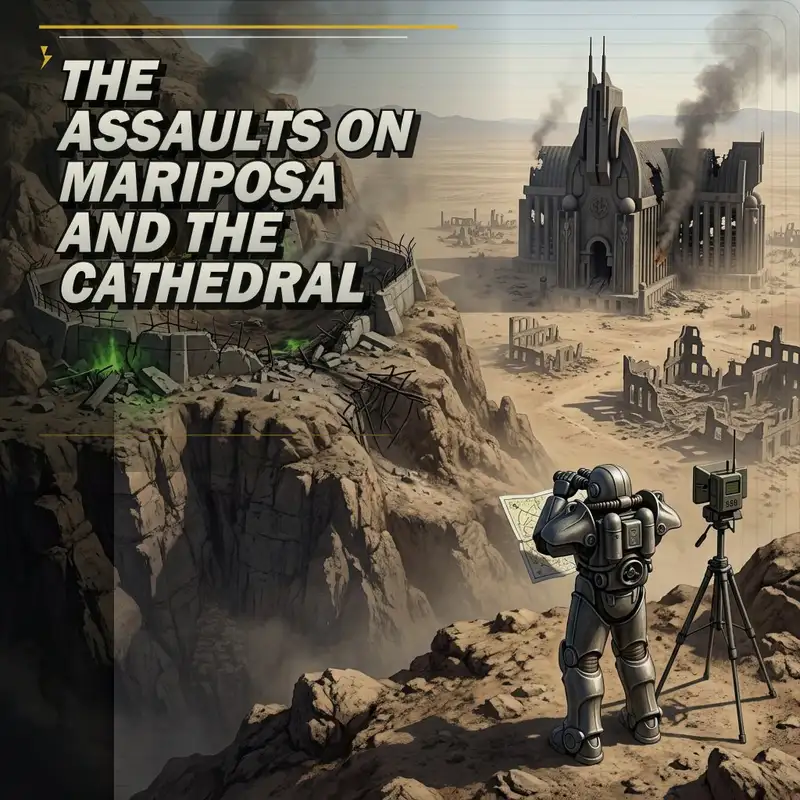
The Assaults on Mariposa and the Cathedral
Above the ruined streets of Los Angeles, the Cathedral offered shelter, medicine, ritual, and certainty. Its missionaries preached unity in a fractured land. Its hospitals treated the sick. Its followers spoke of peace after generations of raiding, isolation, and fear. Beneath that public institution, however, lay the Los Angeles Vault, a hidden command center where the Master directed a campaign of forced transformation. The same organization that promised relief to frightened civilians also helped identify, recruit, intimidate, and deliver human beings into a military project they did not control. Yet even the destruction of that underground headquarters would not have been enough. Far to the north, inside Mariposa Military Base, the vats that created the Master’s soldiers remained intact. The Unity was not one army gathered in one place. It was a system with a political center and a production center. To defeat it required more than killing guards or capturing a fortress. It required breaking the authority that directed the war and destroying the machinery that could keep that war alive.
The later account known as the Vault Dweller’s Memoirs places the Cathedral operation before the assault on Mariposa. The original campaign allowed events to unfold in more than one order, and the exact tactics used at either location could vary greatly. The difference matters. The historical result is clearer than the individual route. The Master was defeated. The Cathedral was destroyed. Mariposa’s vats were destroyed. The Unity’s organized expansion collapsed. But the methods remained partly dependent on the choices of the Vault Dweller, and the surviving record does not support one tidy, cinematic version of the final campaign.
The paired operations are best understood as decapitation and denial. At the Cathedral, the target was the Master himself, along with the human-facing institutions that gave his movement reach, legitimacy, and intelligence. At Mariposa, the target was the Future Evolutionary Virus infrastructure that allowed the Unity to transform captives into super mutants. One site held the regime’s command, doctrine, and political disguise. The other held its ability to replace losses and expand its armed population. Destroying Mariposa first might have limited future production, but it would have left the Master alive, his armies deployed, and his networks functioning. Destroying the Cathedral first would have broken central command, but it would have left the vats available to any surviving Unity leadership capable of using them. Neither objective alone guaranteed victory.
The Master’s system had grown from the fate of Richard Grey, a wastelander changed by exposure to the virus at Mariposa. By the time of the Unity Crisis, Grey had become something far larger and more disturbing than the explorer he had once been. Joined to machines, dependent on a concealed underground complex, and surrounded by servants, guards, and converts, the Master developed a program for ending human conflict through compulsory biological transformation. His argument was simple in structure and monstrous in application. Humanity was divided, weak, irradiated, violent, and doomed to repeat the failures of the old world. The answer, in his view, was not political reform, voluntary cooperation, or patient reconstruction. It was to create a new species under one command.
The Unity’s promise of peace did not make its methods peaceful. It depended on abduction, coercion, forced exposure to the virus, military conquest, and the destruction of communities that resisted. The Master did not merely seek allies. He sought to remove the possibility of dissent by changing the people who might dissent. That made the Unity more than a conventional army and more than a cult. It was an authoritarian state project in embryonic form, built around a biological weapon, a military hierarchy, a doctrine of enforced unity, and an expanding system of human intermediaries.
Its military power came from super mutants, but super mutants alone did not explain how the organization functioned. The Unity needed scouts, guards, captives, labor, secure routes, intelligence, technicians, and places where its operations could be concealed. It needed human beings who could move through settlements without immediately alarming every local authority. It needed stories that would make frightened civilians approach it voluntarily. It needed a command structure able to connect distant raids and local recruitment to a single strategic purpose. The Master’s vision was universal. His resources were not. Like every expansionist regime, the Unity had to translate an ideology into transport, information, manpower, and controlled infrastructure.
That translation was one of the Cathedral’s central functions. The Children of the Cathedral gave the Unity a face that human settlements could recognize. A super-mutant patrol arriving at a town announced danger. A missionary offering medical treatment, food, spiritual comfort, or a place to sleep could announce hope. The difference was operationally significant. The Children could establish contact where mutant forces would provoke flight or resistance. They could listen to local rumors, identify isolated people, learn which communities lacked protection, and spread the idea that unity under a new order was preferable to the uncertainty of the wasteland.
The Children’s hospitals were especially important in this regard. Medical relief can create genuine loyalty because it meets immediate needs. In a region where clean water, safe shelter, and treatment for injury or illness were never guaranteed, an institution that offered care possessed real influence. That influence was not imaginary simply because the organization had a hidden agenda. Some patients may have received help without understanding the wider purpose of the movement. Some ordinary believers may have accepted its promises sincerely. Some workers may have known only the part of the institution immediately in front of them. It would be inaccurate to treat every Child of the Cathedral as equally informed, equally powerful, or equally responsible.
The senior structure was different. Morpheus and the people close enough to the inner organization to understand its connection to the Master were not merely participants in a religion. They were part of a political and security apparatus. Their faith, whether sincere or instrumental, helped conceal the actual chain of command. The Cathedral could present itself as a source of order while directing people toward a system that denied them meaningful consent. It converted humanitarian language into access. It converted access into information. It converted information into leverage.
This was political warfare in a post-nuclear form. The Unity did not rely only on battlefield victories. It also worked through fear, hope, rumor, charity, and the desire for protection. Communities weakened by raiding, hunger, or isolation were vulnerable not simply because they lacked weapons, but because they lacked institutions they could trust. The Cathedral offered a substitute institution. It promised that someone understood the chaos and had a plan. In that respect, its greatest weapon was not a rifle, a mutant patrol, or a hidden warhead. It was the claim that submission was salvation.
The Cathedral also gave the Master a communications and intelligence network that extended beyond the walls of one building. Missionaries could travel. Converts could carry information. Hospitals could receive the injured, the displaced, and the desperate. Clergy could observe tensions within settlements and identify people susceptible to recruitment. None of this required every individual participant to know the full truth. Compartmentalization was part of the system’s strength. A worker who believed they were helping the poor could still support an organization that was helping locate future captives. A convert who repeated a message of peace could still spread a narrative designed to soften resistance to conquest.
Beneath the Cathedral, the public facade gave way to the Los Angeles Vault. This was not merely a hidden chamber where a villain waited at the end of a corridor. It was the Unity’s concealed headquarters. Here the Master exercised supreme authority over doctrine, strategy, scientific ambition, and the broad direction of military operations. The vault’s concealment served several purposes. It protected the Master from attack. It separated the visible religious institution from the regime directing it. And it allowed the Unity to preserve a degree of deniability among its own human supporters. A believer could serve the Cathedral without necessarily seeing the machinery beneath it.
The security system reflected that layered political design. Access was controlled through the Cathedral above, through trusted personnel, through guarded passages, and through the presence of super mutants and Nightkin in the inner areas. The Cathedral did not resemble Mariposa’s overt military hardening. It relied less on mountain fortifications and more on deception, restricted knowledge, social control, and selective violence. A visitor could enter a religious institution. They could not easily identify the route to the actual command center. An infiltrator had to solve an intelligence problem before confronting a combat problem.
The Nightkin and other mutant guards made clear that the supposed separation between the religious organization and the Unity’s armed power was ultimately an illusion. The Cathedral was not simply a civilian structure unfortunate enough to be near a military headquarters. It was part of the headquarters system. The human institution created access and legitimacy. The mutant security force protected the authority behind it. The arrangement let the Master reach into human society while remaining physically removed from ordinary human vulnerability.
The Master’s centralization had obvious advantages. It gave the Unity coherence. It aligned ideology, research, recruitment, and military expansion around one overriding purpose. A movement divided among local commanders, rival doctrines, or uncertain goals would have struggled to coordinate its forces across Southern California. The Master supplied direction. He also supplied a vision compelling enough to attract some followers and frighten others into compliance.
But centralization had a cost. The regime’s authority was concentrated in an irreplaceable figure. The Master was not merely a commander who could be replaced by another officer. He was the ideological source of the Unity’s mission, the architect of its transformation program, and the authority capable of giving disparate elements a common political meaning. The Lieutenant at Mariposa commanded an essential military and industrial site, but he was not a political successor of equal stature. Morpheus managed the human-facing religious network, but he did not possess the Master’s scientific and strategic authority. The Unity had hierarchy, yet its hierarchy pointed upward toward one mind.
Finding that vulnerability required more than courage. It required intelligence. The Vault Dweller’s progress through the crisis was not a simple advance from one combat encounter to another. It involved gathering fragments of information from survivors, settlements, Brotherhood personnel, medical examination, records, and the behavior of the Unity itself. Harold’s testimony connected the threat to Mariposa and to Richard Grey’s earlier expedition. The Brotherhood of Steel possessed technical knowledge and institutional memory relevant to the military base and the virus. At Lost Hills, Doctor Vree’s examination of a super mutant provided evidence with consequences far beyond one laboratory.
That evidence showed that the Unity’s transformed population could not reproduce normally. The finding did not provide a complete biological theory for every strain of mutation in the wasteland, nor did it settle every question about the virus. What it did was undermine the Master’s strategic premise. The Unity claimed to be creating the next stage of humanity, a stable and unified people who would replace the violent old species. But an army made through forced conversion, rather than normal reproduction, remained dependent on a continuing supply of captives and on the industrial process that transformed them.
The Master’s program was therefore not self-sustaining in the way he imagined. It could expand while it captured people and operated the vats. It could produce formidable soldiers. It could terrorize or overrun weak communities. Yet it could not create an independent population capable of reproducing itself through ordinary means. The difference was profound. The Unity was not a permanent biological solution to human division. It was a coercive military machine with a narrow and vulnerable replacement system.
This intelligence created an opening, but it did not automatically produce victory. A strategic contradiction is useful only if someone can bring it to the enemy, exploit it, and survive the effort. The Vault Dweller still had to reach a hidden headquarters guarded by armed servants and then confront the Master. The sterility evidence could be used in one possible route to persuade the Master that his project was doomed. But persuasion was not the only route, and the record does not establish one universal final conversation. Other paths depended on infiltration, combat, access to restricted areas, and the use of the nuclear warhead concealed beneath the Cathedral.
That variation should not obscure the fixed strategic result. The Master was defeated, and the Cathedral was destroyed. The exact manner of his death remains dependent on the path taken. In one account of events, the Master could be confronted with the evidence that his plan could not create the future he promised. In another, the conflict could end through force. In another, a warhead beneath the complex could be activated after gaining the necessary access. These were not steps in one composite operation. They were alternative ways through the same crisis.
Infiltration was especially suited to the Cathedral because deception had always been one of the Unity’s own defenses. A person able to pass through part of the Children’s structure could exploit the gap between public appearance and concealed command. Direct combat, by contrast, accepted the risk of fighting through a defended complex. The nuclear option turned the enemy’s hidden infrastructure into a vulnerability of its own, though the available record does not justify precise claims about the weapon’s yield or the physical extent of its effects. What matters is that the Cathedral’s destruction was not an accidental fire or a symbolic collapse. It was the elimination of a command site at the heart of the Unity’s political system.
The defeat of the Master had immediate tactical consequences. Guards could be killed or dispersed. The underground headquarters could be rendered unusable. The local leadership of the Children of the Cathedral lost the authority and protection that had made its public mission so dangerous. But the deeper effect was institutional. The Unity’s military forces no longer received direction from the figure who had defined their purpose. The political language of unity, salvation, and transformation lost its source. The system still contained armed people, trained personnel, and surviving networks, but it no longer possessed the same center of gravity.
The destruction of the Cathedral also disrupted the machinery through which the Unity had translated military power into influence among civilians. Hospitals, missions, and local branches could no longer operate under confident central direction. Their members faced a sudden crisis of information and identity. Some may have known enough to fear retaliation. Some may have realized they had served a monstrous program. Some may have remained confused about what had happened beneath the institution they trusted. Patients receiving care, converts seeking belonging, workers dependent on the Cathedral, and captives caught within its system all faced consequences that a successful assault could not neatly resolve.
This is one of the limits of decapitation. Removing a regime’s leader can paralyze a command structure, but it does not automatically repair the society the regime has damaged. Settlements that had been raided did not regain their dead. Families separated by abduction did not automatically reunite. Communities intimidated by missionaries and mutant patrols still had to decide whom to trust. The collapse of a coercive institution can create relief, but it can also create a dangerous vacuum. A hospital that was also an intelligence node may stop serving the enemy, yet its disappearance can still leave vulnerable people without care.
More importantly, the Cathedral’s destruction did not remove the Unity’s capacity to create more super mutants. Mariposa remained. The Master was gone, but the vats, the technical infrastructure, and the personnel guarding them had not disappeared with him. A surviving force at Mariposa could not simply recreate the Master’s unique authority. Still, it could preserve the means by which the Unity had converted captives into military manpower. If the production base survived, the political collapse at the Cathedral might become a pause rather than a final defeat.
That is why the next objective was not a mop-up operation. Mariposa Military Base was the Unity’s military-industrial heart. Long before the Unity Crisis, it had been a pre-War military installation built into a mountain. Its original purpose and later history made it unusually valuable. It contained the virus research and transformation infrastructure that Richard Grey had encountered. By the time the Unity controlled it, Mariposa had become the principal site where the Master’s vision could be turned into soldiers.
The base was not important because it was old, or because it contained weapons, or because its mountain location made it dramatic. It mattered because it combined several scarce capabilities in one defended place. It had the vats. It had controlled access to the transformation process. It had security personnel, armories, automated defenses, force fields, robots, sealed internal levels, and facilities that could support a dangerous technical operation. In the wasteland, possessing a machine is not the same as operating a system. The Unity needed a secure place, trained or knowledgeable personnel, supplies, guards, captives, and command authority. Mariposa brought those elements together.
The Lieutenant stood at the center of that operational system. He was a senior super-mutant commander and the authority associated with Mariposa’s defense and production function. His role should not be confused with the Master’s. The Lieutenant represented the armed and industrial arm of the Unity. He could oversee the base, direct guards, and protect the conversion process. But he did not provide the broader political synthesis that had made the Unity more than a fortified laboratory with soldiers. His importance lay in his control of a critical site, not in his status as an equivalent ideological leader.
Mariposa’s defenses also created a different kind of problem from the Cathedral’s. At the Cathedral, the first obstacle was identifying the real target behind a visible religious institution. At Mariposa, the target was unmistakably military, but access was the central difficulty. A mountain base with restricted levels, force fields, mechanical systems, and automated defenses turned technical knowledge into an operational requirement. Firepower alone did not guarantee entry. An attacker had to understand routes, controls, access points, and the risks of being trapped inside a facility designed to resist intrusion.
The Vault Dweller could approach Mariposa through more than one method. The available options included infiltration, direct combat, sabotage, and activation of the base’s self-destruct systems. Brotherhood of Steel assistance could also be obtained under certain conditions. A small paladin assault element could contribute to the attack, bringing equipment and trained fighters to a problem the Brotherhood had strong reason to understand. Yet that support was conditional. It cannot be treated as the definitive account of the operation, and it does not transform the assault into a Brotherhood-led campaign.
The distinction matters because the Brotherhood’s contribution, when it occurred, was operational support rather than sole ownership of the victory. Lost Hills had the technical expertise, the institutional interest, and the military culture to recognize Mariposa’s danger. But the Vault Dweller remained the connecting figure between scattered intelligence and final action. The broader historical outcome was not the product of one faction acting alone. It emerged from information gathered across the region, from the Brotherhood’s knowledge, from the vulnerabilities discovered within the Unity, and from an individual willing to carry the operation into places most settlements could not reach.
The memoir account preserves one particular cost of the assault. Dogmeat died at a force field during the Mariposa operation. The significance is not merely sentimental. It demonstrates the character of the base’s defenses. In a facility like Mariposa, a barrier, control system, or automated security measure could be as lethal as a soldier with a rifle. The assault was not a simple contest of courage against a line of guards. It was an attempt to penetrate an engineered environment in which access controls, power systems, and sealed routes shaped every movement.
This is why the destruction of the vats mattered more than the fate of any one commander. Killing the Lieutenant, even if achieved, would not by itself guarantee that the facility could no longer operate. A replacement commander might be found. Guards might remain. Records, equipment, and infrastructure could survive. The critical objective was to ensure that Mariposa’s established conversion system could no longer continue producing the Unity’s soldiers. The operation had to move beyond attrition and toward denial.
Industrial denial is often less dramatic than battlefield victory, but it can be more decisive. Armies can survive the loss of a patrol, a commander, or even a defended outpost if they retain the systems that recruit, train, supply, and replace their forces. The Unity’s system was unusual because its replacement process depended on forced transformation. It did not recruit super mutants in the ordinary sense. It captured human beings, exposed them to the virus, and incorporated the survivors into a military structure. That system required access to captives, but it also required functioning vats and a secure facility able to conduct the process.
Mariposa was therefore a center of gravity not because it contained every resource the Unity possessed, but because it concentrated the hardest elements to replace. Captives could be seized elsewhere. Weapons could be scavenged or captured. Guards could be reassigned. But the combination of virus infrastructure, technical knowledge, defended space, and operational control could not be improvised in a roadside camp. The Unity had inherited an old-world installation and adapted it to post-war conquest. Destroying it denied the regime the means to convert coercion into continuing manpower.
That denial did not mean every super mutant vanished. The destruction of Mariposa did not retroactively erase the forces already created there. Surviving mutants could remain armed, flee, fragment, or continue to pose dangers in other places. The record supports dispersal and the collapse of coordinated expansion, not a precise accounting of every survivor. It would be a mistake to imagine that one explosion settled the fate of an entire population. The point was narrower and more strategically important. The Unity lost the production base that had sustained its known program of transformation.
The contrast with the Cathedral is exact. The Cathedral had been built around authority. It allowed the Master to direct the Unity, hide behind a human religious movement, collect intelligence, and present domination as deliverance. Mariposa had been built around capacity. It allowed the Unity to create more soldiers, protect the tools of transformation, and turn captured civilians into a renewable military resource. One target controlled the regime’s mind. The other sustained its body.
After the destruction of both sites, the Unity’s forces no longer possessed either advantage in the same form. Without the Master, they lacked a central authority capable of maintaining the same ideological and strategic coherence. Without Mariposa, they lacked the established facility required to replace their numbers through forced conversion. The combined effect was greater than either blow alone. A surviving commander might still control a local force, but not the entire political project. A surviving group of mutants might still be dangerous, but not a self-renewing campaign army supported by an intact production base.
This was a collapse of systems, not merely a series of individual deaths. On the ground, defended sites were destroyed. Across the wider campaign, the Unity’s coordinated campaign across Southern California was disrupted. In the larger struggle, the project of transforming and conquering humanity could no longer be sustained on the terms the Master had established. Politically, no clear successor possessed both the Master’s authority and his vision. Those outcomes overlap, but they are not the same. A battlefield success becomes a durable strategic success only when it destroys or captures the institutions that make the enemy’s war possible.
For civilians, the result was necessarily more uneven. The end of the Unity removed a threat built on abduction, forced experimentation, and conquest. That was a profound change. But communities emerging from the crisis still faced the effects of fear, loss, displacement, and institutional collapse. The Children of the Cathedral had mixed care with manipulation. Their disappearance could free people from surveillance and coercion, while also leaving them without whatever limited services had been available. The destruction of a regime’s apparatus does not automatically create a replacement administration, medical network, or system of local trust.
The Vault Dweller’s own fate underlines that uncomfortable truth. After completing the mission that saved Vault Thirteen from the Unity’s expansion, the Vault Dweller was exiled by the Overseer. The decision reflected the Vault’s fear that one person who had seen the outside world, built relationships beyond its walls, and returned changed by experience could alter the sheltered community’s stability. It was a narrow act of institutional self-preservation, and it demonstrated that victory against an external threat did not guarantee political acceptance at home.
The exile also prevents the story from becoming too simple. The Vault Dweller did not emerge from the campaign as a triumphant ruler who could reorganize Southern California at will. The mission resolved an immediate and existential threat, but it did not create a regional government, repair every damaged settlement, or determine how survivors would rebuild. The destruction of the Unity opened political space. It did not fill that space with justice, capacity, or consensus. Those had to be built by people who remained after the battle.
The assaults on the Cathedral and Mariposa therefore reveal something larger about the Unity. Its apparent strength came from the fusion of ideas and infrastructure. The Master had an ideology capable of explaining violence as salvation. He had a human network capable of extending influence into vulnerable communities. He had a hidden command center that protected and concentrated authority. He had an army of transformed soldiers. And he had a military base capable of producing more of them. The system looked overwhelming because each part reinforced the others.
But the system was also brittle. It depended on a single leader whose authority could not easily be transferred. It depended on a unique technical complex whose function could not be readily reproduced. It depended on secrecy, access to captives, and the continued belief that forced transformation offered a viable future. Once intelligence exposed the weakness in that promise, and once the final operations reached both critical sites, the Unity lost the foundations that made it a regional threat.
The first assault was a political and command decapitation. The second was an industrial and biological denial operation. The Cathedral’s destruction removed the Master’s ability to command, persuade, infiltrate, and present authoritarian transformation as a cure for human disorder. Mariposa’s destruction removed the capacity to turn that vision into continuing military power. Neither action alone guaranteed the Unity’s defeat. Together, they left behind fragmented survivors without a viable system for continuing conquest, and a devastated region still burdened by the damage that system had done.