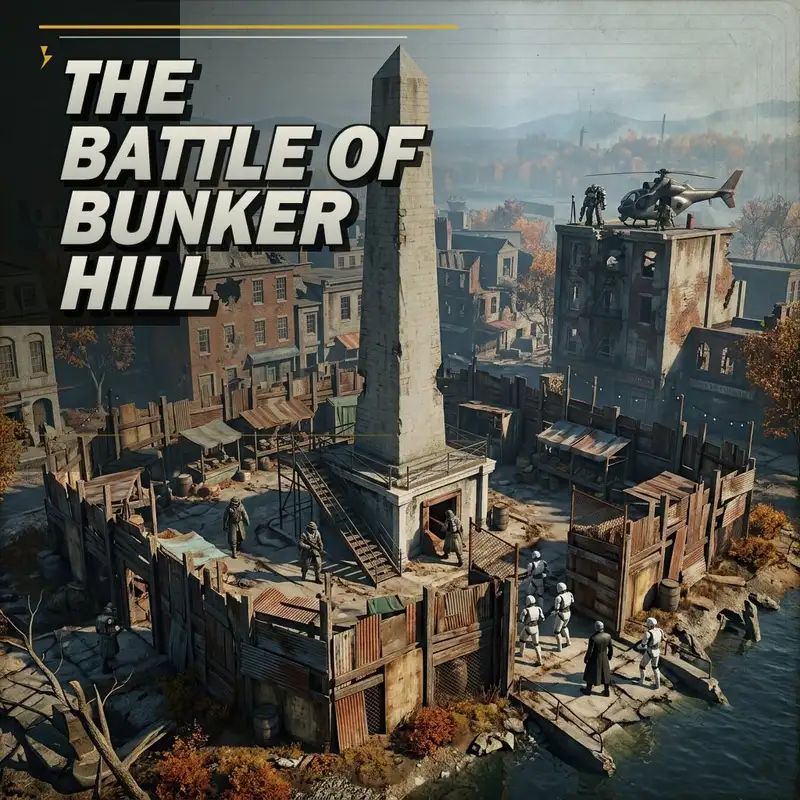
The Battle of Bunker Hill
A merchant town stood beneath the broken silhouette of a monument built to remember an older revolution. In the year twenty-two eighty-seven, Bunker Hill was not a battlefield by design. It was a market, a caravan stop, and a place where people tried to keep goods moving through a Commonwealth that had made movement expensive, dangerous, and politically consequential. Then armed outsiders arrived to determine the fate of four people hidden below the market.
Above ground, there were traders, guards, caravan workers, walls, stalls, and civilians looking for cover. Below ground, four escaped synths waited in a concealed Railroad facility. The Institute wanted them returned. The Railroad wanted them moved beyond the Institute’s reach. The Brotherhood of Steel wanted them destroyed. Bunker Hill’s residents wanted their homes and businesses to remain standing long enough for trade to resume.
That made the Battle of Bunker Hill something stranger than a conventional engagement. It was not principally a contest for a hill, a monument, or a patch of ruined Boston. It was a conflict over movement, sanctuary, intelligence, and authority. The immediate prize was four escaped synths. The larger question was who had the right to decide where those four individuals could live, travel, and belong.
The name Bunker Hill carried an obvious historical weight. The settlement grew around the surviving Bunker Hill Monument, a landmark associated with the American Revolution of seventeen seventy-five. But the fighting in the Commonwealth was not a reenactment of that earlier battle. No colonial militia stood against an imperial army. There was no clean line between defenders and attackers, and no single cause that united the people caught in the middle.
Instead, the settlement became usable ground for three outside powers with incompatible definitions of security. The Institute regarded synth escape as a breach of control. The Railroad treated escape as liberation. The Brotherhood saw synths as a threat tied to a hidden technological adversary. None of those positions required much consultation with the caravan workers, merchants, and residents whose settlement would absorb the consequences.
Bunker Hill mattered because it was one of the Commonwealth’s rare places of organized exchange. The ruins around Boston contained scattered farms, guarded settlements, raider territories, abandoned industrial sites, and isolated communities. But survival required more than a defensible building and a few crops. It required routes. Someone had to move food, medicine, tools, ammunition, salvage, messages, and news between communities that could not produce everything for themselves.
Bunker Hill helped make that movement possible. Caravans could meet there, merchants could trade there, guards could find work there, and travelers could learn which roads had become dangerous. Its importance was not measured by the size of its walls alone. A caravan center connects people who may never see one another directly. A farmer with surplus food, a settlement short of medical supplies, a scavenger with repairable machinery, and a trader carrying information all depend on places where exchange can occur.
That function gave Bunker Hill a form of local legitimacy. People came because it was useful, and because enough people believed that business could be conducted there with some degree of predictability. Predictability is a scarce resource in the Commonwealth. It means a caravan can depart with goods and expect to arrive with at least part of its cargo. It means a trader can make agreements without assuming every stranger is preparing an ambush. It means a settlement can plan beyond tomorrow morning.
Kessler, one of Bunker Hill’s leading figures, governed with the practical instincts of someone managing exposure rather than commanding an army. Her concern was trade, security, and the survival of the settlement’s people. Bunker Hill maintained guards and relied on the value of its commerce, but it did not possess the strength to impose peace on the surrounding region. Its security arrangements were defensive, negotiated, and incomplete.
That incompleteness mattered. The settlement had learned that formal promises of protection were not always enough. The Minutemen, in their earlier and weakened condition, had failed to protect Bunker Hill during a raider attack. The lesson was not necessarily that cooperation was useless. It was that a settlement could not safely base its future on a force that might not arrive, might lack the capacity to intervene, or might already be collapsing under pressure elsewhere.
Bunker Hill adapted as many Commonwealth communities did. It hired guards. It bargained. It paid for protection where it could. It made compromises with threats it could not immediately eliminate. Such arrangements were not signs of strength in the modern state sense. They were evidence of a settlement living between stronger armed groups, trying to purchase time and preserve commerce without becoming a client of any one power.
Protection payments are often described as simple cowardice or corruption by those who imagine that every community can choose between dignified resistance and easy safety. In the Commonwealth, the choices were often harsher. A merchant settlement that lost its caravans could lose food, medicine, income, and the trust that brought travelers through its gates. A settlement that provoked every nearby raider group could become a ruin. Bunker Hill’s leadership had to balance ideals against the daily arithmetic of survival.
The civilians who depended on the market were not passive scenery in this arrangement. Caravan workers needed safe routes. Merchants needed customers and stock. Guards needed pay, equipment, and a reason to remain loyal. Residents needed food, shelter, and some confidence that armed strangers would not turn every commercial dispute into a massacre. The settlement’s political economy rested on limited violence. Not the absence of violence, but its containment.
That made Bunker Hill valuable to organizations with very different goals. A place where people moved could also move information. A place where merchants expected strangers could conceal travelers. A market could provide cover, contact, supplies, and plausible explanations for unfamiliar faces. Bunker Hill’s usefulness was not only that it had walls. Its usefulness was that movement through it seemed ordinary.
The Railroad understood that kind of value. Its struggle against the Institute depended on more than conviction. It needed trusted routes, safehouses, guides, false identities, secure messages, and people willing to risk punishment for assisting escaped synths. The Railroad was not a conventional army occupying territory.
Beneath Bunker Hill, the Railroad maintained a concealed transfer point. A clandestine network survives through compartmentalization. Some people may know a portion of the route, a contact, a door, or a delivery pattern without knowing the entire organization behind it.
The facility under Bunker Hill represented sanctuary in a practical sense. Sanctuary was not merely a sympathetic feeling toward fugitives. It required space, concealment, food, water, medical support when available, trusted personnel, and a plan for the next movement. It also required silence. A safehouse that becomes publicly known is no longer simply a refuge. It becomes a target, a bargaining chip, or a trap.
For the Railroad, the people moving through that network were not contraband. They were synths seeking lives outside Institute control. To treat synths as persons was to accept responsibility for them after extraction. Rescue did not end when someone escaped the Institute. It continued through transport, shelter, identity, security, and the danger of recapture.
The four synths hidden beneath Bunker Hill represented a particular failure in that system. Their presence showed that the Railroad had created enough capacity to move escapees into the settlement. The Institute’s response showed that the network’s security had been compromised, penetrated, or otherwise exposed. The available record does not establish exactly how the Institute discovered their location. It does establish that secrecy, the Railroad’s principal protection, had failed at the moment it mattered most.
This was the danger built into clandestine work. A network can compensate for limited manpower through secrecy, discipline, and local trust. But it cannot easily absorb exposure. A military force can sometimes retreat to a second line, call for reinforcements, or hold open ground through firepower. A secret route, once identified, may endanger everyone who used it before and everyone who might use it after.
To the Institute, however, Bunker Hill was not first a sanctuary. It was the location of missing assets. After the events of the Institute operation known as Synth Retention, Father ordered the Sole Survivor to recover four escaped synths. The task was assigned practical field form through Courser X4-18, an Institute recovery specialist sent to accompany the operation.
The four synths were identified as Z3-22, B2-57, Y9-15, and F6-33. Their names matter because the conflict was not over an abstract class of machines alone. It was over four particular individuals facing recall, death, or escape. Yet the Institute’s language and institutional structure placed them within a system of ownership and command. Their departure was treated as an unauthorized loss, not as political asylum recognized by a legitimate outside authority.
That premise explains why the Institute’s mission was so narrow and so revealing. It did not need to conquer Bunker Hill. It did not need to administer the market, collect taxes, protect caravan routes, or negotiate with the settlement’s leaders. It needed access to a location, identification of four targets, and a means to bring them back under control. In effect, it treated the civilian settlement as terrain through which a recovery operation could pass.
Father supplied strategic authority. X4-18 carried out the field mission. The Sole Survivor occupied an unusual position between those levels of authority. The protagonist entered Bunker Hill as an Institute envoy, but could also possess relationships with the Brotherhood, the Railroad, or local Commonwealth communities. That flexibility was significant, but it was not a settled historical identity. The Sole Survivor’s motives, loyalties, and final decisions remain dependent on player choice.
The Institute possessed capabilities that gave it unusual reach. Teleportation allowed Institute personnel and synth forces to appear where a conventional surface force would have needed roads, vehicles, or concealed routes. That was an operational advantage. It reduced some barriers of distance and access. But it did not remove the need for a physical operation once personnel arrived.
Someone still had to enter the site. Someone had to locate the synths, distinguish them from others, secure the underground space, and carry out the recovery. Teleportation could place a force near the problem. It could not create consent among the people living around that problem. Nor could it guarantee that a location was politically neutral simply because the Institute could reach it.
The operation also exposed a familiar weakness in highly controlled systems. The Institute had technical sophistication, disciplined specialists, and the ability to project force from concealment. But its authority rested almost entirely inside the institution itself. On the surface, its presence inspired fear, suspicion, and resistance. It could retrieve a synth. It could infiltrate a community. It could remove people from their homes. What it could not easily do was persuade Commonwealth settlements that its intervention served their interests.
The Railroad interpreted the same four synths through an entirely different moral and political framework. Where the Institute saw stolen property, malfunction, or unauthorized defection, the Railroad saw people in danger of being returned to bondage. That disagreement could not be resolved by a procedural argument over jurisdiction, because neither side recognized the other’s authority to decide the question.
The Railroad’s defensive force at Bunker Hill was not designed to defeat a major military expedition in open combat. Its heavies and other defenders represented a protective arm of a clandestine organization. Their purpose was to buy time, protect escapees, and preserve routes of movement. They were the armed edge of a network built around concealment, rescue, and evacuation rather than territorial conquest.
That gave the Railroad a particular kind of strength. It could operate in spaces larger armies often ignored. It could recruit people motivated by conscience, fear, friendship, or opposition to Institute power. It could make use of hidden rooms, informal contacts, and the ordinary rhythms of Commonwealth life. A caravan town was not merely a place to hide. It was a place where arrivals and departures did not automatically look suspicious.
But the Railroad’s strengths created vulnerabilities. It needed secrecy. It needed trusted intermediaries. It needed host communities that might not share its full politics but were willing to tolerate, assist, or at least overlook its work. Once a site became known to an enemy, the organization could not compensate simply by displaying more force. Open battle favored those with larger armed formations, better mobility, and a willingness to turn a civilian space into a combat zone.
The Railroad also could not assume that every Commonwealth resident agreed with its view of synth personhood. Many people feared synth replacement, Institute infiltration, or the unknown consequences of artificial intelligence. Others had more immediate concerns. A farmer worried about raiders or a merchant worried about losing a caravan route might sympathize with an escaped synth and still fear becoming involved. Moral claims required institutions to carry them, and those institutions had limits.
The Brotherhood of Steel entered Bunker Hill from a third direction. Its position was neither Institute ownership nor Railroad liberation. Elder Maxson regarded synths as a grave threat connected to Institute power. From the Brotherhood’s perspective, allowing escaped synths to remain at large did not solve a humanitarian problem. It left dangerous technology and possible Institute influence active within the Commonwealth.
The Brotherhood’s preferred answer was destruction. The Brotherhood had arrived in the Commonwealth to confront the Institute, acquire or deny dangerous technology, and prevent what it understood as a catastrophic threat from shaping the region’s future. Destroying synths denied the Institute the return of valuable personnel and denied the Railroad a successful extraction.
The Brotherhood also brought the most visible military presence to the confrontation. Armed personnel and Vertibird activity made its intervention impossible to mistake for a quiet police action. Vertibirds gave the Brotherhood speed, intimidation, and the ability to place forces into contested areas more rapidly than many Commonwealth communities could respond.
The game does not provide a reliable order of battle, a formal assault plan, or a clear chain of command for every Brotherhood fighter present at Bunker Hill. It would be easy to look at armored troops and aircraft and imagine a complete modern military operation. The evidence supports something more limited and more important. The Brotherhood could project armed power into the settlement. It could not claim that the settlement had invited that power or that the people of Bunker Hill had consented to its use.
This distinction separates military access from political authority. A force can arrive quickly, dominate a street, and destroy an enemy position without gaining the right or the capacity to govern the civilians around it. The Brotherhood had discipline, weapons, and mobility. It did not demonstrate a civilian mandate to make Bunker Hill bear the cost of its war against the Institute.
Once the Institute recovery mission collided with Railroad protection and Brotherhood denial, the geometry of the battle became unstable. There was no single front line. No side shared the same objective. The Institute wanted living synths returned. The Railroad wanted those synths protected and moved away. The Brotherhood wanted them eliminated. Bunker Hill’s residents wanted the fighting to stop before it destroyed the commercial neutrality on which their settlement depended.
The physical environment reinforced that confusion. Bunker Hill was a built-up civilian settlement, not an empty training ground. Walls, market structures, narrow approaches, guard positions, and the monument area broke the fighting into short-range encounters. The underground facility below added another layer of confinement. Fighters could control a corner, a doorway, or a passage without controlling the wider settlement.
This was close-range combat in a place designed for trade, not war. Market stalls and barriers that had meaning in ordinary commerce became obstacles, cover, and hazards. Civilians had little ability to direct events once armed organizations began fighting around their homes and workplaces. The settlement’s local leaders might understand its terrain and its people, but they lacked the force needed to compel Institute operatives, Brotherhood troops, or Railroad defenders to stand down.
The Brotherhood’s presence demonstrated that it could reach into the heart of a Commonwealth commercial center. The Institute’s presence demonstrated that underground concealment and surface neutrality did not stop it from pursuing escaped synths. The Railroad’s defense demonstrated that it would contest recovery operations rather than abandon every compromised escapee. None of these demonstrations amounted to a decisive victory in the larger Commonwealth struggle.
The engagement is called the Battle of Bunker Hill, but the name should not mislead us. It was not a fully documented campaign battle with known troop totals, casualty figures, phases of maneuver, or a single command structure. The available evidence is shaped by a player-driven quest, fragmented faction perspectives, and a combat sequence designed to dramatize a political collision. Its historical importance lies precisely in that confusion.
A conventional battle often seeks to destroy an opposing force, seize ground, or compel a government to accept terms. At Bunker Hill, the factions were fighting over different forms of control. The Institute sought recovery. The Railroad sought escape. The Brotherhood sought denial. The settlement sought survival.
For Bunker Hill’s civilians, the most important result was the loss of neutrality. A caravan settlement survives by remaining useful to many people and becoming permanently owned by none of them. Once powerful factions used it as a site for covert extraction and armed intervention, that balance became more difficult to sustain. The market had become proof that no community in the Commonwealth was fully outside the struggle over synths and Institute power.
The battle’s decisive moral and political moment occurred below the market, where the Sole Survivor encountered the four synths at the center of the operation. The protagonist’s role was fixed in one respect. The Sole Survivor had entered the settlement carrying Institute authority and working alongside X4-18. Beyond that, the course of events could divide sharply.
One possible outcome was recall. The Sole Survivor could use the Institute’s recall codes and return Z3-22, B2-57, Y9-15, and F6-33 to Institute control. In that branch, the recovery operation achieved its narrow institutional objective. The Institute recovered the people it considered escaped assets. The outcome affirmed Father’s authority and demonstrated that, at least in this instance, the Institute’s command system could reach into a surface sanctuary and reverse an escape.
That result did not settle the larger political dispute. A successful recall did not persuade the Railroad that the synths lacked personhood. It did not repair the compromised sanctuary network. It did not make Bunker Hill safer.
Another possible outcome was the death of the four synths. The Sole Survivor could kill them rather than return them. This ended the immediate recovery problem in a brutal fashion, but it did not satisfy the Railroad’s objective of preserving the escapees. It also did not represent the Institute’s preferred result, which was recovery rather than destruction. The Brotherhood’s general hostility toward synths made destruction compatible with its strategic view, but the branch should not be mistaken for a universal Brotherhood victory or a single settled history.
The third major outcome was liberation. The Sole Survivor could turn against X4-18 and free the synths. In that branch, the Railroad’s central moral claim received direct operational support. The four escapees were not returned to the Institute, and their survival became an act of defiance against the institution that had created and controlled them.
Liberation also carried costs. It required breaking with the Institute operation in the field, exposing the Sole Survivor to judgment afterward, and accepting that the Railroad’s network had already been compromised. Saving four individuals did not erase the danger to those who had sheltered them. A successful escape could be a humanitarian victory while remaining an operational setback for the wider underground network.
These branches cannot be combined into one account. The four synths were not simultaneously recalled, killed, and freed. The game allows different outcomes, and later official material does not establish one final resolution as the sole history of the Commonwealth. Any serious account must preserve that uncertainty rather than inventing a convenient canonical ending.
The same caution applies to pre-battle intelligence. Depending on player choices and previous progress, the Sole Survivor may warn Elder Maxson, Desdemona, both leaders, or neither. Yet the game’s scripted faction appearances can place major forces at Bunker Hill even without clear player-delivered warning. That makes it unwise to claim that every faction possessed identical intelligence or that one simple message explains the entire engagement.
The most defensible conclusion is narrower. The Railroad’s sanctuary had been exposed to the Institute. The Brotherhood either possessed, acquired, or was given sufficient awareness to intervene in the crisis as the game presents it. The exact channels of knowledge remain incomplete.
After the immediate confrontation, the Sole Survivor returns to Father at the ruins of the Commonwealth Institute of Technology. The Institute can employ intermediaries, tolerate uncertainty during an operation, and benefit from a field agent with cross-faction access. But its hierarchy still depends on obedience, secrecy, and confidence that orders will be carried out.
If the synths are recovered, Father’s approval follows naturally from the Institute’s perspective. The mission’s stated objective has been completed. Control has been restored. The recovery reinforces the belief that the Institute can define the status of synths and enforce that definition beyond its underground headquarters.
If the synths are freed or killed, the encounter with Father becomes a confrontation rather than a simple debriefing. The precise result depends on dialogue choices. The Sole Survivor may preserve standing with the Institute or may be expelled from it. There is no single unavoidable political outcome that can be imposed on every playthrough.
Still, the confrontation clarifies the institutional stakes. The Institute’s underground society depends on controlled knowledge and disciplined authority. Its leaders cannot easily treat defection as a minor disagreement, because defection challenges the premise that the Institute alone may decide who belongs within its system and what its creations are allowed to become. The four synths are significant not because they could defeat the Institute militarily, but because their escape exposes a fracture in its moral and administrative order.
Bunker Hill therefore offers a compact study of Commonwealth power. The Institute possessed intelligence penetration, teleportation, synthetic personnel, and the ability to act without public permission. Yet it lacked surface legitimacy. It could reach a settlement quickly, but it could not openly govern that settlement without confronting widespread fear and hostility.
The Railroad possessed a moral claim rooted in synth autonomy and a network capable of making escape possible. It could create sanctuary where more visible institutions offered none. But its strength depended on secrecy, trusted relationships, and voluntary support. It had limited coercive capacity, and every exposed safehouse threatened the people who relied on it.
The Brotherhood possessed armed discipline, superior visible firepower, and air mobility. It could make itself felt in a way few Commonwealth organizations could. But its intervention at Bunker Hill served the Brotherhood’s security agenda, not the settlement’s local political needs. Its ability to eliminate a threat did not demonstrate that it could preserve the market, reassure merchants, or build consent among civilians who had not asked for the battle.
Bunker Hill itself possessed something the larger factions often lacked. It had local knowledge and commercial legitimacy. People used it because it made ordinary life more possible. But local legitimacy without sufficient force can be fragile. The settlement could mediate trade, hire guards, and bargain with threats.
This is the central distinction. Reaching a place is not the same as holding it. Holding it is not the same as governing it. Governing it is not the same as earning the cooperation of those who live there. The Institute, Railroad, and Brotherhood each proved that they could influence Bunker Hill. None proved that it could replace Bunker Hill’s own fragile civic order with something more secure.
The battle accelerated a wider escalation in the Commonwealth. The Railroad’s infrastructure had been exposed. The Institute had shown that it would pursue escaped synths into a civilian trade settlement. The Brotherhood had demonstrated its willingness to intervene openly against Institute-linked personnel and synths. The lines between covert competition, clandestine rescue, and open factional conflict had become harder to maintain.
But Bunker Hill did not decide the Commonwealth’s future by itself. It did not establish a formal declaration of war among every faction. It did not permanently annex the settlement to the Institute, the Brotherhood, or the Railroad. It did not provide a known territorial transfer, a decisive destruction of an opposing command, or a final answer to the question of synth freedom.
The settlement can become allied with the Sole Survivor through player-facing outcomes, but that possibility should not be mistaken for proof that a major faction conquered or rebuilt Bunker Hill after the battle. A settlement relationship in a player’s Commonwealth is not a complete record of postwar state formation.
The event also demonstrates the limits of technological power. Institute teleportation provided access, but not legitimacy. Brotherhood Vertibirds provided mobility and intimidation, but not a mandate to decide civilian life. Railroad concealment provided sanctuary, but not immunity from intelligence failure. In each case, a powerful capability solved one part of the problem while leaving another untouched.
For the people of Bunker Hill, the essential issue was more immediate. Could caravans still arrive? Could merchants still trade? Could guards still protect the market? Could a settlement built around negotiated movement remain neutral after larger powers proved willing to fight inside it? These questions do not disappear because a Courser, a Brotherhood squad, or a Railroad heavy wins a particular exchange of fire.
Bunker Hill’s real strategic value was never the monument alone, the walls alone, or the market square alone. It was the settlement’s role as contested infrastructure. Goods moved through it. Rumors moved through it. Labor moved through it. Refugees and fugitives could move through it. The ability to move without being seized, killed, or absorbed by a stronger institution was one of the Commonwealth’s most valuable and vulnerable forms of freedom.
The Institute treated that movement as an unauthorized loss of property. The Railroad treated it as liberation. The Brotherhood treated it as a security danger demanding destruction. Bunker Hill’s residents understood it differently. For them, movement was the basis of ordinary life. It was how food reached the market, how caravans earned a living, how a settlement remained connected to a wider region without surrendering itself entirely to any outside power.
For that reason, the Battle of Bunker Hill matters. Durable authority required more difficult things: the ability to protect civilians, preserve exchange, sustain trust, and secure some degree of consent from the people expected to live under its consequences.
At Bunker Hill, every major faction proved it could enter the town. None proved it could speak for the people living there.