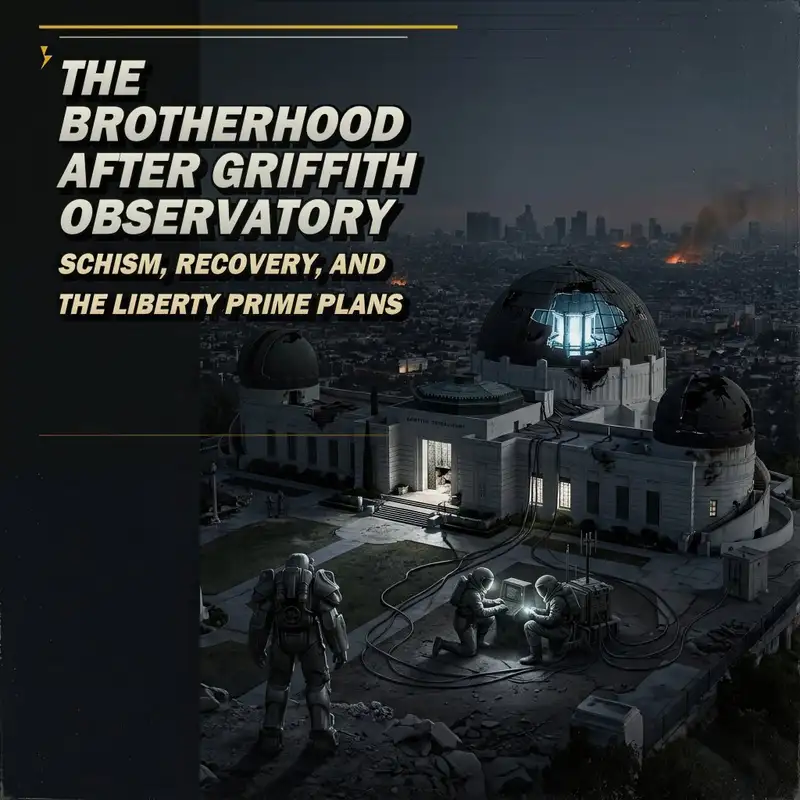
The Brotherhood After Griffith Observatory: Schism, Recovery, and the Liberty Prime Plans
At Area Fifty-One, the Brotherhood of Steel possessed the kind of prize that can alter a region’s political map. The cold-fusion technology taken after the battle at Griffith Observatory had been moved into a fortified pre-War installation. Airships arrived. Armored personnel gathered. Technical specialists had a new source of power to study and protect. Elder Cleric Quintus could present the moment as recovery, the return of Brotherhood strength to a western territory long marked by division and decline. The setting helped his case. Area Fifty-One carried the old world’s reputation for secrecy, advanced research, and weapons hidden behind layers of authority. Yet the gathering was never only a celebration of recovered technology. It was also a struggle over who had the right to command that technology, and who would command the Brotherhood once it had it.
The victory at Griffith Observatory had given Quintus a powerful argument. The Knights of San Fernando had attacked Lee Moldaver’s New California Republic remnant while its cold-fusion project was being brought online. They emerged with control of the technology. That was a military success, but it was more than a battlefield success. Energy determines what a post-War institution can maintain. It can sustain workshops, communications, medical systems, defenses, transport, and the machinery required to keep elite equipment from becoming a collection of ceremonial relics. In a continent where most communities still measure survival in water, food, ammunition, and repair parts, a reliable new source of power could be worth more than another ruined city.
The observatory’s activation also restored electricity to parts of Los Angeles. That mattered to people beyond the Brotherhood, even if the series does not establish the full civilian consequences. Power can mean light, refrigeration, pumps, communications, and the possibility that a settlement will function through another night. But the restoration came through the destruction of Moldaver’s force and the seizure of a project built by others. The Brotherhood captured the machine, but not the political consent surrounding it. That distinction would become central. A strategic asset can be taken in battle. Authority over the people affected by it has to be built, defended, and recognized.
Quintus understood the first part of that equation very well. He saw technological recovery as a path back to influence. The Brotherhood had always attached meaning to old-world science and military power, but the value of cold fusion was not merely doctrinal. It offered leverage. A chapter that controls energy may be able to repair aircraft, recharge equipment, operate advanced weapons, and bargain with neighboring forces from a position of unusual strength. In the best case, it might support a larger military and industrial system. In the worst case, it becomes the object of every rival’s suspicion, ambition, and sabotage.
The Knights of San Fernando were not the whole Brotherhood of Steel. They were a regional chapter with their own leadership, personnel, culture, and immediate interests. They had power armor, aircraft, trained fighters, scribes, and enough institutional memory to claim a place in the Brotherhood tradition. But possession of those assets did not make Quintus the uncontested leader of every chapter west of the Mississippi, or even of every Brotherhood force with an interest in the region. The Brotherhood’s history has never been a simple story of one army following one permanent chain of command. Chapters inherit symbols, rules, ranks, and ambitions, then adapt them to distance, scarcity, local enemies, and the personalities of their leaders.
That fragmentation was the problem Quintus believed he could solve. He regarded the Brotherhood as weakened by division, constrained by distant authority, and reduced from a civilization-shaping order into a collection of separated commands guarding their own traditions. His diagnosis was not entirely irrational. An organization divided among armed chapters can lose the ability to concentrate resources, coordinate strategy, replace losses, or respond to threats that cross regional boundaries. But identifying a real weakness does not guarantee a sound remedy. Quintus treated division as a problem of insufficient power at the center. The evidence at Area Fifty-One suggests the deeper problem was agreement about where the center ought to be, and whether Quintus had the right to place himself there.
The Brotherhood had seen ideological splits before. In the Capital Wasteland, Elder Owyn Lyons had directed his Brotherhood toward protecting local communities from super mutants and other dangers. Members who believed that mission had strayed from the Brotherhood’s older technology-recovery priorities broke away as the Outcasts. That earlier schism is a useful comparison because it shows that Brotherhood institutions can fracture when doctrine, mission, and command authority no longer align. But it was not the direct cause of Quintus’s crisis. The conflict around Area Fifty-One arose in a different region, under different leaders, and with a different strategic prize. Its importance lies in the recurring institutional pattern. Brotherhood unity is never guaranteed merely because members wear similar armor and invoke the same founding legacy.
Area Fifty-One gave Quintus more than a headquarters. It gave him a stage. A hidden installation with surviving infrastructure can serve as a defensible command post, technical archive, communications hub, maintenance site, or depot. It may contain equipment and records whose full purpose has been forgotten. It can also create the impression of depth. A leader operating from a secret military complex appears to possess reach, knowledge, and reserves that outsiders cannot easily measure. Pre-War institutions were often very good at producing that impression. Their bureaucracy could turn uncertainty into classified folders, locked doors, and official seals. The Brotherhood was inheriting not only the hardware of that system, but some of its political habits.
The series does not establish how much of Area Fifty-One remained functional, what arsenal it contained, or how much industrial capacity Quintus could actually command. A base with working lights is not necessarily a base with machine tools, supply chains, skilled labor, secure transport, and replacement parts. A hangar does not guarantee aircraft maintenance. A laboratory does not guarantee the ability to manufacture what its files describe. Still, the installation had enough value to become the center of Quintus’s project. By placing cold fusion there, he made Area Fifty-One both a strategic resource and a political capital. Any chapter seeking access to the new technology would have to deal with him.
Cold fusion was presented as a source of extraordinary energy, potentially useful for weapons, airships, power armor, and fusion cores. That promise was real enough to reshape the Brotherhood’s calculations. Yet power generation is only one part of military capability. Aircraft require crews, navigation, maintenance, parts, secure landing areas, and reliable command. Power armor requires trained users, repair facilities, armor components, weapons, ammunition, and doctrine. A larger force needs food, water, medical care, transport, communications, and a way to replace people who are wounded, killed, or simply decide they no longer accept the orders they have been given. Energy can expand capacity. It cannot make the rest of the system appear by decree.
This was the contradiction at the heart of Quintus’s program. He possessed a source of leverage, but he needed a governing structure. The difference is not academic. A chapter can win a battle through discipline and local command. A coalition has to decide who receives supplies, who gives orders, how disputes are resolved, what happens when an elder refuses a directive, and whether military force can be used against another member of the same order. The more valuable the shared resource, the more urgently those questions need answers. Cold fusion did not reduce the need for rules. It raised the cost of not having them.
Quintus invited the elders of the Coronado, Grand Canyon, and Yosemite chapters to Area Fifty-One. Their presence demonstrated that his proposal had appeal. These were not imaginary grievances manufactured for a ceremony. Regional chapters had reason to be wary of distant authority, especially if they believed their own burdens and opportunities were being misunderstood or controlled from elsewhere. They could see the cold-fusion project as a chance to regain autonomy, influence, or material strength. But a meeting of several elders was not a representative Brotherhood congress. It did not establish that every western chapter agreed with Quintus, or that the visitors had already accepted permanent subordination to him.
The invitation itself was political, and so was the exclusion. Quintus did not include the Commonwealth Brotherhood in his proposed alignment. That choice made clear that the meeting was not simply a technical conference about a recovered energy system. It was an attempt to assemble an alternative center of authority. The Commonwealth chapter represented the most important outside Brotherhood power in the conflict, even though the series does not fully define its senior command structure or its reach across the continent. Excluding it signaled that Quintus intended to negotiate the Brotherhood’s future without accepting the Commonwealth as the unquestioned referee.
That created a coalition built on shared resentment, access to technology, and uncertainty about distant command. Such coalitions can be effective for a short time. They can concentrate force against an external enemy, seize an installation, or resist a central authority. But they are brittle when their members have not agreed on a constitution, command arrangement, logistical system, or mechanism for settling disputes. The elders at Area Fifty-One came with their own chapters to protect. Each had followers, resources, reputations, and fears. None had reason to assume that a stronger Quintus would remain merely first among equals once he controlled the power source on which everyone else depended.
The Commonwealth Brotherhood recognized the danger. It sent Paladin Xander Harkness as a liaison. That act tells us something important, even if it does not reveal every detail of Commonwealth strategy. The Commonwealth leadership knew Quintus’s gathering could become a rebellion or civil war. Harkness’s mission was not simply ceremonial. In a fragmented military organization, a liaison can authenticate authority, observe preparations, carry warnings, and preserve a channel between parties who no longer trust one another. A liaison is a small but important piece of command architecture. He does not need to command an army to affect whether armies begin firing.
Harkness’s arrival also showed the limits of what the Commonwealth could control. Sending a representative is not the same as commanding obedience. The Commonwealth did not arrive as an omnipotent force capable of ending the dispute by declaration. It had to intervene through a person operating inside a hostile and suspicious political environment. That is a sign of both awareness and constraint. A Brotherhood chapter may claim loyalty to common traditions while still resisting outside direction when technology, territory, and local status are at stake. The armor can be standardized. The political interests beneath it rarely are.
Once Quintus had excluded the Commonwealth, Harkness could be portrayed as an observer, a threat, an intruder, or proof that the eastern authority feared western independence. In that climate, the role of liaison became dangerous. He represented information flowing beyond Area Fifty-One. He represented the possibility that the Commonwealth knew more than Quintus wanted the assembled elders to believe. He also represented a legal and institutional challenge to Quintus’s claim that he was acting for Brotherhood unity. A man trying to build a new center of authority generally prefers not to have the old center’s witness standing in the room.
This is where cold fusion failed to solve the real problem. Tactically, additional power might make weapons and protective equipment more effective. Operationally, it might support a base, improve maintenance, extend air mobility, or keep technical systems functioning longer. Strategically, it could strengthen the Brotherhood’s bargaining position against rivals outside the order. But politically, it could not answer the question of command. It could not determine whether the Coronado, Grand Canyon, and Yosemite elders owed obedience to Quintus. It could not decide whether the Commonwealth had a legitimate claim to intervene. It could not define who would control distribution, security, research, or the use of force.
Quintus treated the technology as both a material advantage and a source of legitimacy. That is a familiar temptation among military orders. A leader captures a weapon, a reactor, a dam, or an archive, then assumes possession demonstrates the right to rule. Sometimes it does create authority, at least temporarily. People follow the faction that can keep the water running or defend the road. But control of infrastructure is not the same thing as consent. A machine can supply energy. It cannot create trust between commanders who suspect one another of betrayal. It cannot make a chapter accept permanent subordination if that chapter believes its interests will be sacrificed.
The Area Fifty-One gathering collapsed under accusations, rivalries, and conflicting loyalties. The death of Paladin Harkness, followed by efforts to conceal what had happened, became a decisive point in that breakdown. The exact sequence of responsibility matters to the people involved, but the institutional effect is broader and clearer. Once the participants could no longer trust the information being presented to them, the conference lost any claim to neutral process. Concealment made every earlier suspicion more credible. If an elder or liaison could be removed and the truth managed afterward, then no promise of unity had much value.
That was not just a moral failure. It was an intelligence failure. Military organizations depend on information that commanders believe is reliable enough to act upon. They require authentic orders, recognized channels, and some confidence that a report of attack, withdrawal, or negotiation is not merely a factional weapon. When Harkness’s death became entangled with secrecy, the dispute crossed a threshold. The issue was no longer whether Quintus could persuade rival chapters to accept a new alliance. The issue was whether anyone inside the installation could trust the chain of information on which that alliance would depend.
Violence spread through the base and into the air. Brotherhood airships and vertibirds, designed to project power over difficult terrain, became instruments of fratricide. This is one of the clearest operational lessons of the conflict. Mobility is valuable only when it serves a coherent command. Aircraft need identification procedures, communications discipline, maintenance, flight crews, and confidence that the people giving orders are not enemies in familiar uniforms. Once those conditions disappear, a force’s most advanced transport system can become a liability. The Brotherhood had gathered elite military assets at Area Fifty-One, then demonstrated how quickly those assets could be turned against the organization that had assembled them.
The series does not establish the exact order of battle, casualty figures, flight paths, duration of the fighting, or final balance of surviving strength. Those details should remain uncertain. What is established is enough. A political conference intended to unify western Brotherhood chapters became armed conflict among Brotherhood personnel. That alone represents a major strategic failure. Quintus had hoped to turn a technological victory into a durable coalition. Instead, the coalition itself became a source of attrition, distrust, and destruction. Hardware may have survived. The institutional confidence required to use it together did not.
The people caught inside that failure were not all elders, paladins, or senior officers. Aspirants and ordinary Brotherhood personnel had to navigate danger created by decisions far above their authority. They faced choices between obedience, survival, chapter loyalty, and moral restraint. This is often the neglected human cost of internal war. Senior leaders frame the struggle as a matter of doctrine, honor, or the future of the order. Junior personnel experience it as confusing orders, changing loyalties, frightened comrades, and the sudden realization that the uniform beside them may no longer indicate a friend. Civil conflict is especially corrosive because it weaponizes relationships that once made a force function.
Maximus’s actions mattered within that crisis, but they did not make him the master of it. His conflict with Quintus was personal and institutional at once. He was one knight within a much larger struggle over Brotherhood authority, and his choices affected the people immediately around him. Leaving Area Fifty-One with Thaddeus was significant for both men. It removed them from Quintus’s immediate control and showed that the elder could not simply command loyalty through rank, ritual, or intimidation. But it did not resolve the wider conflict among the chapters. The Brotherhood’s future was not decided by one departure, however consequential that departure may have been.
Dane’s choice carried a different kind of significance. Dane remained behind to help protect vulnerable aspirants and then stole the cold-fusion relic from Brotherhood custody. That action was both moral resistance and material disruption. It showed that dissent within the Brotherhood did not take only the form of elders arguing over jurisdiction. It could also come from personnel who saw the immediate human consequences of Quintus’s program and refused to leave the most vulnerable people inside it without protection. Dane’s act should not be mistaken for evidence of an organized reform movement. The series does not establish such a movement. But one person with access to a strategic asset can still alter the balance of a conflict.
The theft struck at the center of Quintus’s political project. He had made cold fusion the proof that he could revive western Brotherhood power. He had gathered other chapters around access to that technology. Now the asset was no longer securely in his hands. Its future ownership, technical status, and recoverability remained uncertain. The relic may still be transformative. It may still be understood by specialists beyond Quintus’s control. But in the immediate aftermath, he had lost uninterrupted custody of the prize that made Area Fifty-One so politically important. That loss did not merely reduce his resources. It exposed how much his claim to leadership had depended on possessing something others wanted.
Quintus still retained important advantages. He had surviving personnel from the Knights of San Fernando. He had access to Area Fifty-One and its pre-War records. He retained technical knowledge, military experience, and at least some portion of the aircraft and power armor associated with his command, though the series does not establish their remaining strength. Those are substantial assets. A chapter can recover from battle damage if it has workshops, discipline, recruitment, communications, and enough political cohesion to keep its survivors working toward a common purpose. But recovery is not automatic. Damaged aircraft need parts. Wounded personnel need care. Lost specialists must be replaced. Commanders need to know who will obey them when the next order is given.
What Quintus had lost was harder to replace. He had lost the credibility of a consensual unifier. The elders he had invited had not emerged as the foundation of a durable western bloc. The conflict had shown that his coalition did not possess a shared political framework strong enough to survive pressure. He had also lost trust. Even those who accepted his criticism of the Brotherhood’s fragmentation now had reason to doubt whether his remedy would produce unity or merely establish a new tyranny around the ruins of Area Fifty-One. A leader can rebuild a hangar. Rebuilding confidence after betrayal and fratricide is another matter.
This is where the Brotherhood’s institutional weakness becomes visible. Its members possess unusual technical sophistication, military training, and access to surviving pre-War systems. Those assets can make a chapter formidable against raiders, mutants, or isolated settlements. They do not automatically create a state, a federation, or even a stable alliance. Durable power requires procedures that outlive a single leader’s authority. It requires clear responsibilities, accepted limits, reliable distribution of resources, and mechanisms to settle disputes without turning every disagreement into a test of force. Quintus wanted concentration before consensus. At Area Fifty-One, he discovered that armed organizations tend to notice the difference.
The history of Liberty Prime offers a useful warning. In the Capital Wasteland, the original Liberty Prime was recovered and activated against the Enclave. It was an extraordinary weapon, but not a self-creating one. Its restoration depended on technical labor, specialized components, secure facilities, and a Brotherhood structure capable of organizing the work. Prime was later destroyed. In the Commonwealth era, the Brotherhood rebuilt it as Liberty Prime Mark Two for its campaign there. That reconstruction again required more than a heroic decision or a set of old plans. It required access to industrial systems, technical specialists, power, transport, and a command organization able to defend and employ the project.
Liberty Prime’s earlier service demonstrates the military value of a superweapon, but it also demonstrates its dependency. Such a machine is not merely a giant soldier. It is an industrial program with a battlefield role. It needs design knowledge, heavy manufacturing, precision systems, energy integration, testing, maintenance, security, and trained personnel who can understand the limits of what they are operating. It must be transported or assembled in a way that does not expose it to sabotage. It must be given objectives that justify the resources consumed by its existence. If the supporting institution fractures, the machine becomes less a solution than a very expensive argument about who owns the remains.
The post-credits revelation at the end of the season places Quintus in front of a different possibility. He receives recovered pre-War documents identified as plans for Liberty Prime Alpha. He abandons the title Quintus the Unifier and adopts Quintus the Destroyer. The change is not subtle. It marks a shift in how he understands his own mission. The man who claimed to be gathering the Brotherhood’s scattered strength now embraces destruction as the means by which that strength will be secured. The title is a political declaration before it is a military capability.
What the plans establish is limited but important. Liberty Prime Alpha exists as a design in the recovered records, and Quintus sees it as an instrument of future power. The series does not establish whether Alpha is an earlier prototype, an alternate design, a reconstruction concept, or a project related in some other way to the original Liberty Prime and Liberty Prime Mark Two. It does not establish that Alpha is already under construction, that a complete set of blueprints survives, or that Area Fifty-One contains the components required to build it. A plan bearing a familiar name is not the same thing as an operational weapons platform.
The industrial barriers are formidable even in a world with access to cold fusion. A large robotic weapons system would require heavy fabrication, precision components, control systems, armor, sensors, power integration, specialist labor, testing facilities, and protection from sabotage. It would require a supply chain capable of moving bulky materials and a secure base capable of sustaining long-term construction. It would also require political discipline. Workers, technicians, guards, pilots, and officers must believe that the project serves an order worth sustaining. If they are divided by fear, resentment, or competing loyalties, the weapon becomes vulnerable long before it reaches a battlefield.
Quintus’s interest in Alpha therefore reveals more than a desire for greater firepower. It reveals a change in political method. Cold fusion had been meant to draw chapters together through shared opportunity. Liberty Prime Alpha points toward a different model. If unity cannot be negotiated, then perhaps it can be compelled. If rival elders will not recognize his authority, then perhaps a weapon powerful enough to destroy them can make the question irrelevant. This is the oldest illusion of militarized politics. It assumes that the destruction of opposition creates the legitimacy that opposition had denied.
A superweapon can destroy a base, break a defensive line, terrify an opponent, or alter a campaign. It cannot by itself decide who will repair roads, distribute food, protect civilians, maintain trade, recruit replacements, or settle disputes among the survivors. It cannot make an occupied chapter loyal. It cannot guarantee that technicians will continue their work after watching their comrades killed in an internal purge. It cannot turn a frightened aspirant into a committed citizen of a new Brotherhood order. Coercion may create silence. Silence is not the same thing as unity.
The contrast with Griffith Observatory is sharp. There, Quintus’s forces seized a transformative technology from an external rival. At Area Fifty-One, he tried to convert that victory into internal authority. Instead, Brotherhood personnel fired on Brotherhood personnel, a Commonwealth liaison died amid concealment and suspicion, the western coalition collapsed, and the cold-fusion asset slipped from his immediate control. The failure was not caused by a shortage of weapons or energy. It was caused by an attempt to solve a legitimacy crisis through exclusion, secrecy, and control of a strategic prize.
Liberty Prime Alpha represents Quintus’s answer to that failure. Not recovery in the broad sense of rebuilding trust, restoring disciplined command, and creating an institution that rival chapters can accept. It represents recovery as domination. The plans offer him the possibility that overwhelming force might accomplish what persuasion and political design could not. But Area Fifty-One has already shown the limits of that belief. Technology can magnify the power of an institution. It cannot hold that institution together when its members no longer agree on who has the right to command.