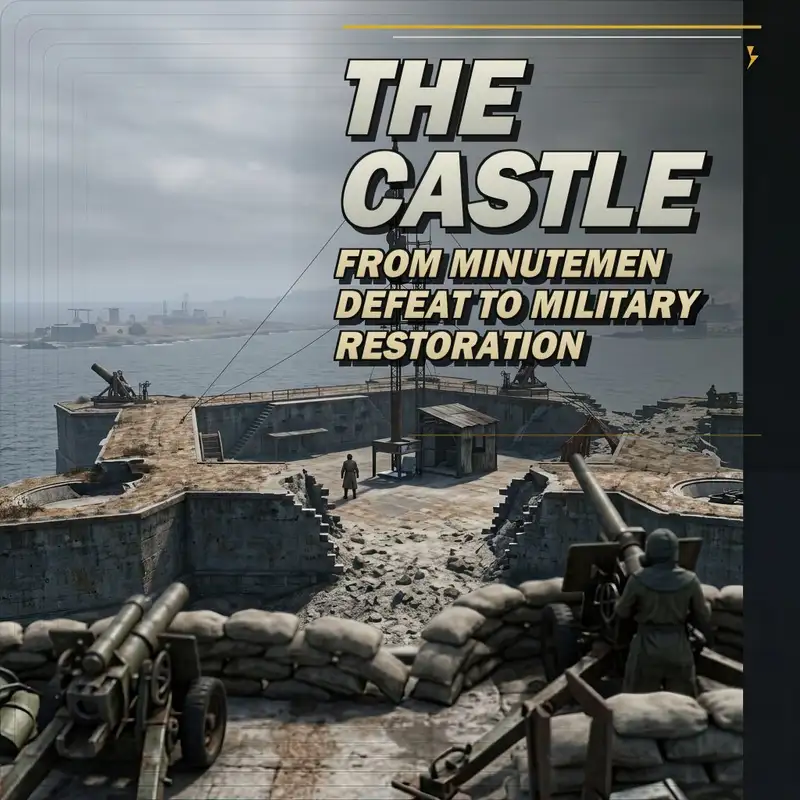
The Castle: From Minutemen Defeat to Military Restoration
General McGann was trapped beneath his own headquarters. Above him, Fort Independence had become a battlefield. Somewhere beyond the sealed passages, the Minutemen were fighting for the Castle. McGann had reached the underground armory and secured its weapons, ammunition, and artillery. Then a collapse cut him off from the rest of the fort. His surviving terminal entries describe a commander trying to make sense of a battle he could no longer see, hear clearly, or influence. He believed super mutants had attacked, perhaps led by a behemoth. He waited for relief. The relief never arrived.
McGann’s account is not a complete battle record. It is the testimony of an isolated officer, writing under pressure with incomplete information. That limitation is part of its value. The Castle did not fall because every Minuteman suddenly forgot how to fight, and it did not fall because its walls vanished. It fell because its defenders lost the ability to identify the threat, communicate across the position, concentrate their forces, and recover their own command structure once the battle went wrong.
By the time McGann understood that no rescue was coming, the underground passages had become less a refuge than a sealed pocket of the old defense. His final problem was not firepower. The armory remained stocked behind him. The problem was water, food, and time. A fortification can preserve weapons while consuming the people trapped inside it. When routes fail, communications fail, and no organized relief force arrives, even a well-built strongpoint becomes a tomb with better walls.
For that reason, the Castle mattered so much to the Commonwealth Minutemen. It was never merely a dramatic coastal ruin, a useful workshop, or a large courtyard behind stone ramparts. It was the closest thing the Minutemen possessed to an institutional center. Its loss in the year twenty-two forty did not destroy every Minuteman company in the Commonwealth. It did something more damaging over the long term. It removed the place where a scattered defense network could gather, store equipment, share information, recognize leadership, and demonstrate that mutual protection was more than a local promise.
The Minutemen had earned their reputation decades earlier. In the year twenty-one eighty, they rose to prominence after helping defend Diamond City against super mutant attackers. That success established the core idea behind the organization. Commonwealth settlements did not need to face every threat alone. Farmers, traders, craftspeople, guards, and local volunteers could call upon a wider network of armed communities. In return, they were expected to answer when another settlement faced danger.
This was not a standing national army in the modern sense. The Minutemen did not possess a clearly documented central bureaucracy, a permanent logistics corps, a standardized recruitment system, or a reliable chain of command reaching into every Commonwealth town. Their strength came from local knowledge and local responsibility. A community knew its own roads, wells, fields, people, and dangers. It could raise defenders who had a direct reason to protect their homes.
That local character was also the Minutemen’s weakness. Volunteer networks can act quickly when people trust one another and recognize a common emergency. They can fail just as quickly when settlements are exhausted, isolated, frightened, divided, or convinced that somebody else will bear the cost. The difference between a militia tradition and a durable security institution is not courage alone. It is the ability to communicate, coordinate, replenish losses, settle disputes, and make assistance dependable enough that people will risk helping strangers.
A headquarters mattered because it gave those obligations a physical form. The Castle could hold arms and supplies. It could serve as a meeting place. It could support planning, recruitment, training, and the recognition of leadership. It could also house Radio Freedom, the communications network that allowed the Minutemen to broadcast warnings and requests for aid. A settlement hearing that signal could know that trouble elsewhere was not merely rumor. It was a call from an organization claiming responsibility for Commonwealth defense.
Fort Independence had practical advantages. Its thick masonry walls and projecting bastions were built for an earlier age of coastal defense, but they still offered cover, controlled approaches, and a defensible perimeter. The underground passages gave the fort storage space and internal depth. The armory preserved military material that scattered settlements could not easily duplicate. Its position beside the water offered access to an open approach rather than total enclosure by urban ruins.
But the coast also created danger. The water was not an empty moat. It was part of the habitat and movement space of mirelurks. The Castle’s defenders occupied a strong position, but strength depended on more than stone. A fort needs observation posts, warning procedures, internal communications, reserves, disciplined defenders, safe routes between key points, and leaders who know what is happening outside their own field of view. Walls can delay an attack. They cannot repair a broken command system.
In the year twenty-two forty, a large mirelurk assault exposed those limits with brutal efficiency. The attack came at night. The Castle’s western wall was breached. A mirelurk queen led the assault, and the defenders suffered the loss of much of their leadership. The exact number of Minutemen present, the number killed, and the duration of the fighting are not established. What survives is enough to show the broad pattern. The garrison was surprised, penetrated, and fragmented.
The mirelurk queen was plainly central to the attack, but it is too simple to say that one creature destroyed the Minutemen. The deeper failure involved surprise, confusion, and the collapse of coordination. An attacker does not need to eliminate every defender to break a defense. It may be enough to force commanders into isolated pockets, sever routes through the position, disrupt communications, and make each group believe it is fighting a different battle.
McGann’s own mistaken identification of the attackers shows how severe that confusion became. He believed the Castle faced super mutants and a behemoth. That error shaped his understanding of the threat. Securing the armory and preventing powerful weapons from falling into enemy hands was a rational priority if he believed a hostile armed force had overrun the fort. It may also have drawn his attention inward while the wider defense disintegrated beyond the blocked passages.
There is no basis for claiming that correct identification would certainly have saved the Castle. By the time McGann wrote his reports, the fort was already in crisis. The western breach had been opened. The command structure had suffered heavy losses. The tunnels had collapsed. Still, his error matters because it shows that the Minutemen were not defeated by brute force alone. They were defeated by a threat they did not understand in time, moving through a position whose defenders could no longer form a common picture of the battle.
This is the ordinary and unforgiving logic of defensive warfare. A fortification divides attackers into exposed approaches only if defenders can watch those approaches. It creates interior lines only if troops can move along them. It protects ammunition and supplies only if commanders can direct those resources where they are needed. The Castle had walls, an armory, tunnels, and artillery. It did not have a functioning system for using those assets once the attack had fractured the garrison.
The loss was especially damaging because the Minutemen did not operate from a reserve capital with multiple headquarters, regional depots, and a permanent field army. Their authority was already distributed across communities. The Castle gave that distribution a center. When the center fell, individual settlements could still organize guards, patrol roads, or repel local raiders. What declined was the ability to turn many small acts of self-defense into a regional response.
Radio Freedom was part of that loss. A radio station may sound modest beside artillery and walls, but communications are military power. A warning sent early can bring defenders to a threatened settlement. A request for aid can identify where a force is needed. A broadcast can counter panic, spread information, and make a dispersed organization visible. Without that connection, every settlement must decide danger for itself, often with poor intelligence and no confidence that anyone will come if it asks.
The Castle’s defeat therefore had an operational effect far beyond South Boston. By destroying a central node in the Minutemen network, they helped turn a coordinated defense tradition into increasingly isolated local groups. The creatures held the fort. The Commonwealth lost the institution that had once used it.
McGann’s death beneath the Castle provides the clearest logistical lesson. He had access to an armory, but not to rescue. He had weapons, but not a functioning supply route. He had a fortified underground space, but no reliable way to reconnect with the wider force. Military history is filled with positions that appeared secure on a map and became untenable once their routes were cut. A fortress is not self-sustaining merely because it contains equipment. People require food, water, medical care, information, and the belief that somebody is still trying to reach them.
The decline that followed was gradual. The Castle’s fall was an institutional wound, not a single moment when the Minutemen vanished from the Commonwealth. Local companies and individuals continued to exist. The name retained meaning. Communities still remembered the promise that neighbors should defend one another. Yet memory is not command, and a tradition is not a functioning network. The longer the Minutemen lacked dependable coordination, the more difficult it became to restore mutual confidence.
Later crises deepened that deterioration. In the year twenty-two eighty-two, General Joe Becker died. Preston Garvey describes Becker’s death as a major turning point in the Minutemen’s fragmentation. The details of the organization’s succession procedures are unclear because the organization itself was increasingly unclear. A title such as General can provide focus, but it cannot ensure obedience if no shared institution exists to recognize the successor, convey orders, and enforce obligations.
The Quincy disaster showed how far that problem had progressed. It was separate from the Castle’s fall by decades and should not be treated as the same event. At Quincy, Colonel Ezra Hollis and his Minutemen responded to a Gunner attack. According to Preston Garvey, other Minutemen groups refused to come to their aid. Hollis died. Most of his force was lost.
Quincy demonstrated the cost of a network whose members no longer trusted that support would flow both ways. A local group could still answer a call. It could still fight bravely. But if other companies decided the danger was not their responsibility, the old Minutemen principle became hollow. Mutual defense depends on mutual obligation. Once settlements conclude that assistance is optional, distant, or too costly, each community has an incentive to conserve its people for the next threat closer to home.
Preston Garvey and the survivors who escaped Quincy represented continuity, but not institutional recovery. They carried the Minutemen name, some of its ideals, and the experience of those who had tried to uphold them. They did not command a broad force, possess a secure base, or control a reliable communications system. By the time they reached Concord, the Minutemen were less a regional defense organization than a handful of survivors carrying the remains of one.
That condition explains why the recovery of the Castle in the year twenty-two eighty-seven mattered. Rebuilding the Minutemen could not simply mean finding more armed volunteers. The Commonwealth already had armed people. Settlements had guards. Caravans hired protection. Mercenaries sold their skills. Raider gangs proved that weapons and manpower alone could create local power. What the Minutemen needed was a way to connect separate communities into something more capable than isolated self-defense.
The decision to retake the Castle was an improvised restoration operation. Preston Garvey helped assemble a small force, with the Sole Survivor serving as the player-defined focal commander of the effort. The title of General gave the renewed organization a political center, but the game does not establish a complete lawful succession process or a professional staff system behind that appointment. It is best understood as a wartime arrangement. Survivors needed someone able to make decisions, represent the cause, and act when the old chain of command had failed.
The objectives were larger than clearing out a dangerous nest. The Minutemen sought a defensible headquarters. They sought control of the fort’s workshop and surviving infrastructure. They sought to reopen Radio Freedom. They sought to reclaim the armory and the historical authority attached to it. Most of all, they sought to show settlements that the Minutemen could recover ground that had been abandoned for nearly half a century.
That public demonstration mattered. In a fractured Commonwealth, claims of authority are tested by visible results. A group calling itself the Minutemen could ask settlements for trust, but trust would be limited if it had no headquarters, no radio network, and no proof that it could secure a major position. Retaking the Castle was a statement in material form. The organization that had lost its center was attempting to reclaim it.
The tactical problem was real. The fort remained occupied by mirelurks, including a mirelurk queen. Preston could discuss several approaches. The force might strike through the breach in the western wall. It might combine an attack through the breach with pressure at the main gate. Or it might try to draw the mirelurks into a prepared firing line. None of those plans should be treated as the one fixed historical method. The available approaches reflect practical alternatives, not a settled canonical battle plan.
What they share is more important than their differences. The Minutemen needed to avoid being trapped in a prolonged fight inside a confined fortification. They needed to clear the courtyard and deny the mirelurks the ability to keep using the Castle as a breeding ground. The eggs mattered because an occupied fort is not truly secured if the source of the threat remains inside its walls. The queen mattered because the attack could not be considered complete while the largest and most dangerous defender remained active.
The Sole Survivor’s exact combat role remains undefined. The game allows many possible weapons, tactics, companions, and approaches. None of those player-specific details should become Commonwealth history. The fixed result, in the Minutemen restoration path, is that the mirelurk threat is removed and the Minutemen regain control of the Castle. That is a tactical victory. It removes the immediate enemy from the fort.
Mission success went further. The Castle became usable again. Its workshop could support repairs and construction. Its walls could shelter defenders. Its central location could support a renewed command presence. Clearing a fort does not automatically reconnect the settlements that had ceased to trust one another.
The first major step in using that opportunity was the restoration of Radio Freedom. It is easy to mistake the radio for atmosphere, a familiar signal in the background while other events seem more dramatic. In fact, it was among the most important assets recovered at the Castle. Communications determine whether a militia network is a collection of armed communities or an organization capable of shared action.
A functioning broadcast allows settlements to hear that the Minutemen exist beyond their own horizon. It allows calls for assistance to move farther and faster than a frightened traveler on a damaged road. It provides warnings. It publicizes successful defenses. It can reassure communities that a threat has been recognized and that somebody may be mobilizing in response. In a region where distance, hostile terrain, raiders, mutated wildlife, and broken infrastructure all impede travel, information can be as valuable as another rifle.
Radio Freedom also had a political effect. A headquarters broadcasts more than orders. Every transmission from the Castle reinforced a claim that the Minutemen were again a Commonwealth-wide institution, not merely a band of survivors moving between settlements. The signal told listeners that someone occupied the old headquarters, remembered its mission, and intended to make the old promise credible again.
That did not make every transmission reliable intelligence or every request for help solvable. Radios can spread false reports as easily as accurate ones. A warning is useful only if somebody can act on it. A call for aid is only as meaningful as the people, weapons, food, ammunition, and transport available to answer. The restored network reduced isolation. It did not abolish distance, fear, exhaustion, or the local calculations that had failed the Minutemen at Quincy.
This distinction is important because the Minutemen were rebuilding a defense network, not activating a magical command system. Radio Freedom could coordinate communities that chose to cooperate. It could not force a frightened settlement to send its only guards down a dangerous road. It could not create medicine, repair weapons, replace casualties, or make every local report accurate. Communications improve capacity, but they also reveal the limits of capacity when the response does not arrive.
The next recovery came through Ronnie Shaw, a veteran Minuteman with knowledge of the Castle’s older military infrastructure. Ronnie’s importance lies in institutional memory. She was not simply another armed recruit or a supplier of equipment. She remembered that the Castle’s underground passages contained more than ruins. They contained a connection to the Minutemen’s former procedures, stored resources, and conception of themselves as an organization able to do more than defend a single gate.
The tunnels had already demonstrated their darker side in the year twenty-two forty. They had trapped McGann and separated command from the battle above. In the restoration, they became a route back to the buried armory. Institutions often inherit the same infrastructure that failed their predecessors. A bunker, archive, radio system, or weapons cache can preserve useful capacity. It can also preserve the blind spots that caused earlier disaster. The value lies in whether people understand what they have recovered and use it differently.
Ronnie led the effort to clear the old passages and recover artillery schematics, smoke flares, and the knowledge needed to reactivate the Castle’s artillery capability. Schematics are stored knowledge. They tell an organization how to build, arrange, and employ a system. Smoke flares establish a crude but practical method of marking targets for indirect fire. An assigned operator turns a constructed gun from inert hardware into a military asset.
The test firing matters because it moves the artillery from possibility to demonstrated capability. Possessing an old plan is not the same as building a working weapon. Building a weapon is not the same as supplying it. Supplying it is not the same as training an operator, maintaining the mechanism, communicating with observers, identifying a target, and avoiding harm to friendly people nearby. The Minutemen recover not a complete artillery branch, but the beginnings of a shared fire-support practice.
Ronnie Shaw helps give that practice historical legitimacy. She reconnects the revived organization to people who had served before its collapse. That continuity can matter as much as the equipment. Volunteers are more likely to believe in a revived institution when they can see that it is not merely using an old name. The recovered armory, the radio, the fort, and the veteran who remembers them all suggest that the Minutemen once possessed a greater degree of coordination, and might regain some of it.
The artillery system developed after the Castle’s retaking is best understood as distributed indirect fire support. Allied settlements can establish artillery positions and use smoke signals to request support. That gives the Minutemen a way to assist one community from another location. A settlement that joins the network does not merely receive a speech about common defense. It may gain access to a tool that can strengthen its own position when a threat appears nearby.
That is a significant operational change. Indirect fire allows defenders to affect a fight without moving every available person directly into danger. It can support local militias, reinforce a threatened point, and make an attacker face risks beyond the settlement it chose to target. More importantly, it links settlements through a shared capability. The Castle does not have to physically occupy every road or field to influence the region. It can provide doctrine, equipment knowledge, and a focal point for coordination.
Yet this should not be mistaken for a modern artillery corps. There is no established permanent Minutemen ammunition system stretching across the Commonwealth. There is no documented fire-direction center, standardized training pipeline, professional maintenance branch, or formal command structure assigning batteries to sectors. The available evidence does not show that every allied settlement builds artillery, that every gun has the same support arrangement, or that the system can strike anywhere in the Commonwealth.
Each artillery position still depends on local labor, materials, security, maintenance, and an operator. It depends on a settlement with enough stability to devote resources to something beyond immediate survival. It depends on ammunition and the ability to keep the equipment functional. A smoke flare can identify a target area, but it cannot replace detailed reconnaissance, reliable maps, or the careful control needed to employ firepower around civilians and friendly defenders.
This limitation reveals the Minutemen’s distinctive structure. Their restored artillery is decentralized because their defense system is decentralized. Local communities retain much of the responsibility for their own safety. The Castle provides a common headquarters, shared knowledge, and a symbol of command. It does not replace every local militia with a centrally controlled force. That arrangement can be flexible and resilient. It can also produce uneven readiness, inconsistent discipline, and gaps wherever settlements lack the resources or confidence to participate.
The Castle’s restoration became more meaningful when it was itself treated as a target worth defending. In later events, the fort may come under attack from different enemies depending on the player’s factional path. The attackers can vary. What remains significant is the change in the Castle’s role. It is no longer a passive ruin occupied by mirelurks.
A headquarters attracts attention because it concentrates assets. Enemies need not destroy every settlement in a network if they can disrupt its central radio, seize its stores, discredit its leadership, or demonstrate that its defenders cannot protect their own base. Defending the Castle therefore becomes more than a local fight over walls. It becomes a test of whether the restored Minutemen can preserve the node that allows their wider system to function.
Holding the fort would prove something important, but not everything. It would show that the Minutemen could fight for their center. It would not prove that they controlled the Commonwealth, possessed secure borders, or had solved their recurring problem of fragmentation. A strongpoint can survive an attack while the roads beyond it remain unsafe. A radio can keep broadcasting while distant communities refuse to answer one another’s calls. Military restoration is not the same as state formation.
The Castle’s recovery must therefore be judged at several levels. The ruined headquarters becomes defensible again. The immediate danger that had occupied it since the year twenty-two forty is eliminated. No institution can rebuild around a headquarters still controlled by the threat that destroyed its predecessors.
At the mission level, the Minutemen recover usable infrastructure. The workshop permits repair and construction. The armory and tunnels preserve access to old resources and designs. Radio Freedom returns as a tool for warning, coordination, and public visibility. Artillery knowledge gives allied settlements a way to provide support beyond the range of ordinary local defense. These are not abstract symbols. They are practical components of collective security.
Operationally, the Castle restores the potential to reconnect the Commonwealth’s scattered defenders. The key word is potential. A headquarters can issue a call. A radio can spread it. Artillery can support a nearby engagement. None of those systems guarantees that the right people will receive accurate information, arrive in time, possess sufficient supplies, or agree that the danger is worth the risk. The Minutemen regain the architecture of coordination, not automatic coordination itself.
The intelligence outcome is similarly limited. Radio links and a central command post can improve warning and reduce the isolation that helped doom the older organization. They can also produce more reports, more rumors, and more demands than the Minutemen can verify or answer. McGann’s experience remains relevant. A force can have weapons and courage yet still fail if it misunderstands what it is facing. Better communication helps create a common picture of danger.
Logistically, the Castle gives the Minutemen a base for storage, maintenance, and repair. That is a real advantage in a region where functional equipment cannot be taken for granted. But the fort does not prove the existence of mass production, secure supply chains, abundant ammunition, or standardized sustainment. A recovered artillery schematic is valuable precisely because the Commonwealth cannot casually manufacture every advanced system it finds. Salvage must be inspected, moved, repaired, guarded, and eventually replaced.
Politically, the Castle offers the Minutemen a credible claim to restored authority. It connects the revived organization to the defense of Diamond City, the older headquarters, the remembered institution of General McGann, and the principle that settlements should not stand alone. It can help recruitment because people are more likely to join an organization that has a base, a signal, visible defenses, and evidence of recent success. It can help command recognition because the title of General is no longer attached only to a wandering survivor, but to a functioning headquarters.
Still, the Castle does not create a government by itself. It does not establish taxation, courts, civil administration, uniform recruitment standards, a permanent succession system, or guaranteed obedience from every settlement. It does not resolve property disputes, distribute food, repair every road, or determine how much authority local communities are willing to surrender for collective protection. The Minutemen may become stronger without becoming a state, and that distinction is central to understanding both their appeal and their vulnerability.
For civilians, the restored Castle can mean better warning, more opportunities for assistance, and the possibility that a threatened settlement is no longer entirely alone. Communities must provide much of the labor, local security, food, maintenance, and manpower that make the network work. A decentralized defense system distributes protection, but it distributes responsibility as well. The people under its protection remain the people expected to sustain it.
The Castle was therefore not simply reclaimed from mirelurks. Its restoration recovered the minimum architecture of collective defense: a headquarters, a radio network, an armory, shared procedures, stored knowledge, and the means for distant settlements to believe that assistance might actually arrive. That made it the first genuine step toward military restoration for the Commonwealth Minutemen.
But restoration remained conditional. The old Minutemen had not failed because they lacked walls alone. They had failed when command fractured, information failed, rescue did not come, and local obligation became unreliable. The new Castle could coordinate a revival, but it could not by itself provide the manpower, administration, discipline, logistics, and public consent required to turn a militia network into a durable Commonwealth institution.