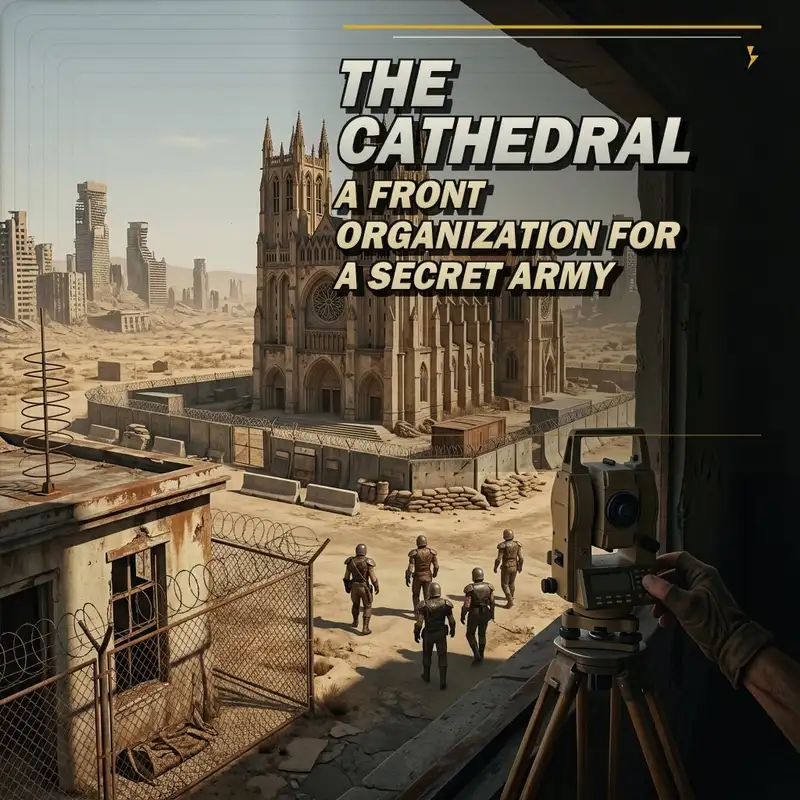
The Cathedral: A Front Organization for a Secret Army
On the surface, the Cathedral offered a frightened population the things frightened populations look for first. It promised peace. It offered healing. Its representatives spoke the language of unity rather than conquest, and they moved through human settlements with flowers, sermons, medical aid, and a confidence that suggested order might still be possible in the ruins of Southern California.
Below that public institution lay a very different center of power. Beneath the church, inside the buried Los Angeles Vault, the Master directed the Unity. His movement was building an army of super mutants, using forced transformation as both a weapon and a political program. Those who joined would be remade. Those who refused would not be left alone. The Master’s promised peace had room for very little human choice.
That contrast is the key to understanding the Cathedral. It was not simply a secret headquarters with a chapel placed above it for decoration. The church was the Unity’s human face. It made contact with communities that would have fled from openly mutant forces. It gathered information, recruited personnel, distributed aid, imposed discipline, and translated the Master’s grand and terrible vision into language that ordinary people could hear.
A hidden bunker can protect a leader. It cannot, by itself, persuade settlements to open their doors. It cannot easily identify dissidents, learn who controls local water supplies, discover which travelers carry useful information, or determine where a frightened population might accept help in exchange for obedience. The Cathedral did those things. It gave the Unity a way to enter human society before the mutant army attempted to remake it.
By the years twenty-one sixty-one and twenty-one sixty-two, the West Coast was not empty territory waiting for whoever carried the largest weapon. It contained towns, caravan routes, merchants, doctors, gangs, farmers, refugees, scavengers, and communities trying to impose some measure of security on a damaged world. Many of those communities were fragile. Their institutions were small. Their records were incomplete. Their capacity to treat disease, settle disputes, or resist organized coercion was uneven.
That environment created an opening for the Children of the Cathedral. The Children did not need to persuade every person in the region. They only needed enough people to see them as useful, respectable, and less dangerous than the alternatives. In a place where raiders, illness, hunger, and isolation were ordinary concerns, a religious organization that offered comfort and medical care could acquire influence long before anyone understood its larger purpose.
The Unity itself was made up of related but distinct institutions. The Master was its supreme authority, the figure whose ideology and strategic direction held the project together. Mariposa Military Base contained the Forced Evolutionary Virus facilities that gave the Unity its capacity to transform captives into super mutants. The Lieutenant commanded the mutant military arm and represented the Unity’s expansionist program in its bluntest form.
The Cathedral and its human organization served another purpose. It was the political and social interface between the Unity and the population it intended to absorb. It did not create the mutant army. It did not replace Mariposa’s vats or its scientific infrastructure. But it helped make the army usable. It reduced the political costs of expansion by making human communities easier to observe, approach, infiltrate, and eventually control.
The difference matters because the Master’s problem was never merely how to create super mutants. The Forced Evolutionary Virus provided a method of transformation, however brutal and uncertain that method could be. The harder question was what to do with the human world around the vats. A force of visibly altered soldiers could terrify a settlement. Terror can open a gate. It does not automatically produce information, administration, labor, or durable obedience.
A purely military campaign would also reveal the Unity too early. If every encounter with the movement involved armed mutants, kidnappings, and destruction, human communities would have every reason to cooperate against it. The Master needed access before resistance became organized. He needed human beings who could travel without attracting immediate alarm, speak familiar languages, handle local institutions, and present the coming transformation as salvation rather than occupation.
The Cathedral answered that need by changing the first impression. It did not announce a biological conquest. It announced a moral one. Its message was that humanity had suffered because it was divided, violent, selfish, and spiritually lost. The solution, according to the Children, was peace through unity. In the abstract, that message was not difficult to understand. The old world had destroyed itself. The new world was often cruel. A promise that conflict could end carried real emotional force.
The Children’s language also matched the Master’s own belief. He was not simply pretending to want peace while privately pursuing chaos or personal wealth. He believed that human conflict arose from weakness, division, and competition. A single transformed species, adapted to the wasteland and stripped of old distinctions, appeared to him as a solution to the cycle of war. His conviction was sincere. That sincerity did not make the program humane.
The Cathedral’s public work made the doctrine credible because it was connected to material aid. The Children operated a hospital in the Hub, one of the region’s important trading centers. Their representatives offered care and spoke of healing. In a society where medical treatment could be scarce, dangerous, or unaffordable, a hospital was not a decorative symbol. It was a practical institution. It brought patients, families, travelers, and local rumors through the same doors.
That kind of work was politically valuable precisely because it could be real. A person who received treatment did not need to know anything about the Master, the Vault beneath the Cathedral, or the Forced Evolutionary Virus program for the service to matter. A family looking for a healer was not necessarily endorsing a secret army. A patient seeking help was not automatically a collaborator in mass coercion. The Cathedral’s influence grew because it met needs that other institutions could not always meet.
Relief creates relationships. It establishes familiarity, gives an organization a reason to ask questions, and builds a reputation that makes those questions seem ordinary. Information about illness, recent arrivals, caravan routes, local guards, desperate families, Vault sightings, and community disputes can all surface through that contact. In stable societies, such information may be held by bureaucracies, markets, and public records. In the wasteland, it often travels through personal networks.
The Children could become part of those networks. Their presence in settlements gave them access to the ordinary traffic of human life. They could hear complaints before they became rebellions. They could identify people looking for protection, purpose, employment, or belonging. They could observe who had influence without holding formal office. They could learn which communities had competent leadership and which had only a frightened guard force standing between order and collapse.
The available evidence does not establish a perfectly mapped espionage service with formal offices, ranks, and files for every town in Southern California. It would be a mistake to turn the Cathedral into an all-seeing intelligence machine. But the game makes clear that the Children were capable of infiltration and that opposition to the Cathedral carried risks. Their network was not merely devotional. It had practical eyes and ears.
The Followers of the Apocalypse understood this danger. They were themselves a human network of scholars, healers, and reformers working amid the ruins of the Boneyard. Their concern was not based on a philosophical disagreement alone. The Followers encountered evidence that the Cathedral’s public image concealed a more threatening project. They also faced infiltration from within their own environment, a reminder that the Children’s influence did not stop at church doors or hospital wards.
Reports of disappearances gave the Cathedral’s peaceful image a harder edge. People who rejected its vision could vanish. That did not mean every skeptical citizen was immediately seized by agents in robes, nor does the surviving record allow a complete account of every abduction. But it does show that the movement combined persuasion with coercion. The flower offered in public and the threat operating in private were parts of the same political system.
Intelligence becomes dangerous when it supports action. Knowing who opposes a movement can help suppress that opposition. Knowing who is isolated can help recruit them. Knowing where people travel can help intercept them. Knowing which settlement has weak defenses can help a military commander decide where intimidation will be cheapest. The Cathedral made human society more legible to the Unity, and legibility is a form of power.
This was especially important because the Unity’s principal military forces could not easily blend into ordinary communities. Super mutants were physically imposing and visibly alien to the humans the Master intended to rule. Nightkin, who served as elite and trusted assets within the Unity, could be used for special tasks, intimidation, and infiltration under particular circumstances. Yet the core problem remained. A mutant army could seize people. It could not easily become invisible among them.
Human personnel could. The Children supplied preachers, medical workers, guards, technicians, spies, administrators, and recruiters. They could rent rooms, carry messages, visit markets, speak to local leaders, and move through the same roads and settlements used by caravans and refugees. They could perform the unglamorous work that turns a movement from a raiding force into something closer to a governing apparatus.
Not every Child of the Cathedral understood the entire program. Some appear to have been sincere believers in peace and spiritual unity. Others were clearly involved in discipline, surveillance, or enforcement. Some had medical or technical roles. Some may have joined because the organization offered security, status, employment, or community. A hierarchical institution does not require every member to know its deepest secret. In fact, secrecy works best when knowledge is divided.
Morpheus was central to this arrangement. As the public leader of the Children, he could translate the Master’s remote and increasingly inhuman vision into a doctrine that sounded comprehensible to ordinary people. He spoke as a religious authority, not as a military officer or laboratory director. His task was to turn obedience into faith, and to make the prospect of a coming Unity appear less like the destruction of human society than its redemption.
Jain, the High Priestess, represented another layer of that religious authority. Her language of the Holy Flame and the coming Unity gave the organization ritual seriousness. The Cathedral did not present itself merely as a charity with armed guards. It offered an explanation for suffering. That matters in a devastated world. Institutions that can explain pain often gain influence over people who have no other framework for making sense of it.
Father Lasher and other enforcers revealed the harsher side of the hierarchy. Faith was not the only mechanism holding the organization together. There was discipline, intimidation, and internal control. This is where the Cathedral becomes difficult to dismiss as either wholly sincere or wholly theatrical. It was a religious movement, but one organized around a concealed military project. It was a provider of aid, but one capable of using dependency and fear. It was a community, but not one that tolerated independent judgment indefinitely.
The human apparatus reduced the cost of expansion for the mutant army. It could identify potential targets before soldiers appeared. It could encourage passive acceptance before force was needed. It could locate people useful for conversion, labor, or technical work. It could spread a message that prepared communities psychologically for the idea that the old human order had failed and needed replacement.
Still, the Cathedral was not the Unity’s army. The distinction is crucial. Its value lay in support, preparation, and concealment. The mutant forces remained the instrument of direct coercion. The Lieutenant’s command represented the military threat behind the sermons. The Children could create access, but they could not replace the armed power that made refusal dangerous.
Mariposa and the Cathedral therefore formed complementary centers of power. Mariposa was the biological and military foundation. It contained the Forced Evolutionary Virus vats and the infrastructure associated with transforming human beings into super mutants. Its importance was industrial in the broadest sense. It was where the Unity could reproduce its military manpower through conversion, even if that process depended on capturing people rather than recruiting them as ordinary soldiers.
The Cathedral was different. It concealed the Master’s headquarters beneath a functioning human institution. It gave him access to the Los Angeles Vault and to the knowledge, equipment, and protected underground space associated with it. It placed the Unity’s supreme authority close to human population centers while disguising that authority behind a public organization built around worship and care.
The Master’s move toward a permanent headquarters was more than a search for a better hiding place. Mobile organizations can survive, but they struggle to coordinate complex projects. A movement attempting biological transformation, military expansion, intelligence collection, religious propaganda, and political control needs stable communications, trusted personnel, records, technical specialists, and secure space. A fixed center allows decisions to accumulate into institutions.
It also creates vulnerability. A central headquarters can direct a far-flung campaign, but it can become a single point of failure. The Cathedral’s underground location protected the Master from casual discovery. Its public surface added another layer of concealment. Yet the same arrangement concentrated ideological authority, command functions, and critical knowledge in one place. If exposed, it could not easily be replaced.
Mariposa faced a related but distinct problem. It was not merely a fortress occupied by mutants. It was the practical basis for continued mass conversion. Destroying it would not erase every existing super mutant, and it would not make the Unity’s military threat disappear instantly. But it would strike at the mechanism through which the movement intended to expand its transformed population. Without that capacity, the Master’s project would lose its biological engine.
Destroying the Cathedral alone would also be incomplete. The Master’s death and the loss of his command center would remove the figure who held the Unity’s ideology and strategy together. But Mariposa’s facilities would remain a danger if left intact. The two sites were not interchangeable, but they supported one another. One directed the project. The other gave it the means to create the force required to carry it out.
The relationship between the sites also explains why the Cathedral mattered so much. It was not simply a false wall hiding a laboratory. It linked biological warfare, military power, intelligence work, religious authority, and civilian access. It made the Unity look less like an invasion and more like an emerging social order. That was a strategic achievement, even if the order it promised was built on coercion from the beginning.
The underground Vault beneath the Cathedral carried another implication. The Unity was interested in more than immediate conquest. Vaults represented protected populations, technical archives, controlled environments, and evidence of how humanity had attempted to survive the Great War. For the Master, they also represented potential sources of people. A population preserved from the worst of the wasteland could be seen not as an autonomous community but as material for conversion.
This reveals the meaning of the Unity’s political language. Conversion was not membership in the ordinary sense. The Master argued that transformation would end human conflict by eliminating the differences that made people fight. But the process did not ask communities to negotiate a common government, share power, or build mutual security. It required people to surrender their bodies and identities to a program imposed from above.
The Master’s own plan made the hierarchy plain. Those who accepted transformation would be converted. Those who refused would be sterilized. Those who actively resisted would be killed. This was not a difficult policy concealed behind peaceful language. It was a system in which the population was divided according to obedience. The phrase unity did not mean consent. It meant that the Master would decide what form humanity was allowed to take.
The biological program was therefore also a political caste project. Super mutants would become the dominant population and military force. Unconverted humans who submitted would be rendered incapable of reproducing. Those who fought would be eliminated. The result would not be a federation of equal communities. It would be a transformed order in which the right to remain fully human depended on abandoning political resistance.
The Cathedral helped normalize the first step in that process. Its language of healing and purification encouraged people to see suffering as evidence that the old human world was broken. Its religious authority framed transformation as a moral necessity rather than an act of conquest. Its humanitarian work made the movement’s representatives familiar. Its internal discipline demonstrated what happened when faith became compulsory.
There is a grim institutional logic here. A regime preparing to absorb a population cannot rely only on soldiers. It needs categories. It needs to know who is willing, who is hesitant, who is useful, who is dangerous, and who can be isolated. It needs people who can administer the process, explain it, conceal it, and identify resistance before that resistance becomes organized. The Cathedral gave the Unity many of those capabilities.
That is why the Followers of the Apocalypse posed such a serious threat. The Followers were not a conventional army. They did not command mutant forces, control a vast industrial base, or possess the means to challenge the Unity in open battle. Their strength lay elsewhere. They gathered knowledge. They offered education and medical assistance. They encouraged inquiry. They maintained a degree of independence from the institutions that claimed to have final answers.
The Followers and the Cathedral could look superficially similar. Both operated among civilians. Both addressed suffering. Both valued learning and healing in some form. Both understood that a damaged society could not survive on weapons alone. But their institutional logic was fundamentally different. The Followers’ work depended on sharing knowledge and allowing people to think for themselves. The Cathedral’s work directed people toward a truth already defined by the Master.
The difference was not simply moral, though it was moral. It was political. The Followers represented a rival model of reconstruction. Their approach was fragmented, imperfect, and vulnerable. It did not promise immediate order or military security. But it treated human beings as people capable of learning, arguing, and making choices. The Cathedral offered a more disciplined answer to insecurity, but its discipline ended in biological compulsion.
For the Unity, independent inquiry was dangerous because it could expose the contradiction beneath the doctrine. A movement that claims to heal humanity must prevent people from examining what its healing actually requires. The Followers’ skepticism, their access to information, and their ability to communicate outside the Cathedral’s authority made them more than philosophical critics. They were an institutional obstacle to monopoly over truth.
The Cathedral’s greatest weakness could be concealed politically for a time, but it could not be solved with sermons, hospitals, or spies. The super mutants created by the Forced Evolutionary Virus were sterile. That fact transformed the strategic meaning of the entire Unity program. It was not a minor technical flaw. It was the point at which the Master’s vision of a permanent replacement civilization stopped making sense.
A society can survive a great deal of hardship if it can reproduce itself, train its young, pass on skills, and sustain institutions across generations. The Unity’s planned population could not do that if its transformed members were sterile. It could expand only by converting existing humans. Every successful conversion would reduce the number of people available to produce future generations. Every sterilization would do the same. Every execution would make the demographic problem worse.
None of this made the mutant army harmless. Existing super mutants remained formidable. They could still attack settlements, capture prisoners, defend key facilities, and intimidate opponents. Sterility did not cause weapons to vanish or walls to collapse. It did not remove the immediate danger faced by communities under pressure from the Unity.
In the near term, Mariposa still mattered because it could continue converting captives while the Unity remained intact. The movement had a mechanism for replacing losses in the short term, provided it could keep capturing people and maintaining its transformation infrastructure. But this was not ordinary recruitment. It was consumption. The Unity’s manpower system depended on absorbing the very human population it claimed to supersede.
Over time, however, the flaw was devastating. The Master envisioned a stable mutant future that would end the old cycle of war. But a sterile successor population could not become self-sustaining without solving its reproductive problem. The more completely the Unity succeeded in its stated program, the more thoroughly it eliminated its own future source of life. Its victory would contain the seeds of demographic extinction.
The political implication was stark: the Master was not building a durable civilization. He was building a one-generation dictatorship with a biological deadline. The Cathedral’s public promise of lasting peace concealed this problem as effectively as it concealed the Vault beneath its foundations. Yet no amount of propaganda could turn a sterile population into a self-reproducing society.
For civilians, the consequences were immediate and irreversible. Conversion meant losing the choice to remain human. Sterilization meant being denied descendants as punishment for refusal. Execution meant that political resistance was treated as a crime against the new order. The Master’s language of unity transformed ordinary human rights into obstacles to be removed. It converted survival into a condition of submission.
When evidence of sterility confronted the Master’s plan, the conflict reached its real strategic center. The question was no longer whether the Unity could defeat scattered communities in the short term. It was whether its project could fulfill the future it promised. The answer was no. The Master’s solution to human conflict depended on destroying human autonomy, and the biological system chosen to replace humanity could not reproduce itself.
The Vault Dweller’s campaign against the Unity therefore mattered because it targeted connected institutions rather than merely a famous leader. The precise route through those events can vary. The Vault Dweller might reach the Cathedral through deception, infiltration, direct combat, or other methods. The confrontation with the Master can unfold differently depending on what the player discovers and says. Those details should not be forced into one official account.
The strategic result, however, is clear. The Cathedral is destroyed, taking with it the Master and the command center that held the Unity together. Mariposa is also destroyed, removing the essential conversion infrastructure that underpinned the movement’s military expansion. The order in which those blows fall is less important than their combined effect. The Unity loses both its supreme authority and its capacity for continued mass transformation.
Killing the Master did not erase every super mutant from the West Coast. It did not repair every settlement harmed by the Unity, restore those already transformed, or erase the trauma caused by abduction and coercion. Military organizations can survive the death of leaders. Armed groups can fragment, retreat, or persist in altered forms. But the Unity was unusually dependent on the Master’s ideological authority and on the biological machinery at Mariposa.
The destruction of both nodes therefore dismantled an emerging regime. The Cathedral had supplied legitimacy, intelligence access, human administration, and a concealed headquarters. Mariposa had supplied the means to create the transformed force at the center of the Master’s plan. Remove one, and the other remains dangerous. Remove both, and the Unity no longer possesses the connected institutions required to continue its project at scale.
The Cathedral had achieved a great deal before that collapse. Politically, it gained credibility among people who needed security, care, and a coherent explanation for suffering. Intelligently, it penetrated human communities and identified opposition. Logistically, it connected personnel, shelter, medical work, information, and social access. Institutionally, it gave the Unity a human administration and a respectable public face.
Militarily, its contribution was indirect but important. The Cathedral did not manufacture mutant soldiers or command every operation. Its value was that it prepared the ground on which military power could operate. It made human communities less opaque. It helped convert uncertainty into targets, recruits, captives, and compliant populations. It supported conquest by making conquest appear, at least in part, like relief.
Its public mission was not false in every practical sense. The care it offered could be useful. The order it promised could appeal to people exhausted by violence and fragmentation. That is why the Cathedral was more dangerous than a simple lie. A crude deception collapses when exposed. A political institution that provides real benefits can survive longer because it gives people tangible reasons to trust it.
But the Cathedral could not solve the Unity’s basic problem. It depended on secrecy because the full program was unacceptable to anyone who valued human autonomy. It depended on coercion because many communities would refuse transformation if given a genuine choice. And it depended on a biological future that could not sustain itself. Its institutions were sophisticated enough to prepare conquest, but not to overcome the contradiction built into the conquest itself.
The Cathedral stands as a reminder that secret armies do not survive on weapons and laboratories alone. They require institutions that enter civilian life. They need messengers, healers, administrators, informants, guards, and believers. They need places where fear can be turned into trust, trust into access, and access into control. The Master understood that much with terrible clarity.
His fatal error was believing that peace imposed through forced transformation could become civilization. The Cathedral made the Unity dangerous because it converted humanitarian credibility into political access, intelligence, labor, and compliance. Yet beneath its promise of healing lay a sterile future, sustained only by consuming the humanity it claimed to save.