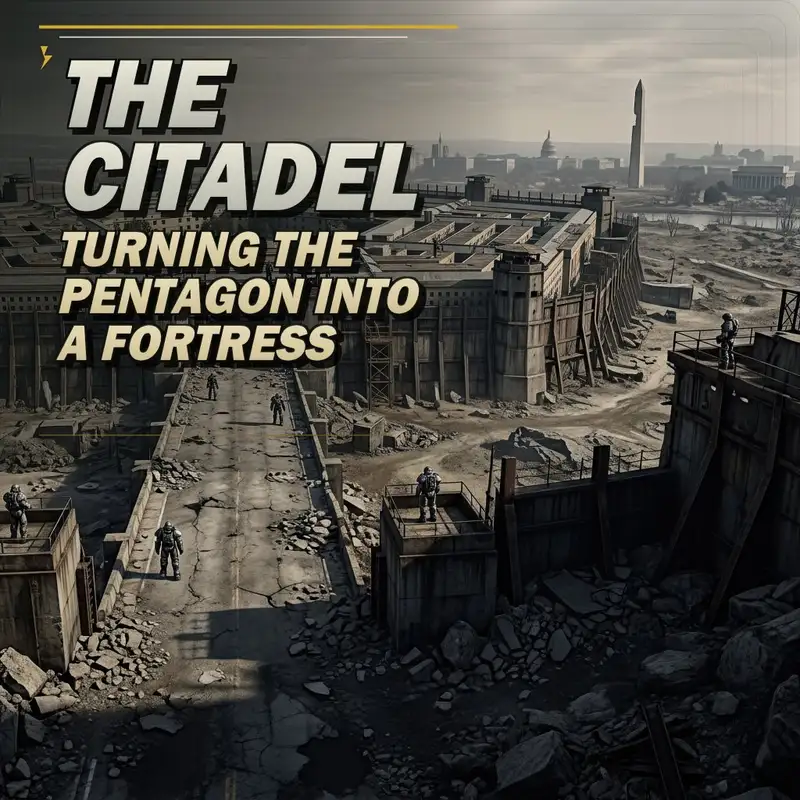
The Citadel: Turning the Pentagon into a Fortress
In the year twenty-two seventy-seven, the Citadel was already at war. Guards watched the main gate. Initiates drilled in the Bailey, the open space at the center of the old complex. Scribes worked among terminals, records, and machinery. Knights and paladins moved between armories, workshops, medical rooms, and command spaces. Patrols left the fortress for a Capital Wasteland still threatened by super mutants, raiders, contaminated ground, and the growing challenge of the Enclave. Beneath and around them stood the ruins of the Pentagon, once a headquarters for the armed forces of the United States.
That contrast matters. Before the Great War, the Pentagon had been designed to help direct a continental military establishment with factories, supply depots, airfields, communications networks, and a functioning state behind it. The Citadel commanded nothing on that scale. It was a smaller institution operating in a damaged region, with limited manpower, irregular supply, and an uncertain political future. Yet it was more than a shelter with thick walls. It concentrated people who could fight, repair equipment, interpret old records, train replacements, treat casualties, and decide where scarce force should be sent. The Brotherhood did not make the Pentagon useful simply by occupying it. They made it useful by turning surviving space into an organized military system.
The Pentagon had been damaged in the Great War and abandoned after the old national command structure ceased to exist. Its surviving portions did not preserve the United States government, nor did they preserve the industrial system that had once supplied it. A building can outlive the institution that built it. Concrete, tunnels, hardened rooms, utility systems, archives, and buried projects may remain. The authority, labor force, transport network, and political legitimacy that once gave them purpose may not.
That was the inheritance waiting in the Capital Wasteland. The upper structure was badly ruined, but portions beneath it remained usable. The site still offered defensible architecture, controlled approaches, interior compartments, old military infrastructure, and remnants of technical knowledge. Most important, it contained Liberty Prime, an unfinished pre-War military project buried below the complex. Prime was not a ready-made answer to the Brotherhood’s problems. It was unfinished, inactive, and dependent on skills and resources that were difficult to assemble after the war. But its existence told the Brotherhood that the Pentagon held more than shelter. It held a concentration of military potential that few other ruins could match.
The Brotherhood expedition that reached the Capital Wasteland in the year twenty-two fifty-five had not originally arrived to establish a humanitarian state or a regional government. Under Star Paladin Owyn Lyons, it had been sent east in search of advanced technology. That mission was consistent with the Brotherhood’s older institutional purpose. Recover dangerous technology. Preserve knowledge. Prevent powerful weapons and systems from being casually scattered across the wasteland.
The Capital Wasteland complicated that mission almost immediately. Lyons found pre-War military sites and technical relics worth recovering, but he also encountered a region shaped by immediate threats. Super mutants operated around the ruins of Washington. Settlements survived with limited protection. The old capital contained strategic infrastructure, but it was also a battlefield filled with civilian communities that could not wait for a distant Brotherhood council to decide whether their suffering was outside the organization’s mandate.
The Pentagon offered Lyons a choice. An expedition can search, recover, and move on. A permanent base can hold territory, retain equipment, train personnel, collect intelligence, and sustain operations over years. The discovery of usable sublevels and Liberty Prime made the site too important to treat as a temporary camp. Lyons was promoted to Elder and assigned to establish a lasting Brotherhood presence in the east. That assignment changed the character of his command. The Brotherhood was no longer simply carrying its mission across the continent. It was building an institution rooted in the Capital Wasteland.
A fixed headquarters reduced some of the problems of long-distance movement, but it also created new obligations. A permanent base needed guards, repair work, medical care, food, water, ammunition, records, discipline, and a way to replace losses. It needed a command structure capable of deciding which threats mattered most. It needed to secure technology without becoming trapped inside a ruin full of it. The decision to remain at the Pentagon was therefore not only a tactical decision about defensible walls. It was a commitment to sustain a chapter in a region where the Brotherhood could not rely on the old world to support it.
The Citadel that emerged from this decision did not occupy every surviving part of the Pentagon, and the Brotherhood did not rebuild the entire complex. The available evidence supports a more practical picture. They adapted usable sections, sealed or controlled vulnerable approaches, established defensible internal spaces, and organized the surviving structure around military functions. The former courtyard became the Bailey, a central area for training, movement, and internal activity. The Brotherhood occupied sections of the old rings and laboratory areas, while other parts of the ruined complex remained damaged, unused, or valuable chiefly as barriers and transit routes.
This arrangement created a form of layered defense. An attacker who reached the outer gate would not automatically control the entire installation. Interior spaces, guards, controlled corridors, defensive systems, and the organization of the building all mattered. A fortified headquarters is not merely a place with stronger walls. It is a place designed so that access can be restricted, important personnel can be protected, weapons and records can be secured, and a breach in one area does not necessarily destroy every function at once.
The Citadel also concentrated division of labor. Scribes preserved and interpreted technical knowledge. They maintained records, examined recovered equipment, supported research, and helped keep advanced systems in operation. Knights and paladins provided security, conducted patrols, and carried the Brotherhood’s force beyond the gate. Initiates trained in the Bailey and represented the effort to replace losses with new personnel shaped by Brotherhood discipline. Medical staff protected one of the most difficult resources in any post-War force, trained people who could not be easily replaced.
It follows that the word fortress is useful, even if it should not be mistaken for an official architectural classification. The Citadel was fortified, but its greater significance lay in the activities its protection enabled. A bunker can hide people. A fortress can resist attack. A headquarters can direct action elsewhere. The Citadel was all three, but the third function mattered most. Its defenses existed so the Brotherhood could preserve the people and systems needed to operate across the Capital Wasteland.
Holding the Citadel was not the same as controlling the Capital Wasteland. The Brotherhood could secure a gate, protect an archive, and guard Liberty Prime without governing every settlement beyond the ruins of Washington. Regional influence depended on movement. Patrols had to leave the complex. Scouts had to gather information. Equipment had to be carried to damaged outposts and brought back for repair. Personnel had to travel through territory shaped by rubble, irradiated zones, hostile groups, broken roads, and uncertain local alliances.
The Pentagon’s location gave the Brotherhood access to the central ruins and to major political and infrastructural sites in the Capital Wasteland. The exact distances cannot be read from a compressed game map, and there is no need to pretend the Brotherhood possessed a perfect military geometry. What mattered was centrality. The Citadel sat near the old seat of national power, near important river crossings and urban routes, and within reach of sites whose control or protection could shape the region’s future.
The Brotherhood’s reach depended on mobile forces, not just static defenses. Sentinel Sarah Lyons and Lyons’s Pride demonstrate the connection between the fortress and the field. The Citadel gave combat units a place to receive orders, obtain support, return for treatment, and coordinate with technical staff. But it could not fight super mutants, protect a project, or confront the Enclave from behind its walls. Its operational value came from the relationship between a secure rear area and forces willing and able to move outward.
That relationship also imposed limits. Every patrol sent into the wasteland required equipment, ammunition, maintenance, medical support, and some expectation of reinforcement or recovery. The game does not establish the Brotherhood’s supply tonnage, reserve stocks, or total force strength, and the number of soldiers visible in the Citadel should not be treated as a census. Still, the institutional problem is clear. The Brotherhood could project force only to the degree that it could sustain the people doing the projecting. A fortress without patrols becomes a warehouse. Patrols without a secure base become a series of isolated risks.
The Citadel’s greatest military resource may have been knowledge. In the wasteland, a weapon found in a ruin is not automatically a usable weapon. A damaged power armor suit requires maintenance. A terminal requires someone who can interpret its information. A laboratory requires power, tools, trained personnel, and a purpose. A pre-War project can be discovered without being understood. The difference between salvage and capability is organization.
Scribe Rothchild represented that side of the Citadel’s power. His work with archives, technical systems, and Liberty Prime shows why the Brotherhood valued specialists as much as armored fighters. A chapter that recovers technology but cannot identify, repair, or employ it gains little more than dangerous scrap. A chapter that can preserve records, compare evidence, train technicians, and coordinate research can turn old-world remnants into selective advantages.
Information also shaped command. Patrol reports, recovered data, local observations, and technical findings had to be gathered in one place before they could influence strategy. The Citadel served as a point where scattered discoveries became institutional memory. A patrol might find a hostile position, a cache of equipment, a new threat, or evidence of an Enclave operation. That information became useful only when someone could evaluate it, compare it with other reports, and direct resources accordingly.
This gave the Brotherhood a form of power that was less visible than power armor or energy weapons. They controlled access to expertise. They could decide who handled dangerous technology, who saw certain records, and which projects received skilled labor. Such control made the Citadel more than an armed camp. It gave Lyons’s command a technical bureaucracy, however limited and military in character. It also reinforced hierarchy. Knowledge was preserved, but it was not broadly distributed. The Brotherhood’s ability to protect the region was tied to its ability to monopolize some of the tools needed to understand it.
That monopoly was not necessarily absolute, and it did not make the Brotherhood self-sufficient. The Citadel was not a factory complex capable of mass-producing power armor, energy weapons, robots, or aircraft. It could maintain, repair, adapt, and integrate scarce systems. Those are formidable capabilities in a post-War environment. They are not the same as industrial abundance. The Brotherhood’s strength came from concentrated specialization, not from restoring the old American defense economy.
Liberty Prime made that distinction impossible to ignore. The robot had been conceived before the Great War as a strategic military project. When the Brotherhood found it beneath the Pentagon, they found a machine that seemed to embody their oldest ambitions. Here was advanced technology of extraordinary military value, preserved in the remains of a national defense complex. Its recovery could validate the Brotherhood’s claim that dangerous old-world systems required disciplined custodians.
But Prime was also a reminder that possession is not readiness. The Brotherhood could not simply uncover the machine, press a button, and send it into battle. Bringing it into operation required research, repair, technical skill, power, command decisions, and a plan for how such a large and valuable asset would be protected and employed. The Citadel mattered because it gathered the people and systems capable of supporting that work. The robot’s eventual activation was not a triumph of one machine. It was evidence that the Brotherhood had built an organization capable of sustaining an exceptional project.
Prime’s battlefield value was obvious when it finally entered the conflict with the Enclave. Yet it remained exceptional. It was not standard Brotherhood equipment. It did not mean the chapter could build an army of similar machines. It did not erase the need for infantry, scouts, technicians, supply lines, intelligence, or political judgment. A single strategic weapon can change a battle. It cannot replace the society that would be needed to reproduce it.
The Citadel could revive one unfinished artifact from the old world because it concentrated surviving expertise around it. It could not recreate the industrial base that had conceived Liberty Prime in the first place. There is a difference between recovering a relic of national power and rebuilding the nation that produced it. The Brotherhood’s success at the Pentagon rested on understanding that difference, even when the spectacle of Prime made it tempting to forget.
Lyons’s most serious problem was not whether technology mattered. It was what technology was for. The Brotherhood had been founded around the preservation and control of advanced systems in a dangerous post-War world. That tradition gave it discipline, identity, and a reason to maintain knowledge others could not easily preserve. Lyons did not discard that tradition. His chapter continued to recover and use advanced technology. But the conditions of the Capital Wasteland pushed him toward a broader mission.
Super mutants threatened settlements. Local communities lacked the capacity to confront every danger on their own. Project Purity offered the possibility of clean water for a region where water could determine whether a settlement endured or failed. Lyons increasingly treated the Brotherhood’s military and technical capabilities as instruments for protecting people as well as securing artifacts. That approach gave his chapter a more visible role in the daily security of the Capital Wasteland.
It also created a doctrinal crisis. The Brotherhood Outcasts rejected Lyons’s priorities. Their disagreement was not merely a personal quarrel, nor was it a simple contest between compassion and cruelty. It involved resources, mission, authority, and institutional identity. Every paladin assigned to defend a settlement or fight super mutants was a paladin not assigned to technology recovery. Every repair effort devoted to a local security mission was effort not devoted to collecting and controlling old-world systems. Lyons’s adaptation could be seen as necessary in the east, but it could also be seen as a departure from the Brotherhood’s original purpose.
The exact size of the split and every stage of its development are not firmly established. What is clear is that the schism mattered. The Outcasts showed that a fortress cannot settle a disagreement about mission. The Citadel gave Lyons a durable command center, but it did not give him unanimous legitimacy within his own order. The same building that symbolized the Brotherhood’s permanence in the Capital Wasteland also symbolized its transformation into something some members no longer recognized.
That transformation was tested most clearly through Project Purity. Doctor Madison Li and the project’s personnel possessed knowledge and infrastructure directed toward clean water. The Brotherhood possessed armed personnel, technical capacity, and the ability to defend important sites. Their relationship was an alliance of complementary institutions, not a merger. Project Purity did not become a Brotherhood program merely because the Brotherhood protected it. The Brotherhood did not become a civilian water authority merely because clean water became central to the region’s future.
The defense of the Jefferson Memorial revealed the Citadel’s role as a command and support node. The decisive struggle did not occur within the Pentagon’s walls. The Citadel provided the organizational depth that allowed Lyons’s Brotherhood to respond to threats, coordinate personnel, and support operations connected to the project. This is what a functioning headquarters does. It allows a force to act beyond its own perimeter without abandoning the systems that keep it alive.
Project Purity also offered Lyons a powerful claim to regional legitimacy. A military order that fights super mutants can present itself as a defender. A military order associated with clean water can become relevant to civilian survival on a far larger scale. Water is not simply another resource. It shapes settlement, agriculture, health, migration, trade, and political authority. Whoever protects or controls distribution gains influence, whether they intend to govern or not.
That influence carried risks. The Brotherhood could secure water infrastructure without becoming a representative civil government. It could protect selected communities without protecting everyone equally. It could help distribute a life-sustaining resource while remaining a hierarchical military institution that controlled access to weapons and technical knowledge. Civilian trust could grow from protection, but trust is not the same as consent. A fortress can become the center of relief without becoming the center of legitimate civilian rule.
The Enclave conflict exposed both the power and the limits of the Citadel’s model. Once Project Purity was activated, the Brotherhood faced an enemy with its own military organization, surviving advanced technology, and ambitions for control. The Citadel functioned as the Brotherhood’s operational center. It supported planning, repair, personnel management, technical work, and the deployment of forces against Enclave positions. It gave the Brotherhood a place to organize a campaign rather than simply react to raids and emergencies.
Liberty Prime became the most dramatic expression of that concentrated capacity. The robot’s advance against Enclave positions demonstrated what could happen when pre-War technology, Brotherhood expertise, and a clear operational objective came together. Prime broke through defenses that would have been difficult for ordinary forces to overcome. Its presence carried military and psychological weight. It was a weapon, but it was also a message. The Brotherhood had taken a symbol of old American military power and placed it in service of its own regional campaign.
Still, the capture or destruction of enemy positions did not automatically create stable control. Military success can remove an immediate threat while leaving broader questions unresolved. Who would secure roads after the battle? Who would maintain the water system? Who would handle disputes between settlements? Who would provide food, medicine, labor, and repair capacity? Who would decide what happened to recovered Enclave technology? The Citadel could coordinate force. It could not solve every political problem created by the use of force.
Broken Steel pushed the campaign beyond the initial victory at Project Purity. The Brotherhood continued operations against the Enclave, and Liberty Prime led an offensive toward Adams Air Force Base. The advance demonstrated the value of a headquarters that could sustain a major operation. Personnel had to be organized. Equipment had to be maintained. Technical knowledge had to be applied. Intelligence had to be assessed. A powerful machine still required an institution behind it.
Then the Enclave destroyed Liberty Prime with an orbital weapon. The loss made a hard point about fortress security and technological advantage. The Brotherhood had recovered, repaired, and deployed one of the most formidable surviving weapons in the Capital Wasteland. It had not made that weapon invulnerable. A hardened base and a heavy ground asset can still be threatened by systems operating beyond their immediate defensive perimeter. Intelligence failures, long-range weapons, and enemy capabilities hidden until the moment of use can defeat even a well-defended force’s most valuable asset.
Prime’s destruction was a tactical and technological blow, but it was not necessarily the destruction of the Brotherhood as an institution. The Citadel remained the chapter’s core headquarters in the standard continuation of the conflict. Its value had never rested entirely on one robot. The base still held trained personnel, records, workshops, command functions, defensive systems, and the organizational memory accumulated since the Brotherhood’s arrival in the year twenty-two fifty-five.
There is an important uncertainty here. A possible outcome in the operation known as Who Dares Wins can result in the Citadel’s destruction. That outcome should not be treated as an uncontested record of what happened. The conflict permits different player-dependent results, and later material does not provide a complete public accounting of every path. The stronger historical conclusion is narrower. The Citadel was vulnerable. It was not an indestructible sanctuary. But the standard postwar picture shows the Brotherhood continuing to operate from the institutional foundation it had built there.
That foundation still faced serious constraints. The Brotherhood had to maintain equipment without a restored industrial base. It had to replace losses without an unlimited pool of trained recruits. It had to decide how much of its strength could be spent on protecting civilians, distributing support to Project Purity, recovering technology, and confronting surviving threats. It still carried the political wound of the Outcast schism. And it still had to answer the question raised by every armed organization that becomes central to a region’s survival. Is it protecting the population, governing the population, or quietly acquiring the power to do both?
Later references from the year twenty-two eighty-seven preserve the Citadel’s institutional memory without fully explaining its later history. Brotherhood personnel still speak of the Citadel with reverence. References to Elder Sarah Lyons confirm that the eastern Brotherhood’s story continued after the Enclave war, though the exact circumstances of her death, the succession struggles that followed, and the relationship between the Citadel and the later Prydwen are not fully established by those references alone.
That uncertainty should not obscure what the Citadel had already achieved. Tactically, it was a defensible headquarters built from usable portions of a ruined military complex. Operationally, it supported patrols, training, repair, intelligence work, medical care, and major campaigns. Strategically, it concentrated a rare combination of military and technical capacity in the Capital Wasteland. Politically, it gave Lyons’s Brotherhood a visible claim to permanence, even as the Outcasts challenged the mission that permanence served. Institutionally, it transformed an eastern expedition into a regional Brotherhood center.
For civilians, its legacy was more complicated. The Citadel helped make protection against super mutants and Enclave aggression more credible. Its support for Project Purity connected Brotherhood force to the practical question of survival through clean water. But it did not become a civilian republic, and it did not resolve every inequality, danger, or dispute in the Capital Wasteland. Its authority rested on military organization, technical expertise, and the ability to secure vital systems, not on broad democratic participation.
The Citadel succeeded because the Brotherhood did more than occupy the Pentagon. It converted surviving infrastructure into a working institution capable of organizing force, preserving knowledge, repairing equipment, training personnel, and directing operations across a damaged region. Its walls mattered, but its real strength was the human system inside them. Its limitation was just as important. No fortress, archive, or superweapon could settle the political question at the heart of Lyons’s Brotherhood: whether an order built to preserve technology could protect civilians, distribute power responsibly, and remain united while trying to do both.