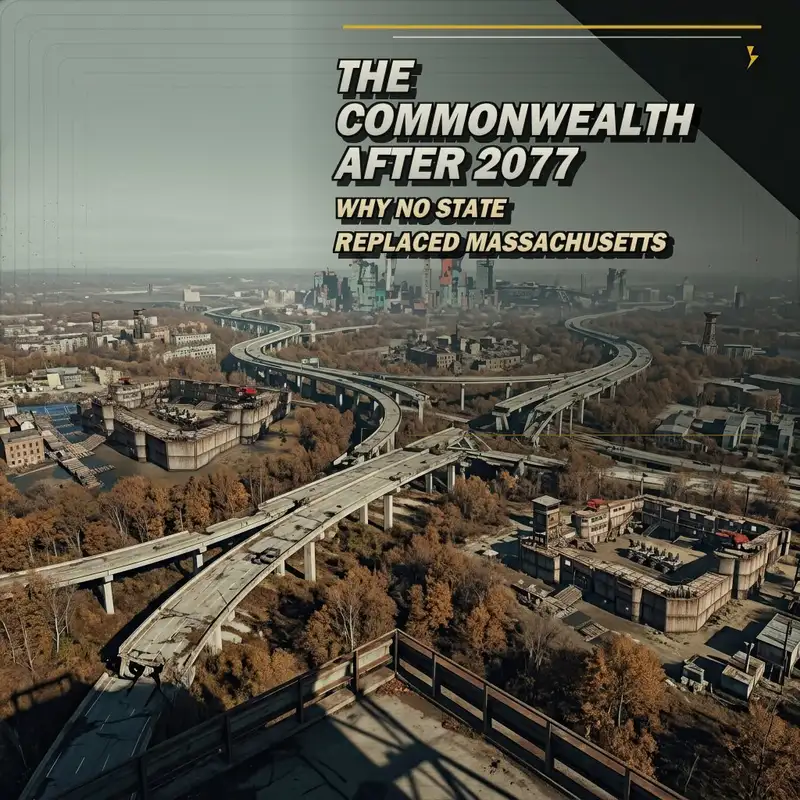
The Commonwealth After 2077: Why No State Replaced Massachusetts
In the year twenty-two eighty-seven, the settlement of Quincy called for help. The Gunners were closing in, and the people behind Quincy’s defenses were not facing a routine raid. They were facing an organized mercenary force with the discipline, weapons, and ruthlessness to break a town that had become a refuge for civilians and surviving Minutemen. Quincy appealed to the old mutual-defense network. In theory, that network existed precisely for this moment. The Minutemen had been created so that a threatened settlement would not stand alone while its neighbors waited behind their own walls. But only Colonel Hollis and his people answered the call. Other Minutemen groups did not come. Some may have lacked the strength. Some may have judged the fight too dangerous. Some may simply have been too distant, too divided, or too disconnected to act. The result was the Quincy Massacre. Civilians died, survivors fled, and one of the Commonwealth’s last active concentrations of Minutemen was shattered. It is tempting to describe this only as a military defeat. That would miss the larger failure. Quincy demonstrated that the Commonwealth’s closest approximation of a regional public-security system had become voluntary in the worst possible sense. It could ask for aid, but it could not ensure that aid arrived. The defenders were not cowards, and the settlement was not empty of social order. Quincy had people worth defending, structures worth preserving, and institutions that had endured long enough to attract refugees. What failed was the connection between local courage and regional obligation. A state is not simply a place with armed people, farms, markets, and flags. At its most basic level, it is an institution able to make protection, law, and mutual responsibility extend beyond the immediate reach of one town’s walls. In Quincy, that promise collapsed under fire.
The name Commonwealth can obscure that problem. After the Great War on October twenty-third, twenty seventy-seven, the former Commonwealth of Massachusetts became known simply as the Commonwealth. The name survived because people needed a way to describe the region around Boston, its suburbs, its farms, its ruins, and its scattered communities. But a regional name is not a government. It does not prove that the old state administration endured, that courts continued to operate, that tax collectors returned to the roads, or that anyone inherited a recognized right to command the entire territory. The bombs destroyed more than buildings and highways. They destroyed continuity. The pre-War government had possessed bureaucracy, police, courts, public utilities, military forces, records, and coercive authority, however compromised and authoritarian that system had become before the war. Much of that machinery vanished, fragmented, or survived only in isolated automated systems and sealed facilities. What emerged afterward was not a blank landscape. The Commonwealth developed towns, farms, merchants, caravan routes, schools, guards, local leaders, religious communities, newspapers, and militias. People rebuilt society in the practical sense every day. They planted crops, repaired generators, treated injuries, settled disputes, raised children, and defended homes. Yet none of that automatically created regional sovereignty. There was no clearly trusted successor bureaucracy, no dependable fiscal base, no accepted justice system covering the region, and no uncontested monopoly on force. The Commonwealth had many authorities. It did not have one authority that most people regarded as both legitimate and capable. That distinction matters because the question is not why Massachusetts became uncivilized. It did not. The question is why civilization remained local, fragmented, and defensive rather than becoming a durable regional state.
Diamond City is the clearest evidence that the Commonwealth was capable of building something more substantial than a fortified campsite. Founded in the year twenty-one thirty inside Fenway Park, Diamond City benefited from advantages few settlements could match. Its walls enclosed a defensible space. Its location placed it near the ruins of Boston and within reach of surrounding trade routes. It developed security, markets, farms, electricity, education, civic leadership, and a public culture visible in its newspaper and daily political arguments. Its residents could expect more than mere survival. They had businesses, homes, social status, local institutions, and a city identity. That did not make Diamond City peaceful, equal, or immune to fear. Like every settlement in the Commonwealth, it had its prejudices, rivalries, security concerns, and political failures. But it was a functioning polity. It maintained order within its own boundaries and exerted influence through commerce beyond them. In another historical setting, a city with those advantages might have become the nucleus of a wider state. Yet the available record does not show Diamond City collecting regular revenue across the Commonwealth, administering distant roads, maintaining regional courts, or commanding a force able to secure every major route. It was a city with a commercial orbit, not a capital with accepted authority over a province. That was not necessarily a failure from the perspective of its residents. A local government that protects the market, keeps water flowing, manages food production, and maintains the walls may be more valuable than a distant political project promising unity at some undefined future date.
For a citizen of Diamond City, regional expansion could mean taxes, conscription, new enemies, and responsibility for settlements that could not repay the cost of protection. Local civilization had rewards. It also gave successful communities reasons to guard their autonomy. Diamond City showed that the Commonwealth’s problem was not incapacity. It was the difficulty of scaling success beyond a defensible center.
The Minutemen emerged as the Commonwealth’s most credible answer to that difficulty. They were not a conventional national army. They did not possess a clearly documented permanent order of battle, a predictable recruitment pipeline, a standardized supply system, or a civil ministry directing military policy. They were a network of local volunteer forces rooted in the settlements they defended. Their strength came from that local character. A farmer, trader, mechanic, or town guard did not need to wait for a distant capital to recognize a threat. The Minutemen could mobilize people with local knowledge, personal stakes, and a direct understanding of what would be lost if raiders burned a farm or super mutants struck a settlement. Their defense of Diamond City against super mutants in the year twenty-one eighty became a defining achievement because it demonstrated that scattered communities could cooperate against a danger too large for one town to manage alone. The Minutemen had legitimacy that many better-equipped forces lacked. They were settlers defending settlers. But legitimacy is not the same as state capacity. A volunteer federation can respond quickly when confidence is high and the threat is obvious. It becomes fragile when danger is prolonged, when ammunition and medical supplies run short, when different towns face different risks, or when one community decides that saving another will leave its own families exposed. A durable state requires ways to turn common interest into dependable obligation. It needs revenue, logistics, records, repair facilities, trained replacements, communications, dispute resolution, and a command structure whose decisions carry authority even when they are unpopular.
The Minutemen had ranks and traditions, but rank alone does not create a staff system, a treasury, or a succession process. Their organization could coordinate defense, but it could not reliably compel it. That weakness was not a moral defect in the people who served. It was the structural consequence of trying to provide regional security without the institutions that make regional security sustainable. The Minutemen could protect communities. They could not consistently govern the conditions that made those communities vulnerable.
Those conditions were severe. The Commonwealth’s insecurity was not one single war against one single enemy. It was a layered environment of threats that consumed labor, disrupted trade, and made long-term investment dangerous. Super mutants posed one kind of problem. Their origins in the Commonwealth were connected to Institute experimentation with the Forced Evolutionary Virus, though the exact scale and chronology of that program remain incomplete. What is clear is that super mutant attacks became a lasting danger for settlements, travelers, and agricultural communities. They were not merely criminals seeking easy loot. They were a distinct military and biological threat, capable of turning roads and isolated farms into zones of constant risk. The Gunners posed another kind of challenge. They were organized mercenaries, more disciplined and better equipped than most raider bands, and capable of operating as a serious armed force when profit, territory, or contract interests aligned. Raider groups were different again. They were decentralized, predatory, and locally variable, but their effect on ordinary life could be just as destructive. A caravan delayed by raiders, a farm forced to maintain round-the-clock watches, or a family driven from its home did not need to know the ideological distinction between one armed threat and another. It still lost crops, labor, security, and hope. Every wall required materials. Every patrol required people who might otherwise be planting, repairing, hauling, teaching, or trading. Every escort tied armed guards to a caravan route. Every injury imposed medical burdens on communities with limited supplies.
State-building depends on surplus. A government needs people and resources beyond the minimum required for immediate survival. It needs enough security to collect revenue, maintain roads, enforce decisions, and invest in public works. The Commonwealth repeatedly spent that potential surplus on staying alive. This did not make unity impossible. Other societies have built states under worse conditions. But it made every attempt at regional consolidation more expensive, more politically risky, and more dependent on trust.
There was, however, an attempt to turn cooperation into government. The Commonwealth Provisional Government was the strongest known effort to create a regional political structure from the settlements that had survived the early post-War decades. The surviving record is incomplete, and it should not be treated as a fully documented constitutional convention with a clear list of delegates, laws, or institutions. What the evidence does establish is that settlements tried to build something larger than local arrangements. Institute records indicate that the Institute supported the project for four years. Shaun, much later, described it as collapsing under bickering and infighting. His account may be self-serving. The Institute had every reason to portray the surface as incapable of governing itself and to present its own withdrawal as an unfortunate but rational response to chaos. Even so, political disagreement would not have been surprising. Settlements had different interests. A fortified city, a farming community, a caravan hub, and a small isolated homestead would not experience taxes, military obligations, trade rules, or representation in the same way. Some communities would fear domination by Diamond City. Others would worry that a regional force would demand soldiers and supplies without protecting distant roads. Some may have regarded any central authority as an invitation to corruption, coercion, or abandonment. Those concerns were not proof of irrationality. They were the ordinary problems of building government after the destruction of the institutions that once made collective action routine.
The deeper issue was enforceability. Negotiation can identify common interests, but it cannot by itself create a state. A provisional government needed a way to make commitments credible. It needed to assure farmers that contributions would produce protection, assure towns that stronger neighbors would not dominate them, assure militias that they would receive support when deployed, and assure citizens that representatives could make decisions with real authority. Without those foundations, disagreement could become paralysis. The failure of the Commonwealth Provisional Government was a lost opening, not because every settlement had suddenly become incapable of cooperation, but because cooperation had not yet hardened into institutions that could survive fear, scarcity, and competing local interests.
The Institute made that failure far more consequential. Founded in the year twenty-one ten by survivors associated with the Commonwealth Institute of Technology, it developed beneath the surface as an insulated scientific society. It possessed resources the settlements above could barely imagine: laboratories, technical expertise, secure underground infrastructure, advanced power systems, synth production, and eventually the Molecular Relay. Those capabilities gave the Institute extraordinary reach. It could conduct research, move selected personnel and equipment in ways surface communities could not easily track, infiltrate targets, abduct people, and pursue projects beyond the supervision of any civilian authority. But technological capability is not the same as state capacity. A state must do more than act. It must make its authority intelligible, predictable, and acceptable enough that people cooperate with it rather than merely fear it. The Institute did not seek that relationship with the surface. It intervened at times, withdrew at others, and increasingly treated the Commonwealth above as a source of materials, experimental subjects, threats, and failed social arrangements. Its leaders claimed a larger mission of preserving humanity, but they defined humanity and preservation in ways that excluded public accountability to the people living outside their walls. The Institute’s strategic logic appears to have favored insulation. The surface was unstable, dangerous, politically divided, and difficult to govern. Rather than accept the cost of building civic institutions there, the Institute built a separate society beneath it. That choice protected its researchers from public demands, elections, taxation, and criticism.
It also prevented the Institute from gaining consent, partners, or legitimacy. A laboratory can hide from the consequences of its experiments for a while. A government cannot. The Institute’s power was selective rather than public. It could reach into the Commonwealth, but it would not stand openly responsible for the Commonwealth. That left the surface with a technologically powerful neighbor that shaped regional politics while refusing to become a recognized part of them.
For ordinary people, the danger was not only what the Institute did. It was the uncertainty it created about who could be trusted. The Broken Mask incident in Diamond City in the year twenty-two twenty-nine made that uncertainty impossible to dismiss. A Generation Three synth prototype, passing as a human being, killed several people before the truth was exposed. The Institute’s internal records characterize the unit as unauthorized and unready, an experiment deployed before it should have been. That distinction may have mattered inside the Institute. It meant little to the people of Diamond City. From the surface perspective, the incident proved that a person could live among neighbors, speak with them, work beside them, and still be an instrument of an unseen power. The political effect was profound. A regional government depends on representatives, negotiations, trusted messengers, and the assumption that disagreement is genuine disagreement rather than covert manipulation. Synth infiltration made all of those assumptions vulnerable. A rival could be accused of being replaced. A compromise could be dismissed as Institute influence. A stranger seeking refuge could become a suspected threat. Institutions facing that kind of fear tend to spend more time screening, concealing, and accusing than governing. Nick Valentine later recounts the massacre of representatives connected to the Commonwealth Provisional Government by a synth. The game’s sources do not completely reconcile that account with the earlier history of the provisional government and the Institute’s claim that the project had already failed through internal conflict.
It may describe a later phase of political cooperation, or it may reflect an unresolved gap in the surviving record. The exact sequence matters less than the pattern. The Commonwealth had evidence of real infiltration, real violence, and real Institute interference. Not every rumor had to be true for trust itself to become a strategic vulnerability. A society can survive open enemies more easily than it can survive the belief that every neighbor, official, and negotiator might be a hidden weapon.
The Minutemen remained the most visible alternative to this climate of secrecy, but their own institutional foundations were eroding. In the year twenty-two forty, they lost Fort Independence, commonly called the Castle, to a mirelurk attack. The loss was more than a blow to morale. The Castle had served as a headquarters, armory, communications point, and physical center for a dispersed network of local forces. A militia federation needs places where supplies can be stored, decisions can be coordinated, leaders can meet, and a regional identity can become more than a rumor carried between settlements. When the Castle fell, the Minutemen lost a command node. Their members did not disappear, and local companies continued to exist. But the organization’s ability to act as one body weakened. The Castle’s fall revealed another truth about post-War institutions. A building matters when it houses systems that cannot easily be replaced. An armory is not just weapons. It is inventory, maintenance, distribution, and confidence. A radio station is not just a transmitter. It is a promise that distant communities can call and receive an answer. A headquarters is not just a symbol. It is the place where authority becomes routine. The problem deepened after General Joe Becker died in the year twenty-two eighty-two. Preston Garvey later describes a succession crisis in which no replacement leader could command broad agreement. That was a devastating failure of continuity. The title of general did not create automatic obedience.
It did not establish a formal succession law, a reliable chain of command, or a political body empowered to choose a new leader. The Minutemen had authority while Becker was alive because relationships, reputation, and shared confidence held the network together. When he died, those informal foundations proved insufficient. By the time Quincy called for help, the Commonwealth still remembered the Minutemen as a regional institution. But memory was carrying more weight than the institution itself.
The Commonwealth in twenty-two eighty-seven was therefore not a vacuum. It was a patchwork of institutions with different purposes, different strengths, and little reason to submit to one another. Diamond City provided civilian order and commerce within its own sphere. Bunker Hill served as a major trading center, linking caravans and settlements through a system of negotiated neutrality, local militia, hired protection, and payments for security. Its usefulness depended on remaining a place where many parties could trade without accepting the rule of a single regional power. Goodneighbor offered another model of local survival, shaped by its own political culture and its resistance to outsiders claiming authority over it. It was not waiting to be absorbed into a shared bureaucracy. The Railroad possessed intelligence networks, safehouses, and a humanitarian mission centered on rescuing synths from Institute control. Its work required secrecy, compartmentalization, and mobility. Those are valuable qualities for resistance, but poor foundations for open territorial government. The Institute had immense technical power but no public legitimacy. It could influence the Commonwealth without representing it. Then the Brotherhood of Steel arrived as an external expeditionary force, organized, disciplined, and equipped for major military operations. The Brotherhood could seize strategic sites, deploy power armor, use aerial mobility, and impose its will in selected areas. But its mission was not the creation of a representative Commonwealth government. Its focus was the control of dangerous technology and the destruction or suppression of threats it judged intolerable.
Military order and civilian sovereignty are not the same thing. A force can clear a route, occupy an installation, or eliminate an enemy without building courts, local consent, tax systems, public services, and durable political participation. Each of these institutions addressed a genuine need. None offered a broadly legitimate and administratively credible compact that could bind the whole region. The Commonwealth had organizations capable of fighting, trading, hiding, researching, and surviving. It did not have an organization able to make those functions serve a shared civilian state.
Trade might seem like the missing foundation. The Commonwealth was not economically isolated in the absolute sense. Farms supplied food. Caravans moved goods, tools, medicine, ammunition, and salvage. Diamond City and Bunker Hill connected producers, merchants, guards, travelers, and customers. Settlements depended on one another even when they remained politically independent. But trade creates interdependence, not necessarily unity. A caravan route raises immediate questions. Who keeps it safe? Who pays the guards? Who repairs a bridge, clears a road, or responds when a settlement along the route is attacked? Who decides whether protection payments are fair, whether merchants can pass, or whether a powerful town can impose terms on weaker communities? In a stable state, those questions are answered through institutions that can collect revenue, enforce law, maintain infrastructure, and claim at least some legitimacy from the people they govern. In the Commonwealth, the evidence supports commerce, negotiation, and local arrangements. It does not support a unified regional system of revenue, route administration, public works, or law enforcement. That left farmers and caravan operators in a difficult position. They wanted predictable security because predictable security made planting, transporting, and investing possible. Yet taxes or conscription would be hard to accept if the authority demanding them could not prove it would protect a distant farm when raiders came, or compensate a caravan when the road became too dangerous to travel. The memory of failed regional efforts made that calculation harsher. Local autonomy was not merely stubbornness.
It was often a practical response to institutions that had promised coordination and then failed to deliver it. The Commonwealth could look lively, connected, and commercially active while remaining politically fragmented because markets do not solve the problem of enforceable mutual obligation. They can even expose it, by making clear how much every community depends on security that no one institution can reliably provide.
At the opening of Fallout Four, this is the fixed condition inherited by the Commonwealth. Settlements are divided but alive. The Minutemen are weakened by lost leadership, broken coordination, and the catastrophe at Quincy. The Institute remains hidden, powerful, and deeply entangled in the region’s fears. Diamond City, Bunker Hill, Goodneighbor, farms, caravans, and smaller communities continue to function without becoming parts of a unified civil administration. The Railroad works in secrecy because its mission demands secrecy. The Brotherhood arrives with the capacity to alter the military balance, but not with a demonstrated mandate to govern Massachusetts as a civilian society. The game then presents several possible interventions into this institutional vacuum. Those outcomes depend on player decisions, alliances, and mutually exclusive faction paths. They cannot be combined into one settled history, and no single ending can be treated as the confirmed political future of the Commonwealth. The Sole Survivor’s personality, chosen loyalties, settlements, and decisions remain player-defined. What can be said is that the Commonwealth becomes a contest over different answers to the same problem. Should security come from local mutual defense, technological control, covert liberation, military occupation, commercial autonomy, or some arrangement not fully shown by the record? Later official material confirms that a powerful Commonwealth Brotherhood chapter exists by the era of the television series. That demonstrates that military consolidation eventually occurs in some form. It does not establish that Massachusetts gained a civilian successor state, that its settlements accepted one shared government, or that the Brotherhood’s presence solved the older problems of consent, administration, and local autonomy. A chapter can be strong without being a republic. An army can be permanent without being a public institution.
The Commonwealth failed to replace Massachusetts with a new state not because it lacked cities, farms, trade, courage, or political imagination, but because every foundation of statehood remained incomplete. Diamond City’s authority was real, but local. The Minutemen’s legitimacy was real, but voluntary. The Institute possessed extraordinary capability, but rejected public responsibility and corroded the trust on which public institutions depend. Trade linked communities, but did not create enforceable obligations between them. The Brotherhood could impose military order, but military order alone is not civilian sovereignty. Across two centuries, people rebuilt society again and again in markets, farms, fortified towns, caravan routes, and mutual-defense networks, yet no institution could reliably make protection, law, and shared obligation extend farther than the community already able to defend itself.