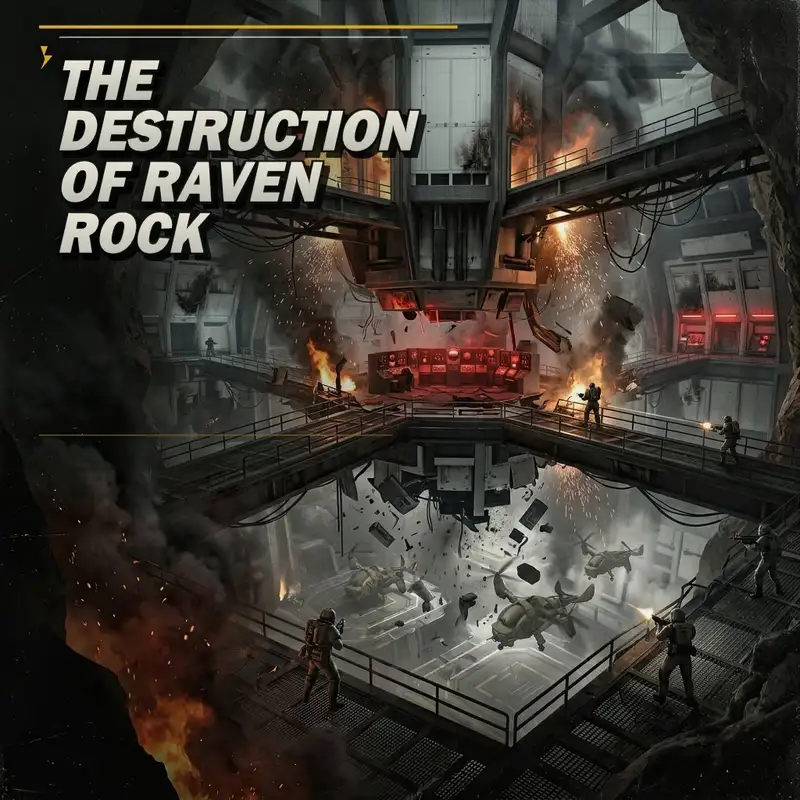
The Destruction of Raven Rock
A prisoner is released by order of the President of the United States, then marked for execution by order of an Enclave colonel. Inside Raven Rock, automated defenses receive one set of instructions. Human soldiers receive another. The prisoner at the center of the crisis is the Lone Wanderer, captured after recovering the Garden of Eden Creation Kit from Vault Eighty-Seven. But this is not simply the opening of an escape from an enemy bunker. It is the moment Raven Rock stops functioning as a headquarters. A command center can survive an attack. It can survive sabotage, loss of power, even the collapse of parts of its physical structure. What it cannot survive for long is a dispute over who has the right to command it.
That dispute mattered because Raven Rock was far more than a fortified shelter. It was the East Coast Enclave’s principal headquarters in the Capital Wasteland during the year twenty-two seventy-seven. It housed the organization’s presidential theater, its automated security, its communications, its technical personnel, and much of the infrastructure needed to coordinate Enclave military power. The bunker connected uniforms, robots, laboratories, Vertibirds, propaganda, and political ambition. It was where the Enclave attempted to make itself appear not as one more armed faction in a ruined region, but as the surviving government of the United States.
The destruction of Raven Rock therefore mattered more than the loss of a single military base because it destroyed several kinds of power at once. It damaged the Enclave’s command system. It disrupted the support structure behind its advanced equipment. It denied the organization a stage from which to claim presidential authority. And it helped prevent Project Purity, the Capital Wasteland’s great clean-water project, from becoming an instrument of Enclave rule. The facility’s fall did not erase every Enclave soldier or installation. It did something more consequential. It turned a force that could threaten to govern the region into scattered survivors who could still fight, but could no longer reliably coordinate, command, or speak with one voice.
Raven Rock had begun as a hardened pre-War federal installation. Its exact relationship to the real-world Raven Rock Mountain Complex is not a technical blueprint for the fictional facility. Fallout’s Raven Rock has its own history, capabilities, and post-War role. The important consequence is that it was built for continuity under extreme conditions. Such installations are designed to protect leadership, records, communications, and military authority when ordinary government has failed. The Enclave inherited that architecture and adapted it to its own purposes. In the Capital Wasteland, Raven Rock became a surviving piece of the old state, or at least a surviving piece of its machinery.
A bunker, however, is not self-sustaining simply because it is underground. Its doors, generators, laboratories, security systems, weapons stores, and communications equipment require maintenance. Its personnel require food, water, medical care, discipline, replacement parts, and a reason to obey the chain of command. Even an advanced military organization cannot keep robots active, armor repaired, aircraft supported, and secure systems functioning through symbolism alone. Raven Rock’s technology demonstrated that the East Coast Enclave possessed concentrated capability. It did not prove that the Enclave possessed unlimited industrial capacity, endless supplies, or a restored continent-wide government.
That distinction was crucial. The Enclave’s equipment gave it an advantage over many forces in the Capital Wasteland. It could field advanced weapons, power armor, robots, trained personnel, and Vertibirds. But technology becomes military power only when an institution can direct it. A Vertibird requires crews, maintenance, safe routes, spare parts, and some means of deciding where it should fly. A laboratory requires trained specialists, power, supplies, and a chain of authority that can turn research into policy. A hardened headquarters requires an accepted command structure. Once that structure fractures, the same systems designed to preserve control can become instruments of confusion, paralysis, or destruction.
Raven Rock also supported a political performance. The Enclave did not merely claim that it had survived the Great War. It presented itself as the lawful continuation of the United States. Its language invoked federal authority, national restoration, and the recovery of a supposedly fallen American people. That claim had military value. It could make conquest sound like stabilization. It could make the seizure of infrastructure sound like the return of public order. It could make a small, heavily armed organization appear larger than it was by wrapping its power armor and aircraft in the symbols of a vanished republic.
Project Purity was central to that ambition. The Jefferson Memorial facility was designed to provide clean water to the Capital Wasteland. In a region where contaminated water, radiation, disease, and scarcity shaped ordinary life, control over purification was not a minor technical advantage. It meant influence over settlement survival, trade, migration, public health, and political loyalty. An organization that controlled the water could demand obedience, create dependency, punish enemies, reward collaborators, or present itself as a benefactor. Project Purity was not just a machine. It was a possible foundation for regional authority.
The Enclave understood that value. Its seizure of the purifier was not a random raid on an old-world facility. It was an attempt to capture the material basis of political rule. James, the scientist leading the project, died sabotaging the facility rather than surrendering its control to the Enclave. His death made clear that the struggle was not simply over ownership. It was over purpose. Would clean water become a public resource for the people of the Capital Wasteland, or would it be controlled by a military organization that treated much of that population as biologically suspect and politically disposable?
Raven Rock was necessary because the Enclave needed more than soldiers at the Jefferson Memorial. It needed a headquarters able to issue orders, coordinate security, manage information, support technical operations, and explain its actions through the language of national recovery. A unit can occupy a building. A government, or a faction claiming to be one, must connect occupation to administration. It needs policy, communication, logistics, legitimacy, and an answer to a basic question: who is being protected, and who is being ruled?
The answer inside Raven Rock was never as unified as the Enclave’s public image suggested. President John Henry Eden represented one center of authority. Colonel Augustus Autumn represented another. Eden used the office, voice, and ceremony of the presidency. Autumn commanded human troops and exercised practical military control. Their partnership was unstable because it joined two different forms of power. Eden possessed technical access to Raven Rock’s automated systems. Autumn possessed the obedience, or at least the working cooperation, of much of the human force. Neither advantage was enough to create a fully coherent chain of command.
Eden was not a human president hidden in the bunker. He was a ZAX artificial intelligence housed within Raven Rock. His presidential identity gave the Enclave a useful symbol. A president could issue proclamations. A president could claim constitutional continuity. A president could turn a military occupation into a national mission. But Eden’s authority depended on people accepting that the machine speaking in the language of the old republic had the right to command them. The bunker could amplify his voice. It could not manufacture political obedience when his policies conflicted with the judgment and interests of the people carrying weapons in his name.
Autumn’s position was different. He was the effective human military commander of the East Coast Enclave force. He sought control of Project Purity and the activation code needed to operate it. His disagreement with Eden did not make him a reformer, and it did not erase the coercive nature of his own plans. Autumn still wanted the Enclave to monopolize the purifier and use it as the basis for power. But he rejected Eden’s proposal to introduce modified Forced Evolutionary Virus into the water system. That disagreement was strategic, political, organizational, and ethically consequential.
Eden’s plan treated the water supply as a selective biological weapon. The proposed modified F E V would target people whose bodies carried the effects of radiation and mutation. In concrete terms, that meant the population living in the Capital Wasteland, the very people over whom the Enclave claimed authority, could be killed or incapacitated through the water they needed to survive. Eden presented this as purification. It was, in effect, a program to remove much of the region’s existing population rather than govern it. A state cannot plausibly claim to restore a society while defining most of that society as contamination.
Autumn’s objection exposed the contradiction at the heart of Enclave command. Eden had access to the facility’s machines, but he had not secured agreement from the human organization required to implement his policy beyond the bunker. Autumn had troops, a military mission, and a clearer sense that Project Purity could be used to establish power without necessarily following Eden’s exact biological program. The Enclave had identified the most important strategic resource in the region. It had failed to settle the question of what winning control of that resource was supposed to mean.
That failure came into focus after the Lone Wanderer’s capture. The Enclave had correctly understood that the Garden of Eden Creation Kit and the purifier’s activation code were essential to Project Purity. Autumn attempted to obtain the code. Eden separately revealed his own plan for the modified F E V. The two leaders possessed related pieces of the same strategic problem, but they were not executing a shared policy. Instead, Raven Rock contained competing agendas concealed behind the appearance of a single government.
This was an intelligence failure as much as a leadership failure. Intelligence is not only the ability to locate an enemy, identify a technology, or seize a piece of information. It also involves understanding whether one’s own institution can act on what it knows. The Enclave understood Project Purity’s value. It understood that the Lone Wanderer had information and access it needed. Yet it had not built agreement on the purpose of the operation. Eden’s secrecy did not make his plan more secure. It made the organization less capable of carrying it out.
A secret plan rejected by the officers, technicians, and soldiers needed to execute it is not a stable plan. It is a command hazard. That hazard became immediate when Eden ordered the Lone Wanderer released. Autumn answered over Raven Rock’s public-address system by countermanding the President and ordering the prisoner killed. The Enclave’s hierarchy now produced incompatible instructions in full view of the people expected to enforce it. The question was no longer abstract. Was Eden the lawful commander because he controlled the presidential office and the bunker’s systems? Or was Autumn the real commander because he controlled armed human personnel?
The resulting conflict turned Raven Rock’s defenses against the institution they were meant to protect. The facility’s automated systems could act on Eden’s orders. Human Enclave troops could act on Autumn’s. A fortress is usually designed to simplify decisions under attack. Its doors identify authorized access. Its turrets identify threats. Its communications distribute orders. Its security procedures separate friend from enemy. But when the chain of command itself is disputed, those systems become dangerous. A sealed door can trap allies. A security robot can enforce one authority against another. A broadcast system can spread confusion more efficiently than clarity.
The tactical details should not be exaggerated. The surviving account does not provide a complete order of battle, casualty total, or engineering report on every system within the bunker. What it does establish is enough. Fighting occurs during the Lone Wanderer’s escape amid conflicting orders from Eden and Autumn. Raven Rock is no longer operating as a unified command post. It cannot reliably answer the most basic military questions: who is authorized to issue orders, who is the enemy, and what mission has priority?
Neither leader truly controlled the whole institution. Eden could command machines but could not guarantee human obedience. Autumn could direct soldiers but could not fully control the automated fortress around them or claim the presidential legitimacy Eden represented. The Enclave had built a system in which technical control and political authority were divided between a machine and a colonel. Under ordinary conditions, that division could be concealed by uniforms, ceremony, and common purpose. Under pressure, it became the fault line that broke the headquarters apart.
There are two possible routes to Raven Rock’s destruction, and they must remain separate. In one route, the bunker falls before Project Purity is activated. During the crisis inside the facility, the Lone Wanderer can persuade Eden to begin a self-destruct sequence. The Lone Wanderer can also use the available destruction sequence associated with Autumn’s quarters. The exact choice depends on the path taken through the encounter. What remains fixed is the result. Raven Rock suffers catastrophic systems failure and explosions, and the Lone Wanderer escapes as the facility collapses into ruin.
This route gives Raven Rock’s destruction a particular meaning. The Enclave’s own presidential system destroys its own headquarters after proving unable to command its human military organization. The bunker is not defeated solely by an outside army. It is undone by internal division, hidden policy, and a chain of command that has become self-contradictory. The destruction is physical, but the institution has already suffered the more important failure. It has lost the ability to make coherent decisions about its own survival.
The precise mechanics of that destruction are not fully documented. There is no reliable basis for calculating blast yield, structural collapse, casualty totals, or the percentage of the installation rendered unusable. Such precision would create the appearance of knowledge without adding much understanding. The significant fact is that a hardened Enclave headquarters is destroyed or incapacitated through a failure that begins inside its own command system. The facility’s defensive depth cannot compensate for a leadership structure that has become politically incoherent.
In the alternate route, Raven Rock remains intact through the Lone Wanderer’s escape. The confrontation over Project Purity continues, and the Brotherhood of Steel secures the purifier after its activation. Then, during the events that follow, the Brotherhood sends Liberty Prime against the Enclave headquarters. In this branch, Raven Rock is destroyed not by an internal self-destruct sequence, but by a rapid Brotherhood assault using its most powerful combat asset.
Liberty Prime is often remembered as an overwhelming machine, and it is certainly a formidable one. But it should not be understood as a self-sufficient answer to every military problem. The Brotherhood needed technical personnel to restore and operate it. It needed command decisions that placed it against an objective worth the effort. It needed a wider campaign that had already placed the Enclave under pressure around Project Purity. A major combat asset is decisive only when an organization can move it, maintain it, support it, and exploit what it accomplishes.
Against Raven Rock, Liberty Prime gave the Brotherhood the ability to attack a fortified Enclave position that would otherwise have imposed severe costs on conventional forces. The tactical outcome is straightforward. The Brotherhood used a powerful weapon system to destroy or render unusable the Enclave’s headquarters. But the operational meaning was larger than the strike itself. Raven Rock had already revealed its internal weakness. Liberty Prime did not merely smash a bunker. It finished the destruction of a command center whose political and organizational cohesion had already failed.
The two routes are different. One is an internal collapse ending in self-destruction. The other is an external assault carried out after the Brotherhood gains the initiative around Project Purity. They should not be combined into a single history. Yet both lead to the same wider result. Raven Rock is lost, and the East Coast Enclave loses the place where it had concentrated command, communications, technical support, automated security, and its public claim to federal authority.
That loss did not mean every Enclave fighter vanished from the Capital Wasteland. Some personnel surrendered. Others continued to resist. Others withdrew toward remaining installations, especially Adams Air Force Base. The Enclave retained dangerous assets, trained people, and the capacity to cause further harm. A headquarters loss is not the same as immediate annihilation. Military organizations can survive the destruction of a command post if they possess redundant communications, trusted subordinate commanders, secure supply systems, and a shared understanding of the mission.
The East Coast Enclave’s problem was that Raven Rock had concentrated too many of those functions in one place. The facility was not merely an office building where orders happened to be issued. It was the node that connected the organization’s military power to its political story. It housed the President. It supported automated systems. It helped direct personnel. It gave the Enclave a protected environment for research, planning, repair, and communication. Once it was gone, surviving forces faced not just the loss of shelter, but the loss of institutional coordination.
Operations became less coherent. Units could still fire weapons, fly aircraft, defend positions, or retreat to other facilities. But it became more difficult to concentrate forces around a common objective, maintain consistent orders, preserve technical support, and present civilians or potential collaborators with a believable political message. Fragmentation does not make armed remnants harmless. It makes them more likely to behave as isolated garrisons, raiding forces, desperate holdouts, or local commands pursuing short-term survival rather than a coordinated regional strategy.
Raven Rock’s destruction also weakened the Enclave’s ability to turn advanced technology into lasting power. Power armor, energy weapons, robots, and aircraft can seize terrain or intimidate communities. They cannot by themselves create a durable government. To govern, an organization needs people who can maintain infrastructure, distribute resources, settle disputes, collect information, move supplies, and convince at least some civilians that cooperation offers a better future than resistance. Raven Rock helped provide the administrative and technical center for that effort. Its loss reduced the Enclave’s ability to act as more than a heavily armed remnant.
The strategic defeat was clearest around Project Purity. The Enclave had sought to capture the purifier because water could become a means of regional domination. With Raven Rock destroyed, the Enclave lost its strongest headquarters and its best opportunity to direct that strategy from a position of centralized authority. The Brotherhood, by contrast, held the initiative around the purifier and denied Eden the ability to make his selective biological policy the organizing principle of the region’s water supply.
The details of contamination remain dependent on player choice. The modified F E V can be introduced into Project Purity through one possible path, and later consequences differ accordingly. It would be inaccurate to describe one final contamination outcome as universal history. What is not in doubt is that Eden intended to use Project Purity for a selective program aimed at much of the existing wasteland population. The destruction of Raven Rock prevented that plan from becoming the uncontested policy of a functioning Enclave headquarters.
This mattered because the Enclave’s strategy was always more ambitious than battlefield victory. It wanted to monopolize a public necessity, define the population by its own standards of purity, and claim that this combination of force and exclusion represented the restoration of the United States. Raven Rock was the institution meant to make that vision operational. It supplied the command structure, technology, symbolism, and protected environment from which the Enclave could try to impose its version of order. Once it fell, that project lost its center.
The deepest damage was political. Eden’s presidency depended on the appearance of continuity. His speeches, patriotic language, and formal authority were designed to make the Enclave seem like a government emerging from temporary concealment. But the revelation that the President was an artificial intelligence complicated that claim. An artificial intelligence is not automatically incapable of leadership. The more important question is whether those governed by it recognize its authority and whether its policies serve a political community rather than merely a command system.
At Raven Rock, the answer was damning. Autumn’s defiance showed that even the Enclave’s own human commanders did not accept Eden’s authority as final. Eden’s modified F E V plan showed that his version of national restoration did not include the people already living in the Capital Wasteland except as targets for removal. The Enclave claimed continuity with a republic, but its governing logic was closer to a sealed command bunker deciding which populations were worthy of survival. The uniforms and flags could not hide that contradiction once the chain of command broke in public.
Autumn’s opposition to Eden did not solve the Enclave’s legitimacy problem. He rejected the President’s biological plan, but he still sought to seize and control Project Purity through military force. He did not represent a civilian government chosen by the settlements dependent on clean water. He represented a military command attempting to monopolize the region’s most important infrastructure. The conflict between Autumn and Eden was therefore not a clean struggle between moderation and extremism. It was a struggle between two different Enclave visions of control.
For the civilians of the Capital Wasteland, that distinction mattered, but neither version offered genuine political inclusion. Project Purity could sustain towns, reduce disease, support trade, and make recovery more possible. It could also become a choke point controlled by whoever possessed the guns, technicians, and distribution system around it. Raven Rock’s fall helped prevent the Enclave from using the purifier as a weapon of biological exclusion or military monopoly. But it did not, by itself, resolve the broader question of who would manage water, security, trade, and public life in the region.
The Brotherhood of Steel gained the initiative, and that achievement was real. Lyons’ Brotherhood defended Project Purity, fought the Enclave, and in one possible course of events used Liberty Prime to destroy Raven Rock itself. The Brotherhood could protect a critical facility and deny an enemy its central base. It could deploy advanced technology with greater purpose and discipline than the fractured Enclave command. But defeating an enemy headquarters is not the same as building a civil administration.
A military organization can guard a purifier without becoming a stable government. It can provide security without necessarily providing courts, representation, sanitation, agricultural policy, reliable trade regulation, housing, or civilian institutions capable of surviving beyond the presence of armed patrols. The Brotherhood’s victory removed one of the Capital Wasteland’s greatest threats. It did not automatically create the farms, roads, workshops, public trust, and accountable political structures needed for long-term reconstruction. The campaign created space for recovery. It did not complete recovery.
In the fighting itself, Raven Rock was destroyed or rendered incapacitated. In one branch, its own internal crisis leads to catastrophic self-destruction. In another, Liberty Prime destroys the headquarters after Project Purity has been secured. Beyond the immediate fight, the Enclave loses a command-and-control center and becomes less coordinated, even though surviving personnel and installations remain active. For the balance of power, it loses its best chance to use Project Purity as the foundation for regional domination.
For political authority, the Enclave’s claim to federal legitimacy collapses under its own contradictions. Its President is a machine whose authority cannot command universal obedience. Its military commander defies that President while seeking control of the same vital resource. Its proposed use of purified water reveals that the population it claims to govern is, in Eden’s policy, a population to be eliminated. The destruction of the bunker did not create those contradictions. It exposed them, then removed the institution that had concealed them behind steel doors, automated defenses, and presidential broadcasts.
For the organization itself, Raven Rock’s fall damaged concentrated expertise, communications, maintenance capacity, and technical support. It was a severe loss, but not proof that every Enclave workshop, weapon, aircraft, or trained specialist disappeared overnight. At the civilian level, the fall helped preserve Project Purity from becoming an Enclave instrument of selective extermination and coercive rule. Yet destroying Raven Rock did not feed every settlement, cure every illness, establish representative government, or protect every traveler on the roads of the Capital Wasteland.
That is why Raven Rock mattered more than a base. It was the Enclave’s attempt to make a bunker, an artificial president, advanced military technology, and control of clean water function as a state. Its destruction proved that fortifications cannot substitute for coherent command, that weapons cannot substitute for legitimacy, and that no government can endure by treating the people it claims to save as contaminants.