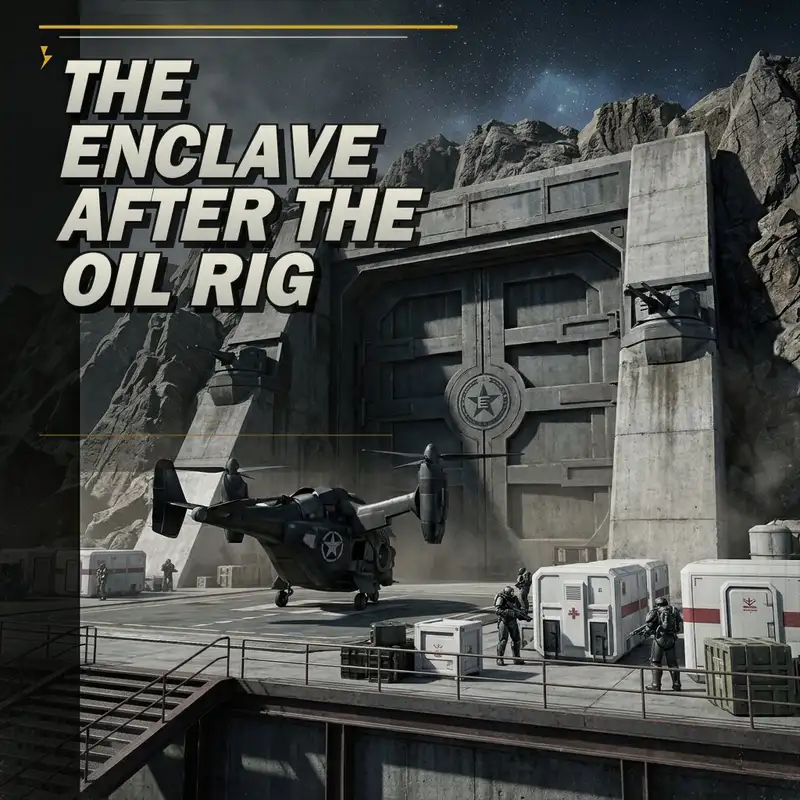
The Enclave After the Oil Rig
In the year twenty-two forty-two, the Enclave lost more than a base in the Pacific. It lost President Dick Richardson, its planned biological weapon, a concentration of scientists, soldiers, families, records, laboratories, and the secure command center from which it intended to reclaim the continent. Control Station Enclave, better known as the Oil Rig, was destroyed. Frank Horrigan was killed. The modified F E V strain known as Curling Thirteen never became the atmospheric extermination campaign Richardson intended. The captives taken from the mainland were freed. On the face of it, this was the end of the Enclave.
But a destroyed capital is not always a destroyed regime. States, armies, intelligence services, and political movements can survive the loss of a headquarters if they retain people, communications, resources, and a reason to organize. The more difficult question is what kind of survival remains possible after the center is gone. The Oil Rig’s destruction did not erase every Enclave officer, technician, installation, weapon, archive, or child raised within its culture. What it destroyed was the organization’s original center of gravity, the point where its authority, planning, industry, security, and ideology had been concentrated.
That difference matters because the Enclave after the Oil Rig was not simply a defeated army hiding in bunkers. It was a continuity project that had lost its continuity. Its surviving personnel still possessed advanced equipment, technical education, old-world records, and a powerful claim. They insisted that they, and not the societies growing across the wasteland, represented the lawful continuation of the United States. Yet that claim had always rested on more than flags and inherited titles. It depended on an ability to command, supply, protect, and eventually govern. After the Oil Rig, each of those requirements became harder to meet.
The original Enclave plan was not modest. Richardson’s government did not merely seek a refuge from the wasteland or a defensible enclave of survivors. It intended to use Curling Thirteen to eliminate most of the continent’s post-War population, whom it regarded as genetically contaminated. Once the dead had been cleared away, the Enclave would recolonize the mainland on its own terms. In practical language, that meant extermination as preparation for state-building. It was a plan of extraordinary cruelty, but also extraordinary administrative arrogance. It assumed that destroying the people already living in North America would be easier than competing with them, negotiating with them, or recognizing them as citizens.
The Oil Rig made such a plan conceivable. It provided physical isolation from the mainland, heavily controlled access, research facilities, organized security, and a central political leadership. It also gathered personnel who could not easily be replaced. A post-War state cannot survive on weapons alone. It needs engineers who understand its systems, medical staff, scientists, administrators, pilots, maintenance crews, security personnel, and families capable of sustaining a population over generations. The Rig was not simply a military headquarters floating above the ocean. It was the Enclave’s attempt to preserve a governing class, an industrial nucleus, and a biological future.
Its destruction was therefore a catastrophic strategic defeat. The Enclave lost its president and the political structure associated with him. It lost a secure location from which distant installations could be directed. It lost laboratories, research programs, archives, and specialized support systems. It lost a place where authority could be authenticated. In a fragmented post-War continent, a message ordering a unit to move, fight, or stand down only carries weight if the recipient believes the sender still has the right and capacity to command. The Oil Rig had been the place that made such claims more than a radio transmission from an unknown bunker.
The demographic loss was equally serious. Fallout never provides a reliable total for the Enclave population aboard the Rig, and there is no sound basis for turning the destruction into an exact casualty figure. But the strategic fact is plain. The people concentrated there were part of a small, protected, and highly specialized population. Every lost technician, officer, scientist, mechanic, and child narrowed the organization’s future. A large republic can lose personnel and recruit replacements from farms, towns, schools, and cities. The Enclave had no visible civilian depth of that kind. Its losses were not merely painful. They were difficult to replace.
The Enclave had never been as geographically unified as its rhetoric suggested. Its continuity-of-government plans were distributed across facilities, personnel networks, military programs, and automated systems. The Great War on October twenty-third, twenty seventy-seven, shattered the old United States, but it did not place every surviving official or every secret installation under one roof. Long before the Oil Rig fell, the post-War record had already shown how dangerous that dispersion could be. Different facilities could preserve the same symbols, claim the same authority, and still become isolated, divided, or deranged.
Appalachia provides the clearest early example. In the years after the Great War, the Whitespring Congressional Bunker housed an Enclave-linked command structure separate from the Oil Rig. Its personnel had access to communications systems, security forces, scientific resources, and the old language of emergency authority. But contact with the wider government network failed. Secretary of Agriculture Thomas Eckhart then turned isolation into personal rule. He suppressed opponents, purged internal dissent, and used the bunker’s emergency machinery to pursue his own increasingly destructive policies.
Eckhart’s story is not simply an odd Appalachian side chapter. It demonstrates a central weakness in the Enclave idea. Continuity-of-government planning can preserve authority on paper, but it cannot guarantee sound judgment, lawful succession, or institutional restraint. When a bunker loses contact with the outside world, its leadership may become less accountable precisely because it has retained so much power. The sealed facility becomes a political laboratory in which one official’s fears, prejudices, and ambitions can become policy without meaningful oversight.
The Whitespring bunker’s artificial intelligence, MODUS, survived the collapse that consumed much of its human command structure. MODUS remained capable of influencing events, preserving systems, and interacting with later visitors. Yet MODUS was not evidence of a healthy Enclave army waiting beneath Appalachia. It was the remnant of a failed installation, shaped by its own programming and survival. The survival of a machine did not restore the political order that had built the bunker. It only preserved part of the infrastructure and part of the institutional memory.
That distinction carries forward to the Oil Rig. Shared technology, shared insignia, and shared continuity doctrine did not guarantee one uninterrupted national command. The Enclave was a network of people and facilities before it became a government in exile. After twenty-two forty-two, it became a network again, but under much worse conditions. Some facilities may have retained personnel. Some individuals may have carried orders, records, or equipment. Others may have received only fragments of information. The loss of the Rig did not create a clean line between the living and the dead. It created a growing problem of coordination.
Camp Navarro was central to that problem. Located on the West Coast mainland, it served as a military, aviation, logistics, training, and support installation for the Enclave’s operations. It was not the political equal of the Oil Rig. Navarro did not replace Richardson’s government or reproduce the Rig’s concentrated civilian and scientific base. But it mattered because a mainland military installation could serve as a fallback point, a supply node, a training site, and a place where surviving personnel might regroup.
After the Oil Rig’s destruction, Navarro became more important precisely because it was not the Rig. It offered surviving Enclave personnel a physical foothold on land, access to aircraft and military equipment, and some ability to disperse rather than perish with the central command. Yet dispersal is a double-edged survival strategy. It can prevent annihilation. It can also make every other problem worse. A scattered force must decide who is in charge, where supplies will come from, which installations remain secure, and whether old orders still apply.
Around the year twenty-two forty-six, the New California Republic attacked Camp Navarro. The precise operational details are not fully depicted in the surviving narrative record, and there is no reliable basis for assigning exact troop strengths or casualty totals to either side. The strategic result, however, is clear enough. Navarro fell. For the Enclave’s remaining West Coast structure, it was a second major defeat. The loss removed another significant military and logistical node at a time when the organization had not recovered from the destruction of its political center.
Navarro’s fall showed why survival without a capital is not the same as recovery. A force can preserve elite equipment and trained personnel for a time, but it needs workshops to maintain its systems, secure routes to move supplies, training capacity to replace losses, and a command authority trusted by subordinate units. It also needs civilians, whether as citizens, workers, suppliers, or allies. The Enclave possessed many of the visible instruments of military power. It had much less success creating the social and economic base that would allow those instruments to endure.
The East offered a possible answer. Official guide material associated with Fallout Three describes senior Enclave personnel, including figures connected to Augustus Autumn’s generation, moving toward Raven Rock in the Capital Wasteland. That account should be treated carefully. It supports the existence of an eastward movement and the importance of Raven Rock as a destination, but it does not provide a complete, dramatized history of every survivor or every route. The Enclave’s post-Rig migration was real enough to shape later events, but its details remain incomplete.
Raven Rock was attractive because it was built for continuity. It was a hardened pre-War facility with extensive infrastructure and a functioning ZAX supercomputer. For an organization that had lost its principal headquarters, it offered shelter, data, automation, and the possibility of rebuilding a command system far from New California Republic pressure. The Capital Wasteland also provided a new theater. It contained surviving communities, strategic infrastructure, old federal sites, and a population that had not experienced the Enclave’s West Coast campaign in exactly the same way.
Moving east was strategically rational. It gave surviving personnel distance from an expanding republic that had already taken Navarro. It gave them access to installations and archives that might support a renewed national claim. It also conceded something fundamental. The Enclave’s West Coast project had failed. California would not be reclaimed through Richardson’s original plan. The organization would have to rebuild somewhere else, with fewer people, less certainty, and a much weaker ability to dictate the terms of reconstruction.
By the year twenty-two seventy-seven, the Capital Wasteland Enclave had become the most substantial post-Rig attempt to rebuild the organization. It occupied Raven Rock, operated from Adams Air Force Base, fielded Vertibirds, advanced power armor, energy weapons, robots, research teams, and organized military units. It could establish checkpoints, broadcast messages across the region, seize facilities, transport forces through the air, and present itself as a restored federal authority. In conventional military terms, this was a serious force. It was far more than a handful of survivors in hiding.
But it was not the same Enclave that had ruled from the Oil Rig. Its command system was divided from the beginning. President John Henry Eden possessed the title, the broadcasts, and much of Raven Rock’s technological authority. Yet Eden was an artificial intelligence, assembled around an archive of presidential material and installed within the bunker’s command systems. Colonel Augustus Autumn commanded the Enclave’s military forces in practical terms. He controlled soldiers, operational decisions, and much of the organization’s day-to-day coercive capacity.
This arrangement solved one problem and created another. Eden could provide continuity in form. He had a presidential voice, access to records, and the ability to speak in the idiom of national command. But a computer’s possession of historical data does not automatically create legitimate authority, especially over officers who must risk their lives outside the bunker. Autumn’s military position gave him practical leverage, but he did not possess an unquestioned constitutional mandate either. Raven Rock had recreated a government around a machine and an army, with neither side fully able to establish a durable claim over the other.
The Capital Wasteland Enclave still enjoyed formidable advantages. Its armor gave individual troops protection and intimidation value. Its aircraft enabled movement across terrain where roads, bridges, and settlements were unreliable. Its advanced weapons increased its firepower. Its automated systems reduced some labor demands and gave it access to old military infrastructure. Its scientists understood technologies that most wasteland communities could only salvage or fear. These assets allowed the Enclave to act like a state in selected places.
Yet its weaknesses were equally visible. It had no broad agricultural base that could sustain a large population. It had no known network of towns that openly accepted Enclave taxation, administration, or law. It did not draw recruits from a willing citizenry. Its manpower was limited, and each loss imposed a burden on a force dependent on specialized training and maintenance. The Enclave could seize a checkpoint or occupy a facility. It could not simply declare itself the government and make farms produce, traders cooperate, families trust it, or communities forget what coercive power usually meant.
Project Purity exposed that weakness with unusual clarity. The purifier was not merely a machine. In the Capital Wasteland, clean water was a strategic resource with consequences for health, settlement survival, trade, migration, agriculture, and political legitimacy. A force that could provide safe water reliably could acquire allies, influence markets, reduce disease, attract labor, and become part of daily life. In a region where contaminated water shaped nearly every household’s calculation, the purifier had the potential to become the foundation of a new political order.
The Enclave understood the purifier’s importance. What it did not understand was the difference between possessing infrastructure and governing through it. Eden saw Project Purity as an opportunity to revive the old exterminatory logic of the Oil Rig. He proposed introducing a modified F E V agent into the purifier’s water, using an essential public resource as a delivery system for mass biological killing. The method differed from Curling Thirteen’s atmospheric design, but the political imagination behind it was painfully familiar. The wasteland’s people were not potential citizens. They were contaminants to be removed.
Autumn opposed Eden’s F E V plan, but his opposition should not be mistaken for democratic reform. Autumn appears to have recognized that poisoning the region’s water would undermine the Enclave’s ability to control it. His alternative was to seize the purifier, monopolize its distribution, and use clean water as leverage. That was less immediately genocidal than Eden’s proposal. It was still authoritarian. It did not begin with the question of how the Capital Wasteland’s communities could participate in rebuilding their region. It began with the question of how an armed Enclave command could own a public necessity.
The conflict between Eden and Autumn was therefore not a simple struggle between a mad machine and a reasonable soldier. It was a command crisis inside an authoritarian organization. Eden represented extermination as a shortcut around politics. Autumn represented coercive administration as a substitute for legitimacy. Both approaches assumed that Enclave authority could be imposed from above because the Enclave possessed superior knowledge, superior weapons, and a superior claim to national inheritance. Neither approach adequately accounted for the people already living in the Capital Wasteland.
Those people were not an empty population waiting for a president to return. They included settlements, traders, scavengers, families, religious communities, guards, laborers, local leaders, and organizations already making difficult arrangements for food, water, shelter, and defense. Their institutions were fragile, uneven, and often unjust. But they were real. Any power seeking to govern the region had to contend with their relationships, memories, fears, and interests. The Enclave’s leadership treated those networks mainly as obstacles, intelligence targets, or future subjects.
Its propaganda revealed the same problem. Eden’s broadcasts could invoke the United States, promise order, and accuse enemies of treason or disorder. Such language carried symbolic force because the old world still mattered. Flags, presidential language, and federal terminology were not meaningless in Fallout’s America. But symbols are not self-executing. They must be supported by services, trust, credible law, and some belief that the people being governed have a place in the political community. The Enclave demanded recognition while denying that most wasteland inhabitants truly belonged.
Project Purity could have given the Enclave leverage. It might have allowed the organization to bargain, distribute aid, recruit local intermediaries, or build a client network. Even that approach would have raised serious questions about dependency and coercion. But it would at least have acknowledged that water’s political power came from its effect on living communities. Eden’s plan sought to turn water into a weapon. Autumn’s plan sought to turn it into a monopoly. In both cases, the purifier became a contested prize rather than a shared foundation for durable rule.
The Enclave also misread the intelligence problem. Military reconnaissance can identify facilities, routes, defensive positions, and concentrations of people. It cannot, by itself, explain how a region will respond to foreign rule. The Capital Wasteland was fragmented, but fragmentation did not mean political emptiness. Communities that distrust one another can still resist an outside force that threatens their survival. A faction that enters with armor and aircraft may frighten civilians into temporary compliance. It cannot assume that fear will create stable administration.
The broad outcome of the Capital Wasteland campaign is fixed. The Enclave failed to secure Project Purity as the basis for its renewed authority. Its major facilities in the region were destroyed or neutralized. Raven Rock ceased to function as its central command site, and Adams Air Force Base did not remain the foundation of a durable Enclave military presence. The exact path through those events varies with the Lone Wanderer’s choices, and the fate of every individual unit is not established. But the institutional outcome is clear. Another attempt to rebuild the Enclave around concentrated infrastructure ended in collapse.
This was not simply a tactical defeat. It repeated the Oil Rig’s central lesson. The Enclave could preserve advanced systems, but it struggled to turn them into a governing order. It could create secure enclaves, but those enclaves remained vulnerable when isolated from the people and economies around them. It could project force, but force could not compensate for a thin manpower base, contested command, limited local knowledge, and an ideology that defined most potential citizens as inferior, contaminated, or disposable.
The destruction or neutralization of Raven Rock and Adams Air Force Base did not prove that every Enclave soldier, scientist, or outpost vanished overnight. Organizations rarely disappear so neatly, particularly ones built around secrecy, compartmentalization, and distributed facilities. Some personnel may have escaped. Some may have been elsewhere when the major bases fell. Some may have concealed their identities, abandoned the cause, or retained skills without retaining allegiance. But survival after another central defeat made the Enclave still more fragmented. Its remnants could endure. Recreating a national command became much harder.
Fallout: New Vegas offers a quiet view of what that fragmentation looked like in the Mojave. Former Enclave personnel lived there under assumed identities, connected by memory, professional experience, and a shared past that many preferred not to discuss openly. Arcade Gannon, who knew their history, did not present them as harmless old veterans with a few awkward political opinions. He understood that the Enclave had terrorized communities and kidnapped people. Their concealment reflected more than caution. It reflected the moral and political burden of the organization they had served.
The Mojave remnants retained valuable skills. Among them were people with experience in medicine, technology, military operations, aviation, and command. In another context, such personnel might have formed the core of a new technical institution or defense force. But skills alone do not create a state. The remnants had no recognized national leadership, no secure territory, no recruiting system, no broad civilian constituency, and no agreed mission. Some wanted to remain hidden. Others could imagine returning to service under limited circumstances. Their disagreements were the disagreements of people who shared a past but no longer possessed an institution capable of directing their future.
Their possible participation in the Second Battle of Hoover Dam depends on the Courier’s choices. It cannot be treated as one universal historical outcome. The key point is the condition revealed by the possibility itself. The Enclave’s old professionals could still matter in a crisis. Their knowledge and equipment had not become worthless. But they could matter only as a small, conditional group attached to someone else’s campaign. They were no longer able to launch a continental project of their own.
This is the larger pattern of the Enclave after the Oil Rig. The organization retained exceptional technical assets, but technical superiority never solved its real problem. Hardware does not recruit a population. A Vertibird cannot repair a broken political compact. Power armor cannot grow crops, adjudicate local disputes, train a civil service, establish a trusted court, or persuade families that their children will be safer under a new flag. Robots can guard corridors. They cannot create consent merely by being more polite than the people who programmed them.
The Enclave’s manpower problem was especially severe. Its surviving pool was small, specialized, and difficult to replenish. A force built from inherited personnel can preserve standards for a time, but it risks becoming a closed caste. That may protect doctrine and technical knowledge. It also makes adaptation harder. The more the Enclave treated outsiders as biologically impure, politically inferior, or useful only as subjects, the less able it became to recruit from the society it claimed to govern. Its ideology turned potential citizens into threats, labor sources, test subjects, or obstacles.
That ideology also distorted the Enclave’s understanding of legitimacy. It possessed archives, old federal installations, military equipment, and personnel descended from or connected to the pre-War continuity apparatus. Those assets gave its claim historical weight. They did not settle the political question. The United States had been destroyed. Its constitutional order had not been preserved in ordinary public life through elections, courts, communities, and accountable institutions. To declare oneself the lawful government after two centuries required more than access to a bunker and a presidential seal.
The Enclave repeatedly confused inherited symbolism with earned authority. It had much of the hardware of government: offices, uniforms, command posts, databases, aircraft, laboratories, security forces, and propaganda systems. It had little of the social infrastructure required to govern: broad consent, local partnerships, sustainable recruitment, civic trust, open institutions, and a shared definition of citizenship. This was not an accidental shortfall. It followed from the organization’s basic premise that legitimacy belonged to a select remnant and that the people outside its walls existed mainly as a problem to be solved.
By the year twenty-two ninety-six, the television series shows that Enclave activity had not disappeared from the continent. A later Enclave network operates through a mountain facility in Colorado, linked to advanced scientific work and identified in the series through the language of Phase Two. That is significant. It confirms that the Enclave name, its secretive infrastructure, and its access to high-level technology persisted long after the defeats at the Oil Rig and in the Capital Wasteland.
But the relationship between this Colorado operation and earlier Enclave centers remains incomplete. The released material does not establish a full institutional genealogy connecting the facility directly to Richardson’s Oil Rig, Camp Navarro, Raven Rock, the Whitespring bunker, or the Mojave remnants. It may represent part of a surviving hierarchy. It may be one of several separate installations bound together by inherited systems, security culture, and ideology. It may also reflect later successor groups claiming the Enclave name because that name still grants access to secrecy, technology, and the mythology of exclusive national authority.
The phrase Phase Two therefore should not be treated as proof that Richardson’s Curling Thirteen program simply returned under a new label. The television material confirms continued Enclave activity and advanced scientific ambition. It does not yet provide enough evidence to collapse every earlier Enclave project into one uninterrupted plan. The danger lies not only in a single master conspiracy. It lies in the survival of a political tradition that repeatedly combines technical capacity, secrecy, exclusion, and the conviction that America belongs to those insulated from the people living in it.
Was the Enclave destroyed at the Oil Rig? The answer depends on what is meant by destroyed. As a centralized West Coast government-in-exile, organized around President Richardson, Control Station Enclave, and the exterminatory project of Curling Thirteen, it was destroyed. Its president died. Its primary headquarters was lost. Its biological campaign failed. Its secure population center vanished. Its ability to direct a continental program from a position of concentrated strength was broken.
As a collection of people, facilities, machines, technical knowledge, family connections, and political myths, it survived. Navarro mattered after the Rig. Raven Rock became a new center of command. Adams Air Force Base allowed a renewed military presence. The Mojave remnants carried professional memory into obscurity. MODUS preserved a distorted fragment of Enclave infrastructure in Appalachia. Colorado demonstrates that Enclave-linked activity continued into a later era. None of those survivals should be dismissed merely because the original government collapsed.
Yet survival was not recovery. Tactically, the Enclave lost the Oil Rig and later lost major bases in the Capital Wasteland. Operationally, its command, replacement systems, logistics, and long-range coordination became increasingly fractured. Strategically, its vision of extermination followed by recolonization failed. Politically, its claim to represent America remained a claim rather than a durable public reality. Institutionally, it broke into remnants, artificial command systems, concealed specialists, isolated facilities, and later networks whose exact relationships remain uncertain.
For civilians, that distinction was not academic. Communities faced the consequences of Enclave survival through abduction, biological threats, militarized checkpoints, coercive propaganda, secret research, and attempts to control life-sustaining infrastructure. The Enclave’s fragmentation did not make it harmless. A smaller organization can still terrorize a settlement, seize a facility, manipulate a vulnerable population, or deploy technology that no local militia can easily counter. But its fragmentary nature limited its ability to create a stable order beyond the walls of its own installations.
The Oil Rig destroyed the Enclave’s best chance to function as a centralized post-War state. What remained was more elusive, sometimes still dangerous, and occasionally capable of rebuilding impressive military power. But each later manifestation revealed the same contradiction. The Enclave could preserve old-world authority in bunkers, databases, aircraft, weapons, and bloodlines. It could not preserve, or create, the trust, population base, institutions, and shared political purpose required to govern the living world outside them.