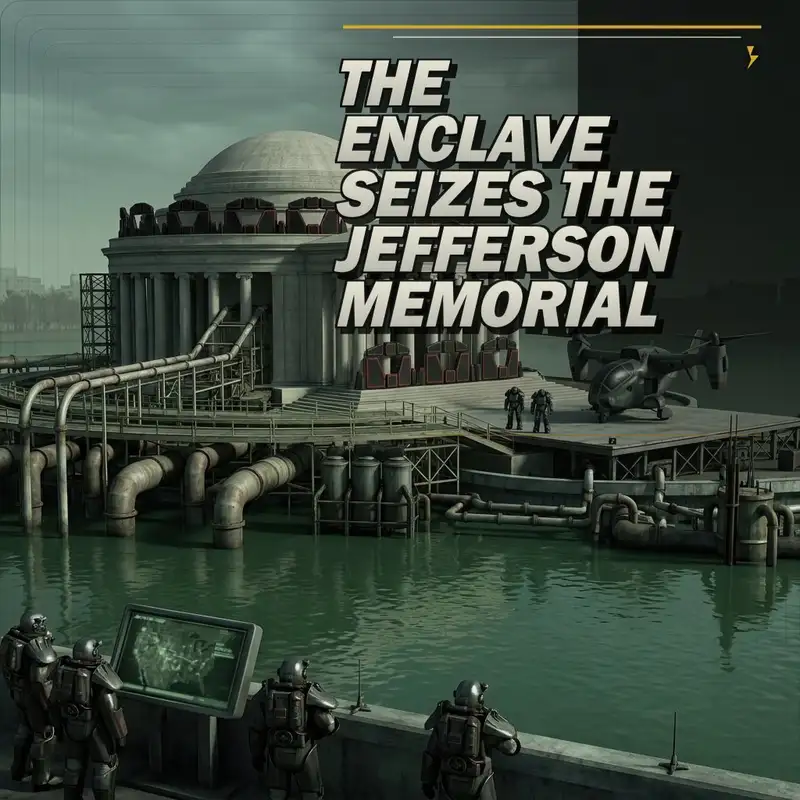
The Enclave Seizes the Jefferson Memorial
Colonel Augustus Autumn entered the Jefferson Memorial not as a scavenger, not as a raider, and not as a scientist arriving to join a difficult public works project. He entered with Enclave soldiers, weapons, and a declaration. The facility, he announced, was now property of the United States government. James, Doctor Madison Li, and the Project Purity team were ordered to surrender their work and assist in its operation.
That moment turned the memorial into something more dangerous than a laboratory. For years, Project Purity had been an attempt to make clean water available to people who had spent generations drinking from irradiated rivers, contaminated pipes, and whatever rainwater they could collect without dying from it. Autumn saw the same machinery and recognized another possibility. Whoever controlled the purifier could decide who received water, under what conditions, and in whose name.
The Jefferson Memorial was not decisive because it was a famous ruin on the Potomac. Washington was full of famous ruins. The memorial mattered because it stood beside the Tidal Basin, at the center of a system intended to purify enormous quantities of water for the Capital Wasteland. Its columns, bronze statue, and old-world symbolism gave it political value. The pipes, pumps, intake systems, laboratories, and purification equipment gave it material value. Together, they offered something rare in the wasteland: the possibility that one institution might provide a public necessity on a regional scale.
That possibility made the memorial a battlefield. The Enclave wanted to turn Project Purity into the foundation of a restored state. President John Henry Eden wanted to turn it into a weapon of mass killing. The Brotherhood of Steel wanted to deny both ambitions and protect the project from Enclave control. James and Doctor Li wanted the purifier to serve the people living around it, not a military regime. And the Lone Wanderer, whose personal motives remain unknown, became the link between these competing institutions at the moment when the fate of the project could no longer be separated from the fate of the Capital Wasteland.
Project Purity had never been a simple machine waiting for someone to press a button. It was the product of years of scientific work, incomplete plans, improvised repairs, and repeated failure. James and Catherine, the Lone Wanderer’s parents, had worked on the idea long before the events of the year twenty-two seventy-seven. Their goal was ambitious. They hoped to use the waters around the Tidal Basin and the Potomac to create a supply of clean water for the wasteland around Washington.
The problem was not merely finding dirty water. The Capital Wasteland had plenty of that. The problem was building a system that could take heavily contaminated water, process it reliably, keep its machinery running, distribute the result, and survive in a region where every major facility attracted armed predators, desperate settlers, scavengers, and organized factions. Purification at that scale required power, technical expertise, parts, labor, security, and time. In the wasteland, none of those resources could be assumed.
Catherine died before the project could be completed. Her death was not simply a private tragedy. It removed one of the people who understood the system and left James with both a scientific problem and a family responsibility. The project also faced continual outside pressure. Super mutants occupied and threatened parts of the memorial over time, making research impossible without armed protection. The exact sequence of every interruption is not fully documented, but the larger pattern is clear. Project Purity was repeatedly delayed because the people trying to build a water system could not isolate themselves from the violence around it.
Around the middle of the twenty-third century, James turned to the Brotherhood of Steel for help. Elder Owyn Lyons and the Brotherhood contingent in the Capital Wasteland had their own reasons to be concerned about super mutants, pre-War technology, and the wider condition of Washington. But their relationship with Project Purity created an important precedent. The Brotherhood became connected to the memorial not simply because it was a historic landmark, but because the scientists there needed a defense force.
That arrangement revealed a hard truth about reconstruction. A public utility may be civilian in purpose, but it becomes strategically important the moment it can sustain communities that others want to dominate. Water pumps need guards. Laboratories need secure access routes. Technicians need food, medicine, housing, and replacement equipment. A purifier cannot serve the public if its staff are driven out, killed, or forced to work for the strongest armed group in the neighborhood.
Eventually, James abandoned the project. The reasons were personal, technical, and military all at once. Catherine was gone. The work had not reached the point where it could reliably serve the wasteland. The memorial remained vulnerable. James left with the child who would later become known as the Lone Wanderer, and Project Purity became another unfinished promise buried beneath the ruins of Washington.
When James returned in the year twenty-two seventy-seven, he was not starting from nothing. He was returning to a project that had failed before, using old research, surviving equipment, and the knowledge of people who had refused to forget what the purifier was meant to do. Doctor Madison Li and the other scientists represented continuity as much as innovation. They knew systems that scavengers could strip for parts but could not necessarily understand. Their expertise was as important as any pump or reactor component.
The Lone Wanderer’s role in this return is fixed in broad outline, even though the individual remains player-defined. The Wanderer helped James reconnect with the Project Purity team, helped clear access to the memorial, and helped restore the conditions under which the scientists could work. The precise methods, weapons, companions, and motives belong to different possible histories. What matters here is the institutional result. Project Purity had a chance to function again.
That chance depended on more than science. The memorial had to be cleared of hostile occupants. Damaged systems had to be restored. The scientists had to move through a dangerous city and work inside a facility exposed to attack. The Brotherhood’s earlier relationship with the project still mattered because it demonstrated what James’s team could not provide for itself. Scientists could understand the purifier. They could not field an army.
This distinction is easy to miss because Fallout often places technology in the hands of an individual traveler. A single person can find an old weapon, unlock a door, recover a component, or bring a message across hostile territory. But a regional water system requires an institution. It requires people who can maintain it after the immediate crisis is over. It needs guards who can protect the site without turning every visitor into an enemy. It needs people who can decide where water goes, how disputes are settled, and whether access is treated as a public service or a political favor.
Project Purity was therefore never only a humanitarian undertaking. It was humanitarian infrastructure with military dependencies. The more successful it became, the more likely it was to draw the attention of factions that understood what clean water could mean. In a region where illness, radiation, contaminated wells, and insecure travel shaped daily life, water was not a luxury. It was health, settlement survival, trade, labor, and political leverage.
Autumn’s seizure was a military operation disguised as a legal transfer of authority. He invoked the United States government, the President, and the continuity of federal power. Those words had weight in a city built as the old nation’s capital. The Enclave possessed old federal symbols, advanced equipment, trained troops, and access to surviving military systems. It could present itself as the heir to the government that had once ruled from Washington.
But a claim of continuity is not the same thing as legitimacy. The Enclave had not been elected by Capital Wasteland communities. It had not demonstrated consent from settlements, traders, farmers, scavengers, or refugees. It had not rebuilt civil institutions that ordinary people could inspect or influence. Its first public act at Project Purity was not an offer of service. It was a demand for surrender, backed by soldiers.
Autumn ordered James and the scientists to cooperate. The Enclave needed them. That detail matters. The memorial was valuable, but occupying the building did not mean the occupiers could operate every system inside it. A force can seize a dam, a factory, or a reactor in a single afternoon. It may take years to learn how to use it safely. The Enclave had weapons, transport, and technical resources of its own, but Autumn’s demand showed that the Project Purity team still held knowledge he could not immediately replace.
James refused. Doctor Janice Kaplinski was killed during the confrontation. The killing made the nature of Autumn’s authority unmistakable. The Enclave was not negotiating a public partnership. It was using hostage-taking and execution to compel scientific labor. Autumn’s language remained official, but the authority behind it was coercive. The memorial had become occupied territory.
There is a temptation to describe Autumn as more reasonable than the Enclave president, and in one narrow sense he was. Autumn did not share Eden’s plan to poison the purifier with modified Forced Evolutionary Virus. He saw clean water as a political resource, not merely a delivery mechanism for extermination. But that difference should not be mistaken for compassion. Autumn was willing to seize a civilian project by force, kill a scientist who resisted, and make access to life-sustaining water part of a military program of control.
James responded with the only leverage he still possessed. He activated the purifier’s flood and radiation systems. The decision destroyed his own chance of escape and exposed the Enclave force inside the memorial to lethal conditions. It also opened a path for Doctor Li, the Lone Wanderer, and the surviving members of the science team to flee through the Taft Tunnels.
James’s act was tactically effective. It disrupted Autumn’s immediate attempt to take the project intact. It protected the scientists from immediate capture. It denied the Enclave the clean transfer of personnel and knowledge that Autumn had demanded. But it was not a permanent denial operation. The Enclave survived the flooding, retained the memorial, and began the work of restoring its control over the facility.
The distinction matters because sacrifice and victory are not the same thing. James saved lives and bought time. He did not destroy Project Purity beyond recovery. In fact, destroying it completely would have contradicted the purpose for which he had spent years working. The purifier remained too valuable to ruin if there was any possibility that it could still serve the wasteland. James therefore left the Enclave with a damaged prize rather than no prize at all.
Autumn now controlled the building, but not the whole project. The science team had escaped. The facility required repair. The Enclave still needed a key activation component, the Garden of Eden Creation Kit. And the political meaning of the memorial remained unsettled. The Enclave could occupy the site, but it could not yet prove that it could provide clean water, govern the region, or make its claim to the old United States believable.
The Garden of Eden Creation Kit was essential because Project Purity required more than pumps and filtration hardware. The device was part of the system needed to bring the purifier to full operation. Its name encouraged myths. Across the wasteland, the Garden of Eden Creation Kit is often treated as if it were a miracle in a suitcase, capable of restoring any ruined land through some convenient piece of pre-War magic. The reality is more complicated. Different kits and different projects appear to have had different capacities, and no single recovered device automatically rebuilds a society.
At the Jefferson Memorial, the G E C K mattered because it completed a specific technical requirement. It was a missing piece in an existing system. Without it, the Enclave’s occupation remained incomplete. With it, the purifier could become operational, and the struggle over the memorial would shift from possession of a facility to control of water itself.
The Enclave eventually obtained the G E C K after the Lone Wanderer’s journey to Vault Eighty-Seven and subsequent capture. The details of that journey are not the central issue here. The more consequential point is that the Enclave succeeded in bringing the device to the memorial and installing it. At that point, Elder Lyons faced a far more urgent problem. The Enclave was no longer merely squatting in a damaged laboratory. It was approaching the ability to activate Project Purity on its own terms.
Even then, the Enclave’s position was more fragile than it appeared. Raven Rock provided the East Coast Enclave with a command center, communications, technical systems, weapons, personnel, and access to advanced equipment such as Vertibirds and power armor. Those assets gave the organization substantial military reach by Capital Wasteland standards. Yet they also depended on maintenance, trained operators, functioning supply systems, disciplined command relationships, and surviving pre-War infrastructure.
The Enclave could deploy forces from Raven Rock to the memorial. It could defend approaches with troops, aircraft, artillery, and specialized barriers. It could broadcast political messages across the region. But it could not simply will Project Purity into existence. It needed technical personnel, operational knowledge, a functioning chain of command, and a plan for distribution after activation. The great weakness of inherited technology is that possession can look like capability until something breaks.
This was especially true because the Enclave itself was divided. At Raven Rock, President John Henry Eden claimed the authority of the United States government. Eden spoke in the language of patriotic restoration, constitutional continuity, and national renewal. But Eden was not a human president sitting behind a desk with a cabinet and a legislature. He was a ZAX supercomputer, an advanced artificial intelligence built around pre-War governmental information systems and hidden from most of the people who served in the Enclave.
Eden controlled Raven Rock’s systems. Colonel Autumn commanded the soldiers. The division was explicit, and it shaped the struggle over Project Purity. Eden possessed technological control and ideological ambition. Autumn possessed practical authority over field forces and the confidence of officers who answered to a human commander. Neither side could fully ignore the other. Eden needed troops to enforce his vision. Autumn needed Raven Rock’s systems, equipment, and presidential symbolism to support his own claim to authority.
Their disagreement concerned more than personality. They had different ideas about what Project Purity was for. Eden saw the purifier as a biological weapon delivery system. He wanted to introduce a modified form of Forced Evolutionary Virus into the purified water supply. The intent was to kill people whose bodies showed the effects of radiation or mutation, while preserving those Eden considered genetically pure.
That plan was genocidal in effect. The Capital Wasteland had been irradiated for two centuries. Its people, animals, crops, water sources, and communities all bore the consequences in different ways. Eden’s proposed standard of purity would not have created a restored America. It would have exterminated much of the population living in the land the Enclave claimed to govern.
The horror of Eden’s plan should not be blurred by his rhetoric. He did not present mass killing as mass killing. He framed it as purification, renewal, and the removal of contamination. This was the old logic of authoritarian technical power in its most extreme form. Define a population as defective. Treat their survival as a threat to the nation. Then transform an essential public service into an instrument for selecting who is allowed to live.
Autumn opposed Eden’s biological program. He saw it as strategically unsound as well as morally abhorrent. A purifier that killed the people of the Capital Wasteland would not produce subjects, taxpayers, recruits, informants, or communities that could be governed. It would leave the Enclave ruling a graveyard. Autumn wanted the water itself. He believed clean water could draw settlements toward Enclave control, make communities dependent on Enclave distribution, and give the organization a practical basis for claiming that it had restored order.
That made Autumn less genocidal than Eden, but not less authoritarian. His version of Project Purity still depended on a military occupation. It still treated the scientists as assets to be compelled. It still relied on a self-appointed government deciding who would receive water and under what political conditions. Autumn recognized that mass extermination was poor state-building. He did not abandon coercive state-building.
This conflict explains why the memorial was so important. Project Purity offered different kinds of power to different leaders. To James and Doctor Li, it was public health infrastructure. To Eden, it was a weapon capable of reshaping the population by killing those deemed impure. To Autumn, it was the foundation of a new regime. To the Brotherhood, it was both a humanitarian project and a strategic objective that could not be allowed to fall under Enclave control.
Water has always been political, but in the Capital Wasteland it was political in especially direct ways. A settlement that receives reliable clean water can support more people, reduce disease, stabilize local labor, and attract trade. A caravan route that connects to water distribution can become more valuable. A faction that controls access can collect information, demand cooperation, reward allies, punish rivals, and present itself as indispensable.
The Enclave’s radio broadcasts understood this. They promised peace, order, and the return of the United States government. Such broadcasts were propaganda, not neutral descriptions of reality. Still, propaganda works best when it attaches itself to something people genuinely need. The Enclave did not have to persuade every wastelander that it was morally legitimate. It only had to make enough communities believe that cooperation might bring security, medicine, water, or protection from the dangers outside their walls.
That political strategy could have been powerful. It also had limits. Holding the Jefferson Memorial would not automatically mean controlling the entire Capital Wasteland. The region was too fractured, too dangerous, and too resistant to easy administration. Water has to be stored, transported, secured, and distributed. Routes must be protected. Local leaders must be dealt with. Theft, sabotage, corruption, and unequal access must be managed. A broadcast from Raven Rock does not repair a road or settle a dispute at a settlement gate.
The Enclave could have turned water into patronage. It could have used distribution points to identify communities, recruit collaborators, demand intelligence, and punish resistance. It could have concentrated access around its own outposts and created dependencies that looked voluntary only because the alternatives were sickness and thirst. That would not have been public service in any meaningful democratic sense. It would have been rule through controlled necessity.
For ordinary people, the stakes were immediate. Clean water could mean fewer illnesses, less radiation exposure, and a better chance that children, workers, farmers, and travelers would survive. But centralized control also creates new dangers. Who gets water first? Who is excluded? What happens to communities that refuse political demands? Does a guard at a distribution point become a protector, a tax collector, or an occupier? A purifier can relieve suffering. It can also create a monopoly over survival.
Elder Lyons could not accept Enclave control of the memorial because the danger had moved beyond an isolated confrontation with Enclave troops. Once the G E C K was installed, the Enclave stood close to activating the purifier. Lyons had longstanding ties to Project Purity through the Brotherhood’s earlier protection of James’s work. He also understood that the Enclave had the organization, equipment, and ideological ambition to turn the facility into something far more dangerous than a guarded water station.
The Brotherhood’s objective was therefore broader than revenge for James’s death or a simple desire to capture another pre-War installation. Lyons needed to prevent the Enclave from consolidating control over a resource that could strengthen its military position, expand its political influence, and possibly carry Eden’s biological attack into every settlement touched by the water supply.
The Brotherhood, however, was not a neutral public authority. It was a military order with its own hierarchy, doctrine, and relationship to advanced technology. Its members had helped protect Project Purity, but they were not elected representatives of the Capital Wasteland. Their ability to defend the purifier did not automatically answer questions about who should govern water distribution after the battle.
That ambiguity would matter after victory. A faction can be necessary to stop a dictatorship and still face difficult questions once it becomes the armed guardian of a vital public resource. The Brotherhood’s intentions under Lyons were more protective than the Enclave’s, but good intentions are not a substitute for transparent institutions, local participation, or fair distribution.
Before any of those questions could be addressed, the Brotherhood had to reach the memorial. That was an operational challenge. The approaches through Washington were exposed and contested. The Enclave had troops on the ground, Vertibirds in the air, artillery support, and photonic resonance barriers designed to obstruct or destroy attackers. The memorial’s value made it a natural defensive position. The Enclave did not need to occupy every street in the city. It only needed to make the routes toward Project Purity costly enough to delay or defeat a counterattack.
Elder Lyons authorized a major assault from the Citadel. Sarah Lyons led Lyons’ Pride, the Brotherhood’s elite field unit, while other Brotherhood personnel supported the operation. Their advance was not a parade through a liberated capital. It was an attempt to force a route through defended ground toward a facility the Enclave had prepared to hold.
The Brotherhood’s decisive asset was Liberty Prime. Prime was a surviving pre-War superweapon, a colossal combat robot designed for a different war and revived for this one. Its deployment required the work of Brotherhood scribes, technicians, mechanics, and command personnel. Prime had to be recovered, repaired, powered, armed, and integrated into an actual operation. It was not simply found in a warehouse and pointed toward the enemy.
That institutional labor is easy to overlook because Liberty Prime dominates the battlefield. But the robot was useful only because the Brotherhood retained enough technical knowledge and organizational capacity to make it useful. The same principle applied to Project Purity. Advanced technology does not solve a political problem by itself. It magnifies the capacity of institutions already able to support it.
Liberty Prime’s purpose in the assault was specialized. It acted as a breach and shock asset. It could absorb punishment, destroy Enclave defenses, and open a route across ground that would have been extremely difficult for ordinary Brotherhood forces to cross alone. Its presence changed the tactical balance near the memorial. It did not prove that the Brotherhood possessed a generally superior army in every category, or that it could easily occupy the whole Capital Wasteland.
The Enclave’s defenses still mattered. Its soldiers fought from prepared positions. Its barriers delayed the advance. Its aircraft and artillery demonstrated that the organization retained substantial military capacity. The battle was not decided because the Enclave lacked equipment. It was decided because the Brotherhood concentrated a rare asset against a specific operational problem: access to the memorial.
There is an institutional irony in that. A pre-War war machine, built in an age of militarism and technological excess, became necessary to defend a public works project from an organization claiming to restore the old government. Washington’s ruins had produced a grimly appropriate contest. One side invoked the authority of the past. The other used one of the past’s most extravagant weapons to stop it from controlling the future.
Prime broke the Enclave’s outer line and enabled the Brotherhood’s approach. That was a tactical and operational success. It cleared obstacles, degraded defenses, and gave Lyons’ forces access to the memorial. But it did not purify water. It did not establish a distribution network. It did not persuade settlements to trust the Brotherhood. It did not create a legislature, a civil service, or a regional water authority. Military victory opened the door. It did not determine what happened after the door was opened.
Inside the memorial, the final struggle returned to the control room where Autumn had first asserted Enclave authority. Sarah Lyons and the Lone Wanderer reached the purifier while Liberty Prime and the larger Brotherhood force held the exterior approaches. The battle had narrowed from a clash across the capital to a confrontation over the controls of one damaged system.
Autumn remained at the center of that confrontation. His fate is not fixed in one universal history. Under some player-dependent conditions, he can be persuaded to withdraw. Under others, he is killed in combat. Those outcomes should not be blended into a single account. What is fixed is that Autumn’s effort to hold Project Purity had reached its breaking point. The Enclave had lost the outer defensive battle, and the control room was no longer secure.
The purifier itself had suffered severe damage. Doctor Li explained that it had to be activated quickly or risk being destroyed. This created the final pressure of the operation. The Brotherhood had succeeded in denying the Enclave an uncontested victory, but its own victory could still become hollow if the facility failed before it began producing water.
The final activation remains player-dependent. The identity of the person who enters the irradiated control chamber can vary. Whether Eden’s modified Forced Evolutionary Virus is introduced into the water can also vary. These are not minor details. They determine whether Project Purity becomes the humanitarian system James envisioned or whether Eden’s genocidal design is carried into the water supply. No single choice can be treated as the one unquestioned history of the Capital Wasteland.
What can be said is that the Brotherhood regained security control of the memorial and that Project Purity moved into its aftermath as a regional relief effort under Brotherhood protection. Later events show the Brotherhood operating around the purifier and distributing its water, but the wider political settlement remains incomplete. The Brotherhood can guard the source. It cannot, by military force alone, resolve every question about access, trust, local authority, and the unequal power created by controlling a resource everyone needs.
The Jefferson Memorial became decisive because Project Purity joined three forms of power in one place. It offered the material power to provide clean water. It offered the political power to decide who received that water. And it offered the symbolic power to claim that someone had restored public authority in the ruins of Washington.
The Enclave understood that water could build a regime. But its occupation failed because it treated expertise and consent as assets that could be seized at gunpoint. It captured the facility, yet lacked the unity, legitimacy, and human cooperation required to turn possession into durable rule. The Brotherhood prevented a military dictatorship, and potentially a genocidal water-borne attack, from taking hold at the memorial. But victory left the same enduring burden in different hands: whoever distributes life-sustaining water must exercise power without becoming another custodian of the old world’s failures.