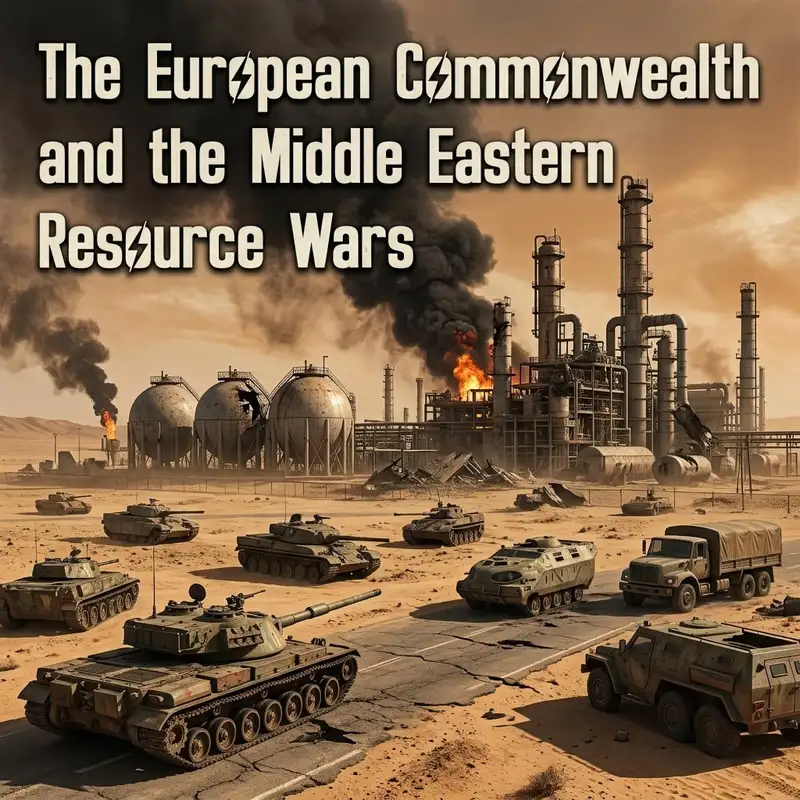
The European Commonwealth and the Middle Eastern Resource Wars
On July twenty-seventh, twenty fifty-two, a report in the Capital Post announced the dissolution of the United Nations. The tone was that of a pre-War newspaper, with all the compression, editorial instinct, and dark confidence that implies. But the event itself matters. The United Nations had been expected to mediate between the European Commonwealth and Middle Eastern nations as the struggle over dwindling resources intensified. Its collapse did not create the shortages. It did not fire the first shot, seize an oil installation, or erase the rival interests already dividing governments. What it showed was more troubling. The institution most visibly associated with international negotiation no longer possessed enough authority, trust, or leverage to keep a resource crisis from becoming a military one.
That failure left the European Commonwealth with a brutal strategic choice. The fuel sustaining its industry, transport, and armed forces lay beyond its borders, while diplomacy no longer offered a credible path to reliable access. In the broad history preserved by Fallout, the answer was war. Yet the conflict with Middle Eastern nations did not secure the political cohesion it was meant to protect. The Commonwealth later dissolved into what the original Fallout narration calls quarrelling, bickering nation-states, all competing for what resources remained. A campaign intended to defend a shared industrial civilization appears instead to have accelerated the breakdown of the political structure built to manage shared needs.
The record is sparse enough that this cannot be a conventional campaign history. No released Fallout source provides a map of fronts, a list of Commonwealth member states, an order of battle, named admirals, confirmed landing sites, or a clear account of who controlled which oil fields at a particular moment. There is no reliable basis for assigning casualty totals, describing a decisive battle, or inventing a European occupation authority. That absence is not a minor inconvenience. It is part of the history. The available material preserves the strategic crisis and its political result far more clearly than it preserves the machinery of war between them.
The games establish that the Resource Wars began in the year twenty fifty-two and that petroleum and uranium had become central objects of international competition. Petroleum is the critical resource for understanding the European Commonwealth and the Middle East. Uranium belongs to the wider global emergency, but the released record does not establish that uranium was the central cause of this particular conflict. The distinction matters. A resource war can involve several scarce commodities without every theater being driven by the same one. In this case, the strongest evidence points toward a struggle in which access to Middle Eastern petroleum had become inseparable from European political and economic survival.
The Resource Wars were not one neat global conflict with a single headquarters, uniform ideology, or agreed beginning and end. They were a period in which states and political blocs increasingly treated material scarcity as a national-security threat. The Museum of History in the Capital Wasteland preserves this period as a long crisis on the road to the Great War. The original Fallout opening offers an even harsher summary. Nations went to war over the last remaining resources. The European Commonwealth and Middle Eastern nations belong within that larger framework, but their conflict should not be reduced to a footnote in the later Sino-American War. It had its own strategic geography, its own institutional failures, and its own consequences.
That uncertainty points to the Commonwealth’s central vulnerability. A coalition can share a problem without sharing a solution. Every member government may agree that fuel is scarce, every industrial center may fear reduced production, and every military establishment may warn that mobility, readiness, and deterrence are declining. Agreement on danger still leaves the coalition to decide who pays to protect supply routes, whose ports become targets, which industries receive priority fuel, which populations face rationing first, who commands the force abroad, and who controls whatever resources are captured.
Those questions are not merely bureaucratic details. In a resource crisis, they become the substance of political legitimacy. A union built during an era of relative abundance can conceal disagreements through trade, credit, subsidies, and promises of future growth. Scarcity is less forgiving. It demands allocation. Someone receives fuel, food, transport, security, or industrial power. Someone else waits. Once citizens and governments conclude that cooperation means enduring sacrifice while another region receives the benefit, the language of common purpose loses force very quickly.
The European Commonwealth therefore faced dependence without assured political unity. It needed access to resources outside its territory, but its capacity to act depended on the cohesion of governments inside its territory. That is a familiar strategic problem, though Fallout gives it a particularly severe form. The Commonwealth could not simply decide that petroleum was essential and make it appear in European depots. It had to obtain access, move the resource, defend the movement, distribute the benefits, and persuade its own members that the cost was worth bearing. Each requirement created opportunities for disagreement, delay, corruption, panic, and national self-preservation.
Oil was not just fuel for tanks. In an advanced industrial society, petroleum supports transport networks, merchant shipping, aviation, chemical production, plastics, agricultural systems, emergency services, and military logistics. Fallout’s pre-War world had extraordinary technologies, but advanced technology did not make material supply irrelevant. Factories still needed inputs. Vehicles still required power. Food systems still depended on transport, machinery, chemicals, and labor. A shortage that begins in the energy sector can therefore move through the rest of society. Freight slows. Prices rise. Production schedules fail. Public services become less reliable. Political leaders discover that a crisis in distant oil fields is also a crisis in domestic streets, farms, warehouses, and hospitals.
For a government, that creates an ugly temptation. If normal trade can no longer guarantee supply, force begins to look like policy by other means. Leaders may convince themselves that temporary military action will restore order. Secure the route. Protect the facilities. Guarantee deliveries. Buy time for industry to adapt. Stabilize the homeland. It is an argument with immediate political appeal, especially when shortages are visible and public patience is disappearing. But it contains a trap. The campaign launched to secure fuel is itself one of the largest consumers of fuel available to the state.
This is the strategic paradox at the heart of the Commonwealth’s war. Petroleum was necessary to sustain the industrial system the Commonwealth hoped to preserve. But securing oil through force required an expeditionary effort that consumed petroleum, industrial capacity, and political unity before any captured resource could produce a benefit. If the war became prolonged, the campaign could deepen the shortage it was supposed to relieve. If it remained limited, it might fail to establish control over the infrastructure that mattered. Either way, leaders faced a problem for which military action offered no cheap solution.
The geography of the conflict made that problem still harder. The European Commonwealth’s interest lay across a substantial distance from the source of the resource. Any campaign toward Middle Eastern oil infrastructure would have faced an expeditionary challenge. It would have required transport across sea lanes, access to ports, protected depots, reliable communications, repair facilities, replacement parts, and security for the route between Europe and the contested region. These are not details supplied by a Fallout battle map. They are the material conditions required by any sustained attempt to project force across water and then convert military access into economic supply.
Taking a facility is not the same as operating it. An oil field, refinery, terminal, pipeline, pumping station, or harbor can be strategically valuable only if it remains functional. It needs trained workers. It needs power, machinery, technical records, spare parts, and protection from damage. It needs routes to carry output from the point of extraction to loading facilities, then onward to consumers. A force can seize ground quickly and still discover that the ground produces little. Equipment may be damaged. Workers may flee. Local authorities may refuse cooperation. Infrastructure may be sabotaged. Transport capacity may be insufficient. The entire system may be too insecure to move a useful volume of fuel.
That distinction between access and control is especially important in a resource war. A government can announce that it has secured strategic facilities. That may be true in a narrow military sense. It does not mean the resource has reached its factories, citizens, or armed forces. Between the flag raised over a facility and the fuel delivered to a distant user lies a chain of labor, administration, transport, maintenance, and security. The chain is only as strong as its weakest link. In a crisis already severe enough to dissolve international mediation, every link was likely under pressure.
The Commonwealth would also have needed to decide how much of its remaining capacity to commit abroad. Convoy escorts and transport ships cannot be in two places at once. Supplies sent to a distant theater are supplies not held in reserve at home. Mechanics assigned to military transport are not repairing civilian infrastructure. Industrial production directed toward war matériel cannot also ease shortages in the domestic economy. None of this proves a particular policy decision by Commonwealth leaders. The released record does not provide one. But it explains why the conflict could damage the Commonwealth even if its forces achieved local military successes.
Occupation would have created another layer of cost. Oil infrastructure is not a hilltop that can be held by a garrison and forgotten. It is a network embedded in a society. The people who operate it live somewhere. The roads and ports serving it pass through territory governed, contested, or inhabited by others. The water, food, medical care, wages, security, and political treatment of workers all affect whether production continues. A foreign coalition can compel compliance for a time, but coercion does not automatically create reliable labor, durable administration, or local legitimacy. It may instead encourage concealment, sabotage, flight, resistance, or simply the quiet collapse of systems that once depended on ordinary cooperation.
The Middle Eastern side of this conflict deserves the same caution. The games refer to Middle Eastern nations. They do not establish a single Middle Eastern alliance, common military command, shared ideology, or unified political program. It is easy, especially from the perspective of a European resource crisis, to turn an entire region into a strategic object called “the oil supply.” That is exactly the kind of abstraction that leads governments to misunderstand the societies they intend to coerce. The region contained nations, governments, populations, infrastructure, and local interests. Those actors may have overlapped in their opposition to outside control without agreeing on every objective or strategy.
A government resisting European intervention might have been defending sovereignty, access to revenue, domestic legitimacy, control over vital infrastructure, or basic survival. A local community might have viewed the same conflict through the immediate realities of employment, security, displacement, shortages, or bombardment. These motivations cannot be reconstructed in detail from the surviving canon. Still, they matter because they show why the Commonwealth could not treat the Middle East as an empty warehouse of fuel. Resource infrastructure exists within political communities. Whoever seeks to control it must confront the people whose lives, authority, and future are tied to it.
A coalition on the defensive can also benefit from ambiguity. If the European Commonwealth did not know whether it faced coordinated state resistance, local security forces, rival governments, irregular fighters, or competing resource claims, then planning would become more difficult. Intelligence is never perfect in war. It is particularly fragile when institutions are collapsing, borders are contested, and every participant has an incentive to conceal supply, weakness, and intent. A multinational coalition may possess impressive technology and still fail because it does not understand the political terrain around the facilities it wants to control.
The Commonwealth’s internal political structure would have magnified these problems. Consider the difference between a front-line government, a maritime government, a manufacturing center, and a poorer member region. Each may support a shared policy in principle while bearing a different portion of the risk. One government may provide ports. Another may provide ships. Another may send soldiers. Another may demand guaranteed fuel allocations in return for political support. Another may see little benefit from the campaign but fear the economic consequences of refusing participation. Those are not established national roles within Fallout’s European Commonwealth. They are the structural pressures inherent in any multinational war for scarce resources.
The question of whose oil and whose losses could become more destructive than the initial decision to fight. If Commonwealth institutions could not distribute burdens and benefits in a way members considered fair, national governments would have strong incentives to protect their own populations first. They might retain supplies, resist deployments, dispute command authority, or seek separate arrangements. Such behavior can look selfish from the outside, but it often emerges when a larger institution cannot credibly guarantee survival. The more severe the shortage, the harder it becomes to ask governments to trust that sacrifice today will produce security tomorrow.
Military coordination cannot repair a political bargain that has failed. A multinational force can establish a joint command for a particular operation. It can share intelligence, issue common objectives, and coordinate naval or ground movements. But operational cooperation is not the same as durable political unity. Soldiers can follow a common plan for a time while the governments behind them argue over cost, casualties, strategic priorities, and the terms of any settlement. If the campaign turns expensive or inconclusive, those arguments move from cabinet rooms into the structure of the coalition itself.
At this point, the dissolution of the United Nations becomes more than background. The loss of an international mediator did not automatically make war inevitable. States can negotiate without a global organization, and institutions sometimes survive even when they are weak. But the UN’s collapse removed a visible forum for restraint at the moment when governments needed ways to de-escalate, share information, establish guarantees, or create some mechanism for managing shortages without conquest. The disappearance of mediation did not solve anyone’s fuel problem. It made every government more likely to treat unilateral action as the only reliable insurance policy.
The original Fallout narration tells us the result for Europe. The European Commonwealth dissolved into competing nation-states, each quarrelling over the resources that remained. That sentence is concise, but its implications are large. The Commonwealth did not merely endure a difficult war. It ceased to function as a political structure capable of keeping its constituent parts aligned. Its members, or at least the states within its former framework, returned to open competition. The union built to manage interdependence could not survive when interdependence became a source of fear.
That distinction between military and political outcomes is essential. A force can win engagements and still fail strategically. It can protect a convoy while losing public support. It can seize a port while draining the treasury. It can control an installation while being unable to transport its output. It can inflict losses on an opponent while convincing its own member governments that the war is no longer worth the cost. Tactical success measures what happened at a particular place and time. Political success measures whether the state or coalition that ordered the action remains capable of pursuing coherent policy afterward. The Commonwealth’s dissolution indicates failure at that higher level.
Coalitions are most comfortable distributing prosperity. They are least stable when distributing scarcity. When there is enough trade, energy, food, and credit to go around, members can compromise because disagreement does not always threaten survival. When supplies shrink, every allocation becomes a political judgment about whose factories run, whose homes are heated, whose roads remain open, and whose military formations receive priority. Leaders may still speak of unity, but their voters, industries, and security establishments see the practical results. If one region believes another is receiving protection at its expense, the union’s legitimacy begins to erode.
Militarization also changes the relationship between civilians and the state. Governments facing strategic shortage often centralize decision-making, prioritize military supply, expand security measures, and portray sacrifice as a patriotic duty. Some emergency measures may be necessary. Others may protect privileged institutions more effectively than vulnerable populations. The key issue is not whether citizens are asked to sacrifice. Every severe crisis imposes burdens. The issue is who decides, who is protected, who is excluded, and whether the political system can explain its choices in terms people still regard as legitimate.
In a multinational structure, unequal sacrifice is especially dangerous. A worker whose livelihood depends on a fuel-starved factory may not care that a distant operation has improved the Commonwealth’s strategic position on paper. A community facing shortages may not be reassured by promises that oil will arrive eventually. A government watching its own reserves decline may question whether joint policy is protecting the union or merely delaying someone else’s collapse. These pressures do not need a dramatic betrayal to become corrosive. They can accumulate through missed deliveries, rationing disputes, industrial stoppages, military losses, and the steady realization that the common system cannot meet every member’s needs.
The same applies to populations in the contested region. Even without a detailed record of specific occupations or battles, it is clear that resource war turns civilian infrastructure into strategic terrain. Ports, roads, refineries, communications networks, and labor forces become objects of military calculation. People living around them are no longer simply citizens or workers. They become, in the eyes of competing governments, potential sources of labor, intelligence, obstruction, legitimacy, or resistance. That transformation is one of the ugliest features of resource conflict. It converts the ordinary systems that sustain civilian life into targets, bargaining chips, and security problems.
The limited source record also requires caution around nuclear escalation. The released games establish a broad Resource Wars crisis, but they do not provide a detailed canonical account of nuclear weapons being used in the European Commonwealth and Middle Eastern conflict. They do not establish target lists, governments responsible, weapon yields, casualty totals, or the extent of damage in Europe or the Middle East before the Great War. It would be irresponsible to fill that silence with maps of glowing craters and invented final battles merely because the larger setting eventually ends in nuclear catastrophe.
There is, however, a later-developed chronology in the Fallout Bible. That material described the conflict as beginning in April of twenty fifty-two, included the destruction of Tel Aviv by a terrorist nuclear device in twenty fifty-three, referred to a limited Middle Eastern nuclear exchange in twenty fifty-four, and placed the end of the war around the year twenty sixty after regional oil fields ran dry. It is useful as a record of development-era ideas and as an example of how the setting’s early history was elaborated. It is not equal to the released game canon that governs this account.
The distinction matters because the games do not answer several critical details. The identity and affiliation of those responsible for the Tel Aviv attack remain uncertain. So do the exact nuclear capabilities of the governments involved, the scale of any exchange, the infrastructure that survived, and the degree to which nuclear use accelerated the Commonwealth’s collapse compared with conventional shortages and coalition failure. The Fallout Bible does not provide a foundation strong enough to settle those points, and later official releases have not transformed its chronology into a fully documented campaign record.
Still, the possibility of nuclear escalation reveals a larger strategic truth. Resource infrastructure is valuable only while it can function. A state may seek to control oil fields, ports, refineries, or pipelines because they promise long-term security. But as conflict intensifies, the incentive to deny those assets to an enemy increases. The more important an installation becomes, the more likely it is to become a target. A war for energy can therefore destroy the very systems that gave the territory its strategic value. The result is not security, but a contest over damaged infrastructure, disrupted trade, and dwindling capacity.
That is the logic of scarcity at its most self-defeating. The resource is too valuable to surrender, too essential to ignore, and too vulnerable to secure cheaply. Governments respond by committing more force. Their opponents respond by contesting access more fiercely. The infrastructure degrades. Transport becomes more dangerous. Civilian suffering rises. The political promise of intervention becomes harder to fulfill. What began as an effort to preserve industrial civilization turns into a struggle that consumes industrial civilization’s remaining margin for error.
The European Commonwealth’s collapse fits that pattern, though it should not be reduced to a mechanical inevitability. Political institutions do not simply break because resources are scarce. They break because leaders make choices under scarcity, because member governments calculate interests differently, because publics lose faith, and because systems fail to distribute danger in a way people will accept. The Commonwealth’s leaders may have faced real strategic constraints. Resource security was not an irrational objective. No government can ignore the loss of energy supplies that sustain transport, production, food systems, and defense.
But recognizing the necessity of the objective does not vindicate the method. War may have seemed like the only remaining instrument once negotiation failed. Yet force could not restore a global resource system already shaped by depletion and competition. At best, it might secure temporary access. At worst, it would consume scarce fuel, expose the Commonwealth to long-distance military obligations, damage the infrastructure it sought to exploit, and intensify the disagreements among its own members. The campaign’s central promise was that external control would protect internal stability. The historical outcome suggests the opposite.
The Commonwealth dissolved, while the resource crisis continued. That is the strategic verdict. Whatever access, leverage, or local military success European forces may have achieved, the Commonwealth did not emerge as a more cohesive political order. It fractured into rival states competing for what remained. The war did not turn dependency into security. It transformed shared dependency into a contest among former partners. Once the union ceased to provide a credible system for mutual survival, governments had every reason to retreat into narrower national calculations.
The wider Resource Wars show that Europe was not uniquely reckless. China’s invasion of Alaska and the United States’ annexation of Canada demonstrate the same broad pattern. Major powers increasingly interpreted resource access as a problem that could be solved through coercion, territorial control, and militarization. The United States was not established as a combatant in the European Commonwealth’s war against Middle Eastern nations, and the conflicts should not be merged. But they reveal a common failure of political imagination. Governments treated scarcity as a contest to be won by securing more territory or denying resources to rivals.
Those strategies could produce short-term gains. An annexation might secure a route. An invasion might seize a resource region. A military occupation might delay a shortage. But none of them repaired the underlying system. They increased military consumption, hardened rivalries, weakened international norms, and made future escalation more likely. By the time the Great War arrived on October twenty-third, twenty seventy-seven, the world had spent decades teaching itself that survival required force before cooperation, control before trust, and national advantage before any shared human interest.
The European Commonwealth’s experience is especially revealing because it began with the appearance of collective capacity. A multinational union should, in theory, be better able to manage dependence than isolated states. It can pool resources, coordinate industry, share risk, negotiate from a stronger position, and prevent members from undercutting one another. But those advantages depend on functioning institutions and a political bargain strong enough to survive hardship. The Commonwealth seems to have lost both. Its external resource crisis became an internal test of trust, and its members ultimately returned to competition.
There is a dry bureaucratic cruelty in that outcome. Political unions are often built to make certain forms of rivalry less destructive. They create committees, common rules, shared infrastructure, joint planning, and diplomatic language designed to keep old conflicts from returning. Then a crisis arrives, and the same institutions must decide who gets the last available fuel, who receives military protection, and who is expected to endure the shortage. At that point, the paperwork becomes a map of fear. Every allocation looks like abandonment to someone.
The war’s deepest failure, then, was not simply that it may have cost too much. All wars cost too much in one way or another. It was that the Commonwealth pursued a solution that depended on the very political unity the crisis was already destroying. It needed common command, common sacrifice, common distribution, and common confidence in the future. But expeditionary war over scarce energy sharpened every reason for its members to distrust one another. The harder the Commonwealth fought to secure a shared resource, the more each government may have feared that someone else would claim the benefit.
The surviving canon cannot tell us who won a particular battle, who commanded a particular fleet, or whether one oil facility changed hands three times. It can tell us something more consequential. The European Commonwealth did not endure the Resource Wars as a unified political body. The United Nations did not remain available as a credible mediator. The former Commonwealth fractured into states competing over the same dwindling resources that had drawn it into conflict. Those outcomes mark a failure of strategy at the level that mattered most.
Tactically, there is too little evidence to declare a winner. Operationally, any effort to control distant energy infrastructure would have been expensive, vulnerable, and dependent on a long chain of transport and maintenance. Strategically, access to oil could not restore a wider world already defined by depletion and rivalry. Politically, the Commonwealth’s dissolution shows that external war did not preserve internal solidarity. Institutionally, the collapse of both international mediation and European cooperation reduced the ability of governments to manage crisis collectively. Civilians, meanwhile, bore the consequences through insecurity, disruption, rationing pressure, militarization, and the loss of trust in systems meant to protect them.
The European Commonwealth did not fail because resource security was an irrational objective. It failed because it tried to solve systemic scarcity through a form of power that consumed the very resource it sought, required political unity it could not sustain, and offered no durable answer to the unequal burdens of extraction, transport, occupation, and rationing. Its dissolution into competing nation-states was the strategic result: a union built to manage shared dependence fractured when scarcity made every member fear that cooperation meant someone else would survive at its expense.