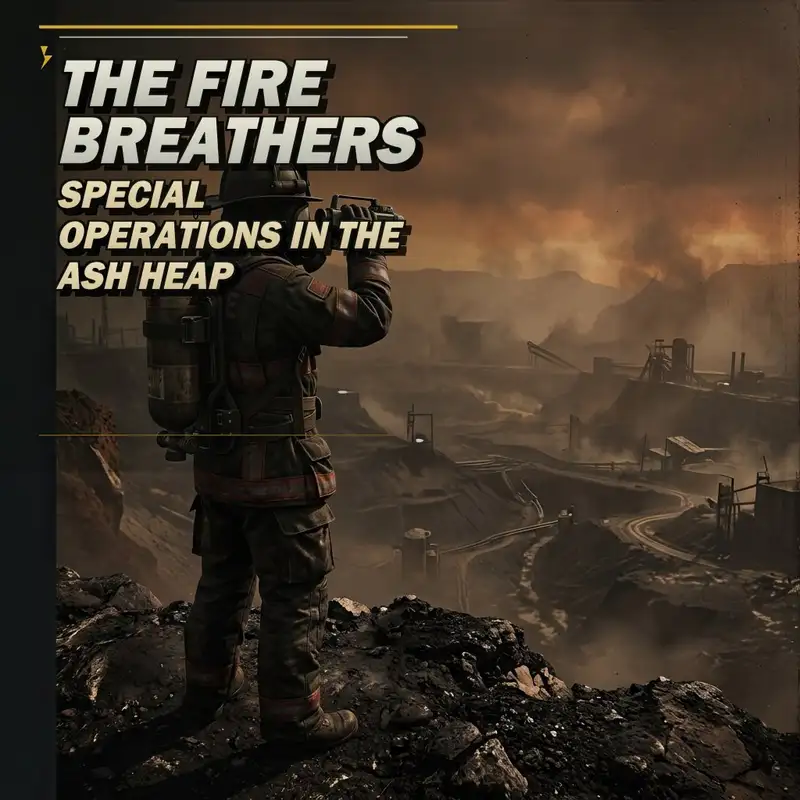
The Fire Breathers: Special Operations in the Ash Heap
A recruit steps into Belching Betty wearing protective gear, carrying the tools expected of a Fire Breather, and enters a mine built to punish hesitation. Smoke and toxic air close down the passages. Heat, darkness, and broken industrial space turn movement into a problem of memory, balance, and nerve. Somewhere ahead are Scorched. Somewhere behind is the route out. The recruit’s task is not to conquer the mine. It is to survive the approach, activate an emergency beacon, and withdraw alive.
That final examination was not ceremonial. It was a compact lesson in the kind of work the Fire Breathers expected to perform across Appalachia’s Ash Heap. They would go where civilians could not safely go, where ordinary volunteers could not remain for long, and where an injured person or isolated settlement might be cut off by fire, poisonous air, collapsed infrastructure, or armed hostility. The beacon mattered because a Fire Breather was not supposed to disappear into the hazard alone. It represented a call for support, extraction, and institutional memory. In a collapsing region, even that modest promise was difficult to keep.
The test also exposed a hard truth about specialized service. Selection can identify people willing and able to accept risk. It cannot create an unlimited supply of them. The records associated with Belching Betty make clear that earlier candidates died in the mine. The examination did not establish a harmless rite of passage, and it did not guarantee that every successful recruit would survive later operations. It demonstrated something narrower and more important. The Responders needed people who could make decisions under pressure in environments where confusion, exhaustion, and injury were not exceptions. They were the normal operating condition.
The Fire Breathers emerged because the Ash Heap created a military and humanitarian problem unlike the rest of Appalachia. This was a region shaped by pre-War extraction and industry. Mines burrowed beneath damaged ground. Processing facilities, workshops, rail lines, company settlements, and power infrastructure had once connected the region to a larger economy. After the Great War, much of that system remained as wreckage, contamination, and dangerous opportunity. The old industrial landscape still offered shelter, salvage, routes, and machinery. It also offered smoke, ash, unstable shafts, toxic water, fire hazards, and places where anyone entering could be trapped beyond easy reach.
The Ash Heap was not simply an unpleasant place to patrol. Its terrain shaped what any force could do there. Open roads and wide fields allow a large formation to maintain visual contact, move supplies, and recover casualties with some predictability. Mines and industrial ruins do the opposite. They divide people into small elements. They block radios. They force movement through narrow passages and vertical approaches. They make smoke, dust, machinery, and darkness part of the tactical situation. A team may know where it needs to go and still have no simple way to reach it, communicate from it, or get a wounded member back out.
That did not make conventional force entirely useless. It did mean that mass alone was no solution. A large body of poorly equipped people would have created more mouths to supply, more casualties to extract, and more confusion in every confined space. The Ash Heap rewarded protective equipment, route knowledge, disciplined movement, and the ability to judge when a rescue could still be attempted and when a structure, tunnel, or fire line had become a death trap. These were the habits of emergency response, but in post-War Appalachia they had acquired a more openly armed character.
The region’s dangers also came from different sources, and the distinction matters. Mole miners were not the Scorched. They were a separate hostile population associated with the industrial underground, and encounters with them posed their own tactical and political problem. Fires, cave-ins, toxic exposure, and damaged machinery were not enemy actions at all, though they could kill just as efficiently. The Scorched, when they became the central crisis, represented something worse still. Treating every danger in the Ash Heap as one generic wasteland threat would miss why the Fire Breathers were needed and why they eventually failed.
The Responders were the institution that tried to make civilian life possible amid those conditions. They were not a conventional government in the pre-War sense, with a stable tax base, a legislature, and a professional army spread across secure territory. They were a post-disaster emergency network. Firefighters, medical personnel, volunteers, administrators, local leaders, and survivors took on the work that ordinary public institutions had once performed. They organized aid, taught basic survival, treated the sick, distributed supplies when they could, and tried to connect scattered communities that had survived the bombs but not the systems that once linked them.
Charleston became one of the Responders’ principal anchors, and its fire department became the center of Fire Breather activity. That location mattered for more than symbolism. A functioning headquarters, even a damaged one, provided a place to store equipment, preserve training material, coordinate requests for help, and create some continuity between one mission and the next. The Charleston Fire Department did not transform the Responders into a state with unlimited capacity. But it gave them a physical and institutional base from which they could attempt to project help into areas where ordinary travel had become dangerous.
In this sense, reaching an isolated settlement was a political act as well as a humanitarian one. A community that receives medicine, warnings, evacuation assistance, or protection from a relief network is less isolated from the wider region. It can trade, communicate, and make claims on others. A community that cannot be reached may remain alive, but it is effectively outside the protection of any larger order. The Fire Breathers existed to preserve access under extreme conditions. Their work helped the Responders claim that Appalachia was still a place where people owed one another something beyond immediate self-interest.
That purpose explains why the Fire Breathers remained part of the Responders rather than becoming an independent military faction. Their missions could involve combat, but combat was not their defining political objective. They were not seeking territory for its own sake. They were not building a separate chain of command to dominate Charleston or the Ash Heap. Their function was to support emergency government, keep routes open, investigate threats, conduct rescues, and intervene where ordinary relief teams could not operate. They carried weapons because Appalachia required them to. Their reason for existing was still civilian survival.
The exact date of the Fire Breathers’ formation is not firmly established. The surviving record places their development in the early post-War decades, after the Responders had begun to organize themselves and after the need for a more specialized unit had become clear. Melody Larkin appears as one of the division’s central operational figures. Her role was closely tied to training, readiness, and the practical standards expected from recruits. That is significant because specialized institutions are not created by uniforms alone. They are created by routines, selection, instruction, equipment checks, and leaders willing to insist that volunteers meet difficult standards before entering dangerous ground.
Maria Chavez represented another side of the organization. Her connection to Fire Breather decisions illustrates that the division remained tied to the broader Responder structure. The Fire Breathers had room for operational initiative, but they did not operate in a vacuum. Their missions drew on civilian priorities, relief requirements, and the larger effort to preserve communities. That relationship could be a strength. It kept the unit focused on real needs rather than abstract displays of force. It could also be a constraint. A relief organization under pressure must divide scarce resources among food, medicine, shelter, communications, and security. Elite teams do not become self-sustaining simply because their work is urgent.
Hank Madigan added another important element. He had been a firefighter before the war and brought experience from Marine Force Recon and the Brotherhood of Steel. That background gave him a perspective unusual within an emergency service. He understood armed operations, discipline, reconnaissance, and the reality that a rescue team entering hostile territory might need to fight its way in and out. His presence helped push the Fire Breathers toward a more capable combat role without severing them from their rescue-oriented identity.
Madigan’s own account of his departure from the Brotherhood emphasized a disagreement over priorities. He believed Appalachian civilians needed direct protection, while the Brotherhood was focused on its own mission and concerns. That perspective is useful, but it should be read as the testimony of a man explaining his own decision. It does not establish that every Brotherhood member or every Brotherhood operation in Appalachia held the same priorities. What it does show is that Madigan saw a gap between preserving dangerous knowledge and protecting people living beside danger. The Fire Breathers were his answer to that gap.
His contribution should not obscure the work of Larkin, Chavez, or the wider Responders. Madigan was not the sole inventor of the organization, and the surviving record does not support the image of a single commander directing every Fire Breather action. The unit’s character came from a combination of local emergency-service culture, broader Responder authority, and the need to operate in a hostile industrial region. Madigan supplied combat experience. The Responders supplied purpose. The Ash Heap supplied the conditions that made both necessary.
The Fire Breathers were therefore not modern special forces in fire-resistant clothing. They had no documented equivalent to a large national military establishment, no known deep reserve of replacement personnel, and no evidence of the broad strategic reach associated with a modern commando force. A better description is a specialized high-risk response formation. Its members were selected for difficult work, trained to function in hazardous conditions, equipped for smoke and fire, and willing to enter places other people could not safely enter. They were emergency personnel adapted to a world in which the emergency had become armed, contagious, and region-wide.
Their likely mission categories show that distinction. They could conduct rescue and recovery. They could inspect or reopen threatened routes. They could scout dangerous sites and bring information back to Charleston. They could respond to fires, industrial failures, and isolated calls for help. When required, they could clear hostile ground or support a limited containment operation. They could use force in a confined and dangerous environment. But none of that meant they were designed to occupy large areas, sustain repeated attritional battles, or impose order across all of Appalachia.
Their equipment reflected their niche. Respirators, helmets, fire-resistant clothing, flamers, axes, and emergency tools were useful because the Ash Heap placed fire, smoke, and industrial hazards at the center of the mission. The equipment gave a Fire Breather more options than an unprotected civilian or a lightly equipped volunteer would have had. It allowed a team to remain in toxic or burning spaces long enough to complete a specific task. It also carried symbolic weight. The uniform said that someone was prepared to enter the place from which others were fleeing.
But protective gear is not invulnerability. A respirator requires filters. Clothing wears out. A flamer requires fuel and maintenance. Weapons require ammunition, repair, and trained handling. Helmets do not stop every falling beam, and fire-resistant clothing does not make a mine shaft stable. Equipment could reduce certain risks. It could not erase infection, enemy fire, fatigue, collapse, isolation, or the danger of a wounded person becoming trapped in a tunnel where no vehicle could reach them. The Fire Breathers’ strength rested partly on specialized gear. Their vulnerability rested on the same fact, because specialized gear is difficult to replace when supply systems are failing.
Belching Betty made that reality visible. The knowledge examination tested whether a candidate understood the principles of the job. The physical evaluation tested whether the candidate could endure it. The final mine test brought those elements together under conditions that resembled an actual operation. Enter hazardous ground. Find the objective. Activate the beacon. Leave. It was a disciplined sequence, but it was also a narrow one. Passing the test showed that a person could perform a dangerous insertion and withdrawal under pressure. It did not prove that a small team could control an entire mine complex, protect a settlement for months, or halt a regional biological crisis.
The beacon itself reveals the logistics behind courage. A signal is only useful if someone receives it, understands it, and has the ability to act. Fire Breathers depended on Charleston and the wider Responders for communications, medical support, replacement equipment, transport, food, ammunition, repair work, and new volunteers. The records do not provide precise stockpiles or a complete manpower roster. They do not need to. Any small specialist unit depends heavily on a support structure. When that support structure weakens, every mission becomes more expensive, because every damaged mask, wounded operator, lost weapon, and experienced death is harder to replace.
This was especially true in the Ash Heap. The very conditions that gave the Fire Breathers their value also made their losses difficult to recover. A casualty in an open area might be carried to a road, loaded into a vehicle, and moved toward treatment. A casualty in a smoke-filled mine or on a quarry ascent creates a much different problem. The team must decide whether it can extract the injured person without losing more people. It must maintain security while moving. It may have limited visibility and poor communications. It may not know whether the route behind it is still safe. In such an environment, one bad operation can remove more capability than the casualty count alone suggests.
Brim Quarry offered a warning of those limits. On March tenth, twenty ninety-five, a Fire Breathers team under Lieutenant Thomas attempted to clear or secure the quarry. The surviving report and the evidence left behind indicate that the operation failed and that multiple Fire Breathers were killed. The exact size of the team is not firmly established. Neither is the full tactical sequence, the number of hostile fighters involved, or whether the unit achieved any temporary local objective before it was overwhelmed. The available record is enough to identify the larger pattern without pretending to possess a complete after-action report.
The quarry was not merely another dangerous location. It combined hostile resistance with industrial terrain. Movement involved a difficult ascent, restricted approaches, exposed positions, and the constant problem of operating around a site built for extraction rather than defense. A specialized team could enter that environment. It could conduct reconnaissance, engage immediate threats, and perhaps reach a specific objective. But clearing a position and controlling it afterward were different tasks. Clearance seeks a temporary change in the immediate situation. Control requires personnel, supplies, observation, reinforcement, and the ability to return when the enemy does.
That distinction is central to understanding the Fire Breathers. At the mission level, they possessed real capability. They could do what many others could not. Across the wider campaign, repeated missions could consume them faster than the Responders could replace them. Brim Quarry was not proof that the Fire Breathers were incompetent. It was proof that competence does not abolish the costs imposed by terrain, hostile defenders, and limited manpower. A small emergency-combat unit can be exceptionally capable and still lack the depth required for repeated clearance operations.
By the middle of the twenty nineties, the Fire Breathers faced a threat that changed the meaning of every earlier mission. The Scorched were not simply another armed group occupying dangerous ground. They were infected hostile agents within a wider plague crisis. The Fire Breathers could fight individual Scorched. They could clear a building, defend a route, or respond to an attack. Yet killing isolated infected people did not automatically reduce the larger danger. The problem was not only the person in front of the team. It was the spread of infection, the movement of hostile groups, the uncertain source of the threat, and the possibility that each new outbreak represented a larger system at work.
This altered the unit’s intelligence problem. Firefighters and emergency responders are accustomed to acting on incomplete information. A building burns now. A person is trapped now. A hazardous site needs to be entered now. The Scorched crisis demanded action under uncertainty, but it also required understanding that no local team could easily obtain. How was the plague spreading? Which communities had already been compromised? How far had infected groups moved? Which routes were safe, and which reports were outdated by the time they reached Charleston? The Responders had records, scouts, radios, and local knowledge. They did not possess a complete disease picture or a stable region-wide intelligence network.
The Fire Breathers were also exposed to the same medical danger they were asked to confront. During the decisive phase of the crisis, they lacked a completed inoculation that could reliably protect the force. This was more than a medical shortfall. It was a strategic limitation. A unit that enters infected areas without adequate protection must treat every mission as a potential loss not only to hostile action but to exposure. Fear of infection can reduce morale, complicate rescue decisions, and weaken trust between communities. A force may be willing to take casualties in combat. It becomes much harder to sustain when personnel believe that success itself may carry an invisible death sentence.
The absence of a completed medical countermeasure also narrowed the Responders’ choices. They could advise communities to avoid contact, restrict movement where possible, and try to contain outbreaks. But containment requires more than warning people about danger. It requires testing, treatment, quarantine capacity, reliable communications, supplies for isolated settlements, and enough trusted personnel to enforce difficult measures without turning every frightened community into an enemy. Appalachia did not have a stable authority capable of assembling all of those elements at the necessary scale. The Fire Breathers became one of the few tools available, even though their tools were built for intervention rather than public-health warfare.
The Scorched crisis therefore transformed the Fire Breathers’ mission from local access and emergency action into something approaching regional containment. That was an escalation in scale, not simply an escalation in danger. A fire can be isolated. A damaged mine can be closed. A hostile group can be driven from a specific position. A contagion linked to an expanding hostile network demands coordination across routes, settlements, and jurisdictions. It requires accurate information and time. The Fire Breathers had courage, training, and specialized equipment. They did not have the medical protection, reserve manpower, or unified regional command needed to solve that wider problem alone.
Big Bend Tunnel became the clearest expression of this strategic shift. The tunnel linked the western side of the Ash Heap toward the direction of the Cranberry Bog. It was not important because tunnels are inherently dramatic. It mattered because routes shape movement. A pass, bridge, rail line, or tunnel can channel trade, refugees, patrols, raiders, and infected groups through terrain that would otherwise be difficult to cross. If the Responders could seal or control Big Bend, they might reduce the movement of Scorched into western Appalachia, protect vulnerable communities, and buy time for a broader response.
That was a sensible objective in principle. A chokepoint can slow an enemy and concentrate limited defensive effort. It can allow a smaller force to influence a larger area. But chokepoints do not govern themselves. To make a tunnel barrier effective, an organization needs surveillance, engineering capacity, communications, supplies, and people who can return after the initial operation. It needs to know whether the enemy has another route. It needs the ability to respond if the barrier is breached, bypassed, or attacked from the opposite side. Sealing an entrance is not the same as controlling a corridor.
For the Fire Breathers, Big Bend represented a conceptual leap. The unit had been created to reach endangered people in hostile conditions. Now it was being asked to influence the movement of a regional threat. Its protective equipment and confined-space training made it one of the few available formations capable of entering the tunnel. Yet the mission’s scale exceeded the tools available. The same hazards that made the tunnel a defensible corridor made it a dangerous place for a small team to operate. Smoke, darkness, narrow routes, uncertain enemy positions, and difficult extraction favored the defenders only if someone had the resources to hold and support them.
The Fire Breathers entered this final phase under deteriorating conditions. Hank Madigan was no longer available to provide the experience he had brought to the unit. The precise circumstances and full significance of his loss should not be overstated. He was not the only capable person in the Responders, and no organization should depend entirely on one individual. But experienced leaders matter most when an institution is already under pressure. They carry practical knowledge, relationships, and judgment that are difficult to replace quickly. Madigan’s absence removed part of the Fire Breathers’ accumulated expertise at the moment the missions were becoming more complex.
More broadly, Appalachia lacked the strategic depth required for a sustained containment campaign. Other communities and factions were under pressure. Communications were unreliable. Potential allies had their own priorities, their own losses, and their own understanding of the threat. There was no stable regional headquarters capable of integrating medical research, evacuation plans, route security, intelligence collection, protective equipment production, force replacement, and long-term border control. The Responders were attempting to perform several functions of government at once while the foundations of that government were eroding beneath them.
This is why the Fire Breathers’ collapse cannot be explained by a lack of bravery or by one poor tactical decision. A specialized team operates inside a larger system. It requires commanders who can assign achievable tasks, civilians who can provide information and support, technicians who can maintain equipment, medics who can treat casualties, and institutions that can replace losses. When the larger network begins to fail, the specialist unit often becomes more heavily used precisely as it becomes less sustainable. Every crisis produces another call for the people most willing to go in. Eventually, there may be too few left to answer.
The Big Bend operation in twenty ninety-six was the final expression of that dilemma. Fire Breather records describe an attempt to seal the tunnel and restrict Scorched movement. The mission took place after earlier losses and amid a worsening regional crisis. The surviving evidence does not securely establish every member of the team, the exact date of every action, or the complete tactical sequence inside the tunnel. It would be easy to turn that incomplete record into a clean last stand. The truth is more useful and more tragic. The available evidence shows a force trying to hold a line that had become too large for it.
The outcome was catastrophic. The Fire Breathers did not return as an intact formation. Their final effort did not establish durable control of Big Bend, and it did not halt the Scorched crisis. On the ground, the unit was killed or lost within the operation. Across the wider campaign, the route could not be secured by a small team acting without sufficient reinforcement and follow-on control. In the larger struggle, the plague had already outgrown the capacity of a local emergency organization. These were related failures, but they were not the same failure.
For civilians, the loss was especially severe. The Fire Breathers were not just another armed group removed from the regional balance. They were a force designed to enter the places where relief had broken down. When roads became unsafe, when mines trapped people, when smoke and contamination blocked ordinary access, the Fire Breathers represented the possibility that someone would still come. Their destruction meant that communities on the edge of Appalachia’s emergency network lost one of the few institutions built specifically to reach them under extraordinary conditions.
By the year twenty-one oh two, when Vault Seventy-Six opened, the original Fire Breathers survived primarily as evidence scattered across a dead organization. Their headquarters, training systems, equipment, recordings, and remains told the story in fragments. The final examination at Belching Betty could still be completed by a resident of the vault, but that did not restore the historical unit. It preserved part of its training culture. It allowed another person to understand, in a limited way, what the Fire Breathers had demanded of their recruits. It did not recreate the Charleston command structure, the support network, or the communities that had once given the division its purpose.
That distinction matters in a setting where institutions are often remembered through uniforms and symbols long after the people who made them work are gone. A fire helmet, a flamer, and a dangerous mine test can create an appealing legend of elite service. The records tell a more grounded story. The Fire Breathers were effective because they were embedded in a civilian emergency system. Their courage had practical value because Charleston could train them, equip them, task them, and connect their missions to the needs of isolated people. When that wider system failed, the symbols remained longer than the capacity behind them.
Later Responders at the Whitespring Refuge carry forward the humanitarian ideal associated with the original organization. They are not proof that the old Fire Breathers survived intact or that Appalachia simply resumed where it had left off. They are a revival, a new movement working under different conditions. That difference is important because institutional names can preserve memory while concealing rupture. The later Responders inherit an example. They do not inherit a fully functioning emergency state that somehow endured the Scorched Plague untouched.
The Fire Breathers succeeded at the level for which they were built. They entered places others could not enter. They made rescue, reconnaissance, route access, and local containment possible in a region designed by industry and disaster to defeat ordinary relief efforts. Their destruction came when Appalachia asked a small emergency-response formation to solve a theater-wide plague war without the medicine, intelligence, reserves, logistics, or regional unity such a war required.