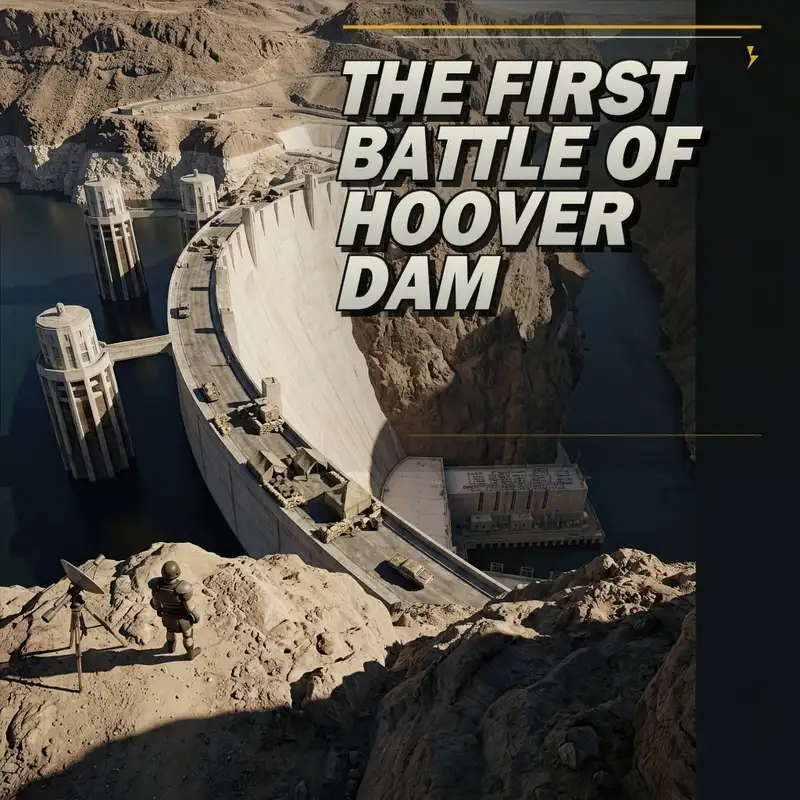
The First Battle of Hoover Dam
Boulder City stood in ruins after the fighting, and that ruin was part of the New California Republic’s victory. The Republic held Hoover Dam. Caesar’s Legion had been driven back across the Colorado River. The battle would be remembered as a Ranger triumph, a decisive defense, and a warning that the Legion could be beaten. But the ground beneath that story was broken concrete, collapsed buildings, and a memorial to more than one hundred NCR men and women who died defending the dam and the civilians of the Mojave.
That is the uncomfortable center of the First Battle of Hoover Dam. The NCR did not simply stand on a wall and repel an invader. Its defenders withdrew, selected their ground, exposed the Legion’s most capable fighters to concentrated fire, and then drew those fighters into Boulder City, where explosives destroyed much of the town. Legionaries died there. NCR personnel died there. A place where people had lived and worked became a weapon.
The operation was militarily effective. It preserved the dam and shattered the Legion assault. Yet it also revealed the limits of military success in the Mojave. Winning a battle for a dam was not the same thing as ending a war across a river, or defeating the state that had sent an army toward that dam in the first place. The NCR had defended an essential frontier position. It had not solved the strategic problem beyond the Colorado.
Hoover Dam mattered because it was much more than a piece of surviving pre-War engineering. In the Mojave, infrastructure was political power. The dam offered electricity, water management, a functioning crossing over the Colorado River, and a durable symbol of what a government might recover from the old world. A faction that could operate, guard, and distribute the benefits of such a site possessed more than a fortress. It possessed an argument for authority.
The New California Republic reached the dam in the year twenty-two seventy-four. Its arrival followed negotiations with Mister House, the reclusive ruler of New Vegas. The Treaty of New Vegas gave the NCR access to the overwhelming share of the dam’s electrical output while preserving House’s sovereignty over the Strip. The arrangement was neither a simple annexation nor an equal partnership. It was a bargain between a growing republic that needed power and a local ruler who needed the Republic’s commerce, protection, and recognition.
For the NCR, the dam helped justify its expensive expansion into the Mojave. The Republic had soldiers, administrators, merchants, prospectors, and settlers moving eastward, but it also had to feed them, supply them, regulate disputes, and protect the roads that connected them to California. Power from Hoover Dam could support that wider project. The crossing itself also mattered. In a region where rivers, deserts, ruined highways, and mountain routes shaped every movement of people and supplies, a secure route across the Colorado had military and economic value.
For House, the dam’s restoration supported the survival of New Vegas as a city of trade, gambling, diplomacy, and carefully managed independence. For settlers, traders, and communities around the Mojave, it represented the possibility that the region might become something more stable than a collection of isolated outposts. None of that meant the NCR controlled the entire Mojave. It did not. Its writ was uneven, its supply lines were long, and many local groups had little reason to welcome distant officials in bear-shaped helmets. But losing the dam would have threatened the Republic’s entire position.
Across the river, Caesar saw the same asset from the opposite direction. Hoover Dam was a crossing point, a source of power, a strategic prize, and a challenge to the Legion’s momentum. Caesar’s Legion had expanded east of the Colorado by conquering, absorbing, and often destroying smaller societies. It had built cohesion through harsh discipline, slavery, military hierarchy, political terror, and the deliberate breaking apart of tribal identities. Its campaigns had produced a large military machine by wasteland standards, backed by a system able to compel labor, recruit fighters, and concentrate authority in Caesar’s hands.
The dam presented a different kind of target. It was held by an organized state rather than a divided tribe or isolated settlement. The NCR had formal military institutions, a civilian government, an economy extending westward, and a population large enough to absorb losses that might have broken a smaller community. It also possessed the Rangers, whose reputation had been built on reconnaissance, mobility, and fighting in difficult terrain. The Legion could still defeat such an opponent, but it could not assume that its usual methods would produce the same result.
Caesar also invested the campaign with ideological meaning. He saw the New California Republic as a rival model of civilization, one that claimed legitimacy through elections, law, commerce, and the recovery of old American forms. Caesar’s own state claimed legitimacy through conquest, unity, and obedience. To him, New Vegas was not merely a rich city on the far side of a river. It was a western Rome waiting to be seized and remade. Hoover Dam was the gate.
That strategic vision belonged to Caesar. The immediate task of taking the dam belonged to Joshua Graham, the Malpais Legate. Graham was Caesar’s senior battlefield commander and one of the central architects of the Legion’s expansion. He led a force that included recruits, experienced legionaries, veterans, and officers shaped by the Legion’s hard system of training and punishment. The Legion’s strength lay not in mindless charges, but in a brutal and disciplined method of war that had worked repeatedly against weaker opponents.
Its weakness at Hoover Dam was that it brought a doctrine designed for offensive momentum into terrain chosen by a defender. A force can be aggressive, disciplined, and courageous, yet still be placed at a disadvantage by the ground, the enemy’s intelligence, and the decisions of its commander. The First Battle of Hoover Dam was not a contest between a competent army and an incompetent one. It was a contest between two institutions with different strengths, meeting at a place that magnified some strengths and punished others.
The NCR was not waiting at the dam from a position of easy abundance. By the year twenty-two seventy-seven, its Mojave campaign was already under strain. The Republic had to maintain distant posts, patrol dangerous roads, deal with hostile local groups, and manage the political consequences of expanding into territory where not everyone regarded NCR rule as liberation. Its forces were dispersed across a wide and difficult region. Holding a dam was one task. Holding the roads, settlements, water sources, and approaches around it was another.
The Republic also faced pressure from the Brotherhood of Steel in the Mojave. The conflict with that Brotherhood chapter had consumed resources and attention, while broader insecurity made every convoy and reinforcement movement more complicated. The Mojave was not an empty battlefield where troops could move freely from one marked point to another. It was a region of damaged roads, exposed outposts, hostile terrain, contested communities, and long lines back to the NCR’s western heartland.
The destruction of the Divide also mattered, though its effect should not be exaggerated into a single explanation for every NCR difficulty. Later testimony indicates that the loss of routes through that region impaired northern reinforcement connections into the Mojave. A damaged route does not make an army helpless, but it reduces options. It can slow replacements, complicate transport, increase the burden on remaining roads, and make commanders more cautious about committing forces they cannot easily replace. For a frontier army operating far from its strongest bases, those limits mattered.
Within the NCR defense, the Army, Rangers, and First Recon served different purposes. Army troops provided the larger conventional force responsible for holding ground and maintaining the Republic’s visible military presence. The Rangers brought reconnaissance, fieldcraft, and specialized combat experience. First Recon added trained sharpshooters capable of selecting important targets at range. These were not interchangeable formations, and the battle depended on using each for what it could do.
General Lee Oliver directed the NCR Army’s response. Chief Hanlon led the Ranger contribution and later described the battle’s critical movements. The surviving record does not provide a complete command chart, every order, or a minute-by-minute record of who stood where. It does show that Oliver and Hanlon had distinct roles, and that the defense blended conventional troops with Ranger planning and long-range fire. That combination was effective in the battle, even if it later produced resentment over who deserved the credit.
There was a cultural difference beneath that tension. An Army commander holding Hoover Dam had to think about the political and physical requirement to retain a strategic site. A Ranger commander could think more flexibly about reconnaissance, ambush, withdrawal, and the selective destruction of an enemy’s critical personnel. Neither approach alone would have been sufficient. An army that only maneuvered could lose the dam. A force that only stood in place could be overwhelmed. The defense required both a position worth holding and a willingness to give up ground temporarily in order to hold it in the end.
The dam itself made that possible. A crossing is not merely a route from one bank to another. It is a channel that can concentrate movement. At Hoover Dam, the Legion could not spread across a broad front and freely maneuver around defenders in the way an attacking force might on open ground. Its troops had to advance through a constrained space under observation. The defender could fall back along prepared lines while keeping the attacker compressed.
According to Hanlon’s account, after the Legion attack began, Oliver ordered NCR troops to pull back toward the middle of the dam. To an observer who only saw troops moving rearward, this could have looked like a retreat under pressure. In military terms, the distinction between a rout and a controlled withdrawal is decisive. A rout is a collapse of command. A controlled withdrawal preserves cohesion, retains the ability to fight, and seeks a more favorable position.
The Legion’s formation made that maneuver especially dangerous for Graham’s force. Hanlon describes a customary sequence in which recruits were placed toward the front, stronger fighters behind them, and veterans farther back. Such an arrangement had its own offensive logic. Less experienced soldiers could absorb the first shock, while the more capable troops remained available to exploit success, impose discipline, and drive the attack forward. In open terrain, or against a weaker opponent, that depth could support a relentless advance.
On the dam, however, depth became density. The assault force was compressed into a narrow approach. Its movement was restricted. Its veterans were not scattered across a wide battlefield where they could maneuver independently. They were placed in a formation whose structure could be observed, understood, and attacked. The exact locations, distances, and numbers are not preserved well enough for a precise battlefield map. But the operational logic is clear. The defender turned the crossing into a funnel and made the Legion’s internal hierarchy visible.
Rangers and First Recon sharpshooters targeted veteran fighters and officers. This was not simply a matter of killing the nearest attacker. It was an effort to damage the parts of the Legion force that were hardest to replace. A recruit could be found, trained, coerced, or pressed into service more easily than an experienced veteran who understood Legion discipline, could lead men under fire, and had survived earlier campaigns. Officers and elite fighters carried more than weapons. They carried institutional memory.
The NCR did not need superior technology in some sweeping sense to exploit that vulnerability. It needed trained observers, disciplined marksmen, communication between units, a defensible position, and the patience to fire at the targets that mattered most. The battle was a reminder that military effectiveness often comes from matching available tools to a specific problem. A rifle, a scope, a strong firing position, and good intelligence can matter more than a dramatic new weapon if the enemy has been forced into the wrong place.
This selective pressure struck at the Legion’s ability to sustain its attack. Losing recruits was costly, but losing the experienced troops behind them could disrupt command and morale. It could also create a political problem for Graham. A Legate was expected to deliver victory. If his veterans were dying under fire while the NCR fell back in apparent disorder, he faced a dangerous choice. He could slow the advance, reassess the defense, and risk losing momentum. Or he could commit his best troops in an effort to destroy the sharpshooters and break the enemy’s resistance.
Graham chose the second course. He pushed veteran troops forward against the NCR marksmen. The choice was not irrational on its face. An attacker under accurate long-range fire often must suppress or dislodge the shooters who are breaking its formation. Leaving them in place would have allowed the NCR to continue stripping away the Legion’s experienced core. But Graham was responding to a problem the defenders had deliberately created, on terrain the defenders had prepared.
Hanlon’s later assessment is harsh. He contrasts Graham’s conduct with Caesar’s own ability to adapt formations and mix forces without losing cohesion. That criticism should be taken seriously, but not expanded beyond the evidence. It does not mean Caesar was a humane or infallible commander. It does not mean every Legion operation was rigid. It means that, in this battle, Graham appears to have applied Legion methods too inflexibly against an enemy that had found a way to exploit them.
Graham’s later fate can make it tempting to turn the battle into a story about one doomed man. That would be too simple. The Joshua Graham encountered years later is the Burned Man, a survivor marked by punishment, pain, and religious transformation. None of that gives us access to his private thoughts at Hoover Dam. We do not know every fear, argument, or calculation that passed through his mind. What the record does show is the consequence of his decision. By committing the veterans forward, he gave the NCR the force it needed for the next stage of its plan.
The withdrawal from the dam continued toward Boulder City. Again, the crucial point is that this was not simply an NCR collapse. The defenders were drawing the Legion away from the dam, away from its constrained crossing, and toward a location where the attacking veterans could be trapped. In a successful deception operation, the enemy does not need to be fooled about every detail. It only needs to make one consequential decision based on an incorrect understanding of what the opponent is doing.
The Legion saw NCR forces withdrawing and pressed after them. That made tactical sense if the withdrawal was genuine. A retreating enemy can be vulnerable. Its units may lose contact with one another. Its wounded and supplies may be exposed. Its commanders may struggle to restore order. A determined pursuit can turn a hard fight into a decisive victory. Graham needed the retreat to be real. The NCR needed him to believe it was real long enough to pull his best troops into the killing ground.
Boulder City became that killing ground. Explosives had been placed in the town, though the surviving evidence does not establish a complete demolition layout, the precise timing of every charge, or the full process by which the site was prepared. We should not invent an engineer’s map where none survives. The broad result is established. Once Legion forces, including many of their veteran fighters, had been drawn into Boulder City, the explosives were detonated. The town was devastated.
The immediate tactical effect was devastating for the Legion assault. The force Graham had pushed forward to recover momentum suffered catastrophic losses. The attack on the dam could no longer proceed as planned. The Legion had lost experienced fighters, command cohesion, and the ability to convert its initial aggression into a breakthrough. The NCR retained Hoover Dam.
At campaign scale, the trap did more than kill enemy soldiers. It disrupted the Legion’s campaign. An army can replace bodies over time. It cannot instantly replace leadership, veteran discipline, trusted subordinates, and the shared experience that allows a formation to operate under pressure. The destruction at Boulder City struck at the professional core of Graham’s assault force. It created the conditions for the Legion withdrawal.
But the victory had a civilian and institutional cost that should not be hidden behind the word trap. Boulder City was destroyed. The NCR memorialization of the battle honors those who died defending the dam and nearby civilians, but a memorial is not an engineering report or a full civilian census. We cannot say precisely who escaped, who remained, or how every resident experienced the decision. What can be said is that a community became part of the battlefield and paid for a military necessity created by a larger war.
There were also NCR personnel caught in the operation. The Republic did not achieve victory without losses of its own, and the memorial’s count of more than one hundred dead makes clear that the price was substantial. The battle therefore resists easy celebration. It was not a clean victory earned by distant commanders without local consequence. The NCR saved the dam by sacrificing soldiers and allowing a town to become a demolition zone. That may have been militarily rational under the circumstances. It was still a grave decision.
This is one of the central realities of defending a frontier. Governments often describe strategic sites in the language of power, water, transport, and security. The people living near those sites experience those same decisions as evacuation, destruction, lost homes, disrupted trade, graves, and the long work of rebuilding somewhere else. A dam can be an asset on a map. Boulder City was a place where the cost of defending that asset became visible.
After the explosion, the Legion withdrew. The NCR had accomplished its immediate objectives. It held Hoover Dam, prevented the Legion from crossing in strength, and inflicted losses severe enough to halt the assault. In tactical and operational terms, the First Battle of Hoover Dam was an NCR victory.
Caesar’s response to the defeat revealed something important about the Legion’s political structure. Joshua Graham was blamed personally. He was covered in pitch, set on fire, and thrown into the Grand Canyon. He survived, though Caesar did not intend him to. Years later, Graham emerged as the Burned Man, a figure whose survival became bound up with fear, legend, and religious conviction.
The punishment was not merely an act of cruelty against a defeated commander. It was also political theater. Caesar’s state depended heavily on the appearance that its hierarchy was strong, its leadership was correct, and its victories were the natural result of superior discipline. A public and terrible punishment turned a campaign failure into Graham’s failure. It protected Caesar’s authority by making the Legate the object of blame.
That did not mean Graham alone had created the conditions for defeat. The Legion’s doctrine had been challenged by prepared defenses, accurate fire, constrained terrain, and an opponent willing to trade space for advantage. Caesar could replace his commander. He could not erase the fact that the NCR had shown the Legion could be stopped. Still, authoritarian regimes are often skilled at preserving their own narrative after a setback. Punishment can restore fear, but it does not automatically correct the military problem that caused the defeat.
The more important fact was that the Legion survived. It had lost a major assault force and its commander’s standing, but it had not lost its political center east of the Colorado. Caesar remained in command. The institutions of conquest, recruitment, slavery, coercion, and tribal absorption remained intact. The Legion still held territory, still had access to manpower, and still possessed the ability to reorganize its military leadership.
This is why the First Battle of Hoover Dam did not end the war. The NCR had won at the point of contact, but it had not destroyed the system that generated the Legion’s armies. It had not occupied Legion territory east of the river. It had not dismantled Caesar’s command structure. It had not liberated the populations held under Legion rule, nor prevented the Legion from recruiting, coercing, or absorbing additional people into its ranks.
The distinction between replacing recruits and replacing veterans mattered, but it should not be overstated. The Legion did not possess infinite manpower, and training alone did not make every replacement equal to the soldiers lost at Boulder City. Yet the Legion’s system was built to convert conquered populations into military capacity. It could replenish ordinary manpower more readily than it could restore a veteran core. The battle damaged the Legion badly. It did not remove its ability to make war.
The NCR faced a different strategic problem. It had held its frontier, but it could not easily exploit the victory by carrying the war deep into Legion territory. Such an offensive would have required transport, supplies, secure crossings, intelligence, replacement troops, political authorization, and a realistic plan for what came after a successful advance. Armies can cross rivers. Governing hostile territory beyond them is harder. The NCR already had difficulty sustaining its Mojave commitments. A larger eastern campaign would have imposed even greater burdens.
The Republic’s western supply network remained vulnerable. Its forces were spread across a large region. Its leaders had to balance military needs against domestic politics, trade, settlement growth, and the many other obligations of a republic that was expanding faster than some of its institutions could comfortably manage. Hoover Dam gave the NCR resources and prestige, but it did not abolish distance. Power lines and water systems do not automatically provide secure roads, loyal communities, disciplined administrations, or enough soldiers to hold every frontier.
The dam itself was therefore a strategic asset, not a strategic solution. It strengthened the NCR position in the Mojave. It denied an important prize to Caesar. It preserved a crossing and an infrastructure base that could support regional order. But it could not, by itself, compel the Legion to surrender. A state can lose a battle and remain dangerous if its leadership, manpower base, economy, and political machinery remain intact. The Legion’s withdrawal was a defeat. It was not a collapse.
The victory also created consequences within the NCR. The Rangers received much of the credit for the successful defense, and that recognition fed resentment within parts of the Army command. General Oliver, responsible for the larger military effort, had reason to see the battle as a success of the Republic’s defense as a whole. The Rangers, whose reconnaissance and deception had been central to the outcome, had reason to see their contribution as decisive. Both claims contained truth. The danger came when institutional reputation became more important than learning the battle’s actual lessons.
Later tension between Oliver and Hanlon should not be treated as an explanation for every NCR failure in the Mojave. The Republic’s problems were broader than any one rivalry. They involved distance, resources, politics, local resistance, corruption, overextension, and the difficulty of governing contested territory. But the aftermath of Hoover Dam did show how victory can harden competition inside an institution. A battle that should produce honest assessment can instead become a struggle over prestige, promotion, and ownership of the story.
By the year twenty-two eighty-one, the Legion had returned to the Mojave under changed leadership and with a new campaign taking shape. The conflict was moving toward another confrontation at the dam. That later battle belongs to a different moment, with different circumstances and outcomes that depend heavily on later events. What matters here is simpler. The first victory had bought the NCR time. It had not bought final security.
The First Battle of Hoover Dam proved that the NCR could defeat Caesar’s Legion when it fought from prepared defenses, understood the terrain, and used its Rangers and sharpshooters to strike at the enemy’s experienced core. The Republic won because it made the Legion attack through a constrained crossing, then turned a controlled withdrawal into a deception that destroyed the veterans Joshua Graham needed to recover the offensive.
But the battle also showed the limits of holding a fortress in a larger war. Boulder City’s destruction demonstrated the cost of defense. The Legion’s survival demonstrated the difference between breaking an assault and breaking a regime. Hoover Dam gave the NCR power, water, prestige, and a defensible frontier, but it could not by itself remove the coercive institutions beyond the Colorado that allowed Caesar’s state to endure.