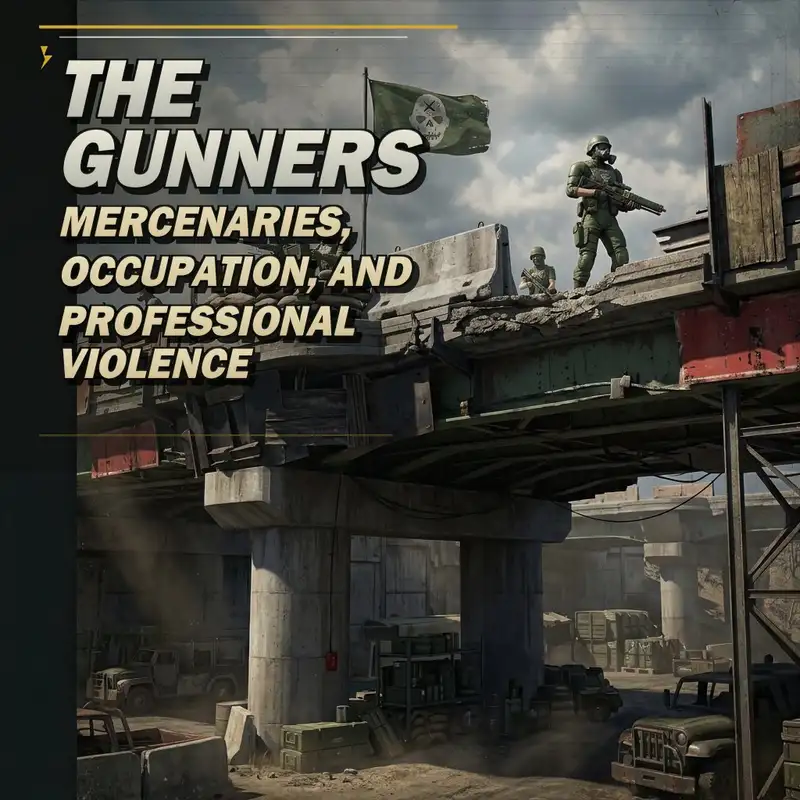
The Gunners: Mercenaries, Occupation, and Professional Violence
The elevated highway above Quincy was not built as a fortress. It was built for commuters in a country that expected automobiles, freight, and ordinary mornings to continue forever. By the year twenty-two eighty-seven, it had become something else. During the Gunner assault on Quincy, the ruined highway gave the attackers commanding ground over a living settlement below. The Gunners exploited that advantage after destroying a support structure, turning a piece of decayed infrastructure into a weapon. From above, they could dominate streets, roofs, and defensive positions. Below, Quincy’s defenders were forced to fight for homes, workshops, and escape routes under pressure from an enemy that had planned its approach.
That battle matters because Quincy was not simply another ruin being fought over by scavengers. It was a settled community with people, resources, local defenses, and enough confidence in the old Commonwealth Minutemen ideal to call for help. The answer that arrived was too small, too late, and badly isolated. The Gunners, led in the field by a former Minuteman named Clint, did not merely rob Quincy and move on. They broke its defenders, captured its ground, pursued survivors, and turned the settlement into a military position. The question is what kind of organization does that. The Gunners are often described as raiders in better armor. That description catches their brutality, but it misses the more dangerous part. Raiders can terrorize a road. The Gunners could plan, concentrate, occupy, and endure.
The Commonwealth knows the difference between an armed gang and a military institution, even when neither one is especially gentle. Raider groups can have leaders, territory, customs, and surprisingly durable economies. Some are large enough to maintain camps, intimidate nearby settlements, and organize attacks. But their power is usually personal and immediate. It depends on fear, access to loot, and the ability of a leader to keep followers fed, armed, or frightened. The Gunners display something more structured. They use ranks. They have recruits, officers, lieutenants, captains, and colonels. They operate from fortified sites. They field personnel with combat armor, energy weapons, robots, and, in some cases, power armor.
None of that proves that the Gunners possess a modern army’s bureaucracy or a stable industrial base. The Commonwealth does not provide a clean roster of their units, a reliable count of their personnel, or a map of their supply system. A power armor suit in Gunner hands does not prove a factory somewhere is producing more of them. An energy weapon does not prove a steady production line for replacement parts and power cells. But equipment of that quality still has implications. Someone must recover it, repair it, allocate it, and keep the people using it supplied with food, ammunition, medicine, and instructions. A force that can maintain fortified headquarters and specialized detachments is operating on a different level from a gang that survives from one successful ambush to the next.
For that reason, military professionalism needs careful definition. It can mean training, hierarchy, discipline, planning, technical skill, and the ability to carry out difficult missions under command. It does not automatically mean honor. It does not mean civilian protection. It does not mean lawful conduct, strategic wisdom, or political legitimacy. A force can be professionally organized and still serve criminal ends. In fact, organization can make predation more effective. The Gunner problem is not that they fail to resemble soldiers. It is that they resemble soldiers without any clear public responsibility for what their violence does to the Commonwealth.
The Gunners present themselves, and are described by others, as mercenaries. Nick Valentine calls them high-end mercenaries. Robert MacCready, who once worked among them, remembers that the money was good. The group’s reputation is built around a simple proposition. For sufficient payment, the Gunners will do work other people cannot do, will not do, or do not want connected to their own names. In a fragmented region such as the Commonwealth, that creates a market. Settlements may need guards. Caravans may need escorts. A wealthy patron may need a difficult item recovered. A rival may need to be intimidated. A dangerous facility may need to be entered. A client may want violence applied at arm’s length.
That last category is where mercenary work becomes politically useful and morally evasive. The person paying for an operation can claim distance from the operation itself. The men and women carrying rifles can describe themselves as contractors. Between them sits a contract, and the contract can make almost any objective sound administrative. Secure the property. Recover the asset. Remove the obstruction. Establish control of the site. Such language does not reveal whether the property was stolen, whether the asset is dangerous, or whether the obstruction is a civilian family refusing to leave its home. The Commonwealth has few institutions capable of investigating such distinctions, and fewer still capable of enforcing them against a heavily armed organization.
What the surviving evidence does not reveal is equally important. No confirmed record identifies a single patron who directs the Gunners as a whole. There is no established proof that the Institute controls them, that the Enclave finances them, that Vault-Tec left behind a hidden command structure, or that some surviving government employs them as an unofficial army. The temptation to solve the mystery with a secret sponsor is understandable. A disciplined mercenary force seems to invite the theory. But the evidence supports a simpler and, in some ways, more troubling conclusion. The Gunners may not need one master. In a divided Commonwealth, many people could have reasons to buy violence.
Their known work suggests a market broader than ordinary guard duty. At the Museum of Witchcraft, a Gunner detachment undertakes a contract involving a deathclaw egg. Sergeant Hart’s recording makes clear that the assignment was paid work. It was not a random raid, and it was not merely a patrol that stumbled into danger. The job required entering a hazardous area, locating a valuable biological object, and extracting it despite the risk posed by a deathclaw. This is specialized retrieval work. It requires a client, a mission brief, an expectation of payment, and enough confidence in Gunner capability to justify the risk.
The identity of that client remains unknown. So does the client’s intended use for the egg. That uncertainty should not become an excuse to invent a grand biological conspiracy. The important point is operational. The Gunners were available for work involving rare, dangerous material that an ordinary settler, caravan guard, or local militia would have little reason to pursue. Their value lay not just in shooting skill, but in their willingness to enter places where death was an expected part of the contract. A market for that kind of service tells us something about the Commonwealth. Wealth, secrecy, and desperation still existed in enough concentration to create demand for specialists in organized violence.
The Atom Cats reveal another side of the Gunner economy. Their garage holds something valuable in the Commonwealth: power armor, technical skill, and the ability to preserve equipment that most people can only salvage in pieces. A Gunner attack on the Atom Cats shows interest in that capability and in the material itself. But the larger objective is not fully documented. It may have been an attempt to seize equipment. It may have involved a broader interest in armor, components, or technical knowledge. The available record does not establish that it was commissioned by the same client involved at the Museum of Witchcraft, or that every Gunner operation formed part of a single strategic plan.
That distinction matters because the Gunners should not be imagined as a perfectly unified machine. A mercenary organization can have central leadership while still allowing commanders, detachments, and local garrisons to pursue different missions. A headquarters can issue orders, allocate resources, and maintain discipline without personally directing every patrol. The Commonwealth’s evidence points to a networked organization with recognizable authority, not an all-seeing conspiracy. Its cohesion may be real, but it is not limitless. Like any armed institution, it likely contains competing ambitions, uneven competence, different levels of loyalty, and commanders who see opportunity in different ways.
The most visible symbol of Gunner permanence is Gunners Plaza, the former building of the Galaxy News Network. Before the war, it was a place associated with mass communication. After the war, the Gunners transformed it into a fortified headquarters. Piper Wright identifies it as their base, and Captain Wes is associated with command there. The building offers what a serious armed organization needs: strong walls, defensible approaches, elevated firing positions, interior space, access to communications equipment, storage, workshops, and a place where orders can be issued under protection. A headquarters is more than a hideout. It is a mechanism for converting armed individuals into an institution.
The practical requirements are easy to overlook because the Commonwealth is full of abandoned military equipment. But possession is not sustainment. Combat armor wears down. Weapons need cleaning and repair. Energy weapons depend on components and power cells. Robots require maintenance, programming, replacement parts, and some system of command. Power armor is even more demanding. It must be recovered, serviced, and used by personnel who understand its limits. The Gunners’ equipment suggests access to salvage, technical labor, and organized maintenance. It does not tell us precisely where those resources come from, how far they travel, or whether the Gunners can replace their losses through manufacture rather than recovery.
Gunners Plaza also implies a need for records, communications, security, and administration. Mercenaries cannot reliably sell their services if every client must negotiate with whichever rifleman happens to be nearby. Someone has to receive inquiries, assess risks, assign personnel, store equipment, distribute payment, and decide whose authority prevails when two missions conflict. The game does not provide a complete Gunner payroll system, and it would be unwise to invent one. Yet the very existence of officers, command sites, and specialized teams indicates that their violence is not entirely improvised. They have made organization itself into a form of capital.
That capital gives the Gunners an advantage over communities that rely on part-time defense. A settlement militia may know the local terrain and have every reason to fight hard for its homes. It may still struggle to maintain watches, train replacements, coordinate with neighbors, or hold weapons in reserve when crops need tending and water must be hauled. The Gunner who is paid, housed, armed, and assigned to violence can devote more of the day to violence. That does not make the Gunner invincible. It does make the Gunner dangerous in a region where most people cannot afford permanent military readiness.
The Gunners reinforce that advantage by occupying secure facilities. Vault Seventy-Five and Vault Ninety-Five both serve as Gunner-held sites by the time of Fallout 4. Each offers hard shelter, defensible entrances, internal rooms, storage space, and access to pre-War systems. In a Commonwealth exposed to weather, raiders, mutated wildlife, radiation zones, and unstable roads, underground infrastructure has obvious military value. A Vault can shelter personnel, protect stores, isolate prisoners or recruits, and provide a base from which patrols can operate. It can also preserve equipment and records that would be vulnerable in an open settlement.
But the history of those Vaults belongs to their original occupants before it belongs to the Gunners. Vault Seventy-Five was built around a pre-War program of youth experimentation and military selection. Its history is cruel enough without turning it into a convenient origin myth for every later armed organization found inside it. The Gunners occupy the Vault. That fact does not prove they descended from its subjects, inherited its mission, or were founded there. The connection is suggestive only if one wants it to be. The released record establishes possession, not lineage.
Vault Ninety-Five tells a different story. It was a rehabilitation Vault whose residents were subjected to a deliberate experiment involving chemical dependency. The facility’s past reveals another version of pre-War institutional cruelty, one hidden behind medical language and corporate control. For the Gunners, however, its importance is more immediate. It is usable military real estate. The organization can exploit its protection and infrastructure without sharing the history of the people trapped there generations earlier. This is a recurring pattern in the Commonwealth. The old world leaves behind structures, machines, and bunkers. The people who seize them inherit capability, but not necessarily wisdom.
A distributed network of headquarters, Vaults, and occupied sites makes an organization harder to dislodge than a single camp. It provides fallback positions, storage, safe places for wounded personnel, and locations where recruits can be screened or trained. Still, the sources do not establish a complete Gunner base network, nor do they reveal the routes that connect one site to another. It would be a mistake to draw a tidy supply map from scattered locations. The important conclusion is narrower. The Gunners understand the value of infrastructure. They do not merely loot the old world. They use its remains to sustain armed power.
Quincy shows what happens when that same logic is applied to a living community. Before the Gunner assault, Quincy was not a Vault, a vacant office block, or an abandoned military installation. It was a settlement with residents and local economic life. Its people had enough faith in the Minutemen to request assistance when the threat emerged. The Minutemen were meant to be a regional mutual-defense network. Their underlying idea was straightforward. When one settlement was attacked, others would send help. No single town needed to stand entirely alone. It was a practical response to the Commonwealth’s geography and insecurity.
By the time Quincy needed that system, however, the system had already fractured. General Becker’s death left the Minutemen without effective unity. The title of general survived longer than the command structure needed to make it meaningful. Local groups still existed. Some members still answered calls for help. But communication, trust, reinforcement, and shared direction had become unreliable. Quincy called, and only Colonel Ezra Hollis’s group arrived. That was not proof that every other Minuteman lacked courage. It was proof that the institution could no longer consistently turn goodwill into force at the point of danger.
This is the difference between an ideal and a capability. The Minutemen ideal had legitimacy because it promised mutual protection among communities. But legitimacy alone does not move people across dangerous roads. It does not create radios, ammunition stores, medical support, reserve manpower, or a command system able to decide who responds first. Decentralized defense can be resilient when communities trust one another and maintain regular ties. It can also fail when every settlement is managing its own crisis, every local commander doubts that help will arrive, and no authority can compel coordination. The Commonwealth did not lose the Minutemen because the idea was meaningless. It lost them because the organization behind the idea had become too weak to fulfill its promise.
Clint understood that weakness from the inside. He had been a Minuteman before he became a Gunner commander. His defection gave him more than a new uniform. It gave the Gunners insight into the habits, expectations, and weaknesses of the institution they were fighting. He knew what the Minutemen represented to settlements. He also knew how far their real capacity had fallen. His records indicate that the assault on Quincy was not simply an opportunistic strike for supplies. It was intended to use force against the Minutemen’s remaining influence. That makes Quincy an attack on both a settlement and an idea of regional solidarity.
The operation also appears to have involved planning beyond a simple frontal assault. The Gunners took advantage of the elevated highway and the destruction of its support. High ground in urban fighting does not guarantee victory, but it changes the problem for defenders. It improves observation, opens firing angles, and allows attackers to pressure movement below. A settlement defending homes and streets must protect civilians, maintain escape routes, and keep its fighters from being isolated. An attacking force that has prepared its position can choose where to concentrate fire and where to deny the defenders cover. The Gunners did not need overwhelming numbers to make terrain work for them.
Clint’s command was not necessarily a model of perfect internal harmony. His records suggest friction between more experienced Gunner personnel and newer arrivals or transfers. That is unsurprising. Mercenary organizations often depend on discipline while attracting people for very different reasons. Some may value money. Some may seek protection, status, or equipment. Some may bring military experience. Others may be recruits drawn by the promise of a regular place in an irregular world. A rank structure can organize those people, but it cannot erase competition or mistrust. The Gunners’ professionalism was real enough to support a complex operation. It was not proof of a unified moral or political culture.
At Quincy, their discipline served destruction. Colonel Hollis was captured and executed. Preston Garvey and the remaining survivors were pursued as they escaped. The attack therefore did not end when the defensive line broke. The Gunners sought to remove the people most capable of carrying the Minutemen identity beyond Quincy’s boundaries. In military terms, this reduced the chance that the settlement’s defenders would regroup nearby. In political terms, it struck at a rival source of legitimacy. The Minutemen could promise protection through mutual obligation. The Gunners demonstrated that obligation could be broken, and that communities asking for help might be left alone to die.
The immediate military result was clear. Quincy fell, and the Gunners established control. But calling it a raid would obscure what followed. Raiders generally take movable wealth, inflict damage, and withdraw before a stronger response can arrive. The Gunners seized a town and held it. They garrisoned the area, used it as a stronghold, and maintained communications activity. That is territorial control. It turns a settlement into an operational asset. Buildings become barracks, firing positions, storage areas, and observation posts. Roads become approaches to defend. The town’s location becomes part of a larger military network.
Occupation, however, is not the same as government. The available evidence shows Gunner control of Quincy. It does not show a civic administration serving Quincy’s former residents. There is no demonstrated Gunner effort to restore households, protect a local market, manage fair distribution of water, establish courts, or negotiate a political relationship with civilians. There is no evidence of a public contract between occupier and occupied. The Gunners held the ground because they could impose force on it. That is a meaningful military achievement. It is not state-building.
For Quincy’s people, that distinction was not academic. A settlement is made of more than walls and useful buildings. It is made of routines: water collection, food preparation, repair work, trade, child care, medical help, shared warning systems, and the knowledge of who can be trusted when something breaks. A massacre and occupation tear through those systems. Some residents are killed. Others flee. Those who escape become refugees dependent on places already struggling to feed and shelter themselves. Homes become military terrain. Workshops become loot or supply points. The physical settlement may still stand, but the community that gave it meaning has been shattered.
The Gunners gained a strongpoint. The Commonwealth lost a town and one more piece of its already fragile security network. That is the central strategic contradiction. A contract may reward the people who ordered an operation. A garrison may benefit the commander who controls it. But the wider effects can be corrosive. Violence against settlements discourages trade, increases displacement, and teaches communities that armed outsiders are threats rather than partners. A mercenary company can profit from insecurity in the short term while helping create the insecurity that sustains demand for its services. It is a business model with a grim kind of logic.
The organization’s behavior beyond the central Commonwealth suggests it could project at least limited operational reach. In the Nuka-World expansion, Colonel Cypress gives Commander Kaylor orders concerning a Nuka-Cola Family Radio signal at the transit center. The purpose is to determine whether the signal is connected to Sergeant Lanier’s missing reconnaissance team. That small record carries several implications. The Gunners use reconnaissance. They track missing personnel. They preserve a chain of command in which a colonel can task a commander with investigating a lead. They can send people toward an area beyond their established Commonwealth strongholds.
It does not prove that the Gunners were preparing to conquer Nuka-World. It does not prove they fully understood the raider situation there, or that they had a deep expeditionary plan. It does not reveal the financial purpose behind the mission. A reconnaissance team can be sent for many reasons: to investigate a signal, search for personnel, assess a route, verify a rumor, or identify a potential opportunity. The record is valuable because it shows institutional habits. The Gunners do not only react to threats in front of them. They gather information, issue orders, and attempt to account for their people.
That is a genuine form of military competence. So is the ability to operate specialized retrieval missions, defend headquarters, maintain advanced equipment, and exploit weak points in rival institutions. But competence without restraint can be more destabilizing than simple banditry. A disorganized raider gang may be limited by poor discipline and short-term thinking. The Gunners can overcome those limits. They can identify a target, arrange an operation, place a commander in charge, sustain personnel at a fortified site, and leave behind a garrison. Their violence has organizational depth.
What they lack, at least in the evidence available, is a demonstrated political purpose beyond profit, power, and control of useful sites. They are not shown building a civilian constituency. They are not shown claiming public authority through consent, law, representation, or a reliable system of services. This does not mean every member of the organization is driven by the same motives. Some may see the Gunners as employment in a brutal world. Some may prefer a hierarchy to the uncertainty of settlement life. Some may believe they are bringing order. But an institution is judged by what it repeatedly enables, not only by the private hopes of its personnel.
The Commonwealth had reason to need professional security. Roads were dangerous. Settlements were isolated. Old-world infrastructure remained full of valuable and hazardous material. Mutated wildlife, raider bands, and rival powers made armed protection a practical necessity. The Minutemen collapse created a vacuum that private force could fill. In that environment, the Gunners’ model was attractive. They could offer trained fighters, advanced weapons, and a willingness to do difficult work. A client who needed immediate protection might not care whether the contract strengthened a force with no loyalty to the wider region.
That is how a security market can undermine security itself. If protection becomes something purchased only by those with enough wealth or leverage, then poor settlements remain exposed. If armed contractors accept any profitable assignment, then the same organization that guards one caravan may intimidate another community. If contracts are secret, civilians cannot know whose interests are being served. And if a company can seize territory when opportunity arises, then its military capacity becomes a threat to every client who cannot keep paying. The distinction between provider and predator begins to collapse.
Quincy demonstrates that collapse in its clearest form. Tactically, the Gunners won through planning, terrain, and a better ability to coordinate violence. Operationally, they acquired a major stronghold and further weakened the Minutemen network. Institutionally, they proved that they could survive beyond a single raid or local skirmish. Yet strategically, their success made the Commonwealth less secure. It removed a functioning settlement, displaced survivors, and deepened the failure of collective defense. The Gunner victory did not create a broader order. It expanded the territory in which their own guns mattered most.
The comparison with the Minutemen is useful precisely because the Minutemen were failing. The Minutemen were not a flawless institution. By the time Quincy fell, their chain of command had fractured, their response capacity had collapsed, and their regional reputation had become painfully unreliable. But their stated purpose was to defend communities through reciprocal obligation. That purpose gave settlements a reason to support them even when their military strength was thin. The Gunners had more visible discipline at Quincy. They also had no equivalent obligation to the people living below their firing positions.
A durable political order requires more than the ability to take ground. It requires food systems, repair work, rules accepted by more than fear, ways to resolve disputes, some protection for people who cannot fight, and enough trust that civilians will cooperate rather than flee or resist. It requires a reason for people to believe that tomorrow under a new authority will be better than today. The Gunners are shown mastering the coercive side of power. They can seize facilities and hold strongpoints. They can sell expertise. They can deploy specialists. But the Commonwealth offers no evidence that they can transform conquered communities into partners in a stable system.
That failure is not incidental. It follows from the incentives of their model. A mercenary organization makes violence a commodity. That does not automatically make every contract illegitimate. Guarding a caravan or protecting a settlement could be defensible work. But when the organization answers primarily to payment, internal command, and access to resources, civilian welfare becomes conditional. Restraint exists only if the contract requires it, if commanders enforce it, or if future business depends upon it. In a weak political environment, those limits are unreliable. The people harmed by an operation are often the people least able to demand accountability afterward.
Professional violence can therefore become a form of occupation even when it begins as business. The first task may be a retrieval job. The second may be protection. The third may be the seizure of equipment or a strategic site. At some point, the organization holds enough ground, weapons, and infrastructure that it no longer needs to wait for a client to define its opportunities. It can create them. Quincy was not evidence of a documented plan to rule the entire Commonwealth. But it was evidence that the Gunners could move beyond the role of hired hands and act as an independent military power.
The Gunners differ from ordinary raiders because they have turned violence into an institution. They recruit, organize, equip, command, reconnoiter, and maintain positions with a degree of professionalism rare in the Commonwealth. But Quincy reveals the danger at the center of that professionalism. Without responsibility to a civilian population, lawful restraint, or a durable political project, the Gunner method does not create security. It converts security into a commodity, and when no client sets limits, the mercenary company becomes an occupying power whose most lasting product is not order, but another shattered community.