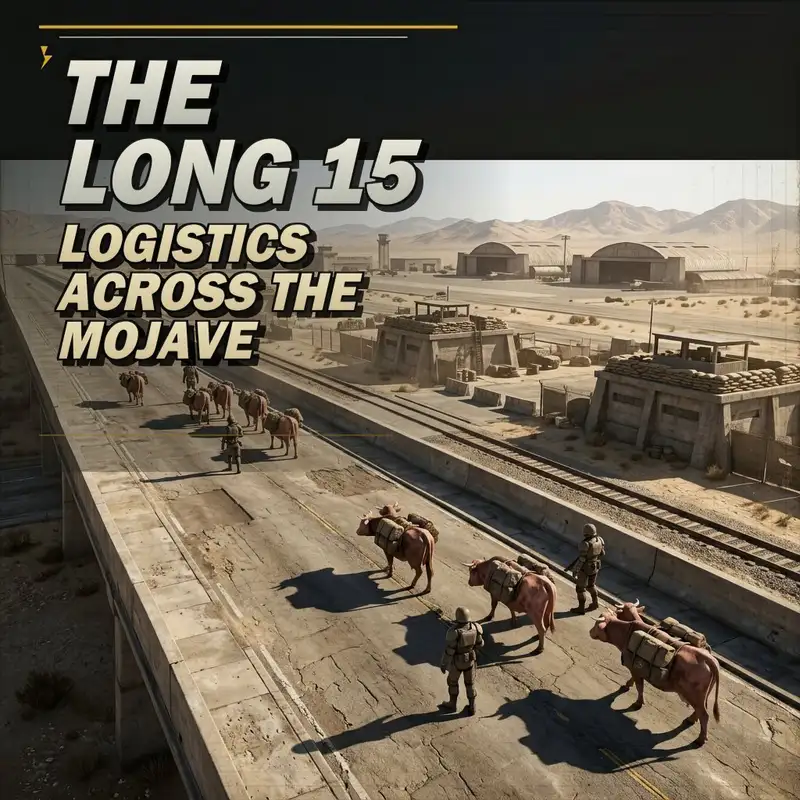
The Long 15: Logistics Across the Mojave
At Mojave Outpost, the New California Republic’s problem is visible before a shot is fired. Caravans are stalled. Primm, farther down the route, is in crisis. Officers know that travelers and traders need protection, and that the road needs patrols. Yet the soldiers at the outpost cannot simply march south and solve the emergency. Major Knight is bound by orders to keep a minimum force at the checkpoint. Ranger Jackson has threats to manage in the surrounding country. Ranger Ghost can watch a dangerous approach, but her people are too few to conduct regular patrols or escort every caravan that needs one. This is the contradiction at the heart of the Mojave campaign. The republic has uniforms, guard posts, officers, roads, and a formal claim to authority. It still lacks the spare capacity to make that authority dependable across the ground it claims.
Holding a checkpoint is not the same thing as securing a route. A checkpoint can inspect traffic, collect information, turn back obvious threats, and give travelers the reassuring sight of a flag and a sandbag wall. But a route extends beyond the gate. It includes the roadbed, the approaches, the stretches of open desert where an escort disappears over the horizon, the places where a broken wheel becomes an ambush, and the settlements where frightened civilians decide whether government promises are worth believing. To keep that system functioning, an army needs patrols, scouts, repairs, communications, reserves, and enough personnel to respond when trouble appears in two places at once. Mojave Outpost had enough people to remain an outpost. It did not have enough people to become a solution to every problem flowing through it.
That is why the Long 15 mattered. Not because a strip of cracked pre-War pavement possessed some mystical strategic force, but because it carried the burdens that the N C R had pushed eastward with its expansion. The road connected the republic’s western territories to the Mojave. It brought military supplies, merchants, travelers, letters, technicians, replacement personnel, medical goods, contracts, rumors, and political expectations. When it functioned, many of those movements became ordinary enough to disappear into the background. When it failed, every institution that depended on it became visible at once.
Interstate Fifteen existed before the Great War as a major corridor between southern California, Nevada, and Las Vegas. After the war, surviving pieces of that old route became useful again because geography does not vanish when a state does. Desert passes, grades, water stops, established settlements, and the broad logic of movement still matter. A road does not need to be pristine to be valuable. It needs to offer a repeatable path for people and cargo, one that is easier to use than crossing open country with no reliable support. In the post-War Southwest, that kind of continuity was a scarce asset.
The name Long 15 can cause some confusion. It refers broadly to the N C R-associated corridor along Interstate Fifteen, the route that helped tie California to the Mojave. In Lonesome Road, it also refers to a specific military area beyond Mojave Outpost, one that can become accessible only if the Courier directs missiles against N C R territory. The later location called Long 15 is the possible wreckage of that corridor’s strategic importance made brutally physical.
A highway also carried more than what armies usually call matériel. It moved migrants looking for work, families trying to return west, prospectors traveling toward New Vegas, and merchants carrying goods that could not be produced in every settlement. It carried information in a world where radio contact was useful but uneven, and where a courier, caravan guard, or traveler could still bring news that no distant office possessed. A route like this was part supply line, part market, part communications network, and part public demonstration that the republic could connect its frontier to its core.
The N C R did not inherit that network as a secure national highway system. It created it through expansion, administration, garrisons, patrols, treaties, and constant negotiation with people who lived along the route. That process made Mojave Outpost more than a fort at the edge of the desert. It made the outpost a frontier institution.
Mojave Outpost stood where the republic’s authority became most concrete and most fragile. It was a border checkpoint, a military post, and a connection between the N C R’s established territory and the Mojave Wasteland. The area is associated with the unification of the N C R Rangers and Nevada’s Desert Rangers, a political and military agreement that gave the republic greater access to local expertise while extending its own institutions eastward. It reflected the reality that a growing republic needed people who understood desert movement, local threats, and the difference between a map claim and a secure frontier.
The outpost marked territory that the N C R regarded as fully within its control. Beyond it, the language of control became less certain. The republic could send troops forward, establish camps, maintain Ranger stations, and enforce rules at particular points. But the Mojave was not an empty board on which an army could place markers. It contained settlements, independent traders, criminal groups, old infrastructure, local rivalries, and a hostile power gathering strength across the Colorado. The republic’s flag might fly over a gatehouse, but that did not tell a caravan whether the next twenty miles were safe.
A border post has two jobs that often conflict. If it becomes too weak, raiders, smugglers, infiltrators, and hostile scouts can move through the area with little resistance. If it becomes too restrictive, commerce slows, travelers accumulate, and the government begins to look like another obstacle between civilians and survival. The outpost could inspect caravans and gather reports. It could not observe every ravine, protect every trader, or know every threat moving beyond its perimeter.
That gap between formal responsibility and actual capacity shaped the N C R’s broader Mojave project. The republic wanted Hoover Dam, not merely as a monument to the old world, but as strategic infrastructure. The Mojave also offered frontier depth, a buffer against Caesar’s Legion, and an opportunity to transform a distant desert into a connected part of a larger republic. Those ambitions made sense from the perspective of an expanding state. They also created obligations faster than the N C R could comfortably meet.
The Army had to hold Camp McCarran, protect Hoover Dam, maintain positions around Primm, support Ranger stations, keep roads usable, respond to Legion pressure, and preserve enough order that civilian trade did not collapse. It had to defend fixed installations that could not simply be abandoned without political cost. Every soldier posted at a gate was a soldier unavailable for convoy escort. Every patrol sent into the desert was unavailable as a reserve. Every crisis at a settlement competed with the larger war for men and material.
This was not proof that the N C R was uniquely foolish, or that its forces were incapable. It was a structural problem common to frontier campaigns. A government can occupy nodes without controlling the spaces between them. In political terms, it was asking civilians to accept N C R rule before it could consistently provide the security and services that made rule credible.
The burden grew heavier because the Long 15 mattered in a region where redundancy had already been damaged. The Divide had once been a significant route toward Nevada. It represented an alternate path through difficult country, one that could help connect the N C R’s western resources to its eastern commitments. Then the Divide was devastated by underground missile detonations after the Courier delivered a device there. The exact wider chain of responsibility surrounding that disaster remains tangled in the testimony of people shaped by loss and grievance. What is clear is that the destruction transformed the region.
Joshua Graham describes the consequences in practical terms. The route through the Divide was blocked. N C R reinforcements were slowed. Companies attempting to move through the area were exposed to destructive storms before they could reach Nevada. He also makes an important qualification. Not every northern route was closed. The N C R was not reduced to a single road under every circumstance. But Highway One Twenty-Seven could no longer serve as a usable way around the mountains, and that loss narrowed the republic’s options.
That distinction matters. Logistics is not a question of whether one route exists on paper. It is a question of whether an organization has enough usable alternatives when its preferred route is threatened, damaged, or closed. Redundancy means more than drawing another line on a map. It means having roads that can carry traffic, personnel who know how to use them, repair capacity when they fail, security along their length, water and support points for travelers, and enough administrative flexibility to redirect movement without breaking everything else. The Divide’s destruction reduced that redundancy. It made the remaining corridors more important because more people and more cargo had fewer practical ways to move.
Terrain itself could become a form of denial. A road may be intact but unusable because storms strip away visibility, radiation makes passage dangerous, bridges fail, or nearby ground becomes controlled by hostile forces. In the Mojave, a commander could not assume that a route remained open simply because it had not been formally captured. Fragmented information, damaged infrastructure, and environmental hazards could impose delays as effectively as an enemy battalion. The Great War left behind many weapons. It also left behind landscapes where movement could be defeated by neglect.
With fewer dependable options, trouble near Primm gained significance beyond that small settlement. The crisis there began with the prison break at the N C R Correctional Facility. Powder Gangers took control of the facility and the surrounding area, turning a local breakdown of security into a disruption of Interstate Fifteen. They did not need to defeat the N C R Army in open battle. They only needed to make passage dangerous enough that normal traffic could no longer proceed.
That is one of the hard lessons of irregular conflict. It can threaten travelers, seize a choke point, destroy confidence, and force an army to spend scarce personnel on protection rather than on its main objective. A roadblock, an ambush, or a hostile settlement can alter military movement far beyond the immediate scene. The cost is not only the danger of an attack. It is the escort requirement, the delay, the rerouting, the extra food consumed during travel, the missed delivery, and the commander’s uncertainty about what will happen next.
Samuel Kerr’s account captures the civilian side of this disruption. With Interstate Fifteen closed near Primm, Highway Ninety-Five became a route for N C R civilians moving toward New Vegas or trying to return west. That alternate flow included people who had gone east with money to spend and found themselves coming back desperate enough to sell possessions. People stranded on the wrong side of a closed road do not experience logistics as a diagram. They experience it as empty pockets, delayed medicine, spoiled goods, lost work, and uncertainty about whether they can get home.
The rerouting of traffic also had military implications. Kerr connects the route to movement between Camp McCarran and Hoover Dam. It would be careless to imagine all N C R supplies moving in a single endless line of trucks, brahmin, or aircraft. But the closure of Interstate Fifteen still mattered because it concentrated traffic elsewhere, increased exposure, and placed more pressure on routes that had to carry both civilian and military movement.
This is why road security cannot be reduced to combat at a checkpoint. The real issue is predictability. Merchants need to know whether a journey is worth the risk. Supply officers need to know whether food will arrive before stores run low. Caravans wait. Prices rise. Settlements become more suspicious of outsiders. The state may still possess territory, but it loses the practical benefits that territory was meant to provide.
What, then, did the N C R actually need to move across the Mojave? The answer begins with the least glamorous requirement of warfare: calories. Soldiers cannot defend a dam, patrol a highway, or stand watch at a border post on promises of future prosperity. They need regular food, clean water, clothing, shelter materials, medical supplies, ammunition, replacement weapons, tools, communications equipment, and trained people who can repair what breaks. Orders, payroll, contracts, requisitions, personnel records, intelligence reports, and medical documentation are not decorative paperwork. They are how a large institution keeps track of obligations spread across hostile country.
The N C R could draw on a larger western economy than most Mojave communities possessed. But distance turns production into a transport problem. A rifle made in California is of no use to a unit near Hoover Dam if it cannot reach the unit. A radio is not a communications system if no one can supply replacement components or trained operators. A medical facility cannot remain effective if its supplies, staff, and equipment are cut off.
The precise method of transportation varied. The setting shows brahmin caravans, vehicles, and limited aircraft capability in different contexts, but it does not provide a complete N C R logistics manual. The important point is not to imagine a single standardized convoy system where none is established. Goods can travel in different ways, but they still need a chain of loading, protection, maintenance, unloading, storage, and distribution. A road becomes valuable because it makes that chain more repeatable.
Maintenance is often the point where ambitious campaigns begin to fail quietly. Weapons wear out. Armor needs repair. Radios lose parts. Vehicles break down. Uniforms wear through. Medical stocks expire or are consumed. Generators and pumps need skilled labor. Even a force with access to advanced technology is not self-sustaining. Power armor, energy weapons, sensors, and automated systems may improve battlefield capability, but they also create demands for specialized parts and technical knowledge. An organization that can salvage a machine is not necessarily able to keep it operating indefinitely in the field.
The N C R’s campaign therefore depended on more than the ability to send men east. It depended on its ability to move replacement capacity east. That includes material replacements, but also human ones. A campaign consumes trained people through casualties, sickness, exhaustion, desertion, rotation, and reassignment. It consumes skilled labor through the constant need for repairs and administration. If the road becomes unreliable, a distant force may remain armed for a time, but it becomes progressively harder to restore what it loses. That is the difference between surviving an interruption and sustaining an army.
Imported supply, however, could not carry the entire burden. The Mojave campaign also depended on local production, local water, local labor, and local cooperation. Camp McCarran’s food problems make this plain. Food is not merely a matter of obtaining crops somewhere in the region. It requires contracts, transportation, storage, inspection, preparation, and predictable distribution. It determines whether a camp remains ready, whether soldiers trust their command, and whether civilian merchants see the Army as a customer or an unreliable burden.
The sharecropper farms were important because they produced food for Camp McCarran and Hoover Dam. Their existence reduced some dependence on supplies moving all the way from the N C R core. Local agriculture gave the campaign a measure of resilience. It meant that not every meal had to come down the Long 15. But those farms did not create full self-sufficiency. They depended on water, labor, security, equipment, access to markets, and a political arrangement that allowed farmers to keep working while serving military demand.
Water was the central constraint. Lake Mead represented a major resource, but access to water did not resolve every agricultural and political dispute. The sharecropper farms faced scarcity and competing demands, including pressure from Westside and concerns tied to Vault Thirty-Four. In this environment, water allocation was not a technical issue that could be solved by a clipboard and a pipe diagram. It was a question of who received enough to survive, who bore shortages, and whose claims the N C R treated as legitimate.
That made logistics a legitimacy problem. The republic needed food for its soldiers and labor for its farms. Local communities needed food and water for themselves. If the N C R obtained supplies through fair contracts, reliable payment, and protection against raiders, it could build cooperation. If it appeared to take resources while failing to provide security, it risked turning its own supply system into a source of resentment. A frontier government cannot eat legitimacy, but it cannot sustain itself without it either.
Local production reduced pressure on the Long 15. It did not eliminate dependence on the corridor. Farms could provide crops, but they could not necessarily produce ammunition, specialized medical equipment, replacement radios, uniforms, trained personnel, or all the mechanical parts required by a deployed army. They could not solve every shortage caused by administrative failure or dispersed command. Lake Mead could support agriculture and settlement, but water alone could not manufacture the tools needed to maintain a military campaign. The Mojave was sustained by a network of imported supplies and local resources, not by one road or one farm.
That network placed the N C R in a difficult position. It needed trade, but it could not always escort it. It needed Rangers to scout hostile country, but Rangers alone could not provide a permanent security presence across every route. It needed fixed garrisons to hold critical points, but those garrisons reduced the pool of troops available to react to new threats. The underlying problem was that every soldier had several plausible jobs, and doing one meant not doing another.
Mojave Outpost illustrates this garrison dilemma with unusual clarity. Major Knight’s obligation to maintain a minimum standing force may sound bureaucratic, but the order reflects a real concern. An understrength border post invites attack, undermines confidence, and may lose control of the very gateway through which supplies and travelers pass. Yet a force sized only to meet its static requirement has little flexibility. It can stand guard. It cannot easily send escorts to Primm, patrol distant approaches, reinforce an ambushed convoy, and retain a reserve against a larger threat.
A military organization can become trapped by its own defensive geometry. Each post appears necessary because abandoning it creates a new vulnerability. Each road requires observation because leaving it unguarded invites disruption. The result is a dispersed force that looks present everywhere on paper and thin everywhere in practice. It is the consequence of commitments exceeding the capacity available to meet them.
A small patrol can reopen a road temporarily. It can clear an obstacle, scatter a gang, or reassure a caravan long enough to get traffic moving again. A reliable corridor requires recurring patrols, intelligence about threats before they strike, repair crews, local reporting, escorts when necessary, and enough reserve strength that one incident does not immobilize the entire system. If merchants believe that protection is sporadic, they may stop moving goods even when the Army declares the road open.
The Rangers mattered because they could provide reconnaissance, frontier presence, and specialized combat capability. Their merger with Nevada’s Desert Rangers brought valuable regional knowledge into the N C R system. But elite scouts do not replace broad manpower. They cannot simultaneously serve as convoy guards, farm security, garrison troops, police, repair crews, and a field army. It does not create more soldiers.
The same limitation affected communications. Remote stations, dispersed posts, and wide desert distances meant that reports could arrive late, incomplete, or distorted by the priorities of the person sending them. The N C R needed Rangers, patrols, local guides, caravan workers, civilian informants, and its own officers to build a picture of the Mojave. That picture was never complete. A state fighting at the end of a long line of communication must make decisions with imperfect knowledge, and every delay on the road can become a delay in understanding.
Caesar’s Legion did not need to conquer every mile of desert to exploit this situation. The Legion’s larger objective was Hoover Dam, but the struggle for the dam involved more than the ground immediately around it. Pressure on settlements, roads, morale, and reinforcements could weaken the N C R before a decisive battle began. It becomes vulnerable to rumors because its commanders know that every disruption may signal a larger threat.
Ulysses understood this logic, though his understanding was shaped by personal grievance and symbolism as much as military analysis. He describes the Long 15 as the N C R’s main supply line and sees it as a way to isolate the republic’s Mojave forces. Rather than defeating every N C R unit in a conventional battle, an adversary can attack the artery that allows those units to remain supplied, reinforced, and politically supported.
That is a strategically coherent observation. The N C R had local resources, alternate routes of varying usefulness, established positions, and a larger state behind it. It would not guarantee that Hoover Dam fell, that Caesar’s Legion won the war, or that the republic collapsed. Military history is full of plans that correctly identify an enemy weakness but overestimate what striking that weakness can achieve.
It is also important not to treat Ulysses as a spokesman for Legion command. His vision of the Mojave is intensely personal. That gives his analysis a certain insight, because he notices connections that conventional commanders may dismiss. He tends to see systems through the lens of the destruction they have caused and the identities they have overwritten. His assessment of the Long 15 is valuable evidence of the route’s importance. It is not an omniscient account of what every Legion commander intended.
Still, the logic of isolation fit the broader strategic environment. The N C R could be pressured by attacks that imposed costs below the level of a decisive battle. The Legion, Powder Gangers, raiders, and other hostile actors did not need identical goals to create compounding problems. A shortage at McCarran could strain relations with local suppliers. The cumulative effect was a campaign in which every disruption competed for limited attention.
Lonesome Road turns that preexisting vulnerability into a possible catastrophe. At the end of that story, the Courier can redirect missiles against N C R territory. If the player chooses that branch, the Long 15 installation beyond Mojave Outpost becomes a devastated, irradiated landscape. Colonel Royez and other N C R personnel survive there as badly altered remnants of the strike. The branch presents the human cost of attacking a supply corridor not as an abstract strategic calculation, but as the destruction of people assigned to guard, operate, and move through it.
But that missile strike is not fixed history. Later official material set in the Mojave confirms that the N C R-Legion conflict belongs to the region’s established past, but it does not establish a single New Vegas ending, and it does not confirm the destruction of the Long 15 as the definitive outcome. The conditional branch must remain conditional.
Within that branch, the likely consequences are severe without needing to invent exact figures. The N C R would lose personnel, infrastructure, and confidence in a major connection to the Mojave. Traffic would have to be redirected or halted. Remaining routes would face more demand. The shock would affect more than uniforms and equipment. It would reach farmers waiting for tools, merchants waiting for goods, families waiting for travelers, and commanders waiting for replacements.
Yet even this disaster would not settle the entire war by itself. A state as large as the N C R could attempt to open alternate routes, shift local procurement, reduce commitments, or accept temporary hardship to preserve more important positions. The outcome would depend on how quickly it adapted, how much local support it retained, what resources remained available, and whether its enemies could turn disruption into a broader political and military advantage. Destruction matters. Adaptation matters too.
The significance of the Long 15 is therefore not limited to the missile branch. The possible destruction makes visible a weakness that already existed in the Mojave campaign. The republic’s position rested on connections. It needed routes from the west, food from local farms, water from a contested system, garrisons at critical points, Rangers in the field, merchants willing to trade, civilians willing to travel, and officers capable of making choices under scarcity. Remove or strain any one element, and the others must work harder. Damage several at once, and the system begins to lose flexibility.
On the battlefield, road insecurity forced escorts, patrols, diversions, and emergency responses. Strategically, pressure on the Long 15 could weaken the Mojave campaign without deciding the struggle for Hoover Dam in a single battle. The road mattered because it connected distant capacity to immediate action.
The political effect was just as important. Civilians judge a government less by the elegance of its territorial claims than by whether trade can move, medicine can arrive, roads can be traveled, and emergencies receive a response. A checkpoint that cannot spare a patrol becomes a symbol of constrained authority. A stalled caravan becomes evidence that the republic’s reach may exceed its grasp. A farm struggling with water allocation becomes proof that military necessity and civilian survival are competing for the same resources.
The economic costs also spread unevenly. Officers and major merchants may have reserves, official access, or armed protection. A small trader with one loaded brahmin does not. A family traveling with limited caps does not. A settlement dependent on a delivery of tools, food, or medicine does not. When routes close, the first burden falls on people without escorts, stockpiles, influence, or an office that can file a complaint. Logistics is often described in the language of tonnage and transport. In the Mojave, it was also the distribution of vulnerability.
The Long 15 reveals the limits of frontier power. The N C R had institutions that many wasteland societies lacked. It had an elected government, a bureaucracy, an Army, Rangers, contracts, farms, and an expanding commercial network. Those were meaningful achievements. But institutions are not self-executing. A uniform does not repair a road. A flag does not grow food. A garrison order does not create a reserve. A claim to protect civilians does not protect them unless people, supplies, intelligence, and authority can be brought together at the moment they are needed.
The road was decisive not because a highway possesses power by itself, but because it concentrated the N C R’s wider problem: a distant republic could seize strategic infrastructure and deploy an army, yet still depend on vulnerable routes, strained farms, overstretched garrisons, local cooperation, and civilians willing to believe that its promises of order were real.