The Minutemen: Mutual Defense as a Military System
Quincy called for help, and help came unevenly. Colonel Ezra Hollis led a Minutemen force toward the threatened town. Other Minutemen did not arrive. The Gunners, a disciplined mercenary force with better cohesion than the defenders facing them, overwhelmed Quincy. Hollis was killed. Survivors fled through a ruined Commonwealth that had just watched its supposed mutual-defense system fail at the precise moment it was needed. By the time Preston Garvey reached Concord with the remaining refugees, only a handful were left.
The tragedy at Quincy was larger than one lost settlement. A militia can lose a battle and remain a militia. A town can lose a wall and rebuild it. But a mutual-defense organization begins to die when neighboring communities conclude that another settlement’s emergency is somebody else’s problem. The Minutemen did not collapse merely because the Gunners had guns, training, and aggression. They collapsed because their system could no longer turn a call for help into a reliable regional response.
The surviving record does not provide a clean order of battle for Quincy. It does not establish exactly how many Minutemen answered, how many stayed away, what every local leader knew, or how the fighting unfolded street by street. It would be easy to invent a story of cowardice, betrayal, or incompetence. The evidence does not support that certainty. What it does show is more important. The force that arrived was insufficient, the wider organization did not concentrate enough support, and the people of Quincy paid the price.
That failure reveals the central problem of the Commonwealth Minutemen. Could a decentralized militia protect a broad, dangerous region without becoming either a conventional standing army or a collection of isolated farms, trading posts, and towns that happened to share a name? Their answer was mutual defense. Every settlement would retain its own life, leadership, labor, and local priorities. Yet each would recognize that the security of one community depended on the willingness of others to act.
That was an intelligent answer to the Commonwealth’s conditions. The region was not empty, but neither was it governed by a stable state with dependable roads, taxation, barracks, courts, and supply depots. It contained farms, scavenger camps, markets, fortified neighborhoods, caravan routes, ruins, raider territories, mutant threats, and communities trying to survive without knowing whether help would arrive.
The Minutemen offered a different model. They were citizen defenders, organized from ordinary Commonwealth residents and identified with the protection of settlements. The exact details of their founding are incomplete, but they rose to regional prominence after helping defend Diamond City from a super mutant attack around the year twenty-one eighty. That defense mattered not just because it saved a major settlement. People living outside a fortified city could organize, respond to danger, and provide security without waiting for a distant government.
Their legitimacy came from service rather than conquest. The Minutemen did not present themselves as a hereditary ruling class, a corporate security contractor, or a technical order entitled to control dangerous knowledge. They were not a state army collecting taxes under a central bureaucracy. Their authority rested on a simpler promise. If a Commonwealth settlement faced raiders, mutants, kidnappers, or some other immediate threat, the Minutemen would stand with it.
That promise had real appeal in a post-War landscape. A caravan operator could see the value of safer roads. A small community could accept mutual obligations without surrendering every local decision to a distant capital. The Minutemen’s ideal was not that every settlement should become identical. It was that independent settlements should not have to face every crisis alone.
Still, this was not a modern army in colonial costume. The name evokes old-world citizen soldiers, but the Commonwealth Minutemen had no clearly documented force structure, no known standardized training pipeline, no reliably established manpower pool, and no complete table of ranks. The title of General existed, as did local Minutemen groups and veteran leaders. That does not prove the presence of professional staff branches, regular readiness inspections, or a disciplined chain of command extending across every Commonwealth road.
The organization is better understood as a paramilitary federation. Local communities supplied the people, shelter, food, knowledge, and defensive positions that made military action possible. A regional Minutemen identity linked those communities together. In a crisis, the network was supposed to transform scattered defenders into a larger force. That transformation was the system’s strength. It was also its permanent point of failure. A network only works when its nodes remain connected, informed, and willing to bear costs for one another.
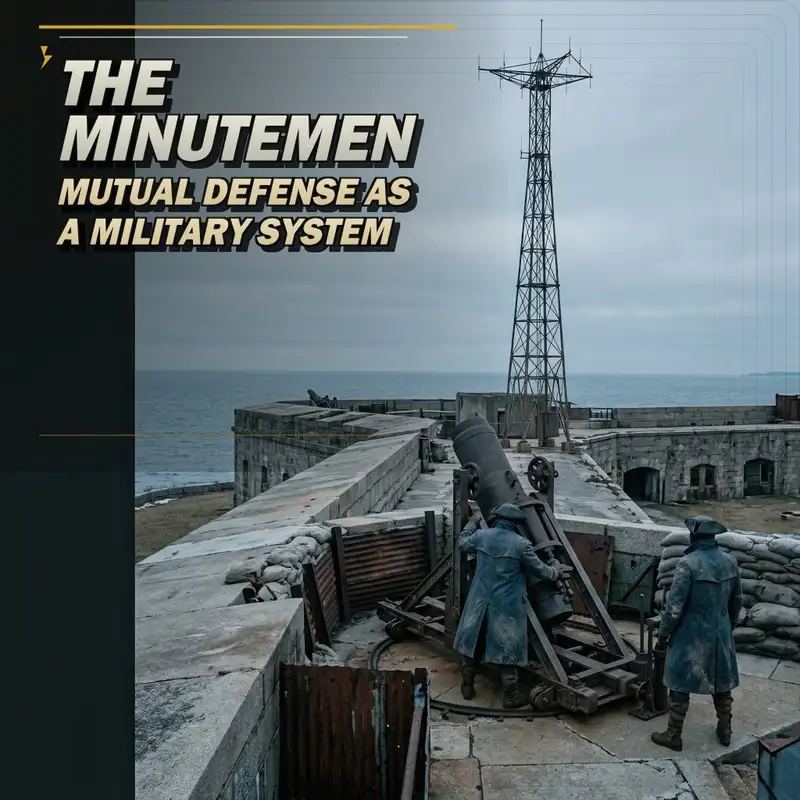
For much of its earlier history, the Castle gave the Minutemen a center strong enough to make that promise credible. The old Fort Independence stood on the coast, its walls and position offering a defensible headquarters in a region where many settlements had little more than improvised barricades. It contained an armory, artillery, and a powerful radio transmitter. More than a fortress, it was a concentration of military functions that scattered local militias could not easily reproduce on their own.
The Castle provided physical security, but its greater value was institutional. It was a place where authority could be recognized, supplies could be stored, weapons could be maintained, and requests for aid could be broadcast over distance. The radio transmitter that later became associated with Radio Freedom represented a practical military asset. In a fractured region, warning is power. A settlement that knows trouble is coming can prepare. A neighboring force that knows where trouble is occurring has at least a chance to respond.
The fort also gave the Minutemen a visible center of gravity. A General at the Castle was not simply an individual with a title. The position was tied to a headquarters, a communications node, weapons, symbols, veterans, and an expectation that the organization could coordinate more than one local fight. People will accept broad obligations more readily when they believe there is some mechanism capable of organizing sacrifice fairly and turning it into useful action.
The coastal location was useful, but it should not be overstated. Nothing establishes a Minutemen navy, organized maritime patrols, or control of Boston Harbor. The Castle did not make the Minutemen a seapower. Its value was fortification, communication, storage, and artillery support. It was a strongpoint with access to open water, not evidence of naval logistics or maritime government.
That distinction matters because the Castle’s strengths also created a vulnerability. The Minutemen had distributed their defenders across the Commonwealth, but they had concentrated too many of their shared institutional capabilities in one place. The armory, the artillery, the radio infrastructure, the symbolic headquarters, and senior leadership were closely associated with the fort. If the Castle fell, local communities could still defend themselves. What they would lose was the connective tissue that turned many local defenses into one regional system.
That is exactly what happened in the year twenty-two forty. A mirelurk attack led by a queen overwhelmed the Castle. General McGann became trapped inside the fort and died there. The Minutemen lost their headquarters, their principal radio capability, their armory, and their artillery position. The fort remained on the map, but it ceased to function as the nervous system of a regional defense network.
The immediate military lesson was not that walls are useless or that one monster can destroy any organization. Local courage cannot substitute for communications. A farm militia cannot easily replace a regional armory. A neighborhood watch cannot coordinate artillery, manage emergency requests across distance, or resolve disputes between companies that each believe their own settlement deserves priority.
After the Castle fell, the Minutemen did not vanish overnight. Their identity, traditions, and local defenders survived. But they became more vulnerable to fragmentation. A community could still call itself Minutemen while acting almost entirely within its own area. Without a functioning headquarters, shared communications, and a respected command center, the distance between mutual defense and local self-defense became dangerously small.
The loss also damaged institutional memory. Armories preserve weapons, but they also preserve procedures. Headquarters do more than house commanders. They collect reports, maintain relationships, train replacements informally, and create habits of cooperation. When a system loses its central site, it can lose the people who know how to operate its equipment, the routines that make its promises believable, and the records that explain why one settlement should trust another.
That problem became sharper after the death of General Joe Becker in the year twenty-two eighty-two. Preston Garvey later describes a struggle over succession, with Minutemen leaders unable to agree on who should take Becker’s place. The full internal politics are not documented. We do not know every claimant, every grievance, or every local calculation. But the broad result is clear enough. The organization possessed the rank of General without possessing a durable and trusted system for selecting one.
This is a common weakness in militia movements and volunteer institutions. Personal authority can be remarkably effective while a respected commander is alive. Veterans know the leader. Local captains accept the leader’s judgment. A reputation for fairness may substitute for written rules. But once that individual dies, every unresolved argument returns at once. Who has the right to command? Who controls scarce weapons? Which settlement deserves reinforcement? Who decides whether one community’s emergency is truly the region’s emergency?
A conventional army addresses some of those problems through formal succession, professional staffs, permanent units, pay systems, records, and enforceable orders. The Minutemen do not appear to have possessed those systems in a developed form. That was not necessarily a failure of imagination. Those systems are expensive. The Minutemen had chosen, or inherited, a lighter model because the Commonwealth could more readily sustain local defenders than a large standing force.
But a lighter model requires strong habits of reciprocity. Local autonomy is not the same as local isolation. If each company can decide whether to answer a call, and no shared institution can settle disputes or enforce obligations, then the network becomes vulnerable in exactly the kind of crisis for which it exists. The more dangerous the threat, the more each community may feel compelled to protect its own walls first. That is understandable.
By the time the Gunners moved against Quincy, these weaknesses had accumulated. The Minutemen still had a name, veterans, and a public memory of what they were supposed to do. Yet their command system had fractured, their central infrastructure was gone, and their obligations had become uncertain. Colonel Hollis answered Quincy’s call. Other Minutemen groups did not arrive in time, or did not arrive at all. Quincy was left without sufficient reinforcement.
Tactically, the Gunners defeated the defenders. They were a mercenary organization capable of operating with a degree of discipline and concentrated force that the remaining Minutemen could not match at Quincy. The Minutemen faced an enemy able to bring violence to one point while the defenders remained divided across the wider region. No amount of local determination can fully compensate for being outnumbered, outmaneuvered, or unable to coordinate under pressure.
Operationally, Quincy was a failure to concentrate force at the decisive point. The Minutemen did not need to control every road in the Commonwealth to save Quincy. They needed enough warning, enough agreement, enough transport, enough ammunition, and enough command unity to assemble a meaningful defense before the town fell. Their system did not produce that result. The problem was not simply a lack of fighters.
The intelligence lesson is equally severe. A warning is not the same as a response. Settlements may know that raiders are active. They may hear reports of kidnappings, attacks, or armed columns. Yet information must travel, be believed, be prioritized, and produce action. Fear can distort reports. Roads can be unsafe. Radios can fail. Leaders can disagree about the threat. Even accurate intelligence has limited value if the institution receiving it cannot mobilize people and supplies.
Politically, Quincy exposed the cost of voluntary obligation. The Minutemen gained legitimacy by not treating settlements as occupied territory. They did not require every farmer to become a permanent soldier under distant orders. But consent has a hard edge. A community that retains autonomy may decide that it cannot spare defenders, food, ammunition, or labor for a neighboring town. It may calculate that the danger is too great, the warning too uncertain, or its own defenses too thin. Those choices can be rational at the local level while disastrous for the region.
The civilian consequences were immediate. Quincy was not merely a tactical objective on a military map. It was a community of homes, work, families, and people who had expected some measure of protection. Its fall meant death, displacement, fear, and the destruction of trust. The survivors who escaped with Preston Garvey carried more than weapons and supplies. They carried evidence that the Minutemen’s promise had failed. Once communities stop believing a defense organization can protect them, recruitment, cooperation, and legitimacy become harder to sustain.
By the opening of the events of Fallout Four, Garvey’s group in Concord had been reduced to five people. That number is not the measured strength of every Minuteman who might have remained somewhere in the Commonwealth. Garvey possessed a uniform, a title, memory of the old cause, and a determination to protect civilians. He did not possess a secure headquarters, a functioning command network, dependable reinforcements, or a broad pool of trained personnel.
Concord demonstrates the difference between a name and an institution. A name can survive in one person’s memory. An institution requires people who recognize authority, equipment that works, routes that can be traveled, communities willing to cooperate, and procedures that continue after particular leaders die. Garvey remained a Minuteman.
The possible revival that follows is therefore not best understood as one person recruiting an army overnight. It is a conditional process in which the player can help rebuild the pieces that had been lost. Different choices can lead to different alliances, battles, and outcomes in the Commonwealth. There is no single uncontested history in which every settlement joins, every crisis is solved, and the Minutemen automatically become the permanent government of the region.
What that possible revival does show is the logic of reconstruction. The Minutemen do not begin by creating a barracks complex and issuing uniform orders across Massachusetts. They rebuild through relationships with settlements. A community receives assistance against a threat, gains confidence that cooperation has value, and may become part of a wider network. People have to believe that mutual defense will protect them more effectively than isolation.
In that system, settlements are not barracks. They are nodes. Each can provide some combination of warning, shelter, food, repair labor, local guides, defensive positions, and people willing to fight when their own security or their neighbors’ security demands it. A network of communities can be harder to destroy than a single fortress. If one settlement is attacked, others may endure. If one route becomes dangerous, local knowledge may identify another. If a leader is lost, the community itself may still possess skills and memory.
This distributed structure also fits the Commonwealth’s fragmented geography. Farms and towns are separated by ruined urban terrain, hostile territory, damaged roads, and the practical difficulty of moving people and supplies safely. A centrally based force would spend much of its strength simply reaching trouble. Local defenders begin closer to the problem. They know the people, terrain, threats, and possible escape routes. In a sudden raid, that proximity can matter more than the theoretical power of a distant army.
Yet local strength is not the same as regional strength. A settlement can defend itself from a small raider attack and still be unable to resist a concentrated force. It may have food for its residents but not enough to feed passing reinforcements. It may possess a few armed defenders but lack medicine for casualties, ammunition for prolonged fighting, or labor to repair damaged walls. Mutual defense works only when local resilience is joined to a credible expectation of outside support.
That expectation can become fragile. Communities have competing harvests, injuries, disputes, shortages, and fears. Some may contribute more than others. A settlement repeatedly asking for help without offering personnel, supplies, or risk in return can turn solidarity into resentment. A central Minutemen leader who demands too much can undermine the autonomy that makes local participation acceptable. A leader who demands too little may discover that mutual defense has become a polite phrase for every settlement looking after itself.
The game’s settlement systems illustrate the idea of expansion, but they should not be mistaken for a literal historical ledger. A recruitment beacon does not prove a standardized force-generation program. A workshop does not establish instant construction or unlimited material supply. Repeated calls for assistance do not mean that every Commonwealth emergency occurred in one fixed sequence. The broader point remains sound. A militia network must turn civilian resources into defensive capacity, and that always depends on labor, trust, and material limits.
The Minutemen’s political strength is that they can ask communities to participate rather than simply submit. Their weakness is that participation cannot be assumed. They are most credible when they deliver practical security while respecting local control. They are least credible when they promise protection they cannot provide, or when they become dependent on one exceptional leader solving every crisis personally. A system built around mutual aid must make mutuality visible. Otherwise it becomes another armed organization asking exhausted settlements for support.
Communication is the mechanism that allows this federation to act like more than a collection of local militias. Radio Freedom, once restored at the Castle in a possible Minutemen revival, provides a shared channel for warnings and requests. Its significance is easy to miss because a radio broadcast can sound ordinary. In the Commonwealth, it is strategic infrastructure. It connects settlements that may never see one another, gives them a common picture of danger, and reinforces the idea that threats in one place concern the region as a whole.
But Radio Freedom is not magic. A broadcast must be heard. The receiving settlement must have a working radio or someone listening. The message must be trusted. People must decide that the threat merits action. Fighters must then gather equipment, leave their own posts, and travel through hazardous territory. A radio can shorten the time between warning and decision. It cannot eliminate distance, fear, exhaustion, or the possibility that a community has nothing left to spare.
The Minutemen’s flare guns represent an even more local form of command and control. They signal a nearby emergency and can summon support from Minutemen in the area. A settlement under attack should not wait for a distant headquarters to authorize every response. Nearby defenders act first. The regional organization provides recognition, mutual obligation, and the possibility of reinforcement, but local survival cannot depend entirely on central permission.
That creates a layered model of command. At the lowest level, settlers and local defenders respond to immediate threats. At the regional level, the Castle and Radio Freedom can communicate warnings, prioritize crises, and coordinate broader support. In a larger operation, a General or other recognized leader may help unite forces that would otherwise remain separate. The model is flexible, but flexibility can become ambiguity. If responsibilities are not clear, everybody may assume somebody else is responding.
Local knowledge gives the Minutemen a meaningful intelligence advantage. Settlers know which roads have become dangerous, which gangs are active, where crops have failed, who has gone missing, and what unfamiliar movements have appeared near their homes. That information is often more useful than distant theory. Yet it is also fragmented. Rumor, fear, misinformation, and damaged communication can turn a useful warning network into a patchwork of partial reports.
The Castle’s restoration addresses some of these weaknesses through limited centralization. In the possible revival, the fort is retaken from the mirelurks that occupied it after the old disaster. A restored headquarters can store equipment, host a radio transmitter, symbolize renewed authority, and provide a defensible place from which the Minutemen can coordinate a regional response.
Ronnie Shaw’s return is important in this process. She is not simply another armed veteran arriving with useful equipment. She represents institutional memory. She knows the Castle’s past, the location of the armory, and the artillery system that earlier Minutemen maintained. Organizations often lose capability not because the equipment is physically gone, but because the people who understood its purpose, procedures, and risks are dead, scattered, or ignored. Shaw reconnects the revived Minutemen to practical knowledge their predecessors once possessed.
The recovery of the armory and restoration of artillery give the network a form of heavy support beyond rifles, walls, and local patrols. Artillery can alter the balance of a settlement defense because it gives dispersed communities the ability to strike threats at some distance.
Still, artillery is not a magical answer to the Minutemen’s problems. Guns require crews who know how to operate them, ammunition that has been obtained and protected, equipment that can be maintained, communications that can direct fire, and positions secure enough to keep the battery from being overrun. Effective fire also depends on some form of observation and judgment. A weapon that cannot be supplied, aimed responsibly, or defended becomes an expensive monument to a better-organized past.
The Commonwealth Minutemen demonstrate artillery capability, not a mature artillery arm. The available evidence does not establish mass ammunition production, standardized batteries across the region, precise firing ranges, or a permanent professional corps. Nor should an exceptional player-dependent operation involving several supported settlements be converted into a claim that the Minutemen possess unlimited firepower. Their artillery is best understood as limited central support reinforcing a distributed militia network.
That distinction captures the Minutemen at their strongest. They do not need to imitate a conventional army in every respect. A few carefully restored shared assets can greatly improve the security of many local communities. A radio transmitter, an armory, experienced technicians, and artillery positions can multiply the value of local defenders. Centralization is useful when it provides capabilities that no individual settlement can sustain alone.
The possible late-war operations against the Institute and the Brotherhood of Steel test how far this model can scale. These events are conditional branches, not one settled Commonwealth history. Depending on player choices, the Minutemen can become involved in major operations against one of those powerful institutions.
At the tactical level, that is plausible. A coalition of local forces can attack a specific objective. It can exploit local knowledge, use artillery support, and bring determined fighters together for a mission. Campaigns against organized rivals require synchronized decisions, reliable communications, intelligence, transport, medical support, ammunition, and a clear sense of who is responsible when plans fail. The more distant and prolonged the operation, the more militia flexibility begins to encounter the hard requirements of organized warfare.
Even a successful campaign would not automatically create a Commonwealth state. Destroying a rival facility, surviving an airship attack, or winning a battle does not establish courts, taxation, public health, food distribution, trade regulation, succession, or the ability to govern communities that do not wish to be governed. Military victory can remove an immediate danger.
This is where the Minutemen must resist the temptation to become a failed conventional army waiting to become a better one. Their comparative advantage is not permanent mobilization, elite technology, or centralized coercion. It is local legitimacy joined to regional cooperation. They can warn settlements, deter smaller threats, organize nearby responses, share limited support, and create habits of solidarity across a dangerous landscape. In the Commonwealth, they may be more useful than a grand headquarters issuing orders it cannot enforce.
Their limits are equally substantial. Militias struggle with prolonged campaigns because volunteers have homes, crops, injuries, families, and local duties. They struggle with standardized training because training takes time, instructors, ammunition, safe facilities, and agreed doctrine. They struggle with major logistics because feeding, equipping, and replacing a force far from home requires more than goodwill. They struggle with medical systems, industrial production, and secure transport because those are not simply military functions. They are products of wider social organization.
They also struggle with succession. The deaths of McGann and Becker show that a respected General can hold together more than a title. But no organization should depend on the hope that every crisis will produce another respected leader at exactly the right moment. A durable Minutemen system would need recognized procedures for replacing commanders, resolving disputes, distributing scarce support, and deciding when one settlement’s emergency requires help from another. Those procedures do not have to resemble an old-world army manual. They do have to outlast personalities.
The same is true of resources. Mutual defense is not free. A settlement that sends fighters risks weakening its own walls. A community that provides food to a passing force may reduce its winter reserve. A workshop repairing weapons for regional service may delay local repairs. The first option sustains legitimacy. The second weakens it. The third would transform the Minutemen into something very different from the voluntary protective institution that gave them meaning.
Civilians remain the real measure of success. The Minutemen do not exist to possess artillery, display uniforms, or occupy the Castle for its own sake. Their purpose is proved when farms, caravans, families, and small settlements are safer because a call for help can produce a response. It is proved when people can travel, plant crops, repair homes, and raise children with less fear of being abandoned by every neighboring community. A flag over a fort is only a symbol. Reliable protection is the institution.
The Minutemen can contribute to state formation, but they are not automatically a government. Their network could become the security foundation for broader political cooperation. Or it could remain a loose emergency alliance, effective against raids but unable to manage the difficult work of revenue, law, infrastructure, and regional disputes. Both futures are possible in principle. The available record does not establish one completed political settlement after the events of Fallout Four.
Their deeper value lies in the kind of order they attempt to build. The Commonwealth has no shortage of groups capable of using force. What the Minutemen offer is an argument that force should be accountable to the people it protects, and that local independence need not mean local abandonment. That argument is demanding. It requires communities to accept that another settlement’s danger can become their own before the enemy reaches their own gate.
Quincy proved what happens when that obligation becomes optional. The Castle, Radio Freedom, artillery, and renewed leadership can rebuild parts of the Minutemen’s military capacity, but none of them can substitute for trust, discipline, shared sacrifice, and a succession system strong enough to outlive one respected commander. Their durable achievement would not be conquering the Commonwealth. It would be making mutual defense reliable enough that ordinary settlements can survive without surrendering their independence.