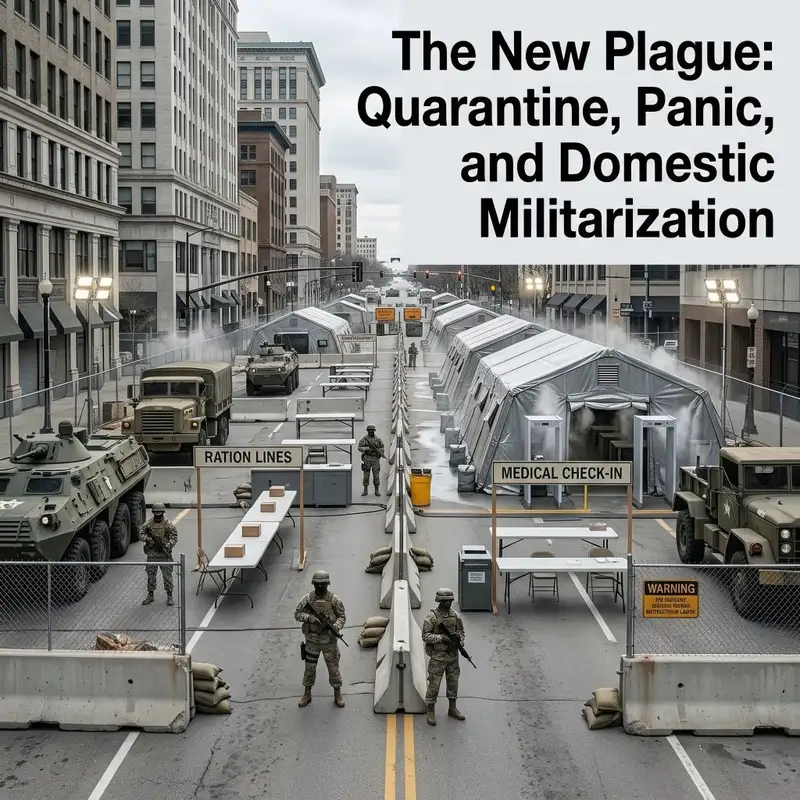
The New Plague: Quarantine, Panic, and Domestic Militarization
In a disaster-relief outpost near Point Lookout, a pre-War pamphlet instructed citizens to watch their neighbors for sweating, unexplained bruising or swelling, and massive external bleeding. Those are frightening symptoms. Then the pamphlet added another warning sign. A suspected victim might display new ideals, such as socialism. The instruction was not subtle. Identify the suspect. Report the suspect. Isolate the suspect.
That document is one of the clearest surviving records of the New Plague, and it presents an immediate problem. It does not prove that the disease was imaginary. A government can face a genuine medical emergency and still lie, exaggerate, classify, and exploit. What it does prove is that at least part of the American response treated political belief as something adjacent to infection. Medical language had become a way to describe dissent. Quarantine had become entangled with ideological conformity.
The New Plague occupies an uncomfortable place in Fallout history because its importance is clearer than its biology. The released record establishes that it was serious enough to shape medical research, government messaging, and public administration. Yet it does not provide a reliable pathogen, transmission route, incubation period, mortality rate, cure, vaccine, or national casualty total. The official memory is full of institutional reaction and remarkably thin on medical detail.
That gap matters. When historians cannot establish precisely how a disease spread, how many people died, or which treatments worked, they should not fill the silence with a tidy conspiracy. The New Plague was not a proven hoax. Neither is it a fully documented national catastrophe in the way later generations might expect. It is a poorly preserved emergency whose surviving evidence tells us more about the state that managed it than about the pathogen itself.
The most defensible conclusion begins there. Something was feared, and perhaps something was killing people. But fear does not remain only in hospitals. It enters homes, workplaces, schools, factories, military installations, and political arguments. It creates pressure for visible action. It rewards officials who can promise control. It gives bureaucracies a reason to collect names, addresses, movements, family relationships, and private habits. It can turn care into a test of obedience.
Quarantine, in principle, is not tyranny. Isolation can be a necessary response when an illness is dangerous and poorly understood. A community may need to limit contact, trace exposure, protect medical workers, and separate those who are ill from those who are not. None of that is inherently sinister. Disease control often requires organization, and organization requires information.
But quarantine is not a poster on a wall. It is a logistical undertaking. People cannot remain isolated if they have no food. Families cannot comply if they lose access to water, medicine, wages, or shelter. Medical staff need training, supplies, sanitation, transportation, communications, and some method of determining who is actually sick. Authorities need public trust, because a frightened population that believes diagnosis will lead to punishment has every reason to hide symptoms and avoid officials.
The pre-War United States appears to have had a stronger instinct for classification than for care. The surviving Point Lookout material shows pamphlets, reporting procedures, fitness language, registration requirements, and a relief apparatus tied to federal compliance. It does not show a confident public-health system with abundant medicine, reliable diagnosis, and broad local legitimacy. That imbalance is important. A government may be able to print instructions faster than it can supply a clinic.
For civilians, the consequences of that imbalance could be severe even without a documented nationwide campaign of mass detention or military quarantine. If illness carried stigma, people might conceal it. If reporting a neighbor could attract official attention, private disputes could become medical accusations. If relief depended on registration, then the decision to seek help became a decision to enter a federal record. If political views could be treated as symptoms, then health surveillance became a threat to speech and association.
The New Plague therefore raises an issue larger than medicine. Once the state defines public safety through an expanding category of suspicion, the target can widen from a sick person to a household, a workplace, a neighborhood, or anyone who refuses to cooperate. The danger is not simply that authorities make mistakes. It is that the administrative machinery begins to find more value in sorting the population than in serving it.
The Point Lookout records offer a small but revealing window into that machinery. They connect disaster relief with the Federal Fitness Registry Compliance program. Relief workers were not described solely as medical volunteers. Their work included evaluating medical and social needs while assisting federal registration. Those two functions could overlap in legitimate ways. A relief effort needs to know who requires food, shelter, medicine, or evacuation.
Yet registration is never just neutral paperwork when the people being registered fear punishment. A list of vulnerable households can guide supplies to those in need. It can also guide surveillance, rationing, exclusion, coercion, and political screening. The same file can serve a nurse, a local administrator, a police officer, or an intelligence service. The distinction lies not in the existence of records, but in the rules governing their use and the power available to those who hold them.
The Federal Fitness Registry belonged to a political culture already accustomed to presenting discipline as health. The language of fitness implied more than physical well-being. It suggested that a good citizen was productive, compliant, vigilant, and properly patriotic. In that setting, the claim that socialism might be a symptom was not merely a foolish line in a pamphlet. It exposed the political assumptions beneath the program. The body of the citizen and the loyalty of the citizen were being treated as related administrative concerns.
That did not require every clerk, volunteer, doctor, or local official to share the same motives. The federal government was not a single mind. The Presidential Fitness Program, registry bureaucracy, relief organizations, military establishment, private contractors, and local authorities had different responsibilities and incentives. Some personnel may have believed they were protecting communities. Some may have followed procedure because procedure was all they had. Others may have seen the system as a useful means of control.
The important point is institutional rather than personal. A program can become coercive without every person inside it becoming a villain. A volunteer can distribute supplies while also collecting data for a registry. A medical worker can care for patients while being required to report them. A local official can accept federal help while resenting the conditions attached to it. The structure itself creates pressure, especially when resources are scarce and authority is uneven.
Point Lookout also reveals the limits of federal capacity. The relief outpost contains the language of organized response, but it does not convey an institution fully prepared to meet the human needs created by disease and panic. There are signs of administration without the corresponding confidence of effective relief. That is a familiar failure in states under strain. The central government can announce a program, create a registry, and define procedures. It cannot automatically produce trained staff, functioning sanitation, reliable transport, or the trust of people who have learned to expect neglect.
A registry cannot disinfect water. It cannot feed a household ordered to remain indoors. It cannot replace an absent doctor, repair a road, or make an understaffed clinic credible. It can only record that those things are missing. Pre-War America had developed remarkable systems for data collection, advertising, and coercive coordination. Those capabilities did not guarantee that it could perform the slower, less glamorous work of public health.
That failure of capacity helps explain why surveillance might appear attractive to officials. When an institution cannot cure a crisis, it may attempt to measure it. When it cannot provide security everywhere, it may ask citizens to watch one another. When it cannot resolve uncertainty, it may redefine uncertainty as disloyalty. Classification becomes a substitute for competence. The paperwork grows because the practical remedy remains out of reach.
Citizen reporting was especially valuable in this kind of system. It was cheap. It extended state awareness into places where no official could be present. A reporting network could potentially reveal household connections, workplace attendance, travel patterns, social ties, and local grievances. In a genuine disease outbreak, some of that information could support contact tracing and relief. In a paranoid political environment, the same network could also identify people whose ideas, associations, or behavior appeared suspect.
The pamphlet’s reference to socialism marks the moment where epidemiology becomes ideological screening. No serious medical framework can diagnose a political conviction as a contagious symptom. The phrase was propaganda, bureaucratic abuse, or both. It taught citizens that political difference could be interpreted as a public danger. It also taught them that official concern for health might conceal a demand for conformity.
The likely civilian response was not uniform. Some people would have wanted protection and accepted official instructions in good faith. Some would have complied because they feared illness more than registration. Some would have distrusted the government but lacked other options. Some might have avoided clinics, concealed symptoms, or resisted reporting neighbors. Others may have used official suspicion for personal advantage. Fear has always created opportunities for both solidarity and betrayal.
The records do not allow us to invent particular arrests, neighborhood raids, or military operations. They do not establish a complete national chain of quarantine command. But they do show the conditions under which abuse becomes likely. When the state encourages reporting, associates dissent with sickness, and links aid to compliance, it creates a system in which ordinary people must calculate the risk of seeking help. That calculation is itself a public-health failure.
The New Plague also mattered because disease was not only a civilian problem. A serious outbreak threatens factories, laboratories, transportation networks, food distribution, military readiness, and political confidence. A government fighting for resources and preparing for larger war could not treat biological danger as a minor medical inconvenience. Disease could remove workers from production, weaken troops, disrupt strategic industries, and deepen panic in a population already living under severe pressure.
That strategic concern helps explain the role of West Tek. The West Tek Research Facility was established in the year twenty fifty-five as a biological research site for experimental cures to the New Plague. This is one of the firmest facts in the record. The facility was not simply a generic laboratory later associated with the disease. Its early institutional purpose was connected to the search for a solution.
West Tek, however, was a contractor, not a charitable hospital floating above politics. Biomedical research at that scale required specialized laboratories, scientific labor, security systems, steady funding, access to materials, and control over intellectual property. It operated where corporate interest, federal policy, and military need could overlap. The existence of a medical mission did not make the institution neutral. It made the institution strategically valuable.
A disease crisis creates enormous demand for such expertise. The ability to prevent infection, develop treatments, understand immunity, or protect workers could become a source of profit and state power. The government needed resilient personnel and functioning industry. Corporations had reason to seek contracts and patents. Scientists had access to funding and facilities that ordinary public-health institutions often lacked. In a system already shaped by militarization and corporate influence, medical research could be drawn toward national-security objectives with little public visibility.
The crucial change came in the year twenty seventy-one, when the United States military took control of the West Tek Research Facility. This transfer is the clearest confirmed point where the New Plague’s research legacy enters direct military oversight. It does not prove that the whole country was under martial law. It does not establish that soldiers were conducting plague quarantines across every American city. It does show that a facility established to pursue experimental cures had become important enough to be placed under military command.
For the facility itself, military control meant stronger security around a sensitive site, restricted access to personnel and research, and tighter handling of classified material. A biological laboratory dealing with disease, immunity, and military interests would have been regarded as a potential intelligence target and a potential hazard. Protecting the facility could be presented as prudent defense.
For military planners, the transfer allowed biomedical work to be integrated more closely with military planning. The laboratory was no longer simply answering a medical problem. Its research could support force protection, biological defense, strategic resilience, and the wider requirements of a country preparing for conflict. The question changed from, “How do we cure this disease?” to, “How can biology protect or enhance national power?”
Strategically, the change was more consequential. Biological knowledge is dual-use knowledge. A system that can study immunity may also study vulnerability. A program meant to defend soldiers from disease may attract interest from those seeking to alter soldiers, resist biological weapons, or gain advantage through human experimentation. The line between medicine and weaponization is not always crossed in a single dramatic order. Often it erodes through successive changes in funding, secrecy, mission language, and command authority.
That is what happened to the broader West Tek research trajectory. Later work associated with the facility included the Pan-Immunity Virion project and eventually the research that produced the Forced Evolutionary Virus, commonly called F E V. The institutional lineage is real. The exact path through every project, every decision, and every objective is not fully preserved. It would be too simple to say that the New Plague was merely an excuse to create F E V, or that a cure project naturally became a super-soldier program.
What the evidence supports is mission drift. Research that began in the context of disease and experimental cures moved into a wider defense environment shaped by biological weapons fears and military ambition. In that environment, the human body was no longer understood only as something to be healed. It became something to be hardened, modified, protected, controlled, and potentially remade for strategic purposes.
The Pan-Immunity Virion concept carried an obvious appeal for military planners. A force protected against disease would be more resilient in contaminated environments, under biological attack, or during long campaigns. But the search for universal biological protection also invited more dangerous ambitions. If a body could be made resistant to infection, perhaps it could be made resistant to radiation, toxins, injury, or other threats. The logic of protection could slide toward transformation.
F E V represented the horrifying extreme of that slide. It was not simply a vaccine that went wrong, nor should it be reduced to a single laboratory accident. It emerged from research systems in which human biology had been turned into a strategic field of competition. The ethical catastrophe was not only the virus itself. It was the willingness of institutions to regard people as material for a defense project, particularly when secrecy and military necessity shielded decision-makers from scrutiny.
That transformation illustrates a broader lesson about emergency science. A genuine threat can create a legitimate need for research. But when research is absorbed into an unaccountable security apparatus, the original duty of care can be displaced by the pursuit of advantage. The people meant to be protected become subjects to be managed. The body becomes a military resource. Medical uncertainty becomes a reason to expand secrecy.
The New Plague did not, by itself, create the domestic militarization of late pre-War America. That wider process had many causes. Resource scarcity had strained the economy and intensified competition. Food unrest exposed failures of distribution and governance. Automation displaced workers and sharpened labor conflict. Anti-communist fear shaped public rhetoric and internal security policy. Espionage concerns grew alongside the Sino-American War. Corporations, federal agencies, and military institutions all operated in an atmosphere of crisis.
It would be inaccurate to attribute every domestic deployment of armed force, every act of repression, or every use of advanced military hardware to disease control. The released record does not support that claim. In particular, it does not establish as settled history that power armor was first used against civilians in New Plague quarantine operations. Domestic military force became more visible through the broader breakdown of the pre-War order, not through one clearly documented medical campaign.
Still, the plague mattered because it helped normalize certain habits of rule. It accustomed institutions to the language of emergency. It gave officials a reason to classify citizens by health, behavior, and loyalty. It linked relief work with registration. It placed biological research on a path toward military control. It demonstrated that fear could be organized, advertised, and entered into a file.
These practices were useful to a state facing multiple crises because they promised speed and visibility. A registry could make the population legible. A fitness program could frame obedience as civic virtue. A reporting system could extend official reach without requiring a large professional presence in every community. Military control of a laboratory could reassure leaders that valuable knowledge was secure. Each measure could be defended as practical, even when the combined effect was deeply corrosive.
The problem was that administrative control could not solve the underlying failures of American society. A citizen entered into a registry was still hungry if food distribution failed. A worker screened for ideological reliability was still anxious about automation, wages, and war. A laboratory guarded by the military still required ethical limits, competent scientists, and accountable oversight. A fearful public did not become loyal simply because officials had more files.
In fact, coercive administration often made the crisis harder to manage. People who distrust the medical system delay seeking care. Communities that expect surveillance conceal information. Relief workers associated with registration lose the confidence needed to persuade families to cooperate. Officials receive more reports, but the reports become less reliable as panic, prejudice, and political accusation enter the system. The state gains data and loses truth.
This is the central operational weakness of militarized public health. Force can protect a hospital, secure a laboratory, escort supplies, or enforce a limited perimeter. Those may be necessary tasks in extreme conditions. But force cannot replace diagnosis. It cannot create trust through intimidation. It cannot make a treatment effective, keep sanitation systems running, or persuade frightened people that disclosure will not destroy their lives. When coercion substitutes for capacity, disease and distrust can reinforce one another.
The commercial culture surrounding the New Plague offers another clue to its place in pre-War America. In the later television record, a pre-War hospital advertises revolutionary treatments for the New Plague. That image does not tell us whether the treatment worked. It does not reveal the disease’s biology or establish a nationwide medical system. What it does show is that the plague had become recognizable enough to sell against.
That is a small but revealing piece of evidence. Medical fear was not confined to government pamphlets and classified laboratories. It also entered the marketplace. A private hospital could turn the name of the crisis into a promise of rescue, innovation, and consumer choice. In the pre-War United States, catastrophe was rarely allowed to remain only catastrophe. It became a contract, a product line, a political message, or a branding opportunity.
Commercial medicine did not need to invent the New Plague to profit from it. Nor did every advertised treatment need to be fraudulent for the system to exploit fear. The important fact is that access to reassurance could be sold. Those with money might purchase better facilities, faster attention, or the appearance of security. Those without it might receive pamphlets, registration requirements, and instructions to monitor their neighbors.
That division between marketed care and administered control was consistent with the broader character of late pre-War America. The country possessed extraordinary technology, extensive military capacity, and sophisticated corporate institutions. Yet those strengths were unevenly directed. The systems best funded were often the systems that promised advantage, security, or profit. The slower work of building equitable public trust remained vulnerable to neglect.
The New Plague survived in cultural memory partly because institutions made it useful. Government agencies could invoke it as a warning about vigilance. Medical businesses could invoke it as a reason to buy treatment. West Tek could trace part of its strategic relevance to the search for a cure. Later audiences could inherit its name without inheriting a clear account of what it actually was. The disease became a symbol because the record had been shaped by those who benefited from managing the symbol.
The New Plague does not fit neatly into a choice between genuine public-health emergency and political pretext. The released evidence does not establish that the plague was fabricated. It was real enough, or at least officially recognized enough, to motivate experimental cure research, public warnings, and a continuing commercial vocabulary of treatment. At the same time, disease control gave the United States a language for surveillance, isolation, political registration, and domestic militarization.
But the political use of the crisis is documented more clearly than the medical facts. At Point Lookout, public-health guidance sat beside ideological suspicion. Citizens were encouraged to report and isolate suspected cases, while political beliefs appeared on the symptom list. Relief work was linked to federal registry compliance. The administrative system treated medical and social needs as part of the same process of population management.
The intelligence outcome was not necessarily a single centrally designed conspiracy. It was more durable than that. A reporting system encouraged citizens to observe one another. A registry transformed vulnerability into a record. Medical language made private life available to official scrutiny. The state could gain information about households, movement, relationships, and attitudes under the banner of protection. Once political deviation appeared in the same document as bleeding and swelling, the boundary between health surveillance and loyalty screening had already been breached.
The institutional outcome was equally significant. West Tek began as a biological research facility connected to experimental New Plague cures. By the year twenty seventy-one, it was under United States military control. Later work moved through biological defense and into the research that produced F E V. This was not proof that every stage had been planned from the beginning. It was evidence that emergency medicine, defense research, and military power had become increasingly difficult to separate.
The public-health outcome remains uncertain. The surviving material does not establish a cure, a successful vaccination campaign, or even the full scale of the disease. The record instead suggests uneven capacity, weak local legitimacy, and a response in which administrative control may have arrived more reliably than effective care. For ordinary people, the burden was immediate. Illness could mean stigma. Seeking help could mean registration. Suspicion could mean isolation. Political difference could be recast as pathology.
The New Plague should therefore be understood neither as a proven hoax nor as a completely documented national disaster. Its clearest legacy lies in what institutions did with fear. Pre-War America did not need to invent disease in order to exploit it. By tying relief to registration, turning ideology into a symptom, and placing biological research under military control, it transformed public health from a duty of care into another instrument for sorting, monitoring, and controlling a population already living under the pressure of national decline.