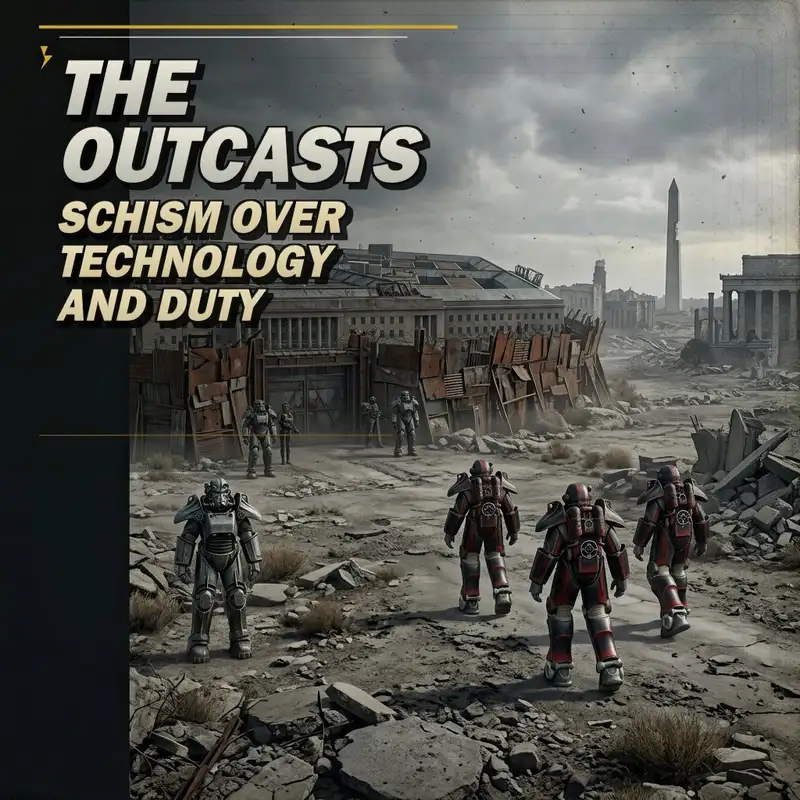
The Outcasts: Schism Over Technology and Duty
At Fort Independence in the year twenty-two seventy-seven, the Brotherhood of Steel’s Outcasts held a battered old fort against raiders, guarded storerooms of recovered equipment, and sent patrols into a landscape they regarded with profound suspicion. Their armor, weapons, and discipline made them look like one of the Capital Wasteland’s more formidable military forces. Yet the fort’s daily reality was less grand. Advanced technology had to be assessed, secured, repaired, and, at times, exchanged for ammunition, medical supplies, and other necessities. The men and women inside its walls believed they were preserving the Brotherhood’s true mission. But their survival depended on dealing with the same fractured civilian economy they believed the Brotherhood should stand apart from. That was the Outcasts’ central paradox. What did it mean to safeguard humanity’s most dangerous inheritance when people beyond the gate were thirsty, hunted, and largely unprotected?
The Outcasts were not a separate Brotherhood chapter arriving from some distant western bunker. They were a fracture within the Brotherhood expedition led east by Elder Owyn Lyons. Their dispute was not simply about whether to help civilians. It concerned authority, institutional identity, strategic priorities, and the purpose of technological power after civilization had collapsed. Lyons concluded that the Brotherhood had a responsibility to defend the Capital Wasteland’s people from immediate threats. The Outcasts concluded that he had abandoned the organization’s defining obligation to recover and control advanced technology. Both sides could point to a real danger. Neither possessed the resources to solve the whole problem alone.
The story began in the year twenty-two fifty-five, when Owyn Lyons led a Brotherhood expedition from the western territories toward Washington, D.C. The stated mission was familiar Brotherhood business. The East Coast held an enormous concentration of pre-War military, scientific, and governmental infrastructure. Recovering its technology could strengthen the Brotherhood’s long-term position and keep dangerous systems out of irresponsible hands. The expedition was also meant to establish a durable eastern presence. This was not originally a humanitarian relief mission, a civilian government, or an army assigned to pacify an entire region. It was a military and technical expedition moving into a continent-sized graveyard of old-world capability.
Washington offered exactly the kind of prize the Brotherhood had been trained to seek. The ruins of the Pentagon contained surviving underground structures, military records, equipment, workshops, and defensive potential. Lyons’s forces converted that complex into the Citadel, a headquarters with symbolic and practical value. It gave the expedition a defensible center, access to old military infrastructure, and a place from which to organize patrols and technical work. It also contained one of the Brotherhood’s most extraordinary discoveries, Liberty Prime. The giant war machine represented more than firepower. It represented the old world’s industrial arrogance, its military ambition, and its dependence on systems that were difficult to understand and harder still to restore.
Liberty Prime was a prize, but also a warning. A machine that large could not be made useful merely because it had survived. It required technical knowledge, replacement components, energy, secure facilities, and enough organizational continuity to maintain it. In that sense, it embodied the Brotherhood’s larger problem. The order possessed fragments of a pre-War military inheritance, but it did not possess the industrial civilization that had built that inheritance. Salvage could recover a weapon. It could not automatically recreate the mines, factories, laboratories, schools, transportation networks, and stable institutions that had once supported mass production. The Brotherhood’s power rested on what it could preserve, repair, and operate, not on an unlimited ability to rebuild the past.
The Capital Wasteland made that mission harder and more morally complicated than Lyons’s original orders may have anticipated. The region was not empty. It contained settlements, traders, scavengers, farmers, small communities, religious groups, and people trying to make ordinary life possible amid extraordinary ruin. But it lacked a reliable regional authority capable of securing roads, protecting communities, or coordinating recovery across the whole area. Raiders exploited weak defenses. Contaminated water damaged health and narrowed settlement options. Infrastructure existed in fragments, but most people lacked the equipment, labor, and security needed to make extensive use of it. The region had society. What it did not have was much strategic depth.
Then there were the super mutants. To Lyons, they were not simply another hostile population occupying a few ruined blocks. Their presence was tied to an ongoing process of abduction, mutation, and organized violence. Their origin and activity suggested that the Capital Wasteland faced a continuing threat to human survival, not merely the usual insecurity of frontier life. Brotherhood patrols could recover rifles, circuitry, armor components, and military records. But none of that answered the immediate question facing a settlement whose residents could be taken by super mutants, killed by raiders, or weakened by contaminated water before the Brotherhood’s archivists had finished cataloging another crate of pre-War hardware.
This was Lyons’s intelligence problem as much as his moral one. A commander does not interpret threats in a vacuum. The same landscape that one officer sees as a repository of strategic technology can appear to another as a human emergency demanding armed intervention. Lyons increasingly believed that the Brotherhood could not protect humanity in the abstract while ignoring the actual human beings living around its installations. If super mutants destroyed settlements, if disease and thirst hollowed out communities, and if roads remained too dangerous for ordinary exchange, then the Brotherhood would be preserving technology in a region too broken to make responsible use of it.
Lyons therefore expanded the Brotherhood’s mission. His chapter fought super mutants, patrolled the wasteland, recruited from the local population, and gave support to efforts that could improve civilian survival. The clearest example was Project Purity. It is easy to describe clean water as charity, because water distribution lacks the visual drama of power armor or artillery. Strategically, that description is far too small. Reliable water affects disease, migration, food production, trade, labor, and the ability of settlements to survive without becoming dependent on whichever armed group controls the nearest well. Water can turn a defended refuge into a more durable community. It can also generate political trust, because people notice who helped them remain alive.
For Lyons, Project Purity was not a distraction from security. It was a way of making security meaningful. A Brotherhood patrol could drive off a super mutant force from one neighborhood, but a population still trapped by thirst and illness would remain vulnerable. A clean-water project could not replace military defense, but it could reduce the conditions that made every local crisis a catastrophe. This was a reconstruction argument. The Brotherhood’s weapons, training, and technical skills should not merely keep dangerous artifacts from the hands of others. They should help create a region in which fewer people were forced into desperation, predation, or dependence.
It was also an institutional gamble. The Brotherhood was not a state. It had no broad tax base, no established agricultural system, no large population of citizens, and no demonstrated capacity to govern every settlement it might protect. Its personnel were finite. Its equipment required maintenance. Its technical staff could not be everywhere at once. The more Lyons committed to patrols, civilian defense, super-mutant operations, recruitment, and Project Purity, the more his chapter risked overextension. Every knight guarding a vulnerable route was a knight not recovering technology. Every part assigned to a field repair was a part unavailable for some other system. Every local recruit expanded manpower, but also changed the character of an order once defined by controlled inheritance and specialized training.
That transformation earned Lyons local legitimacy. It also created anxiety within his own ranks. To many Brotherhood traditionalists, the organization existed because the old world had demonstrated what happened when powerful technology escaped ethical control. Nuclear weapons had not simply destroyed cities. They had exposed the bankruptcy of governments, corporations, and military institutions that treated enormous destructive capability as a tool of policy. The Brotherhood’s custodial mission emerged from that catastrophe. Its members believed advanced technology could not be left to chance, greed, or poorly supervised political power. In that view, collecting and controlling dangerous systems was not selfishness. It was preventive defense.
Paladin Henry Casdin became the leading voice of that objection in the Capital Wasteland. Casdin was not best understood as a cartoonish hoarder who happened to enjoy wearing power armor. He had served alongside Lyons and had standing within the expedition’s military culture. His disagreement reflected a serious question of command legitimacy. Was a Brotherhood member’s primary duty obedience to the elder currently in command? Was it fidelity to the Brotherhood’s inherited doctrine? Or was it responsibility to the civilians living near Brotherhood positions? Those obligations could overlap. In the Capital Wasteland, they had begun to collide.
Casdin and those who followed him believed Lyons had misplaced the organization’s priorities. In their view, the Brotherhood had been sent east to secure technology, not to become a regional constabulary. If the chapter neglected recovery and containment, advanced weapons and systems would fall into the hands of raiders, opportunists, rival factions, or people unable to operate them safely. The result, they feared, would not be humanitarian progress. It would be another cycle of destruction, only with better weapons. The Outcasts regarded Lyons’s policies as a departure from the Brotherhood’s core purpose, and they expected that traditional Brotherhood authority would eventually recognize the difference.
That claim should be handled carefully. The Outcasts’ own statements are arguments made by people defending a break with their commander. They are not a neutral court record. Their belief that they represented the authentic Brotherhood does not prove that western elders formally recognized them as the sole legitimate eastern force. Lyons’s own records are not neutral either. They reflect the fatigue, frustration, and guilt of a commander trying to do too much with too little. His concern for thirsty and vulnerable wastelanders was sincere, but sincerity did not make his strategic problem disappear. Each side saw a truth that the other treated as secondary.
The argument became irreversible because it concerned people and equipment, not just principles. By the time Fallout 3 takes place, the schism is complete. The split is commonly placed around the year twenty-two seventy-six, although the available record establishes the consequences more clearly than it establishes a precise date. Casdin’s faction left the Citadel and took weapons, power armor, and other material with them. They established themselves at Fort Independence, west of the Fairfax ruins. From Lyons’s perspective, they were deserters who had taken needed equipment during a regional crisis. From the Outcasts’ perspective, they had removed Brotherhood resources from a command that was misusing them.
The loss was more than symbolic. A technical military order depends on its maintenance base. Power armor is not a suit of indestructible medieval plate with a reactor attached. It is a complex system requiring trained users, technicians, tools, components, secure storage, and a supply chain of some kind. Energy weapons, medical systems, communications gear, and specialized defenses carry similar burdens. The Citadel retained major infrastructure, but the departure of personnel and equipment reduced its flexibility. Brotherhood scribes and technical staff faced shortages of parts. Combat units faced a larger mission with fewer resources. The chapter’s humanitarian turn did not merely anger traditionalists. It became harder to sustain after the traditionalists departed.
The Outcasts paid a different price. They gained clarity of purpose and a headquarters dedicated to their priorities. But Fort Independence was not the Citadel. It did not give them the same central position in the Brotherhood’s regional network, the same relationship with the settlements Lyons was trying to protect, or the same claim to speak for the entire eastern chapter. They had selected institutional purity over organizational unity. That choice gave them a more coherent doctrine, but it also narrowed their political reach. They could guard technology. They could conduct recovery operations. They could maintain patrols and defend their fort. They could not easily make themselves the security guarantor for the Capital Wasteland.
The schism created two incomplete military models. Lyons retained the broader social mission, a major headquarters, and a growing relationship with the wasteland’s people. But he lacked the manpower, spare parts, and administrative depth to provide security on the scale his choices implied. The Outcasts retained a more focused technical mission and a sharper sense of what made the Brotherhood distinctive. But they had separated themselves from the principal struggle shaping the region’s future. One side had a purpose too large for its means. The other had means that were too narrow for the crisis around it.
Fort Independence revealed both the strengths and limitations of the Outcast model. As a defensive position, it gave them walls, controlled access, storage space, and a base from which to operate. As a recovery node, it allowed them to receive and assess valuable equipment. As a military headquarters, it offered a protected site for disciplined personnel who did not want to dissolve into the general disorder of the wasteland. The fort was not merely a warehouse. It was a statement that the Brotherhood could preserve professional standards, technical knowledge, and internal hierarchy even after breaking with its own elder.
But every such institution rests on ordinary material requirements. The Outcasts needed ammunition. They needed medicine when patrols were wounded. They needed food, tools, energy, and people capable of maintaining equipment that had already outlived the society that produced it. Their willingness to trade recovered technology for necessary supplies was not hypocrisy in the simple sense. It was evidence that their doctrine had to operate in a real economy. The Outcasts could not sustain themselves by locking every artifact behind a gate and refusing all contact with the outside world. They depended on exchange, even as they sought to regulate what kind of technology entered that exchange.
That dependence complicates the image of the Outcasts as pure guardians. They did not possess a self-sufficient industrial enclave. They possessed inherited capability, technical expertise, a defensible installation, and enough discipline to make those assets useful. Their authority over technology was therefore always partial. They could recover some equipment before others found it. They could decide what to keep, what to study, and what to trade. They could prevent certain dangerous systems from becoming immediately available to raiders or scavengers. But they could not erase the Capital Wasteland’s wider scarcity, nor could they prevent every weapon, laboratory, or military cache from entering circulation beyond their walls.
Their limited engagement with local society also had political consequences. Lyons’s Brotherhood gained goodwill because wastelanders could see it fighting super mutants and supporting a water project. The Outcasts preserved more autonomy by avoiding those commitments, but autonomy is not the same as legitimacy. A force that appears only to recover equipment can be respected, feared, or tolerated without becoming part of the region’s social fabric. It may retain control over its own personnel. It may even maintain a formidable local defense. Yet it has fewer reasons for civilians to share intelligence, offer recruits, support supply movement, or regard its survival as connected to their own.
The Outcasts’ occupation of the Virtual Strategic Solutions facility demonstrates the concentrated logic of their position. The facility contained access to a sealed pre-War armory, and the Outcasts wanted what lay behind it. Their objective was fixed and understandable. The armory promised advanced military equipment, including winterized T Fifty-One B power armor and related assets. To an organization worried that the Brotherhood was losing its technical edge, such a cache represented an opportunity that could not easily be ignored. A sealed armory was not just a collection of valuable objects. It was a potential restoration of military capability.
Access to that armory required participation in the Anchorage Reclamation simulation. The simulation should not be mistaken for a neutral historical record of the Sino-American War in Alaska. It was a constructed military exercise shaped by its designers, their assumptions, and their intended training purpose. Its troop movements, conditions, dialogue, and outcome tell us more about how a pre-War institution wanted war to be remembered or rehearsed than they do about every reality of the Alaska campaign. The historical importance of the Outcasts’ operation lies elsewhere. They were willing to commit effort and risk to unlock a concentrated reserve of old-world military power.
That decision made perfect sense within their doctrine. A small order that cannot replenish its equipment must seize opportunities to improve its stock of armor, weapons, and technical systems. The armory could strengthen individual operators and perhaps improve the fort’s defensive posture. It could provide equipment that ordinary scavenging might never recover intact. But it did not solve the larger problems of sustainability. An armory does not generate trained technicians. It does not automatically provide replacement parts once the recovered equipment begins to fail. It does not produce recruits, secure trade routes, create a political constituency, or turn an isolated detachment into a regional institution.
This was the limit of technology as capability. Hardware matters. In a wasteland where a single working system can alter the balance between a settlement and its attackers, dismissing equipment as mere fetishism would be foolish. Yet equipment only becomes durable power when an organization can maintain, deploy, and justify it. The Outcasts understood the first part better than Lyons sometimes did. Lyons understood the second part better than the Outcasts did. The tragedy was that they chose separation at precisely the moment when the Capital Wasteland required both forms of knowledge.
Project Purity made the contrast impossible to avoid. Lyons’s support for clean water did not mean that he had ceased to care about technology. A purification project depended on technical expertise, infrastructure, security, and skilled labor. It was technology directed toward civilian survival rather than technology retained principally as a guarded inheritance. Water mattered because it changed the strategic environment beneath military conflict. Communities with safer water had a better chance of resisting disease, maintaining stable populations, supporting trade, and developing something beyond emergency subsistence. A region where settlements could endure was a region less likely to be dominated by whoever possessed the largest gun in the immediate moment.
That was the strongest case for Lyons’s doctrine. Protection was not simply the act of killing threats. It was the creation of conditions in which people could survive after the patrol moved on. A Brotherhood that defended a water source, guarded a purifier, or helped keep a settlement alive was not abandoning security. It was addressing security at a deeper level. The chapter’s military power became politically meaningful because civilians could connect it to their own continued existence. In a post-collapse environment, that kind of legitimacy can be as important as another recovered weapons cache.
But Lyons’s approach created obligations that could consume the Brotherhood. Once a military order becomes visibly responsible for local security, people reasonably ask where that responsibility ends. Does the Brotherhood protect only settlements near the Citadel? Does it escort trade? Does it distribute water fairly? Does it recruit locals and, if so, under what rules? Does it intervene in disputes between communities? Can it protect civilians without becoming a government in all but name? Lyons’s chapter had no easy answer. It was trying to build a more humane relationship with the Capital Wasteland while remaining an organization designed for a different mission.
The Outcasts avoided that mission creep, but avoidance was not a complete strategy. Their doctrine answered an important question: who would prevent dangerous technology from being casually scattered across the wasteland? It did not answer another question: what would the Brotherhood preserve technology for if the people it claimed to protect continued dying from conditions that technology could help address? The Outcasts could say that dangerous systems must remain under Brotherhood control. Lyons could reply, in effect, that control without service risked becoming a form of institutional self-preservation. Neither position was absurd. Each became inadequate when treated as the whole mission.
The crisis of the year twenty-two seventy-seven exposed the cost of divided capacity. The Capital Wasteland faced conflict involving Project Purity and the Enclave, while Lyons’s Brotherhood was already strained by years of super-mutant operations, patrols, technical work, and civilian commitments. The chapter had major assets, including the Citadel and eventually the possibility of restoring Liberty Prime. But its strength was uneven. Personnel had been lost to the schism. Equipment and spare parts were limited. The organization had been forced to disperse attention across threats that a more conventional military might have assigned to separate commands, separate supply systems, and separate institutions.
The Outcasts remained armed and technically focused, but they stood apart from the principal regional emergency. That does not mean every individual Outcast was indifferent to the fate of the wasteland, nor does it establish every action taken by every patrol. It means their organization had chosen a different center of gravity. Their priority remained the recovery and custody of advanced military technology. At the moment when the Capital Wasteland needed technology, military force, and civilian reconstruction to work together, the Brotherhood had divided those functions between hostile factions.
The strategic loss was not measured only in guns or armor. It was measured in coordination. The Citadel had technical resources, military personnel, and an expanding relationship with local communities, but it lacked enough capacity for all of its commitments. Fort Independence had disciplined custodians and recovered technology, but it lacked broad legitimacy and access to the larger institutional effort. The two groups had more in common than either wished to admit. Both relied on Brotherhood training, inherited equipment, technical knowledge, and a belief that the old world’s technology could not be handled casually. Their dispute was over the political purpose of that inheritance.
Later events changed the organization without settling the argument cleanly. Owyn Lyons and his daughter, Sarah Lyons, both died in the years after the Capital Wasteland crisis. The available record does not establish a simple conspiracy behind Sarah’s death, and it should not be filled with speculation. What matters here is succession. The Lyons chapter had been built around a particular elder’s effort to adapt Brotherhood doctrine to local conditions. When that leadership passed away, the question of what the eastern Brotherhood should become became unavoidable. Institutions often discover their real doctrine during succession, when personal authority can no longer hold competing priorities together.
In the year twenty-two eighty-three, Arthur Maxson reunified the Outcasts with the Capital Wasteland Brotherhood. That reunification matters because it demonstrates that the schism was politically reversible. The Outcasts had not become an entirely separate civilization or an alien ideology. They remained recognizably Brotherhood, even after years of mutual hostility. Their differences concerned emphasis, authority, and mission. Reunification did not prove that every Outcast returned, that every grievance vanished, or that Arthur Maxson simply accepted Casdin’s position. It showed that a new leadership could make room for both the eastern chapter’s outward reach and the traditional concern with technological control.
By the year twenty-two eighty-seven, the Brotherhood operating under Maxson displayed the shape of that synthesis. It was more conventionally Brotherhood in its confidence about controlling advanced technology and asserting authority over dangerous systems. It possessed a stronger capacity for large-scale military projection than Lyons’s exhausted chapter had managed in the Capital Wasteland. Yet it also retained distinctly eastern characteristics. It recruited beyond an old hereditary core. It operated openly in major regional conflicts. It was willing to leave the bunker, deploy force across distance, and treat the condition of surrounding societies as relevant to Brotherhood security.
This was not a simple victory for either Lyons or the Outcasts. The later Brotherhood combined Lyons’s recognition that the order could not remain isolated with the Outcasts’ insistence that advanced technology required centralized custody. That combination made the Brotherhood more capable. It also made it potentially more coercive. A small isolated order can hoard knowledge without shaping a whole region. A stronger expeditionary Brotherhood can protect people, defeat threats, and preserve infrastructure on a far larger scale. It can also decide, with greater force behind the decision, who is permitted to possess technology, who is considered responsible enough to use it, and what forms of social development it will tolerate.
That is the warning inside the Outcast schism. Technology is never only equipment. It is authority over equipment. It is the right to inspect, confiscate, repair, deploy, deny, and define danger. The Outcasts feared that Lyons’s humanitarian mission would weaken the Brotherhood until it became another overstretched wasteland militia, dependent on local goodwill and unable to preserve its technical independence. Lyons feared that an order devoted chiefly to collecting weapons would become detached from the people whose survival supposedly justified its existence. Arthur Maxson’s later Brotherhood showed that those positions could be joined institutionally. It did not prove that joining them removed the ethical danger.
The Outcasts were right about one fundamental point. The Brotherhood could not protect anyone for long if it lost the equipment, knowledge, and technical independence that made it distinctive. A force without maintenance capacity, trained specialists, secure stores, and control over dangerous systems eventually becomes another armed group living off whatever it can seize or barter. Lyons was right about another. A Brotherhood that preserved weapons while civilians died of thirst, predation, and neglect had confused its inheritance with its duty. Its technology might survive, but its purpose would have narrowed into the defense of its own institutional memory.
The split therefore was not idealism against realism. Both factions were responding to real limits. The Outcasts understood that technology decays without disciplined institutions to preserve and control it. Lyons understood that institutions lose their claim to stewardship when they preserve machines while ignoring the people living among them. Maxson’s later reunification showed that the two priorities could be brought back under one command. It did not make the tension disappear.