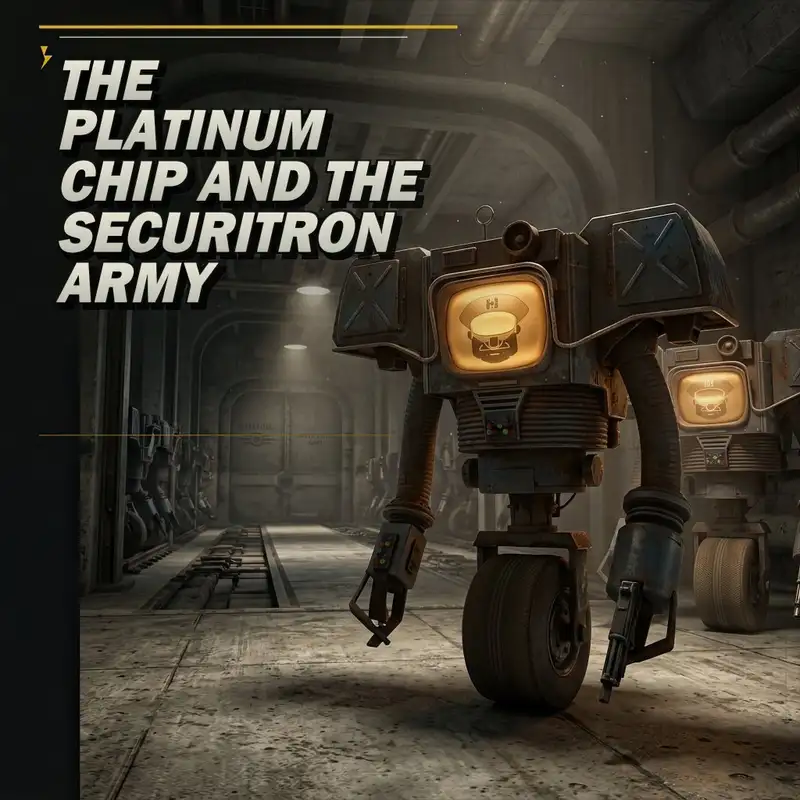
The Platinum Chip and the Securitron Army
A Securitron rolls onto the floor of the Lucky Thirty-Eight looking much as it did before. It has the same broad screen, the same wheeled chassis, the same cheerful face that has spent years telling trespassers to leave, citizens to move along, and customers that their safety is somebody else’s responsibility. Then its casing opens. Missile racks unfold. A grenade launcher deploys. Systems that had been dormant since before the bombs return to service. Robert House calls the result a Mark Two upgrade and claims it increases each unit’s combat effectiveness by two hundred and thirty-five percent.
The visible weapons are impressive, but they are not the important part of the demonstration. The important part is the Platinum Chip, a small pre-War data-storage device whose recovery makes the demonstration possible. The Chip is not a superweapon in the ordinary sense. It does not explode, irradiate a target, or win a battle by itself. It is more consequential than a weapon because it restores the missing conditions that make weapons useful. It provides access, software, authentication, repair capability, and a route into a concealed reserve force. In a war for the Mojave, that makes it less like a gun and more like the key to an arsenal, its command post, and the maintenance manuals required to keep it fighting.
That distinction explains why the Platinum Chip sits at the center of the struggle for New Vegas. The Mojave already contains armies. The New California Republic has soldiers, supply lines, institutions, and the burdens that come with trying to govern a distant frontier. Caesar’s Legion has a disciplined war machine, a base across the Colorado, and a political order built through conquest and terror. House has neither the Republic’s manpower nor the Legion’s ability to absorb populations into a permanent military system. What he has is a surviving urban enclave, a network of machines, and a plan to make a limited number of machines matter at exactly the right moment.
Before the Great War, Robert House had built RobCo into one of the dominant technology corporations in the United States. His interest in Las Vegas was not sentimental. The city was an asset. It had infrastructure, commercial value, a defensible position relative to the surrounding desert, and enough concentrated wealth to justify extraordinary protective measures. House prepared systems intended to defend the region from the nuclear exchange he believed was coming. The Platinum Chip was part of that system, manufactured in Sunnyvale and intended to arrive shortly before the war.
According to House’s own account, seventy-seven warheads were aimed at Las Vegas and the surrounding area on October twenty-third, twenty seventy-seven. His defense network intercepted most of them, but not all. The city survived better than many American population centers, yet it was still damaged, and House attributes the incomplete result in part to the Chip’s late arrival. That figure comes from House, not from an independently preserved military archive, so it should be understood as the testimony of the man who designed the system and has every reason to emphasize both his foresight and the tragedy of a final missing component.
Still, the broad outcome is difficult to dispute. Las Vegas did not escape the Great War untouched, but enough of it endured for House to build upon later. The unfinished nature of his defenses also endured. The war had not merely destroyed cities. It had broken supply chains at the precise moment when advanced systems depended most heavily on specialized parts, secure deliveries, and functioning command networks. A delivery delayed by days became a recovery operation lasting more than two centuries.
That is one of Fallout’s recurring institutional lessons. Technology rarely fails because one machine is inherently weak. It fails because its supporting system disappears. A missile launcher without targeting data is less useful. A robot without maintenance support becomes a liability. A command network without trusted access becomes a collection of expensive boxes. The Platinum Chip mattered because House’s pre-War design had been interrupted at the point where hardware became an integrated military system.
For decades after the war, House retained Securitrons, but only in their Mark One condition. These robots were not harmless. They could patrol, enforce boundaries, carry out orders, intimidate intruders, and collect information across a city whose human population had little capacity to challenge a coordinated machine force. A Securitron does not desert because its family needs it at home. It does not demand a larger ration, form a faction within the ranks, or decide that a commander has lost moral authority. It can remain on duty as long as power, repairs, and command signals remain available.
Those advantages made the Mark One Securitrons useful as a security force. They gave House persistence. A human militia may guard a gate for a night. A centrally directed robot network can guard it indefinitely, at least in principle. The machines also gave him standardization. Their loyalty was not based on tribal ties, wages, ideology, or the promise of land. It was based on programming and control of the network. In the fragmented Mojave, where many armed groups were local, temporary, or internally divided, that made House’s force unusually coherent.
But a force can be coherent and still be limited. The Mark One Securitrons lacked the software drivers required to employ the principal weapons built into their frames. They also lacked access to the upgraded auto-repair functions House had intended them to use. They could maintain order on the Strip. They could threaten violence. They could support surveillance and coercion. Yet they were not the fully realized combat formation House had designed before the war.
Their limitations were broader than weapons software. The game establishes that House possesses surviving robots and a hidden reserve. It does not establish that he possesses a functioning post-War industrial base capable of producing unlimited replacements. It does not tell us how many Securitrons can be repaired after serious damage, how much ammunition their launchers require, how many specialized components remain available, or whether new Mark Two units can be manufactured at scale. House inherited an arsenal. That is not the same thing as inheriting an economy capable of renewing an arsenal forever.
The robots also could not replace every human function of war and government. They were not infantry who could mingle with civilians, recruit local allies, negotiate with hostile communities, administer food distribution, or establish legitimate courts. They did not provide engineers to repair every road, medics to care for every casualty, or officials who could persuade people that House’s rule served more than House. Their presence could impose security. It could not automatically create consent.
Even incomplete, however, the Securitron force gave House leverage. That became clear when the New California Republic entered the Mojave in the year twenty-two seventy-four. The Republic had a powerful interest in Hoover Dam. The dam promised electricity, strategic position, and a foothold in a region that connected California to the Colorado River and points beyond. The N C R also wanted McCarran Airport as a military installation. But it encountered a Strip already controlled by House’s Securitrons and by the tribes he had reorganized into the Three Families.
House did not need to defeat the N C R in a full-scale war to get what he wanted. He only needed to make an assault on New Vegas expensive enough that negotiation looked cheaper. The resulting Treaty of New Vegas allowed the Republic access to Hoover Dam and McCarran. House retained control over the Strip. He also received a share of the dam’s power and access to an expanding market of N C R soldiers, officials, contractors, tourists, and merchants.
The arrangement was not a partnership of equals. The N C R remained the larger state, with more people, more territory, and greater long-term capacity. House remained dependent on a narrow urban base and a specialized security apparatus. But the treaty demonstrated the political value of a credible local veto. House’s machines did not have to conquer California. They only had to ensure that the Republic could not casually absorb New Vegas without paying a cost it preferred to avoid.
That was deterrence in its most practical wasteland form. A small force cannot always defeat a larger force. It can still shape the larger force’s choices by raising the price of coercion. House’s Mark One Securitrons made New Vegas difficult to seize. The Platinum Chip promised to make it difficult to challenge at all.
The First Battle of Hoover Dam, in the year twenty-two seventy-seven, made that promise more valuable. The N C R defeated Caesar’s Legion at the dam, but the victory did not settle the Mojave. It secured the immediate objective and prevented a Legion breakthrough, yet it did not eliminate the Legion’s ability to fight. Caesar’s forces remained across the Colorado and later occupied Fortification Hill. The Republic held the dam, but it did so at the end of a long and increasingly strained line of communication from California.
By the year twenty-two eighty-one, the N C R was still formidable, but it was also extended. Its military commitments in the Mojave were shaped by politics at home, shortages at the frontier, divided command relationships, and the problem of defending roads, settlements, power infrastructure, and military installations across a harsh region. The Republic’s soldiers did not operate in an empty desert. They operated in a contested territory where every supply convoy, water source, road junction, and local alliance could become a military problem.
Caesar’s Legion faced different constraints. It had demonstrated that it could organize conquest, compel obedience, and concentrate force. It had also built its power through the destruction or absorption of other communities. Its presence on the eastern side of the Colorado threatened the N C R’s position and endangered House directly. A Legion victory would not simply change the flag over Hoover Dam. It would place an expansionist, militarized regime beside the Strip, one with little reason to tolerate an independent commercial city run by an old-world executive sealed inside a tower.
House therefore needed neither side to win too completely. The N C R represented annexation through bureaucracy, military occupation, and the gradual extension of republican authority. The Legion represented conquest through force, slavery, and the elimination of rival institutions. House’s objective was different. He wanted New Vegas to remain independent under his personal control, protected by enough force to keep outside armies from dictating the city’s future.
Hoover Dam was essential to that objective. The dam was not merely a famous battlefield or a trophy of regional power. It was electrical infrastructure. It supplied energy that could sustain the Strip’s lights, defenses, communications, and commercial economy. In a post-War society, reliable power is not a luxury. It supports water systems, workshops, medical facilities, radio networks, transport, security, and whatever advanced machinery remains in service. A city built around robots and mainframes has an especially strong interest in controlling the energy that keeps those systems alive.
The recovered Platinum Chip entered this unstable balance through the Courier. The Courier’s identity, motives, and loyalties are not fixed by history. The essential facts are. The Courier carried the Chip toward New Vegas. Benny intercepted the delivery, took the Chip, and attempted to remove the person who had carried it. Victor later retrieved the Courier, preserving a chain of events that none of the major powers had fully planned.
Benny’s actions are sometimes remembered as a personal betrayal or a struggle for the Strip. They were both, but they were also an intelligence operation aimed at command architecture. Benny did not want the Chip merely because it was rare, valuable, or symbolically connected to House. He wanted it because it could give him access to the system House had spent two centuries trying to complete. He understood that political control of New Vegas rested not only on casinos, guards, and reputation, but on the ability to direct the machines beneath the city’s security order.
His alternative was Yes Man, a modified Securitron interface capable of providing a different route into the network. Yes Man is important precisely because he demonstrates that the Securitron army is not politically neutral. House’s authority is powerful, but it rests on systems that can be infiltrated, redirected, or destroyed.
Yes Man’s agreeable manner should not be confused with independent strategic wisdom. He can acknowledge the force available to him and the risks it faces, but he is not a separate sovereign with a proven capacity to govern the Mojave. His existence reveals a vulnerability in House’s model. They are also vulnerable when a small number of credentials, terminals, facilities, and trusted intermediaries can alter who sits at the top of that chain.
House’s surveillance network is formidable, but it is not omniscient. He has roaming Securitrons, information sources, and the ability to monitor much of the Strip. Yet Benny is able to organize a conspiracy within House’s own political environment. The Chip is intercepted. The Courier survives outside House’s immediate control. The hidden reserve remains inaccessible until a human intermediary reaches it. The episode is not a story about a machine god who sees everything. It is a story about a networked autocracy discovering that information advantage is not the same as total control.
The Platinum Chip’s real function becomes clearer when its roles are separated. First, it opens secure access to the concealed bunker beneath Fortification Hill. Second, it carries the Mark Two operating system needed to restore capabilities dormant within the Securitron design. Third, it enables the activation of a reserve force that House had hidden away before the war. Fourth, it restores access to systems he could not otherwise fully use, linking hardware, maintenance functions, weapons integration, and strategic deployment.
None of these functions means the Chip independently commands every Securitron in the Mojave. It is not a magic remote control. Under House’s plan, command still depends on the Lucky Thirty-Eight mainframe, functioning communications, available power, and House’s own control of the network. Under an Independent path, Yes Man provides a different command route, but that still requires access to the physical and informational systems that make the army usable. The Chip enables control. It does not eliminate the infrastructure required to exercise control.
This is why describing it as a treasure understates the case. A treasure can be owned and stored. It is an authorization device, a software package, a key to a hardened facility, and a bridge between a pre-War military design and a post-War political struggle. It turns House’s long-preserved machines from incomplete assets into a force that can intervene in the Mojave’s decisive campaign.
The Mark Two upgrade is the point at which that intervention becomes militarily credible. House identifies the major improvements clearly. The upgraded Securitrons gain M-two-thirty-five missile launchers, G-twenty-eight grenade launchers, and drivers for their onboard auto-repair systems. The names are less important than their operational meaning. The robots move from limited security enforcement toward a role that can threaten concentrated armed forces, deliver heavier firepower, engage targets at greater range, and remain in the fight longer after taking damage.
The missile launchers give the force a way to reach beyond the immediate street-corner encounter. The grenade launchers provide close-range area fire against troops using cover, clustered positions, or confined approaches. The repair systems reduce dependence on immediate external maintenance during an engagement. Together, those changes make the Securitrons more than armored police patrols. They become mobile weapons platforms capable of contributing serious firepower at a decisive point.
House’s claim of a two hundred and thirty-five percent increase in combat effectiveness should be treated carefully. It tells the listener something useful about House’s confidence and the scale of the intended change. It does not provide a neutral military measurement. The Mojave has no independent testing authority that has published comparable trials, force-on-force studies, maintenance reports, or casualty analyses. The exact figure is less important than the design purpose. The Mark Two system restores weapons and repair functions that House considered central to the army he had planned.
Even so, improved firepower does not make the robots a complete army in the modern sense. They can substitute for some roles that human formations would normally perform, especially local security, direct fire, and rapid concentration around established infrastructure. They do not automatically provide reconnaissance doctrine, combat engineers, field hospitals, civil affairs teams, transport units, replacement personnel, or occupation administrators. They cannot create a functioning tax system or convince an occupied population that machine-enforced rule is legitimate.
The distinction matters because House’s plan is not simply to win a battle. It is to turn military advantage into political independence. The Mark Two upgrade improves his ability to seize a moment. It does not answer what happens after that moment, when damaged machines require parts, civilians demand services, local groups resist authority, and a city’s stability depends on more than the absence of gunfire on the Strip.
The location of the reserve force makes those limits even more striking. Beneath Fortification Hill, under ground occupied by Caesar’s Legion, lies a concealed bunker filled with dormant Securitrons. It is a protected reserve force, held out of sight until the moment House believes the balance of power can be changed.
The irony is severe. The Legion occupies the ground above a force designed to frustrate Legion conquest. Caesar’s soldiers control Fortification Hill as a visible position, but territorial occupation does not always mean control over every system buried beneath the terrain. The old world left behind layers of infrastructure, sealed facilities, and automated defenses that no current faction fully understands. The Legion can possess the hill without possessing the network below it.
That is a classic problem of post-collapse warfare. Maps show territory. Power often lies in access. A dam, bunker, relay station, reactor, or factory may sit inside one faction’s claimed zone while answering to another faction’s passwords, technicians, or command systems. The physical location matters, but so do the people and machines capable of making the location function. Fortification Hill is Legion ground. The bunker beneath it is House’s reserve, provided the Platinum Chip reaches the right system and somebody is willing to activate it.
The reserve’s dormancy is both a strength and a weakness. It protects the force from routine attrition. The robots are not spending years on patrol, consuming ammunition, suffering combat losses, or exposing themselves to every raider and scout in the Mojave. They wait until the strategic situation matures. But a dormant force is also a force that cannot influence events until it is activated. Its existence depends on secrecy, access credentials, reliable power, and a human agent capable of reaching it.
The bunker’s fate is not fixed. The Chip can be used to activate the army and install the Mark Two operating system. It can also be used in circumstances where the reserve is destroyed through the bunker’s reactor systems. These are mutually exclusive outcomes. The historical record of the Mojave does not permit them to be combined into one convenient story. What remains constant is the strategic fact that the reserve exists and that its future depends on a contest over access.
That contest reveals another weakness in House’s seemingly perfect preparation. He could hide machines for centuries, preserve the information needed to upgrade them, and construct a plan around their eventual use. Yet he could not complete the plan alone. He needed the Platinum Chip recovered. He needed somebody to carry it through hostile territory. He needed access to a bunker beneath an enemy camp. The most elaborate automated system in the Mojave still depended on individual human decisions.
House’s intended campaign concept follows from this reserve. He does not want to commit his forces early against either the N C R or the Legion. Instead, he wants the two major powers to exhaust one another at Hoover Dam. Once their formations are committed, damaged, and politically strained, the upgraded Securitron army can intervene against forces that have already spent much of their strength.
On the battlefield, the plan gives House concentrated firepower. Their standardized design and centralized direction allow House to shift them without waiting for local commanders to negotiate, recruit volunteers, or build a coalition from scratch.
At campaign scale, the army functions as a reserve. House intends to keep his decisive capability hidden until the N C R and Legion have already revealed their plans and weakened their forces. He is trying to enter the battle late, when the cost of defeating him is highest and his own limited numbers can have the greatest effect.
Strategically, the objective is New Vegas’s independence. If the N C R is expelled from the immediate political core of New Vegas, and if the Legion is prevented from crossing into lasting control of the region, House can preserve a protected commercial state built around the Strip’s infrastructure.
The political level is more difficult. House’s plan concentrates authority in himself. The army does not defend a representative government, a broad coalition, or a negotiated regional settlement. It defends House’s right to determine the future of New Vegas. That centralization gives the plan clarity. It also means that any failure of House’s command system becomes a failure of the entire political order. There is no obvious succession mechanism, no demonstrated civilian legislature, and no evidence that the surrounding Mojave has accepted House as its legitimate sovereign.
Waiting for the N C R and Legion to weaken each other is rational, but it is also risky. House must assume that neither side destroys his urban base before the reserve can act. He must assume that the Legion does not uncover and neutralize the bunker. He must assume the N C R does not decide that the Strip is worth seizing despite the cost. He must assume that Benny’s attempt to replace him fails. Most importantly, he must assume that he survives long enough to give the order.
The different endings of the Mojave conflict demonstrate that control of the Securitron army does not produce one inevitable history. In a House victory, the upgraded force helps secure the Strip and Hoover Dam. New Vegas becomes independent under House’s authority. The resulting order is presented as efficient and stable in its own narrow terms, but also cold. Security is imposed from above by a ruler who has survived the old world and intends to manage the new one as a long-term corporate project.
That outcome fulfills House’s immediate military objective. The N C R and Legion are denied control of New Vegas. The dam and the Strip become the material foundation of an independent city-state. Yet the ending does not prove that every deeper problem has been solved. An orderly Strip is not the same as a secure Mojave. Machine patrols can protect commerce, but they cannot automatically repair relations with Freeside, provide equal protection to every surrounding settlement, or transform an autocratic security regime into a broadly legitimate society.
In an Independent outcome, the command architecture shifts away from House. Yes Man becomes the alternative interface through which the reserve can be activated and directed. The upgraded army may be available, though an Independent course can also proceed without the full upgrade. The essential point is not that one version is automatically stronger than another. It is that the Platinum Chip allows control of the force to move from House’s personal system into a different political arrangement shaped by the Courier’s choices.
That does not establish a guaranteed republic, a stable democracy, or a durable new state. Independence from House is not the same thing as a completed constitutional order. The robots can clear the Strip, remove outside armies from the immediate center of power, and provide coercive capacity. They cannot tell the Mojave who has legitimate authority, how disputes should be resolved, or how a new government will endure after the crisis that created it.
In an N C R victory, House’s intended independent deployment does not become the decisive regional outcome. The Republic’s success means that its institutions, army, and political claims prevail over House’s attempt to use the reserve as a final veto. That does not mean every Securitron vanishes or that every technical question about the network is resolved in the same way. It means the strategic purpose House designed the Chip to serve has been defeated.
In a Legion victory, the outcome is harsher still. House’s model of protected commercial autonomy is incompatible with a conquering regime that demands submission and eliminates rival centers of authority. The Legion’s victory prevents House from converting the reserve into an independent regional order. Again, the fate of individual machines need not be invented to understand the larger result. The army fails to become the instrument through which House secures New Vegas against outside conquest.
No later account selects one of these paths as the single established conclusion to the events of the year twenty-two eighty-one. House’s order and Yes Man’s alternative remain different possible outcomes, not pieces of one merged chronology. That uncertainty is not a flaw in the story. It is the point. The Platinum Chip does not carry a predetermined future inside it. It gives a small number of people access to the means of imposing one.
The Chip is more important than a weapon because a weapon is only the final component of military power. A missile rack without software, a robot without repair systems, a bunker without access, and an army without command are all incomplete tools. The Platinum Chip reconnects those tools. It turns scattered potential into an operational system. It gives its holder the ability to activate a reserve, upgrade its weapons, restore its maintenance functions, and place that reserve into the contest for Hoover Dam and New Vegas.
The Mark Two upgrade makes the Securitrons decisive because it changes when and how they can be used. The robots become most dangerous not as a force trying to occupy every mile of the Mojave, but as a centrally controlled reserve introduced after larger armies have committed themselves. They can exploit exhaustion, secure critical infrastructure, and impose a new balance around the Strip. That is enough to alter a campaign, even if it is not enough to govern an entire region by itself.
House understands the military side of that equation very well. He understands that an army does not need to be the largest force in a theater if it can appear at the decisive point with a capability the other side cannot easily match. What he understands less clearly, or perhaps chooses to postpone, is that sovereignty requires more than control of machines. It requires succession, institutions, services, legitimacy, and some answer to the people who live outside the polished corridors of the Strip.
The Platinum Chip does not decide who deserves New Vegas. It decides who can, for a time, turn its surviving machinery into sovereign power.